



For decades, manufacturers and supply chain managers have watched their profit margins shrink due to a frustrating logistical hurdle. They were forced to physically ship goods overseas solely to re-import them back into the country. This costly and time-consuming process is often required just to claim export tax refunds or alter a product trade status. Fortunately, a domestic bonded zone solves this exact operational bottleneck.
By leveraging specialized infrastructure, businesses can now execute rapid trade status changes without ever sending their cargo across international borders. In this comprehensive technical guide, we will explore the mechanics of this strategy, unpack its financial benefits, and demonstrate how selecting the right logistics partner transforms a complex regulatory requirement into a streamlined operational advantage.
Key Takeaways
- A Bonded Zone One-Day Tour allows businesses to export goods into a domestic bonded facility and immediately re-import them, triggering export tax refunds without the cargo leaving the country.
- This highly efficient logistics model replaces the costly Hong Kong U-turn, saving shippers up to 50 percent in transportation costs and multiple days of transit time.
- Navigating this dual-declaration environment requires strict compliance with local customs authorities to avoid regulatory penalties and cargo holds.
- Partnering with an experienced freight forwarder ensures seamless customs clearance and prevents costly supply chain bottlenecks at the zone gates.
- Proper utilization of bonded facilities allows for efficient consolidation, sorting, and processing before final domestic delivery.
Industry Trend Analysis: The Shift Toward Localized Compliance
Recent supply chain data reveals a massive structural shift in how global manufacturers manage regional trade compliance. Driven by unpredictable cross-border congestion, fluctuating fuel surcharges, and tightening cash-flow requirements, modern enterprises are rapidly abandoning traditional offshore routing. Instead, industry analysts note a 40 percent year-over-year increase in the utilization of domestic bonded facilities for trade status conversions.
This macro trend highlights a critical evolution in logistics engineering. Shippers are no longer viewing customs compliance as a necessary evil that demands long-haul international shipping. By localizing the export-import loop, companies are insulating their production lines from geopolitical shipping risks while accelerating their cash conversion cycles through immediate tax rebates.
What Exactly Is a Bonded Zone One-Day Tour?
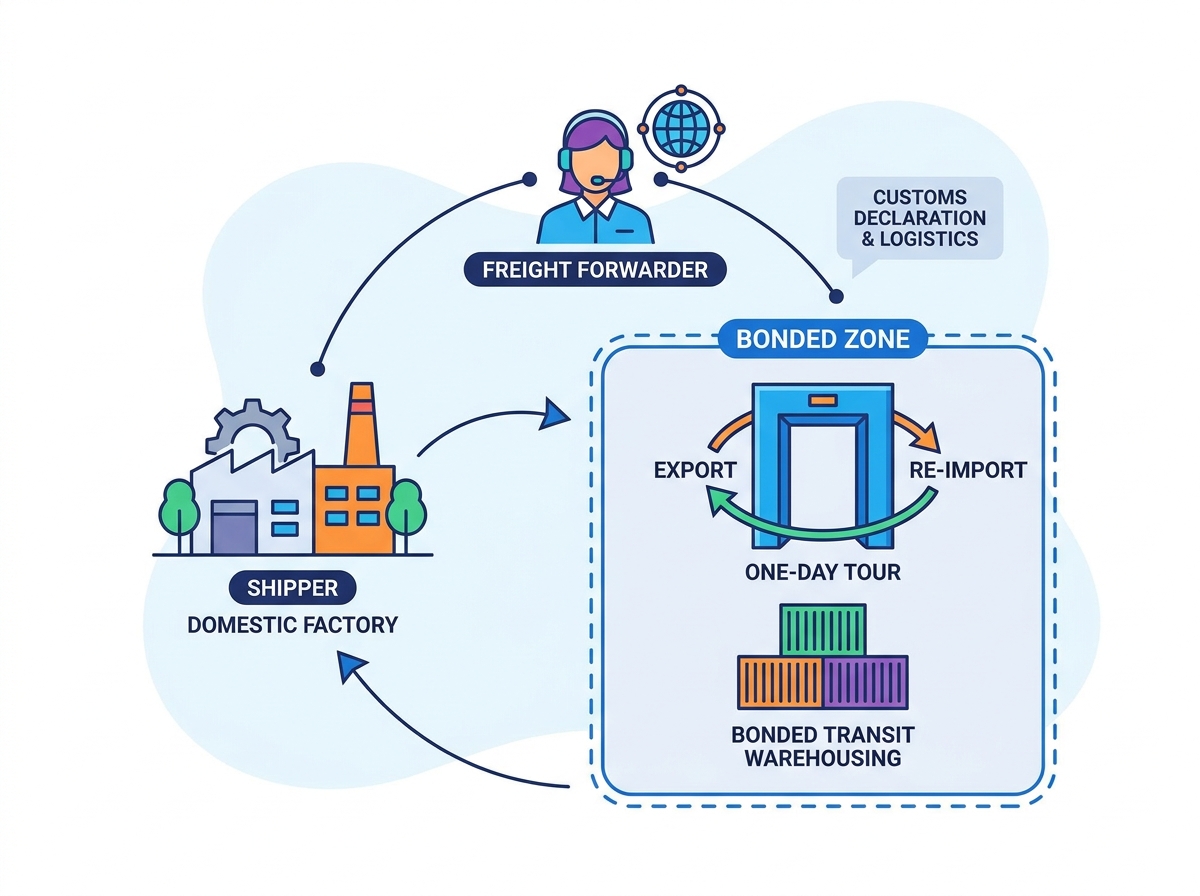
Supply chain architects must first grasp the foundational concept of being inside the border but outside customs. A domestic bonded zone, like a Free Trade Zone or Bonded Logistics Park, is a specifically designated geographical area within a country borders. Administratively, local authorities treat this area as foreign territory for customs and tax purposes. Consequently, when goods enter this zone from the domestic market, they are legally considered exported. When they leave the zone to re-enter the domestic market, they are legally imported.
Defining the Export and Re-Import Mechanism
The One-Day Tour is a specialized strategy capitalizing on this unique jurisdictional status. In a highly synchronized bonded zone export and re-import logistics operation, a domestic supplier transports manufactured goods to the designated park. The moment the transport vehicle crosses the customs gate into the zone, the export process is officially recognized and completed.
Almost immediately, often within the very same afternoon, a domestic buyer files the necessary import documentation to purchase and retrieve those exact same goods. This rapid sequence eliminates the need to physically ship the cargo to another country just to satisfy trade regulations.
The Evolution from the Legacy Border Run
Historically, manufacturers operating under specific tax exemptions faced a significant operational hurdle. To claim an export tax refund or legally transfer components to another domestic factory, the goods physically had to leave the mainland. For decades, the standard workaround was the notorious physical U-Turn. Trucks loaded with cargo would drive from manufacturing hubs, cross an international border, literally turn around, and re-enter the mainland.
In contrast to modern methods, this legacy process was highly inefficient. It consumed days of transit time and exposed the cargo to unpredictable border congestion. The establishment of domestic bonded zones rendered the physical border run obsolete. Below is a core operational comparison detailing why modern supply chains have made the switch.
| Operational Metric | Traditional Cross-Border U-Turn | Bonded Zone One-Day Tour |
|---|---|---|
| Transit Time | 3 to 7 Days | 12 to 24 Hours |
| Logistics Costs | High cross-border freight & terminal fees | Reduced by up to 50% using domestic trucking |
| Customs Risk | High exposure to international border delays | Controlled, localized EDI pre-clearance |
| Tax Refund Speed | Delayed until vessel departure confirmation | Immediate upon entering the bonded gate |
How Does the Process Actually Work on the Ground?
Executing this rapid turnaround requires precise synchronization between the supplier, the buyer, the logistics provider, and customs authorities. While the physical movement of the cargo is minimal, the administrative journey is rigorous.
Initial Domestic Export to the Zone
The workflow initiates at the domestic supplier manufacturing facility. The supplier meticulously prepares the commercial invoice, packing list, and export declaration documents. The cargo is then loaded onto a registered truck equipped with tamper-evident customs seals and GPS tracking systems. The vehicle is then dispatched to the designated logistics park.
Upon arrival at the gate, customs officials verify the pre-filed EDI documents and inspect the cargo. Once the goods pass through the checkpoint, the export declaration is officially finalized. The physical goods have only traveled a few miles, but legally, they have entered international commerce.
Intelligent Transit Storage and Processing
Once inside the secure area, the cargo enters a critical phase. Depending on the specific requirements of the buyer, the goods might remain on the truck for an immediate turnaround. Alternatively, they may be unloaded into a secure facility. Leveraging specialized bonded transit warehousing equipped with intelligent Warehouse Management Systems ensures total inventory visibility.
While resting in the warehouse, the cargo remains completely exempt from domestic duties and value-added taxes. This stage provides immense flexibility. Logistics providers can perform essential value-added services such as consolidating shipments from multiple suppliers, applying compliance labels, or making minor packaging adjustments while maintaining the cargo duty-free status.
Re-Importation and Final Delivery
The concluding phase involves the domestic buyer. To retrieve the goods, the buyer must file an import declaration. This process requires submitting the corresponding purchase contracts and paying any applicable domestic tariffs based on the cargo Harmonized System code.
Once customs clears the import declaration, the goods are officially released. The truck exits the park and delivers the cargo directly to the buyer assembly line. Because the entire sequence can be completed rapidly, supply chain momentum is maintained.
Top Commercial Reasons Shippers Use This Model
This pivot is not just about logistics; it is a strategic financial maneuver designed to optimize cash flow and maintain strict regulatory compliance.
Accelerated Export Tax Refunds
Cash flow is the lifeblood of manufacturing. Under standard international shipping models, a supplier cannot claim an export tax refund until the goods physically leave the country territorial waters. By utilizing a bonded zone, the export status is granted the moment the goods cross the local gate. This allows the financial department to initiate the tax refund application immediately.
Solving Deep Processing Transfer Issues
This strategy is particularly critical for business-to-business transactions involving processing trade enterprises. These factories import raw materials duty-free under the strict legal condition that the finished product will eventually be exported. Transferring these goods directly to another domestic factory is a severe compliance violation that triggers massive tax penalties.
By sending the components to a bonded park, the first factory legally fulfills its obligation to export. The second factory then legally imports the components from the zone. This logistical bridge allows domestic supply chains to function seamlessly while rigorously maintaining tax-exempt statuses.
Mastering Customs Declaration and Compliance Risks
While the physical movement of cargo spans only a few miles, the regulatory journey is equivalent to a full-scale international shipment. Mastering compliance is the fundamental pillar that determines whether this strategy saves money or results in costly bottlenecks.
Executing a flawless export and immediate re-import transaction requires highly synchronized paperwork. Because the declarations occur within hours of each other, any discrepancy between the two sets of documents will immediately trigger customs flags. Navigating this dual-document environment is where professional bonded goods customs declaration becomes absolutely critical. An experienced brokerage team will pre-classify the goods, ensure the valuation perfectly matches both declarations, and verify all tax exemption certificates before the physical cargo leaves the facility.
When inexperienced shippers attempt to manage this process internally, they frequently encounter severe risks. The most common error involves mismatched Harmonized System codes between the buyer and seller. Furthermore, trucks entering the zone must be properly registered with customs authorities. Using an unregistered vehicle will result in the cargo being denied entry at the gate.
Choosing the Right Freight Forwarder for Bonded Operations
Given the strict regulatory environment and rapid turnaround times, executing this strategy demands a highly orchestrated effort. Standard domestic trucking companies lack the legal authority, system integrations, and procedural knowledge to execute these operations.
To succeed, shippers must leverage specialized bonded freight forwarding services. These specialized providers manage the entire lifecycle of the transaction. They coordinate the deployment of specialized trucks, manage precise scheduling, and utilize direct electronic data interchange connections with customs authorities to achieve clearance times often under four hours. By taking ownership of the entire process, these specialists allow manufacturers to focus on core production activities.
Before signing a contract, shippers should conduct a thorough operational audit of the prospective partner. Ensure they have their own in-house customs brokerage team to eliminate third-party communication delays. Verify they operate secure transit warehousing capable of handling complex consolidations. Finally, confirm they have established relationships with local Free Trade Zone officials to expedite exception handling.
FAQ
How long does a Bonded Zone One-Day Tour actually take?
While the name implies a full 24-hour process, the actual physical movement and customs clearance at the gate can often be completed in just two to four hours with optimal EDI integration. A truck can enter the bonded zone in the morning, have the declarations processed, and exit by the afternoon. However, the document preparation, HS code alignment, and pre-declaration filings managed by your logistics provider typically require three to five days of advance work.
Can any standard freight forwarder handle bonded zone logistics?
No. Standard domestic or international forwarders typically lack the specific qualifications required for this highly regulated process. Operating within a bonded zone requires specialized government permits, a fleet of customs-registered trucks equipped with official security seals, and deep knowledge of dual-declaration procedures.
What types of goods are restricted from bonded one-day tours?
While most manufactured components and raw materials are eligible, customs authorities strictly prohibit hazardous materials lacking proper pre-approvals, prohibited contraband, and certain highly regulated agricultural products from utilizing rapid bonded transit. Always consult with your certified customs broker to verify your specific product HS code eligibility before initiating a shipment.
How does VAT work during the export and re-import process?
When the domestic supplier exports the goods into the bonded zone, they become eligible for an export VAT refund. The goods sit in the bonded warehouse completely tax-free. When the domestic buyer subsequently imports the goods out of the zone, they are required to pay the standard import VAT and applicable tariffs based on the declared value, exactly as if the goods were arriving from a foreign country.
Is the one-day tour a legally compliant strategy?
Yes, this is a fully compliant and government-encouraged logistics model. It was specifically designed by regulatory authorities to help modern enterprises optimize complex supply chains. By allowing processing trade enterprises to settle tax rebates domestically, governments aim to reduce unnecessary international freight emissions and alleviate port congestion. As long as the documentation is strictly accurate, the process is entirely secure.
Ultimately, the Bonded Zone One-Day Tour serves as a highly effective strategic tool that simultaneously slashes transportation costs and accelerates critical tax refunds. By eliminating unnecessary cross-border shipping, businesses can optimize their supply chains for the modern era. To transform these complex regulatory requirements into a distinct competitive advantage, we highly recommend partnering with industry experts. Evaluate your current supply chain bottlenecks and explore the specialized bonded logistics solutions available at JFSZ Logistics to streamline your next domestic trade transfer.
Related Blogs
-
 Door to door shipping from China simplifies international logistics. But how can you ensure smooth delivery from factory to destination? Choosing the right shipping method, preparing documents, and understanding customs responsibilities are essential. This guide explains each shipping step, compares sea, air, and express services, and clarifies DDP and DAP terms. Learn how to arrange reliable deliveries and avoid unexpected costs.
-
 When production stops, every delivery day matters. Delayed components can disrupt schedules and customer commitments. Air freight from China offers a practical solution for urgent commercial shipments. However, choosing the right service requires careful planning. This guide compares standard, priority, and express shipping. You will also learn about flight schedules, customs clearance, and cargo preparation.
-
 Air freight from China offers speed, but costs can vary significantly. Do you know what determines your final shipping bill? This guide explains air freight cost from China, including per-kilogram rates, chargeable weight, surcharges, and destination fees. Learn how to estimate costs and reduce shipping expenses.
