



Are delayed tax rebates suffocating your factory cash flow? Moving goods between domestic plants frequently creates complex customs hurdles. These bottlenecks trap vital working capital in bureaucratic limbo for months. For manufacturing enterprises and processing trade facilities, maintaining healthy liquidity is just as critical as optimizing production lines. In this comprehensive technical breakdown, we will explore how a strategic logistics maneuver solves this exact problem using special customs supervision areas.
Key Takeaways for Supply Chain Directors
- Immediate Tax Relief: The bonded U-turn model allows manufacturing facilities to claim export tax rebates almost instantly through a highly structured domestic transit model.
- Simplified Compliance: Traditional factory transfers demand strict ongoing customs approvals. Manual manual verifications often consume massive administrative resources and introduce audit risks.
- Cost Efficiency versus Cash Flow: The bonded route incurs short-term transportation costs. However, the immediate cash flow improvements and long-term tax savings typically outweigh these initial logistical expenses.
- Expert Guidance is Mandatory: Navigating either method requires architectural precision. A specialized logistics partner is essential for handling complex customs declarations and ensuring smooth physical transitions.
What is a Bonded Zone One-Day Tour?
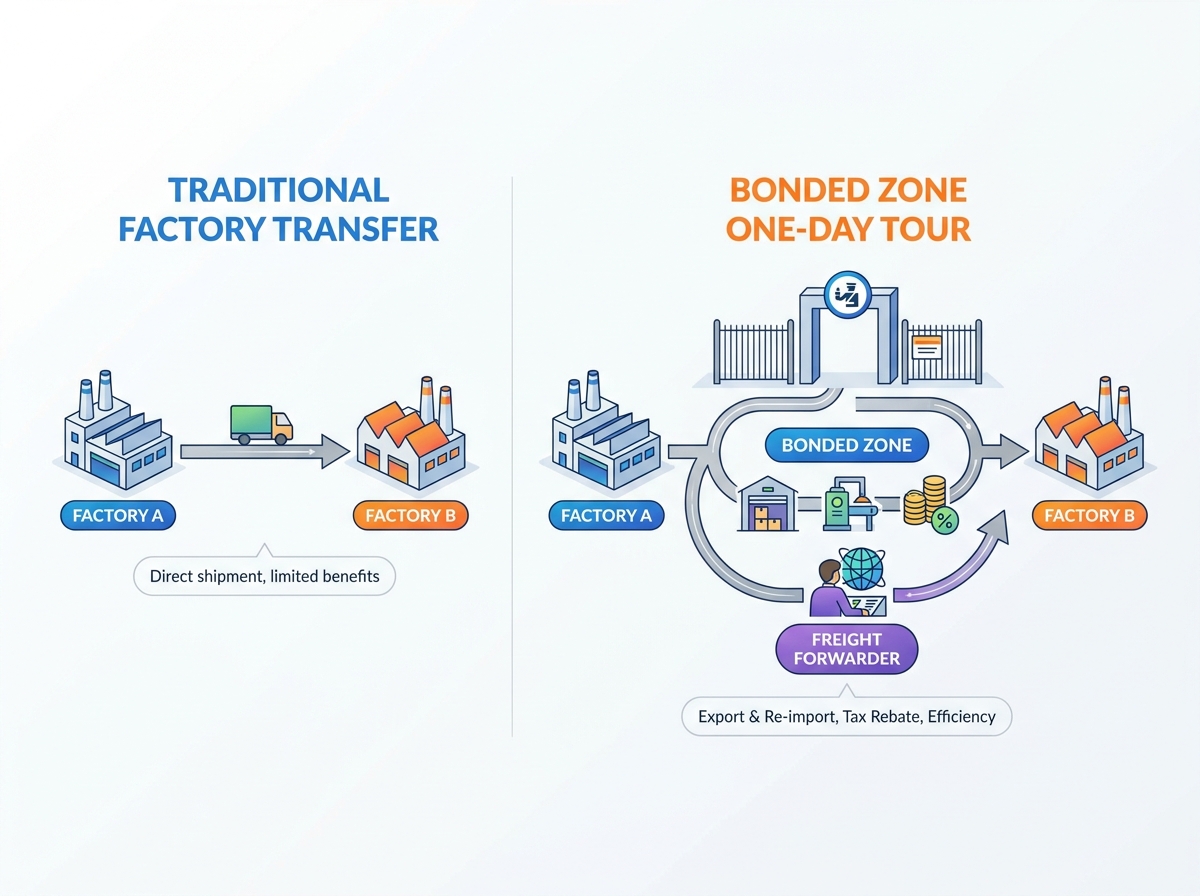
This logistics maneuver is frequently referred to by frontline operators as a Bonded U-turn. It serves as a strategic supply chain mechanism used primarily by processing trade enterprises. The workflow involves a domestic supplier exporting finished components into a designated special customs supervision area, specifically a Comprehensive Bonded Zone. Once the goods cross into this physical zone, they are legally recognized as exported. Immediately following this declaration, a domestic buyer imports those exact same goods back from the bonded zone into the domestic market.
The Mechanics of Domestic Transit
The entire process relies on the unique jurisdictional status of special customs areas. For customs and tax purposes, a bonded zone is treated as an overseas territory, despite being physically located within the country borders. Executing a domestic export and re-import via bonded zone follows a strict and highly choreographed sequence.
Picture a heavy-duty truck loaded with high-value electronic components arriving at the bonded zone gate. The electronic lock pings the customs network. The driver hands over the manifest. Upon entry, the supplier files an electronic export declaration through the Single Window system. At this exact moment, the goods officially leave the domestic tax jurisdiction. This trigger enables the supplier finance team to initiate the tax rebate process immediately. Within hours, the receiving factory files an import declaration. The goods are subsequently cleared, loaded back onto the truck, and delivered to the buyer facility. Consequently, the entire physical movement and data processing cycle concludes within a single business day.
Industry Trends: The Shift Toward Bonded Logistics
Recent supply chain data reveals a massive shift in how mid-to-large tier manufacturers handle domestic transfers. Global economic pressures are squeezing profit margins tighter than ever before. Consequently, supply chain directors are prioritizing immediate liquidity over direct freight savings. The industry consensus is clear. Relying on delayed tax rebates through traditional transfer methods is becoming financially unsustainable. More enterprises are adopting the bonded U-turn to accelerate capital recovery, mitigate compliance risks, and maintain a competitive edge in volatile markets.
Understanding Traditional Factory Transfer
The Traditional Factory Transfer is formally known in customs terminology as Deep Processing Transfer. This model serves as an alternative logistics strategy for highly integrated supply chains. Goods travel directly from one processing trade enterprise to another within the same country. The physical cargo moves from the supplier loading dock straight to the buyer warehouse, entirely bypassing bonded zones and special customs checkpoints.
The Process of Customs Clearance
This direct route is heavily reliant on the customs electronic manual system. Both the supplying and receiving factories must possess valid and matching processing trade qualifications approved by local customs authorities. Managing processing trade customs clearance requires meticulous data synchronization.
Before a single pallet is moved, both parties must apply for a transfer quota through the electronic customs platform. The supplier declares the transfer-out data. Simultaneously, the buyer declares the matching transfer-in data. Only after customs algorithms verify that the item numbers, quantities, and weights align perfectly in both manuals can the physical transfer commence. At the end of a designated period, both factories must undergo a rigorous reconciliation process. This proves that no duty-free materials were illegally diverted into the domestic consumer market.
Limitations of the Direct Route
While direct shipping undeniably saves on immediate transportation costs, the administrative burden is severe. The primary limitation stems from strict customs supervision and the rigid requirement for identical product manuals. If the supplier finished product description deviates even slightly from the raw material description in the buyer manual, the customs system rejects the transfer outright.
More importantly, the traditional transfer does not trigger an immediate export tax rebate for the supplying factory. The supplier must wait until the receiving factory completes its final manufacturing process and physically exports the end-user product out of the country. This systemic delay can lock up millions in working capital for months. It creates immense financial strain on the upstream supplier and stifles operational growth.
Core Comparison: Operational Metrics
To make an informed decision, supply chain architects must evaluate both methods across several critical operational metrics. There is no universal solution. The optimal choice depends entirely on the value of the goods, the urgency of cash flow, and the compliance infrastructure of both trading partners.
| Operational Metric | Bonded Zone One-Day Tour | Traditional Factory Transfer |
|---|---|---|
| Physical Route | Factory A to Bonded Zone to Factory B | Factory A directly to Factory B |
| Tax Rebate Timing | Immediate upon zone entry | Delayed upon final product export |
| Customs Status | Goods legally exit and re-enter the country | Goods remain within domestic borders |
| Manual Requirement | Flexible allowing general trade for buyer | Strict requiring matching electronic manuals |
| Transport Cost | Moderate to High due to bonded detour | Low due to direct point-to-point transport |
The Financial Advantage of Customs Brokerage
Working capital is the lifeblood of modern manufacturing. When it stalls, production halts. Because profit margins in processing trade are often razor-thin, the speed at which a company recovers its tax rebates directly dictates its overall financial health. Fast capital recovery empowers factories to procure new raw materials without relying on expensive short-term commercial loans.
Maximizing Profit Margins Through Precision
Achieving these financial advantages requires flawless documentation. A single data entry error regarding Harmonized System codes, unit weights, or currency values can result in customs rejecting the rebate application. Worse, it could trigger a comprehensive facility audit. This is where partnering with an expert export tax rebate customs brokerage team becomes invaluable.
Professional brokers manage the rigorous paperwork mandated by customs authorities. Top-tier providers utilize AI-assisted pre-declaration audits to ensure that the export declaration form strictly matches the commercial invoice, packing list, and logistics waybill. By eliminating discrepancies before the goods ever reach the bonded zone, the brokerage team ensures that the legal proof of export is generated smoothly. This level of precision allows manufacturers to forecast their cash flow with absolute certainty.
The Role of a Freight Forwarder in Trade Clearance
Executing a seamless supply chain transition requires far more than just booking a truck. The complexity of dual customs declarations and bonded zone protocols demands the oversight of a strategic logistics architect. In this highly regulated environment, a specialized forwarder ensures that physical movement aligns perfectly with regulatory compliance.
End-to-End Asset and Data Management
A professional forwarder manages the entire lifecycle of the transfer. They proactively analyze client customs manuals, advise on the most cost-effective routing, and anticipate potential inspection triggers. To facilitate these complex transfers, a professional forwarding partner provides a comprehensive suite of high-level services.
- Asset Coordination: Arranging specialized bonded trucks equipped with real-time GPS tracking and customs-approved electronic locks to guarantee cargo security during transit.
- Dual Declaration Management: Concurrently filing the export declaration for the supplier and the import declaration for the buyer through the Single Window system. This ensures perfect data symmetry and enables clearance speeds of two to four hours.
- Bonded Warehousing: Providing 24/7 temporary staging areas within the bonded zone if the buyer is not immediately ready to receive the goods. This critical step prevents costly demurrage charges.
- Discrepancy Troubleshooting: Acting as the first line of defense if customs algorithms flag a mismatch. Expert brokers leverage regulatory knowledge to resolve holds quickly and keep the supply chain moving.
Selection Guide: Which Strategy Fits Your Supply Chain?
Determining the right logistics maneuver requires a rigorous assessment of your operational parameters. Use this practical guide to align your logistics strategy with your financial goals.
When to Choose the Bonded Zone Strategy
The bonded detour is highly recommended under specific operational conditions. If your organization prioritizes rapid cash flow recovery and simply cannot afford to wait for downstream exports, this is your best option. Furthermore, it is the only viable choice for asymmetrical trade modes. For instance, if the supplier operates under processing trade but the buyer operates under general trade to sell domestically, the bonded zone legally bridges this gap. Finally, if the transaction requires formal foreign currency settlement between domestic entities, crossing into the bonded zone is a mandatory legal prerequisite.
When to Choose Traditional Transfer
The direct deep processing transfer remains viable for highly integrated setups. If both factories are geographically close, possess perfectly matching processing trade manuals, and maintain robust internal compliance teams, direct shipping makes sense. It is also suitable for low-value, high-volume goods where the profit margins are too thin to absorb bonded zone gate fees. Lastly, if the receiving factory has a very short manufacturing cycle and exports the final product rapidly, the supplier wait time for tax rebates is minimized, making the direct route acceptable.
How to Choose the Right Logistics Partner
The theoretical benefits of optimizing your customs strategy can only be realized through flawless execution. Selecting a partner based solely on the lowest trucking quote introduces critical operational risks. Delays at the bonded zone gate can result in missed production schedules for the buyer and delayed financial documentation for the supplier.
When evaluating a provider for bonded zone freight forwarding, supply chain directors must assess several critical criteria. Geographical proximity is vital. Your partner should have established operations and strong relationships with the administration of major Comprehensive Bonded Zones near your manufacturing hubs. Look for a proven track record specifically in U-turn logistics, rather than just standard international ocean freight. The most efficient forwarders possess in-house licensed brokerage teams capable of reacting instantly to customs queries. Demand digital visibility. The ability to track both the physical truck and the electronic status of the customs declaration in real-time is an absolute non-negotiable standard for modern supply chain management.
Conclusion
Traditional factory transfers work well for highly integrated, low-margin setups where both parties share identical trade statuses. However, the bonded U-turn offers unmatched flexibility, significant tax benefits, and compliance safety for modern dynamic supply chains. By legally transforming a domestic transfer into an international export and import, manufacturers can reclaim their working capital months ahead of schedule.
Ultimately, your operational success relies entirely on the technical competence of your logistics partner. Navigating these customs frameworks requires specialized infrastructure, intelligent declaration systems, and deep regulatory expertise. Ready to stop waiting for your tax rebates? Visit JFSZ Logistics today to discover customized freight forwarding and customs brokerage solutions tailored to accelerate your supply chain.
Frequently Asked Questions
How long does a Bonded Zone One-Day Tour actually take?
Despite the name, the physical turnaround process rarely takes a full day. With an experienced logistics provider managing the operation, the actual time a truck spends inside the bonded zone can often be reduced to just two to four hours. This rapid execution is contingent upon all customs clearance documents being accurately prepared and pre-filed electronically before the truck arrives at the zone gates. Delays typically only occur if there are discrepancies in the paperwork or if customs selects the cargo for a random physical inspection.
Can any factory use the domestic export and re-import model?
Yes, the model is widely accessible, provided the participating entities hold the correct legal statuses. The supplying factory must possess official export rights, and the receiving factory must possess import rights. This model is particularly valuable because it bridges the regulatory gap between different types of enterprises. It allows a processing trade factory to legally sell its products to a general trade factory without violating customs supervision rules. This effectively expands the potential domestic customer base for export-oriented manufacturers.
Will I definitely get a tax rebate using this bonded strategy?
Securing the tax rebate is the primary financial driver of this strategy. From a legal standpoint, once your goods cross the physical and electronic threshold into the Comprehensive Bonded Zone, they are recognized by the customs authority as having been exported out of the domestic customs territory. However, the actual payout of the rebate depends on the absolute accuracy of your documentation. Working with a skilled brokerage team ensures that your commercial invoices, packing lists, and declaration forms meet the exact requirements for a rapid and successful payout.
What are the penalties for manual discrepancies in traditional factory transfers?
Customs authorities strictly monitor Deep Processing Transfers. If a discrepancy is found during the reconciliation of the electronic manuals, it can trigger severe consequences. Minor data entry errors may result in administrative fines and delayed clearances. However, significant discrepancies regarding material weights or classifications can lead to comprehensive facility audits, downgrading of the enterprise customs credit rating, or even allegations of smuggling duty-free materials into the domestic market.
Can general trade enterprises use the Bonded U-turn model?
Absolutely. One of the greatest advantages of the bonded route is its flexibility regarding trade modes. A processing trade enterprise can export finished goods into the bonded zone to claim their tax rebate. Subsequently, a general trade enterprise can act as the buyer, importing those goods from the bonded zone into the domestic market by simply paying the standard import duties and value-added tax. This creates a fully compliant bridge between export-focused manufacturers and domestic-focused buyers.
Related Blogs
-
 Door to door shipping from China simplifies international logistics. But how can you ensure smooth delivery from factory to destination? Choosing the right shipping method, preparing documents, and understanding customs responsibilities are essential. This guide explains each shipping step, compares sea, air, and express services, and clarifies DDP and DAP terms. Learn how to arrange reliable deliveries and avoid unexpected costs.
-
 When production stops, every delivery day matters. Delayed components can disrupt schedules and customer commitments. Air freight from China offers a practical solution for urgent commercial shipments. However, choosing the right service requires careful planning. This guide compares standard, priority, and express shipping. You will also learn about flight schedules, customs clearance, and cargo preparation.
-
 Air freight from China offers speed, but costs can vary significantly. Do you know what determines your final shipping bill? This guide explains air freight cost from China, including per-kilogram rates, chargeable weight, surcharges, and destination fees. Learn how to estimate costs and reduce shipping expenses.
