


Introduction
Recognized globally as the Silicon Valley of Hardware, Shenzhen operates as a premier global logistics hub. It serves as the vital artery connecting China's vast production capabilities to the rest of the world. However, international trade is rarely without friction. Importers frequently struggle with crippling upfront tariff costs, labyrinthine customs procedures, and inefficient cross-border e-commerce logistics that severely delay delivery times.
To combat these bottlenecks, savvy supply chain managers are turning to specialized warehousing services within Shenzhen's designated bonded zones. This strategy serves as the ultimate operational solution. By utilizing these heavily regulated yet highly flexible facilities, businesses can legally defer taxes, drastically accelerate shipping timelines, and optimize cash flow management.
This comprehensive guide is designed specifically for importers ready to make calculated logistical decisions. From navigating intricate customs compliance to comparing regional Asian transit hubs, we will walk you through the essential data points needed to choose the right logistics partner and build a resilient supply chain.
Key Takeaways
- Tax Deferral and Cash Flow: Goods stored in a Shenzhen bonded facility do not incur import duties or Value-Added Tax until they officially cross the domestic border into the Chinese consumer market.
- Strategic Location: Immediate proximity to mega-ports like Yantian and Shekou, alongside dense manufacturing clusters, makes Shenzhen an unparalleled node for global distribution.
- Hong Kong Alternative: Operating in mainland bonded zones offers a highly cost-effective alternative to traditional offshore hubs. This approach frequently provides lower storage rates without sacrificing global connectivity.
- Seamless E-commerce: Pre-stocking inventory closer to the end consumer allows cross-border sellers to slash delivery times from several weeks to just a few days.
- Streamlined Compliance: Collaborating with seasoned customs experts ensures your operations remain strictly compliant with China’s rapidly evolving Free Trade Zone regulations.
Understanding Shenzhen Bonded Warehousing Logistics
Navigating the complex landscape of Shenzhen bonded warehousing logistics requires a foundational understanding of how these specialized districts operate. They are not standard storage units. Instead, they are distinct economic zones governed by specific international trade laws.
What is a Bonded Warehouse?
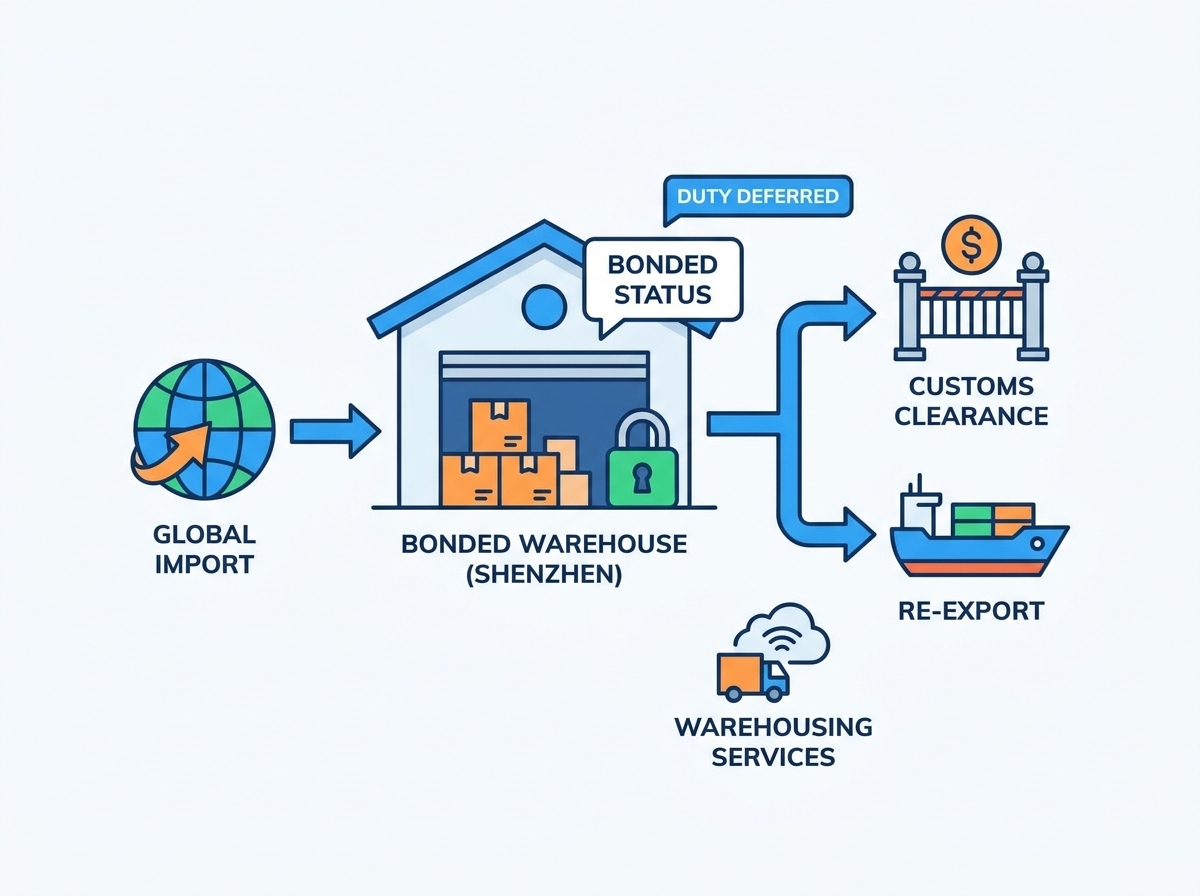
At its core, a bonded warehouse is a highly secure, customs-regulated facility. When imported goods enter this designated area, they are legally considered to be outside the host country's domestic customs territory. Consequently, importers can store, manipulate, or even perform light manufacturing operations on their cargo without the immediate burden of paying duties and taxes. The financial trigger only occurs when the goods are dispatched for local consumption. If the inventory is re-exported to a third country, local tariffs are bypassed entirely.
Key Bonded Zones in Shenzhen
Shenzhen does not rely on a single monolithic zone. Rather, it features multiple specialized districts strategically oriented toward different industrial sectors. Specifically, the Qianhai Comprehensive Bonded Zone near Shekou Port is heavily optimized for cross-border e-commerce and rapid regional distribution. Furthermore, the Yantian Port Bonded Logistics Park directly abuts one of the world's busiest container terminals, making it the premier choice for heavy machinery and ocean freight consolidation. In contrast, the Futian Free Trade Zone facilitates urgent cross-border transfers due to its proximity to the Hong Kong border. Finally, the Pingshan Comprehensive Bonded Zone is tailored for advanced manufacturing and high-tech medical devices.
The Financial and Operational Benefits of Warehousing Services in a Bonded Zone
For mid-to-large scale importers, adopting a bonded strategy is rarely about simply finding a place to put boxes. The true strength of these facilities lies in their measurable return on investment and operational elasticity.
Cash Flow Optimization and Duty Deferral
Imagine pallets of high-value consumer electronics sitting idle at a port. Under standard import procedures, a substantial Value-Added Tax plus applicable tariffs must be paid immediately. This ties up massive amounts of working capital in unsold inventory. Duty deferral flips this dynamic entirely. By delaying these capital expenditures until the point of final sale, businesses instantly free up liquidity. This retained capital can then be aggressively reinvested into marketing campaigns or expanding product lines.
Value-Added Services Inside the Zone
Before goods are cleared for domestic sale, they often require modification to meet local compliance laws or consumer expectations. Bonded zones uniquely permit comprehensive value-added services. Warehouse technicians do not just store boxes. They actively pick, pack, and apply specific localized compliance labels directly on the warehouse floor. Furthermore, businesses can conduct rigorous quality assurance inspections and process global returns without ever triggering import taxes.
Industry Trend Analysis: The Shift to Supply Chain Resilience
A close examination of recent market shifts regarding international fulfillment reveals a distinct paradigm change. As global supply chain disruptions continue to create unpredictable freight environments, multinational brands are aggressively pivoting away from fragile direct shipping models. Empirical data shows a massive surge in near-shoring and bonded pre-positioning strategies across the Asia-Pacific region. Companies are now prioritizing supply chain resilience over mere cost-cutting. By utilizing Shenzhen's bonded infrastructure, importers create a strategic buffer against ocean freight volatility, ensuring inventory is always within arm's reach of the final consumer.
Shenzhen vs. Hong Kong Warehousing Services: Which is Better?
Decision-makers frequently find themselves weighing the logistical merits of Shenzhen against neighboring Hong Kong. While both cities are undisputed titans of global trade, they operate under fundamentally different regulatory frameworks.
Cost Comparison: Rent and Labor
Historically, severe geographic space constraints in Hong Kong have driven commercial real estate prices to astronomical highs. In contrast, Shenzhen generally offers significantly lower per-square-meter rental costs for industrial space. Additionally, labor-intensive warehouse operations such as sorting, kitting, and complex pick-and-pack fulfillment are notably more economical on the mainland. This cost delta directly improves the profit margins of high-volume importers.
Core Comparison Matrix
| Logistics Model | Storage Costs | Customs Complexity | Best Suited For |
|---|---|---|---|
| Shenzhen Bonded Zone | Low to Medium | Moderate documentation required | Mainland distribution, labor-intensive repackaging |
| Hong Kong Free Port | High | Minimal to None | High-value global transit, financial staging |
| Direct Overseas Shipping | Varies by origin | High risk of parcel delays | Low-volume niche products |
The Hybrid Approach
Rather than viewing this as a zero-sum game, highly sophisticated supply chains often employ a hybrid model. Multinational corporations frequently utilize a combination of Hong Kong warehousing services for staging high-value global transit goods, while simultaneously leveraging Shenzhen facilities for bulk storage and direct-to-consumer mainland distribution.
The Workflow of Bonded Transit Storage and Distribution
To effectively integrate these facilities into your existing supply chain software, it is crucial to understand the exact operational steps. A seamless bonded transit storage and distribution workflow ensures that cargo moves swiftly from the ocean vessel to the final buyer without regulatory friction.
Step 1: Port Arrival and Transfer
When a massive container vessel docks at a major terminal like Yantian, the operational clock starts ticking. Instead of waiting weeks in standard customs clearance queues, the shipping container is filed under a bonded transit declaration. Specialized customs trucks immediately shuttle the cargo directly from the port terminal into the physical confines of the Comprehensive Bonded Zone.
Step 2: Inventory Management and Storage
Upon arrival at the loading dock, goods are swiftly unloaded, palletized, and scanned into an advanced Warehouse Management System. Because customs authorities demand strict accountability for untaxed goods, this system must maintain absolute precision. Importers gain real-time visibility into their stock levels, enabling accurate sales forecasting.
Step 3: Order Processing and Dispatch
As digital orders flow in from wholesale buyers or storefronts, warehouse technicians locate and pick the items. The orders are then packed to exact specifications and labeled with appropriate shipping barcodes. If the buyer resides in mainland China, the logistics provider processes the import declaration, pays the deferred duties, and hands the parcel to a local carrier. Conversely, if the buyer is in Europe or North America, the goods are exported completely bypassing Chinese domestic taxes.
Navigating Bonded Cargo Customs Clearance in Shenzhen
Regulatory compliance is arguably the highest risk factor in international logistics. A single documentation error or a misclassified product can lead to catastrophic shipment holds, exorbitant demurrage fees, or total inventory seizure.
The Frontier Open, Second Line Safe Policy
China manages its Comprehensive Bonded Zones through a unique regulatory philosophy. The First Line represents the border between the overseas market and the bonded zone. Entry here is highly liberalized, requiring only basic filing without tariff collection. However, the Second Line acts as the strict gatekeeper to the domestic market. Crossing this line triggers rigorous customs scrutiny, formal import declarations, and mandatory tax collection.
Why You Need a Customs Clearance Expert
Because crossing the Second Line involves intense regulatory oversight, attempting to manage this through disconnected third-party brokers is a recipe for costly delays. Specifically, partnering with a provider that offers in-house bonded cargo customs clearance is highly recommended. Dedicated in-house brokers intimately understand the nuances of classification codes and valuation methods, ensuring a frictionless transition to the local market.
How to Choose the Right Partner for Warehousing Services in Shenzhen
Selecting a logistics provider is akin to choosing a business partner. It requires a rigorous evaluation of their technological infrastructure, physical facility standards, and comprehensive service capabilities. Do not settle for a generic storage shed. You need an engineering-grade fulfillment center.
Technology and API Integration Standards
A modern warehouse is only as effective as the software that runs it. Your chosen logistics partner must deploy a robust warehouse management system capable of seamless API integration with your existing platforms. Look for providers that guarantee an inventory accuracy rate of 99.9 percent and offer API response times under 300 milliseconds. Real-time visibility into inventory levels and automated order transmission are non-negotiable features for maintaining total supply chain control.
Facility Capabilities and Environmental Controls
Not all bonded warehouses are built to the same specifications. If you are importing sensitive goods like cosmetics or pharmaceuticals, you must verify that the facility offers strict temperature and humidity controls. A professional provider will maintain dedicated climate-controlled zones operating reliably between 18 to 22 degrees Celsius. Furthermore, high-value electronics require specialized security protocols, including 24/7 biometric access controls and secure storage cages to prevent shrinkage.
End-to-End Supply Chain Solutions
Fragmenting your supply chain across multiple disconnected vendors exponentially increases the risk of communication breakdowns. The most efficient strategy is to select a unified partner that provides end-to-end solutions. A provider capable of handling ocean freight forwarding, port drayage, bonded storage, and last-mile delivery under a single roof ensures a seamless flow of data and goods.
Conclusion
Shenzhen bonded warehouses offer unparalleled strategic value for global importers. By bridging the gap between international manufacturing and local consumer markets, these facilities empower businesses to scale efficiently while protecting their bottom line. Deferring upfront taxes optimizes working capital, while localized fulfillment slashes transit times and dramatically improves customer satisfaction rates.
However, unlocking these benefits requires more than just renting space. It requires a sophisticated logistical setup engineered for precision. Choosing a reliable, technologically advanced partner is the key to transforming your supply chain from a cost center into a competitive advantage. Evaluate your current fulfillment metrics and partner with industry leaders at JFSZ Logistics to implement a customized, high-performance warehousing strategy today.
FAQ
How long can I store my goods in a Shenzhen bonded warehouse?
Generally, goods can be stored indefinitely or for an extended period, depending on the specific regulations of the chosen Free Trade Zone. This extended timeline provides importers with maximum flexibility to time the market perfectly, avoiding the financial pressure of immediate forced liquidation.
Do I have to pay taxes if I re-export the goods to another country from Shenzhen?
No. If your inventory is brought into a bonded facility and subsequently re-exported to a third country, those goods remain entirely exempt from Chinese import duties and taxes. The bonded zone acts as a tax-free international transit hub.
Can my products be assembled or repackaged inside the bonded zone?
Absolutely. Light assembly, kitting, barcode labeling, and repackaging are legally permitted and highly common operations. These value-added services are routinely performed by warehouse staff to ensure products meet specific destination market compliance standards before clearing customs.
Is it cheaper to store goods in Shenzhen or Hong Kong?
While total landed costs depend heavily on your specific product profile and inventory turnaround time, Shenzhen typically offers significantly lower per-square-meter storage rates and more economical labor costs for pick-and-pack operations. This makes it a highly competitive alternative to neighboring offshore logistics hubs.
What are the specific compliance requirements for electronics entering a Shenzhen bonded zone?
Electronics must be accompanied by a detailed commercial invoice, accurate packing lists with precise SKU weights, and a valid Certificate of Origin. While entry into the bonded zone is liberalized, crossing into the domestic market requires strict adherence to China Compulsory Certification standards where applicable.
How does a bonded strategy benefit Amazon FBA sellers?
Amazon FBA sellers utilize Shenzhen bonded warehouses as a cost-effective staging ground. Instead of sending bulk inventory directly to expensive Amazon fulfillment centers overseas, sellers store bulk goods in Shenzhen duty-free. They then drip-feed inventory into regional FBA warehouses based on actual sales velocity, drastically reducing overseas storage fees and improving inventory performance indexes.
Related Blogs
-
 Door to door shipping from China simplifies international logistics. But how can you ensure smooth delivery from factory to destination? Choosing the right shipping method, preparing documents, and understanding customs responsibilities are essential. This guide explains each shipping step, compares sea, air, and express services, and clarifies DDP and DAP terms. Learn how to arrange reliable deliveries and avoid unexpected costs.
-
 When production stops, every delivery day matters. Delayed components can disrupt schedules and customer commitments. Air freight from China offers a practical solution for urgent commercial shipments. However, choosing the right service requires careful planning. This guide compares standard, priority, and express shipping. You will also learn about flight schedules, customs clearance, and cargo preparation.
-
 Air freight from China offers speed, but costs can vary significantly. Do you know what determines your final shipping bill? This guide explains air freight cost from China, including per-kilogram rates, chargeable weight, surcharges, and destination fees. Learn how to estimate costs and reduce shipping expenses.
