



Delays at Chinese customs directly impact your supply chain lead times. Such bottlenecks inflate inventory levels and erode profit margins rapidly. Missing or inaccurate documentation remains the leading cause of export holds today. We must treat border compliance as a strategic priority rather than a mere administrative hurdle. This guide provides a definitive, compliance-focused breakdown of mandatory and conditional export documents. The General Administration of Customs of China (GACC) enforces strict regulatory frameworks you must follow. We will explore universal baseline requirements and specific regulations for complex cargo types. You will also understand how transport-specific nuances alter your required paperwork. Finally, we cover practical methods to evaluate a logistics partner for flawless customs execution.
Key Takeaways
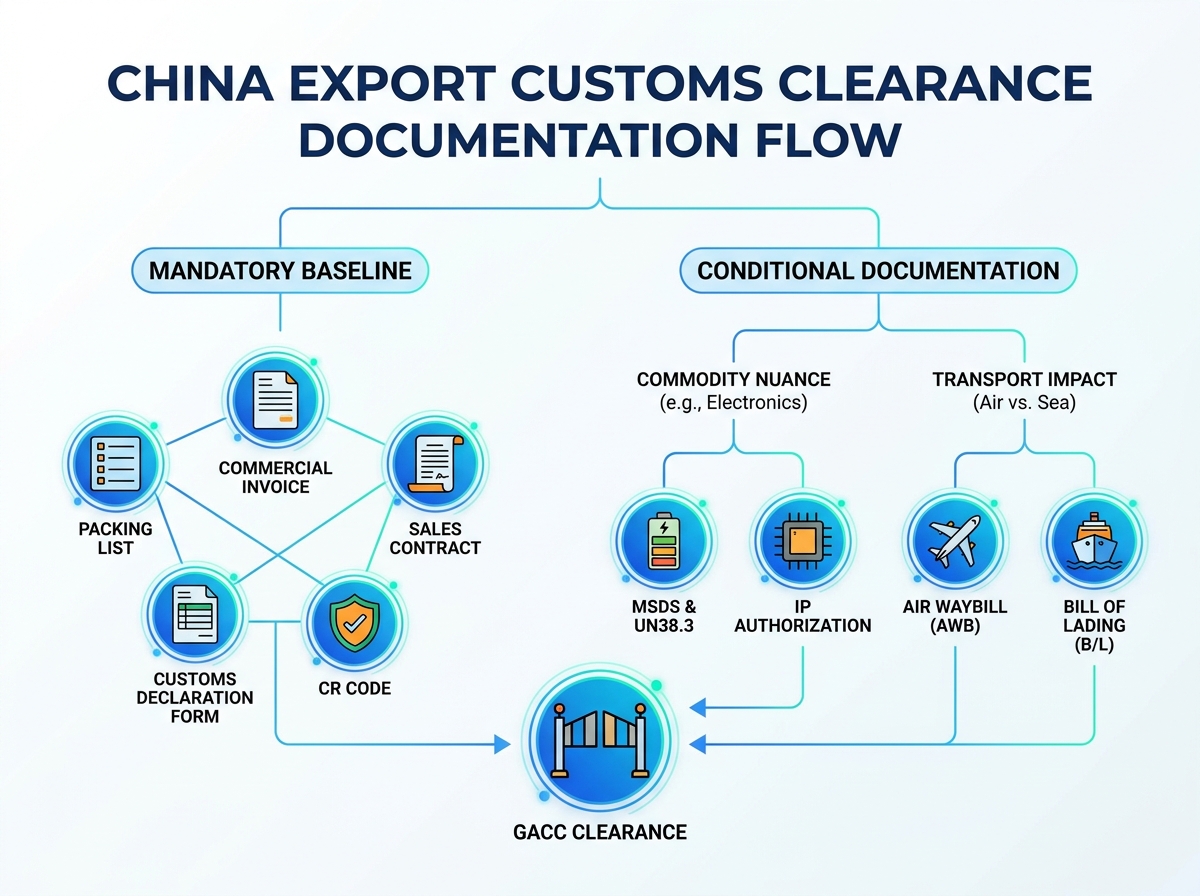
- Mandatory Baseline: Every standard export requires a Commercial Invoice, Packing List, Sales Contract, and a formal Customs Declaration.
- Commodity Nuance: electronic goods shipping requires stringent battery certifications (MSDS, UN38.3) and potential IP declarations.
- Transport Impact: Your choice between air vs sea freight dictates the required transit documentation (Air Waybill vs. Bill of Lading) and clearance timelines.
- Risk Mitigation: HS code discrepancies and valuation errors are the primary triggers for GACC audits and cargo seizures.
- Partner Evaluation: Reliable forwarders act as risk managers, not just document filers.
The Universal Export Clearance Checklist
Every commercial export leaving China demands strict foundational paperwork. GACC inspectors expect absolute perfection across these baseline documents. We must ensure every detail matches the physical cargo exactly.
The Commercial Invoice and Packing List form your core declaration. Customs relies heavily on the commercial invoice for accurate cargo valuation. Any discrepancy triggers immediate automated system alerts. If your packing list shows 500 cartons, the invoice must reflect 500 cartons. Ensure gross and net weights align perfectly across both files.
A flawless Commercial Invoice includes several mandatory data fields:
- Complete buyer and supplier corporate details.
- Accurate item descriptions and technical specifications.
- Precise unit prices and total cargo values.
- Appropriate currency designations.
- Agreed Incoterms for delivery.
The Sales Contract proves the legitimacy of your cross-border transaction. GACC uses it to verify the genuine buyer-seller relationship. It helps officials prevent illegal money transfers and fraudulent exports. Your contract should clearly outline payment terms and delivery responsibilities.
Next, you need the official Customs Declaration Form. Brokers typically submit this electronically via the China International Trade Single Window. You must ensure all data fields mirror the physical cargo perfectly. Errors here frequently result in disruptive physical cargo examinations.
Finally, the Chinese supplier must possess a Customs Registration Code (CR Code). This 10-digit number legally authorizes them to export goods. Buyers operating under EXW terms must verify supplier credentials early. If a factory lacks this code, they cannot export directly. You must then hire an authorized Exporter of Record to facilitate clearance.
Conditional Documentation for High-Scrutiny Cargo
Product specifications often dictate additional regulatory filings. Tech products face particularly intense scrutiny from Chinese border authorities. We must secure these conditional documents long before cargo reaches the departure port.
Certificates of Origin (COO) serve a very specific financial purpose. You need this document to claim preferential tariffs upon arrival. Destination countries use it to apply bilateral free trade agreements. China issues various COO types depending on your destination market. Ensure your supplier applies for this early in the production cycle.
Export Licenses apply to highly restricted or sensitive goods. Raw materials, rare earths, and dual-use technologies require formal government approval. Dual-use items have both civilian and military applications. Attempting to export these commodities without proper licenses invites severe legal penalties.
When managing electronic goods shipping, tech products face rigorous safety checks. Electronics containing lithium batteries require highly specific safety documentation. You must provide UN38.3 test reports for all lithium batteries. A Material Safety Data Sheet (MSDS) is also strictly mandatory. GACC reviews these files to ensure cargo poses zero fire risk during transit.
Branded electronics face equally stringent intellectual property checks. You require a formal Letter of Authorization from the trademark owner. This document proves you hold legal rights to export branded items. Customs maintains a comprehensive intellectual property registry. Without authorization, officials will seize your cargo for suspected IP infringement.
Common electronics requiring strict battery documentation include:
- Smartphones and consumer tablets.
- High-capacity power banks.
- Wireless headphones and speakers.
- Laptops and portable gaming consoles.
Transport-Specific Paperwork: Air vs Sea Freight
Your choice of transport mode heavily influences documentation requirements. It also dictates distinct timelines for paperwork submission and processing. We must align our document preparation strictly with carrier schedules.
The transport mode determines your primary transit receipt. Ocean freight carriers issue a Bill of Lading (B/L). This document serves as the legal title of goods. It acts simultaneously as a receipt, a contract, and a title document. Conversely, air cargo carriers issue an Air Waybill (AWB). The AWB acts merely as a non-negotiable transit receipt. Unlike a B/L, an AWB does not grant ownership title to goods.
When choosing between air vs sea freight, factor in clearance speeds carefully. Air freight demands immediate document readiness prior to airport cut-offs. You must finalize all paperwork well before the cargo arrives. Missing an air cut-off means waiting days for alternative flights. Sea freight allows a slightly wider window before port gate-in deadlines.
Airlines impose exceptionally strict pre-clearance checks on cargo. They scrutinize battery test reports heavily due to strict aviation safety protocols. Ocean liners generally have slightly higher risk tolerances for certain commodities. However, both modes demand flawless alignment between physical goods and paperwork. When deciding on air freight or sea freight, remember air travel leaves zero room for documentation errors.
Table 1: Core Transit Documentation Differences
| Feature | Air Freight | Sea Freight |
|---|---|---|
| Primary Transit Document | Air Waybill (AWB) | Bill of Lading (B/L) |
| Document Function | Non-negotiable receipt | Legal title of goods |
| Battery Scrutiny Level | Extremely High (Aviation Rules) | High (Maritime Rules) |
| Paperwork Timeline | Immediate readiness required | Slight buffer before gate-in |
Implementation Risks: Common Discrepancies and GACC Audits
Real-world operational risks threaten global supply chains daily. You must understand compliance realities to avoid devastating financial delays. Border authorities utilize advanced technology to catch minor paperwork errors instantly.
Every product requires an accurate Harmonized System (HS) code. Misclassifying goods remains a primary trigger for intense GACC audits. Some shippers use incorrect codes to secure lower export taxes. Others manipulate codes to bypass strict export license requirements. Chinese customs uses advanced risk-management algorithms to spot classification anomalies. If authorities catch a mismatch, they will freeze your shipment immediately.
Valuation scrutiny represents another major compliance hurdle for exporters. Declaring abnormally low values invites immediate trouble from customs officials. Shippers sometimes under-declare cargo values to avoid destination import duties. GACC algorithms track historical pricing data for similar global commodities. If your invoice falls below expected thresholds, the system flags it. Customs officers will demand proof of payment and original contracts.
Errors cause severe and tangible business impacts rapidly. Port authorities charge steep demurrage and storage fees for delayed cargo. You will likely miss your scheduled vessel sailing or booked flight. This scenario forces you to re-book at much higher spot market rates. Repeated compliance violations can result in severe supplier penalties. Authorities might blacklist the supplier’s Customs Registration Code entirely. A blacklisted supplier loses their legal right to export goods permanently.
How to Evaluate a Customs-Competent Logistics Partner
Selecting the right freight forwarder protects your entire supply chain. You need a logistics partner who acts as a proactive risk manager. They should identify paperwork errors long before customs submission.
Prioritize logistics partners holding Authorized Economic Operator (AEO) status. China grants this elite certification to highly compliant logistics firms. AEO-certified brokers enjoy significantly lower physical inspection rates. They also receive priority clearance during peak seasonal shipping periods. Partnering with an AEO broker stabilizes your lead times predictably.
Your partner must clearly define all export clearance responsibilities upfront. Misunderstandings here cause immediate cargo abandonment at the departure port. EXW terms place the clearance burden entirely on the buyer’s forwarder. FOB terms place this responsibility squarely on the Chinese supplier. Ensure your logistics provider audits the paperwork regardless of agreed Incoterms.
Avoid logistics providers guaranteeing zero-delay clearance blindly. No broker can completely control random GACC physical inspections. Instead, evaluate partners on their internal discrepancy protocols. Ask how quickly they identify a missing document before system submission. The best brokers audit every commercial invoice against the packing list manually. They flag intellectual property or battery risks before cargo leaves the factory.
Ask these questions during your partner evaluation:
- Do you hold AEO certification in China?
- How do you handle complex IP documentation?
- What is your internal pre-submission audit process?
- How do you verify battery test reports?
Conclusion
Flawless documentation remains the absolute prerequisite for predictable lead times. Navigating Chinese customs requires proactive attention to every minor detail. Every invoice, packing list, and classification code holds immense weight. We cannot treat export clearance as a mere afterthought.
You must take immediate action to secure your supply chain operations. Schedule a comprehensive compliance audit of your current shipping documents today. Request a specialized quote for complex goods to ensure absolute regulatory alignment. You can also download a printable pre-shipment checklist for your team. Standardizing your internal processes prevents costly delays at the border.
FAQ
Q: Who is responsible for preparing China export customs documents?
A: Responsibility shifts entirely based on your chosen Incoterms. Under Free on Board (FOB) terms, the Chinese supplier prepares the documents and clears customs. Under Ex Works (EXW) terms, the buyer’s logistics agent assumes full responsibility for all export paperwork. You must clarify these terms in your sales contract early.
Q: How long does export customs clearance take in China?
A: Standard cargo usually clears Chinese customs within one to two days. Electronic submissions via the Single Window system make this process highly efficient. However, timelines extend significantly if authorities select your shipment for a random physical inspection. Always build a buffer into your supply chain schedule.
Q: Do I need a special license for electronic goods shipping out of China?
A: Standard electronics do not universally require a formal export license. However, border officials strictly enforce battery transport certifications like UN38.3 and MSDS. Furthermore, you must provide official Intellectual Property authorizations for branded tech. Failing to produce these documents results in immediate cargo seizure.
Q: Does the customs process differ between air freight or sea freight?
A: The core GACC electronic declaration process remains identical for both modes. However, carrier-level documentation and strict cut-off timelines vary significantly. Air carriers demand immediate document readiness and heavily scrutinize battery reports. Sea freight offers a slightly wider window for document submission before port gate-in.
Related Blogs
-
 Door to door shipping from China simplifies international logistics. But how can you ensure smooth delivery from factory to destination? Choosing the right shipping method, preparing documents, and understanding customs responsibilities are essential. This guide explains each shipping step, compares sea, air, and express services, and clarifies DDP and DAP terms. Learn how to arrange reliable deliveries and avoid unexpected costs.
-
 When production stops, every delivery day matters. Delayed components can disrupt schedules and customer commitments. Air freight from China offers a practical solution for urgent commercial shipments. However, choosing the right service requires careful planning. This guide compares standard, priority, and express shipping. You will also learn about flight schedules, customs clearance, and cargo preparation.
-
 Air freight from China offers speed, but costs can vary significantly. Do you know what determines your final shipping bill? This guide explains air freight cost from China, including per-kilogram rates, chargeable weight, surcharges, and destination fees. Learn how to estimate costs and reduce shipping expenses.
