



Navigating today’s supply chain landscape requires serious agility. Fluctuating freight rates, port strikes, and shifting geopolitical tariffs make cross-border trade increasingly complex. You simply cannot afford to rely on outdated strategies. What worked perfectly two years ago will likely erode your margins today.
Moving inventory reliably demands more than just grasping introductory logistics concepts. You must master strict customs compliance, precise landed cost modeling, and proactive risk mitigation. A single documentation error or missed classification can lead to catastrophic delays at the border. These operational bottlenecks often evaporate profit margins overnight and destroy customer trust.
This guide breaks down everything you need to know about the import process. We cover different logistics modes, essential customs compliance regulations, and specialized Amazon FBA routing strategies. You will also learn practical, field-tested criteria for selecting the right freight forwarder. Applying these insights will protect your margins, keep you compliant with federal regulations, and streamline your entire global operation.
Key Takeaways
- Transit times dictate strategy: Expect 3–7 days for air express versus 20–40 days for ocean freight (port-to-port).
- Compliance is non-negotiable: Accurate HTS classification and documentation prevent costly US Customs and Border Protection (CBP) holds.
- Incoterms matter: Selecting the right Incoterm (e.g., FOB or EXW) defines your financial risk and control over the shipment.
- Total landed cost > base freight rate: Hidden fees like demurrage, detention, and peak season surcharges must be factored into initial evaluations.
Air vs Sea Freight: Selecting the Right Mode for Your Margins
Choosing between air vs sea freight heavily impacts your overall bottom line. You must align your transport mode with your product type, margin structure, and strict delivery deadlines. There is no universally perfect choice, only the right choice for your specific cargo profile.
Evaluating Air Freight
Air freight offers unmatched speed and reliability. We highly recommend it for high-margin, time-sensitive, or highly perishable goods. High-value electronics, seasonal fashion items, and urgent manufacturing prototypes fit this category perfectly. However, you pay a severe premium for this velocity.
Understanding cost mechanics is critical when booking flights. Airlines charge shippers based on "chargeable weight." They calculate both the actual gross weight and the dimensional (volumetric) weight of your cargo. They will bill you for whichever number is mathematically higher. Consequently, large, lightweight boxes cost much more than their physical weight suggests. You must optimize your packaging to avoid paying for empty air.
You must also distinguish between Express Courier and Standard Air Freight in practical implementation. Express couriers like DHL, UPS, or FedEx provide seamless door-to-door service. They handle customs clearance internally, making it entirely frictionless for small parcels. Conversely, Standard Air Freight typically requires a third-party forwarder. It only covers airport-to-airport transit. You must arrange the final delivery and customs clearance yourself.
Evaluating Sea Freight (Ocean Freight)
Ocean freight remains the undisputed backbone of global trade. It offers massive cost savings for large volumes. When moving goods across the Pacific, you will face a choice between Full Container Load (FCL) and Less than Container Load (LCL).
LCL works best for shipments under 15 cubic meters (CBM). Your goods share a shipping container with cargo from other importers. Once your volume exceeds the 15 CBM threshold, renting an entire FCL usually becomes cheaper. FCL gives you exclusive use of a 20-foot or 40-foot container. It also heavily reduces handling risks because the container stays sealed from the factory to your warehouse.
Routing dictates your transit timelines. Shipping to the US West Coast (like Los Angeles or Long Beach) typically takes about 14 to 20 days on the water. Routing to the East Coast (like New York or Savannah) takes 25 to 35 days. Port congestion and chassis shortages can add significant delays upon arrival. Always build generous buffer days into your inventory schedule.
The Decision Matrix
When deciding between air freight or sea freight, consult this simple checklist to guide your decision-makers:
- Product Lifecycle: Does the product expire, lose value, or go out of trend quickly? If yes, prioritize air freight.
- Inventory Holding Costs: Can your cash flow survive tying up capital in transit for 40 days? If no, utilize air freight to turn inventory faster.
- Profit Margins: Can the retail price absorb a $5 to $10 per kilogram shipping cost? If no, you must rely on sea freight.
Logistics Mode Comparison Chart
| Feature | Air Express | Standard Air Freight | Ocean Freight (LCL) | Ocean Freight (FCL) |
|---|---|---|---|---|
| Best For | Urgent parcels (< 150kg) | Mid-size, urgent cargo | Small volumes (1-15 CBM) | Large volumes (> 15 CBM) |
| Transit Time | 3 - 7 days | 7 - 12 days | 25 - 40 days | 20 - 40 days |
| Cost Level | Highest | High | Moderate | Lowest per unit |
| Handling Risk | Low | Moderate | Higher (consolidation) | Lowest (sealed at origin) |
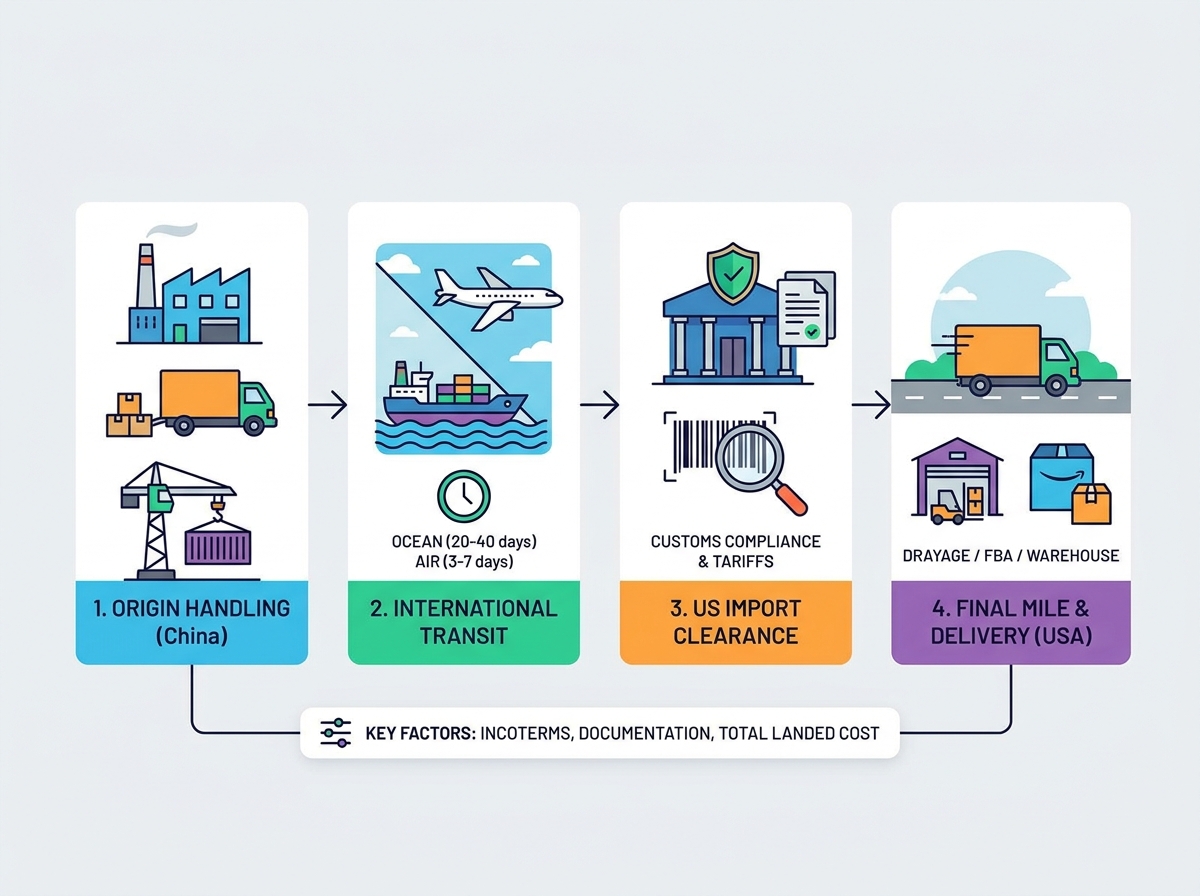
Step-by-Step Logistics: The Process of Shipping from China to USA
Mastering shipping from China to USA requires a deep understanding of each logistical handoff. Moving cargo spans several distinct phases across two continents. You must manage each phase tightly to avoid costly disruptions.
- Origin Handling & Export Clearance: The process begins directly at the Chinese manufacturing facility. A local carrier picks up the goods. They transport the cargo to a consolidation warehouse near a major port (like Shenzhen or Shanghai) or an airport. Customs officials in China then inspect the commercial export documents. They must officially clear the goods before departure.
- International Transit: This phase represents the actual movement of goods across the ocean or through the sky. Ignore best-case scenario promises from aggressive sales representatives. Realistic ocean transit takes 20 to 40 days. Weather disruptions, vessel blank sailings, and port strikes happen frequently. Plan your inventory replenishments accordingly.
- US Import Clearance: Cargo arrives at the US port of entry. A licensed customs broker takes over. They file electronic entry summaries with Customs and Border Protection (CBP). They also remit the necessary duties and taxes. CBP may flag the container for random X-ray or physical inspections during this phase.
- Final Mile/Drayage: Once cleared by customs, specialized truckers move the cargo out of the port terminal. The industry calls this step drayage. They deliver the container or pallets to a designated warehouse, a 3PL facility, or the final retail destination. Quick retrieval prevents expensive port storage fees.
US Customs Compliance, Tariffs, and Essential Documentation
Customs compliance forms the absolute foundation of successful importing. CBP does not tolerate guesswork. Sloppy paperwork triggers intense audits, extended delays, and severe financial penalties.
Core Documentation Requirements
Your Commercial Invoice and Packing List must reflect perfect accuracy. CBP requires exact line-item descriptions. Do not use vague, generic terms like "accessories" or "parts." State exactly what the items are, what materials they are made of, and their intended commercial use. Discrepancies between the invoice and the physical cargo guarantee an inspection.
The Bill of Lading (B/L) for ocean freight, or the Air Waybill for air freight, acts as your most crucial transport document. It serves as the official contract of carriage between you and the carrier. More importantly, the original B/L acts as the title of goods. Whoever legally holds the original B/L controls the physical cargo.
Tariffs and HTS Codes
Every imported product requires a specific 10-digit code from the Harmonized Tariff Schedule (HTS). This code dictates your baseline duty rate. You must classify your products and estimate these duties long before you finalize your supplier purchase order.
Section 301 tariffs introduce severe implementation risks for modern importers. These punitive tariffs apply to a vast array of Chinese-manufactured goods. They often add a massive 25% surcharge on top of your baseline duty. Some inexperienced importers try to tweak product descriptions to circumvent Section 301 tariffs. This misclassification strategy is highly illegal. CBP frequently audits importers post-entry. They will penalize you aggressively for tariff evasion.
Importer of Record (IOR) Responsibilities
The Importer of Record holds full legal and financial liability for the shipment. If you buy goods under FOB terms and bring them into the US marketplace, you act as the IOR. You cannot blame your freight forwarder or your Chinese supplier for compliance failures. You bear the ultimate burden for accurate duty payments and product safety compliance.
Specialized Routing: Amazon FBA and E-commerce Requirements
Amazon sellers face unique logistical hurdles that traditional B2B importers rarely encounter. Amazon enforces incredibly rigid inbound guidelines. Failing to meet them results in inventory rejection, account strikes, and massive rework fees.
FBA Prep and Packaging
Fulfillment by Amazon (FBA) requires highly specific pallet dimensions, strict carton weight limits, and flawless labeling standards. FNSKU barcodes must appear clearly on every single sellable unit. Poly-bags require specific suffocation warnings based on their opening size. You must complete this prep work at the Chinese factory or a specialized staging warehouse before the goods reach an Amazon facility. Fixing prep errors on US soil is prohibitively expensive.
Direct to FBA vs. 3PL Staging
You essentially have two main routing options. Shipping directly from China to Amazon fulfillment centers saves one transit leg and reduces initial handling fees. However, Amazon heavily restricts storage capacity during peak seasons. They also charge exorbitant long-term storage fees for slow-moving inventory.
Many successful sellers prefer routing through a domestic Third-Party Logistics (3PL) provider. A 3PL acts as a strategic staging ground. You hold bulk inventory there relatively cheaply. You then drip-feed smaller, compliant shipments into the FBA network as your stock runs low. This strategy protects your margins during Q4 storage rate hikes and keeps your Seller Central IPI score healthy.
Delivery Appointments
Carriers cannot simply drop off loaded containers at Amazon fulfillment centers whenever they please. They must secure highly regulated delivery appointments through Amazon Carrier Central. Securing these delivery slots during Q4 often takes weeks. This logistical reality causes severe delays. You must account for appointment waiting times in your Q4 inventory planning.
Managing Risks and Hidden Costs in the Supply Chain
Relying solely on a base freight quote is a massive mistake. The logistics industry hides numerous surcharges in the fine print. You must evaluate the true landed costs comprehensively to protect your profit margins.
Demurrage and Detention Fees: Terminal delays rapidly erode profits. Demurrage refers to penalty fees charged when your container sits inside the port terminal beyond its allotted free days. Detention applies when you take the container out of the port but fail to return the empty equipment to the carrier on time. Congested ports turn these daily fees into thousands of dollars in just a single week.
General Rate Increases (GRI) and Peak Season Surcharges (PSS): Ocean carriers introduce sudden rate spikes during periods of high demand. General Rate Increases occur frequently and often with little warning. Peak Season Surcharges hit predictably right before the Chinese New Year shutdown and the Q4 holiday rush. Budget aggressively for these seasonal fluctuations. Your deeply discounted summer freight rate will not survive the winter rush.
Cargo Insurance: Never assume the carrier will willingly cover your losses if a ship encounters a severe storm. Under standard maritime law, carrier liability pays literal pennies on the dollar based on weight. A lost container holding $50,000 worth of electronics might yield a paltry $500 legal payout. We strongly advocate purchasing comprehensive, third-party cargo insurance. It usually costs a tiny fraction of your cargo value and guarantees full replacement value in a disaster.
Shortlisting and Selecting a Freight Forwarder
A capable freight forwarder acts as your most vital strategic partner. Do not simply hunt for the lowest initial quote on a digital load board. Cheap forwarders often compensate for low rates by hiding destination fees or providing terrible customer service during crises.
Evaluation Criteria
- Licensing and Experience: Ensure they hold a valid NVOCC (Non-Vessel Operating Common Carrier) license. They must possess deep, proven experience specifically within the turbulent China-USA trade lane.
- Technology and Visibility: Ask for a live demo of their software platform. Do they offer real-time GPS tracking? Can you access automated dashboard reporting and document storage? Relying on manual, delayed email updates is no longer acceptable in modern logistics.
- In-House Brokerage: Forwarders with in-house customs brokerage teams provide much smoother handoffs. Outsourced brokers add an extra layer of communication lag during urgent customs holds.
Questions to Ask Providers
When interviewing forwarders, ask pointed, scenario-based questions:
- "How do your teams proactively handle exceptions, rolled cargo, or CBP customs holds?"
- "Are your quotes completely all-inclusive? Will destination handling charges and chassis fees be billed separately upon arrival?"
- "Do you hold dedicated space agreements directly with specific ocean carriers, or rely entirely on spot market rates?"
Next Steps
To request a highly accurate quote, gather your essential shipment data first. You need the exact origin city, the final destination zip code, gross weight, and precise carton dimensions. You also need the exact commodity type and commercial value. Provide this structured data to three thoroughly vetted forwarders to compare their service levels and transit times.
Conclusion
Successful importing demands a delicate balance between speed, cost, and strict regulatory compliance. You cannot optimize one metric without affecting the others. Rushing transit times dramatically increases your total freight spend. Cutting corners on customs documentation guarantees catastrophic delays at the border.
We highly encourage proactive planning. Treat your supply chain as a powerful strategic advantage rather than a simple cost center. Partnering with vetted logistics experts always yields better long-term results than chasing the lowest preliminary quote. A reliable, technologically advanced partner will successfully guide you through peak seasons, tariff shifts, and unexpected port strikes.
Take action today. Audit your current shipping strategies and evaluate your landed costs. Request comprehensive freight quotes from licensed forwarders using precise shipment data. Download a customs compliance checklist to ensure your HTS codes remain accurate. If you feel overwhelmed by the complexities, consider speaking directly to a specialized supply chain consultant to map out your next profitable move.
FAQ
Q: What is the cheapest way to ship from China to the USA?
A: Ocean freight is universally the cheapest method. For smaller volumes (under 15 CBM), Less than Container Load (LCL) is highly cost-effective. For bulk shipments, Full Container Load (FCL) provides the absolute lowest per-unit cost. However, utilizing the cheapest option requires longer lead times, often taking 30 to 40 days to reach your facility.
Q: Do I need a customs broker to import from China?
A: While technically not legally required for every single transaction, hiring a licensed customs broker is practically mandatory for commercial goods. CBP regulations change constantly. A broker ensures accurate duty payments, handles complex documentation, and actively prevents massive compliance disasters and financial penalties.
Q: How much are customs duties from China to the US?
A: Duties depend entirely on your specific product's HTS code. Furthermore, many Chinese goods fall under punitive Section 301 tariffs, which can add a massive 25% surcharge on top of standard rates. You must check the official US International Trade Commission website or consult a broker to determine exact rates.
Q: Can a freight forwarder handle Amazon FBA requirements?
A: Yes, but only if you choose the right partner. Specific forwarders offer dedicated FBA prep, precise palletization, and direct-routing services to Amazon. Standard forwarders might just drop the goods at a warehouse. You must explicitly specify your need for strict Amazon compliance upfront during the quoting process.
Related Blogs
-
 Door to door shipping from China simplifies international logistics. But how can you ensure smooth delivery from factory to destination? Choosing the right shipping method, preparing documents, and understanding customs responsibilities are essential. This guide explains each shipping step, compares sea, air, and express services, and clarifies DDP and DAP terms. Learn how to arrange reliable deliveries and avoid unexpected costs.
-
 When production stops, every delivery day matters. Delayed components can disrupt schedules and customer commitments. Air freight from China offers a practical solution for urgent commercial shipments. However, choosing the right service requires careful planning. This guide compares standard, priority, and express shipping. You will also learn about flight schedules, customs clearance, and cargo preparation.
-
 Air freight from China offers speed, but costs can vary significantly. Do you know what determines your final shipping bill? This guide explains air freight cost from China, including per-kilogram rates, chargeable weight, surcharges, and destination fees. Learn how to estimate costs and reduce shipping expenses.
