



Moving high-value tech across global borders presents immense logistical hurdles. Fragile components demand strict handling protocols. Hazardous materials regulations demand absolute precision from everyone involved. electronics shipping from China carries unique risks, primarily driven by high cargo value and extreme physical fragility. Additionally, lithium batteries trigger strict hazardous materials (Hazmat) classifications worldwide. A successful shipment requires zero customs seizures and perfectly intact cargo upon arrival. You must also optimize your freight costs to protect tightening profit margins. Navigating these overlapping constraints requires specific knowledge and flawless execution.
This guide provides an evidence-based framework for handling complex global logistics. We will explore how to manage essential compliance steps effectively. You will learn how to select optimal transport modes for your specific inventory. We will detail exact execution strategies for robust packaging standards. Finally, we will outline exactly how to vet and select specialized logistics partners. Master these critical elements to secure your supply chain and prevent costly delays.
Key Takeaways
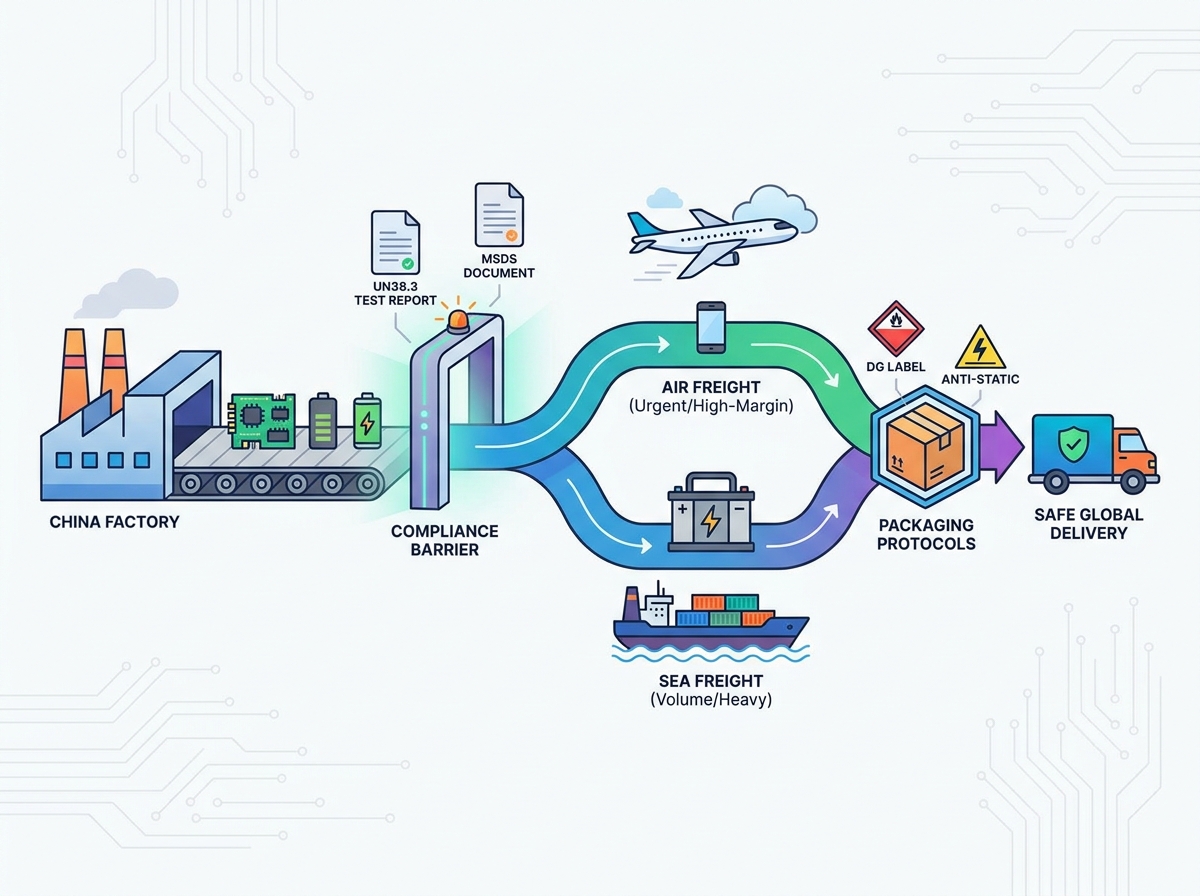
- Battery Compliance is Non-Negotiable: Lithium battery shipments require UN38.3 test reports and MSDS documentation to clear Chinese export and destination customs.
- Mode Dictates Margin: The choice between air vs sea freight depends on product lifecycle, gross weight, and battery integration (standalone vs. contained in equipment).
- Specialized Forwarders are Required: General cargo agents often lack the DG (Dangerous Goods) licenses required for electronics shipping from China, leading to delays or rerouting.
Navigating the Compliance Barrier: Essential Documentation for Electronics
Missing documentation causes most cargo seizures at major Chinese ports. Ports like Shenzhen and Guangzhou operate under strict export controls. Officials routinely halt shipments missing proper battery certifications. This creates massive delays and unexpected storage fees. You must prepare all compliance paperwork well before moving cargo to the departure terminal.
Battery-Specific Requirements (Lithium-Ion & Lithium-Metal)
Lithium batteries power almost all modern consumer electronics. Transport authorities classify them as dangerous goods due to fire risks. You must provide specific documentation to prove their safety.
UN38.3 Test Report: This document is absolutely mandatory. It proves battery stability under extreme pressure and severe temperature changes. Accredited laboratories subject the batteries to eight rigorous tests. These include altitude simulation, thermal testing, vibration, and impact tests. You cannot export batteries from China without a valid UN38.3 report.
MSDS (Material Safety Data Sheet): Airlines and shipping lines require this document. It dictates proper handling procedures for emergency responders. The MSDS outlines chemical compositions, firefighting measures, and safe storage protocols. Carriers review this document before accepting any booking.
PI965, PI966, PI967 Distinctions: Airline regulations separate batteries into distinct packing instructions (PI).
- PI965: Covers standalone lithium batteries shipped loose (e.g., power banks). These face the strictest regulations and cannot fly on passenger aircraft.
- PI966: Covers batteries packed together with equipment (e.g., a power tool packaged beside its battery).
- PI967: Covers batteries contained within equipment (e.g., a fully assembled smartphone). These face slightly relaxed rules but still require clear labeling.
Destination-Specific Certifications
Export clearance only solves half the logistical puzzle. Your electronics must also meet strict import regulations at their final destination.
US Market: The Federal Communications Commission (FCC) regulates electronics entering the United States. Any device emitting radio frequency requires FCC certification. This includes Bluetooth earbuds, Wi-Fi routers, and smart home appliances.
EU Market: European authorities mandate the CE mark. This proves conformity to local health and safety standards. You also need RoHS (Restriction of Hazardous Substances) compliance. RoHS limits heavy metals like lead and cadmium in electronic components.
Implementation Reality: Your supplier must provide these certifications before booking freight. Freight forwarders cannot generate safety documents retroactively. A common mistake is assuming your forwarder will handle compliance testing. They only process the paperwork you provide.
Air vs Sea Freight: Choosing the Right Transport Mode for Electronics
Logistics managers constantly balance time-to-market against volumetric weight costs. Selecting the correct mode profoundly impacts your bottom line. Assessing air vs sea freight requires analyzing your specific product profile.
Air Freight (Express & Standard)
Air transport offers unmatched speed. Transit times range from three to seven days globally. It provides excellent security for high-value goods.
Best for: Air freight suits high-margin, lightweight goods perfectly. Think smartphones, smartwatches, and medical wearables. It also makes sense for urgent inventory restocks. Testing new product lines usually justifies the higher transport costs.
Limitations: Airlines enforce extremely strict rules on standalone lithium batteries. Many cargo planes restrict high-capacity power banks entirely. Air freight also carries the highest cost per kilogram. Carriers charge based on actual weight or volumetric weight, whichever is higher.
Sea Freight (FCL & LCL)
Ocean transport forms the backbone of global trade. It offers massive capacity at a fraction of the cost of air transit. However, it introduces different environmental risks.
Best for: Sea freight fits large-volume shipments best. White goods, heavy appliances, and desktop computers ship efficiently via ocean. It works perfectly for stable inventory cycles. Goods housing high battery capacity, like e-bikes and portable power stations, almost always require sea freight.
Cost Dynamics: Ocean transport is significantly cheaper per unit. However, the 25–40 day transit time introduces physical risks. You must utilize careful palletization to prevent moisture damage. Salt air easily corrodes unprotected microchips. Physical turbulence during rough seas demands heavy-duty packaging.
How to Decide: Air Freight or Sea Freight?
Deciding between air freight or sea freight requires a mathematical approach rather than guesswork.
First, calculate your cargo's "Density Ratio." This compares actual weight against volumetric weight. Air freight uses a standard divisor of 6000 (1 CBM = 167 kg). Sea freight typically uses 1 CBM = 1000 kg. Dense, heavy goods become prohibitively expensive on airplanes. Lightweight, bulky items also suffer under air volumetric pricing.
Second, evaluate your product's obsolescence risk. Consumer electronics lose value rapidly. A new smartphone model depreciates every single week. Gaining an extra month of sales often justifies paying air freight premiums. Conversely, basic cables and chargers retain value long-term, making sea freight ideal.
Transport Mode Comparison Matrix
| Factor | Air Freight | Sea Freight |
|---|---|---|
| Best Product Types | Smartphones, Wearables, Microchips | Appliances, E-bikes, Power Stations |
| Transit Time | 3 - 7 Days | 25 - 40 Days |
| Battery Restrictions | Extremely Strict (Many bans on standalone) | Moderate (Follow IMDG DG rules) |
| Cost per Kg | High | Low |
| Environmental Risks | Barometric pressure changes | Saltwater corrosion, prolonged humidity |
Packaging Protocols for High-Value & Fragile Cargo
The standard packaging provided by Chinese factories rarely survives international transit. Factory cartons might look fine on a local truck. They will inevitably fail during multi-hub air transit or turbulent LCL (Less than Container Load) sea journeys. You must upgrade your packaging standards.
Anti-Static and Moisture Protection
Electronic components remain highly vulnerable to environmental factors. Static electricity and humidity cause catastrophic damage.
Use ESD (Electrostatic Discharge) bags for any bare components. Motherboards, RAM modules, and bare sensors require metallized shielding bags. Pink antistatic bags only prevent static generation; they do not shield against external static fields.
Sea freight introduces severe moisture threats. Containers undergo massive temperature swings during a 30-day voyage. This creates "container rain" as condensation drips from the ceiling. You must use high-capacity desiccant packs. We strongly recommend vacuum-sealed aluminum barrier bags for sensitive equipment to prevent salt-air corrosion completely.
Structural Integrity and DG Labeling
Physical protection prevents crushing during warehouse stacking. Forklifts and conveyor belts subject cartons to significant stress.
- Box Standards: Use double-walled corrugated boxes for all outer cartons. Ensure they meet minimum bursting test standards (often printed on the box maker's certificate on the bottom).
- Palletization: Never ship loose cartons in LCL freight. Group them on ISPM-15 certified wooden pallets. Heat-treated wood prevents pest infestations and avoids customs rejection. Alternatively, use heavy-duty plastic pallets. Shrink-wrap the entire load extensively. Apply rigid edge protectors to all four corners.
- Compliance Execution: Proper labeling prevents heavy fines. You must affix Class 9 Dangerous Goods labels clearly on the outer carton. Battery handling marks must display the correct UN number (e.g., UN3481) and an emergency contact phone number. Ensure labels remain visible after shrink-wrapping.
Customs Clearance, HS Codes, and Tariff Strategies
Navigating customs involves significant financial risks. Mismanaging your declarations can destroy your profit margins overnight. Incorrect entries trigger excessive duties, shipment holds, or even anti-dumping investigations.
Tariff Classification
Every imported product requires an HS (Harmonized System) code. This 6-to-10 digit number dictates exactly how much import duty you pay.
Classifying multi-function electronics presents a unique challenge. Does a smartwatch classify as a watch or a radio transceiver? Does a smart speaker classify as a speaker or an internet processing device? Working with a licensed customs broker becomes an absolute necessity here. Brokers secure binding rulings to ensure accurate classifications. Guessing your HS code frequently leads to harsh customs penalties.
Section 301 Tariffs (US Focus)
Importers bringing Chinese electronics into the United States face additional hurdles. Section 301 tariffs impose significant extra duties on specific Chinese-origin goods. Many electronic components carry an additional 7.5% or 25% tariff on top of standard rates.
You must accurately calculate your Landed Cost before ordering inventory. Landed cost equals the product price, plus freight, plus standard duty, plus Section 301 tariffs, plus insurance. Failing to calculate this accurately often results in selling products at a net loss.
Cargo Insurance Realities
Never rely on standard carrier liability. For air freight, the Montreal Convention limits airline liability to roughly $26 per kilogram (22 SDR). For sea freight, COGSA limits ocean carrier liability to a mere $500 per container. These amounts are laughably insufficient for electronics.
You must secure Comprehensive All-Risk Marine Insurance. Do not assume all policies cover everything. You must specifically check the fine print for common exclusions. Look for clauses regarding "concealed damage" (finding broken screens weeks after delivery). Also, explicitly confirm coverage for "battery fires." Many basic policies exclude damage caused by internal battery failures.
How to Shortlist a Freight Forwarder for Electronics
Vendor evaluation determines your overall success. General cargo agents ship textiles and plastic toys effectively. They often lack the infrastructure to handle dangerous goods or high-value tech safely.
Evaluation Criteria
When interviewing potential logistics partners, demand proof of their capabilities. Ask these specific questions:
- DG Certification: Do they hold valid dangerous goods handling licenses? Ask to see their specific IATA DGR certifications.
- Carrier Relationships: Do they have direct contracts with DG-approved airlines? Airlines like Cathay Pacific and Korean Air excel at handling tech cargo. Ask the forwarder if they book directly or outsource to a third party.
- Warehouse Security: Electronics face high theft risks. Do their origin warehouses in Shenzhen or Shanghai feature comprehensive CCTV? Do they maintain climate-controlled areas? Do they use secure, locked cages for high-value tech processing?
Red Flags to Avoid
Be extremely wary of unusually low quotes. Predatory forwarders often strip out necessary fees to win your business. They will omit origin terminal handling charges (OTHC) from the initial quote. They might also hide destination DG surcharges. Once your cargo sits in their warehouse, they hold it hostage until you pay these "unexpected" fees. Always demand an itemized, all-inclusive quote before booking.
Conclusion
Shipping electronics successfully requires intense preparation. Proactive compliance ensures your goods move swiftly through export controls. Rigorous packaging protects your delicate investments from physical and environmental destruction. Finally, utilizing mode-appropriate logistics balances your speed requirements against your financial constraints.
Take immediate action on your next shipment. Before placing your next manufacturing order, request the supplier's MSDS and UN38.3 reports. Verify these documents are current and valid. Next, begin engaging DG-certified freight forwarders to request accurate landed-cost quotes. Secure your cargo insurance early. By controlling these variables, you build a resilient, highly profitable electronics supply chain.
FAQ
Q: Can I ship lithium batteries by themselves (without equipment) from China?
A: Yes, but it is highly regulated. They are classified as Class 9 Dangerous Goods under PI965. Air freight options are severely limited to specific cargo-only aircraft. Sea freight allows them, but requires specific DG container placement and extensive safety declarations.
Q: Who is responsible for providing the UN38.3 test report?
A: The manufacturer or supplier in China remains legally responsible for providing testing documentation. They must obtain this report from an accredited testing laboratory before you arrange transport. Freight forwarders cannot create this document for you.
Q: How much extra does it cost to ship electronics compared to standard goods?
A: Shipping electronics generally adds 15-25% to standard freight rates. This increase covers DG handling fees, specialized antistatic packaging, and hazardous materials surcharges. The exact premium varies heavily depending on the battery size and the specific transport mode chosen.
Related Blogs
-
 Door to door shipping from China simplifies international logistics. But how can you ensure smooth delivery from factory to destination? Choosing the right shipping method, preparing documents, and understanding customs responsibilities are essential. This guide explains each shipping step, compares sea, air, and express services, and clarifies DDP and DAP terms. Learn how to arrange reliable deliveries and avoid unexpected costs.
-
 When production stops, every delivery day matters. Delayed components can disrupt schedules and customer commitments. Air freight from China offers a practical solution for urgent commercial shipments. However, choosing the right service requires careful planning. This guide compares standard, priority, and express shipping. You will also learn about flight schedules, customs clearance, and cargo preparation.
-
 Air freight from China offers speed, but costs can vary significantly. Do you know what determines your final shipping bill? This guide explains air freight cost from China, including per-kilogram rates, chargeable weight, surcharges, and destination fees. Learn how to estimate costs and reduce shipping expenses.
