



Are rising freight rates and unpredictable tariffs continuously eating into your profit margins? In today's volatile global supply chain landscape, fragmented shipping silently destroys your bottom line. Many businesses miscalculate their total landed cost. They bleed capital through inefficient storage, redundant manual labor, and suboptimal transportation choices.
Implementing a strategic consolidation framework solves this problem. It maximizes container space and minimizes individual shipment fees. In this comprehensive guide, we explore how professional logistics facilities provide the infrastructure, advanced technology, and operational expertise needed to execute seamless consolidation and protect your revenue.
Key Takeaways
- Cost Efficiency: Implementing a strategic consolidation framework directly lowers total landed cost by maximizing container utilization and minimizing individual shipment fees.
- Optimized Handling: Systematically grouping cargo limits the number of physical touchpoints, thereby significantly reducing damage risks and labor expenditures.
- Ocean Freight Savings: Grouping smaller, disparate shipments into full containers secures highly competitive rates and bypasses destination deconsolidation delays.
- Global Flexibility: Utilizing bonded hubs for multi-origin goods offers distinct tax and tariff advantages for complex international supply chains.
- The 3PL Advantage: Partnering with expert logistics providers supplies the necessary infrastructure and technology required to execute a seamless strategy without heavy capital investment.
Understanding Total Landed Cost and the Role of Warehousing Services
To effectively reduce supply chain expenses, decision-makers must first establish a clear, objective understanding of where capital is actually being allocated. The most critical metric in this evaluation is the Total Landed Cost, commonly referred to as TLC. Without a granular view of TLC, companies often chase cheap unit prices while losing money on the back end.
What is Total Landed Cost?
Total Landed Cost represents the complete financial expenditure required to manufacture a product and transport it from the factory floor to the final buyer's door. Many organizations fail to capture the full scope of this metric. They focus almost exclusively on unit production costs and base freight rates. However, a comprehensive calculation includes several hidden variables.
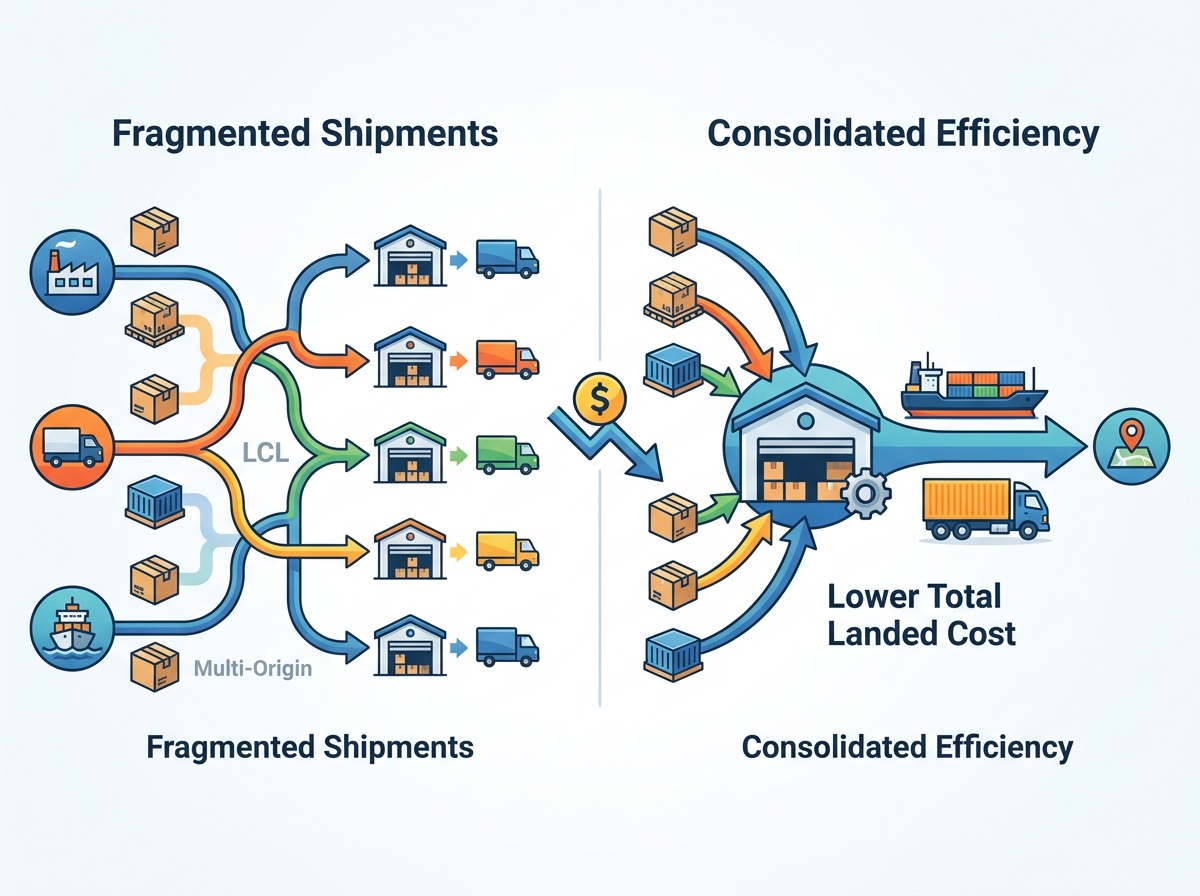
In our daily logistics operations, we frequently see procurement teams celebrating a minor drop in manufacturing costs, only to wipe out those savings through decentralized shipping. When strategies are fragmented, meaning goods are shipped in small, frequent batches directly from multiple suppliers, the freight and handling portions of the equation become heavily inflated. Imagine sourcing electronic components from five different regional factories. If each supplier ships independently via Less-than-Container Load, you are paying premium spot-market rates five separate times.
Below is a breakdown of the standard cost components and how fragmentation impacts them:
| Cost Component | Description | Impact of Fragmented Shipping |
|---|---|---|
| Manufacturing | The base cost to produce the unit. | Neutral. Generally unaffected by transit methods. |
| Freight & Transport | Fees for ocean, air, or road transit. | High. Multiple small shipments incur premium shared-space rates. |
| Customs & Duties | Tariffs, taxes, and brokerage fees. | High. Each individual shipment requires separate customs entries and administrative fees. |
| Handling | Labor costs for loading, unloading, and moving. | High. Fragmented shipments require constant manual handling at multiple docks. |
| Storage | Costs associated with holding inventory. | High. Decentralized safety stock leads to redundant facility fees and dead inventory. |
How Inefficient Storage Inflates Your Bottom Line
Operating multiple, decentralized storage facilities often creates a false sense of supply chain security. In reality, decentralized networks hide significant financial inefficiencies. Businesses end up paying for redundant labor, excess safety stock to prevent localized stockouts, and duplicated administrative overhead across multiple sites.
Centralizing your inventory acts as the foundational step in regaining control over these spiraling costs. By routing goods through a single, strategically located facility, businesses can stabilize inventory levels. They can standardize handling procedures and prepare cargo for highly efficient, bulk transportation.
What is a Warehouse Consolidation Strategy?
A warehouse consolidation strategy is a systematic logistics framework designed to optimize the flow of goods. Instead of moving small volumes of freight continuously in a reactive manner, supply chain managers use historical data and demand forecasting to group shipments together. This approach achieves massive economies of scale.
The Mechanics of Consolidation Facilities
At its core, this method involves receiving multiple smaller shipments from various suppliers, holding them briefly at a centralized hub, and combining them into a single, larger shipment before final distribution. Executing this requires robust physical and digital infrastructure.
Integrated warehouse consolidation and storage services provide the essential physical space, material handling equipment, and tracking systems necessary to act as this central nervous system. Within these dynamic hubs, forklift operators and automated sorting conveyors stage incoming pallets. Goods are meticulously sorted, repackaged if necessary, and held until enough volume is gathered to maximize the cubic capacity of a complete truck or shipping container.
Consolidation vs. Traditional Distribution
To truly grasp the financial benefits, one must compare the consolidation model against traditional distribution methods. In a conventional setup, a buyer might order components from three different suppliers. Each supplier dispatches their goods independently. The buyer subsequently pays three separate premium freight bills, processes three distinct customs entries, and ties up dock workers unloading three different trucks.
In contrast, under a consolidated framework, those same three suppliers ship their goods to a single center located near the origin point. The center combines the goods into one Full Truckload or Full Container Load. Ultimately, the buyer pays one optimized freight bill and unloads a single container. This drastically reduces both administrative friction and dock congestion.
Core Methods of Optimizing Freight Movements
The overarching goal of this strategic framework is to utilize cargo consolidation to reduce handling cost. Every time a carton is manually lifted or a pallet is transferred between docks, labor expenses increase. Simultaneously, the statistical probability of product damage rises. By employing specific grouping methodologies, logistics managers can systematically eliminate these unnecessary touchpoints.
Ocean Shipping Consolidation Techniques
Ocean freight remains the absolute backbone of global trade, but carrier pricing structures heavily favor volume. When a business lacks sufficient cargo to fill a 20-foot or 40-foot container, they are forced to rely on shared space. These shared rates are inherently higher per cubic meter. The carrier must factor in the labor of packing multiple shippers' goods into one box, alongside the administrative burden of managing split bills of lading.
Leveraging LCL freight consolidation for ocean shipping allows a single buyer to group their own smaller shipments into one dedicated Full Container Load. For instance, converting multiple small shipments into a dedicated 40HQ container secures flat-rate pricing. Furthermore, these full shipments entirely bypass time-consuming deconsolidation processes at the destination port and significantly lower terminal handling charges.
Global Bonded Hub Strategies
For enterprise-level supply chains, taxation and tariffs represent a massive percentage of the total landed cost. A bonded warehouse is a highly secure facility, regulated by customs authorities, where imported goods can be stored, manipulated, or undergo light manufacturing operations without the immediate payment of duties.
Implementing multi-origin bonded cargo consolidation involves importing components from various countries into a single, tax-advantaged hub. Facilities equipped with Grade-A bonded status and 24/7 CCTV monitoring allow businesses to safely defer duty payments until the consolidated finished goods actually enter the local commerce market. If the consolidated goods are subsequently re-exported to a third country, the business may avoid paying local duties entirely, drastically improving corporate cash flow.
Cross-Docking and Deconsolidation
While traditional grouping involves a brief period of storage, cross-docking is a highly synchronized method. Inbound goods are unloaded, sorted, and immediately reloaded onto outbound transport with zero or minimal storage time. This represents the ultimate execution of lean logistics. It requires precise scheduling and advanced Warehouse Management Systems to ensure that inbound supply perfectly matches outbound transport capacity.
Industry Perspectives on Supply Chain Resilience
Recent industry data indicates a massive shift toward regionalized inventory buffers. With global port congestion and volatile spot rates becoming the new normal, relying on just-in-time direct shipping is increasingly risky. Logistics analysts note that top-tier enterprises are rapidly transitioning to hub-and-spoke consolidation models. This shift not only builds resilience against sudden supply shocks but also aligns with the growing demand for sustainable, low-carbon freight movements. Consolidation is no longer just a cost-saving tactic; it is a critical survival mechanism in modern trade.
Direct Financial Benefits: How Consolidation Lowers Total Landed Cost
Transitioning to a consolidated supply chain model requires upfront planning and cross-departmental coordination. However, the resulting financial benefits provide a highly measurable return on investment. The reductions are typically realized across three primary operational categories.
Slashing Freight and Transportation Expenses
The most immediate and visible financial impact is seen in line-haul transportation costs. Specifically, the logistics industry prices capacity based on space utilization. Partial shipments leave empty, unmonetized space in trailers and containers, which carriers inevitably price into their margins. By consolidating cargo into full shipments, shippers maximize the cubic volume of the transport asset. Data consistently shows that converting multiple partial shipments into a single full route can reduce transportation line-item costs by up to 30 percent. This simultaneously shields the business from volatile spot-market rate spikes.
Lowering Inventory Holding and Storage Fees
Inventory carrying costs encompass warehouse rent, utilities, insurance, and the opportunity cost of tied-up capital. These can account for 20 to 30 percent of total inventory value annually. Fragmented supply chains force companies to hold safety stock at multiple regional nodes simply to buffer against unpredictable transit times.
Furthermore, a consolidated strategy dramatically improves transit predictability. When shipments move via dedicated full containers, the delays associated with carrier hub-and-spoke sorting are eliminated. This newfound reliability allows supply chain planners to confidently reduce safety stock levels. This directly translates to lower overall storage fees and a leaner, more agile inventory profile.
Minimizing Customs, Tariffs, and Administrative Overhead
Every international shipment triggers a complex series of administrative actions. Customs brokers charge per entry, and port authorities levy fees per bill of lading. If a company imports ten separate partial shipments a month, they pay these administrative fees ten times over. Consolidating those orders into two full shipments reduces the administrative burden by 80 percent. Additionally, fewer shipments mean fewer opportunities for customs holds, documentation errors, and subsequent demurrage or detention penalties at the port.
Strategic Advantages: Nearshoring, Reshoring, and Green Logistics
Beyond direct cost savings, optimizing freight movement aligns with broader macroeconomic trends currently reshaping global trade. Supply chain resilience and environmental sustainability are no longer optional corporate public relations initiatives. They are critical operational requirements demanded by stakeholders.
Recent industry analyses highlight a structural shift in global procurement. As companies pivot away from single-source dependencies to mitigate geopolitical risk, the adoption of regionalized supply chain models has surged. However, simply moving a factory closer to the end consumer does not automatically yield cost savings. The true financial advantage is unlocked only when these nearshoring efforts are paired with aggressive freight consolidation frameworks. Without centralized hubs to manage the influx of regional materials, transportation costs can quickly erode the benefits of shorter supply chains.
Adapting to Supply Chain Shifts
Geopolitical tensions and recent global disruptions have accelerated the trends of nearshoring and reshoring. Even when sourcing from a nearshore location, businesses still rely heavily on robust consolidation hubs. These facilities manage the flow of raw materials from remaining global suppliers and consolidate finished goods for efficient final-mile delivery. They provide the agile infrastructure needed to support transitional supply chains.
Sustainable Shipping and Green Home Delivery
Environmental, Social, and Governance criteria are increasingly influencing corporate logistics decisions. Fragmented shipping is inherently carbon-intensive. Dispatching half-empty trucks and containers results in significantly higher fuel consumption and greenhouse gas emissions per unit of freight.
Shipment consolidation directly supports green logistics initiatives. By maximizing container fill rates and reducing the total number of trips required to move a set volume of goods, companies drastically lower their carbon footprint. This sustainable approach is particularly vital for retail and e-commerce sectors striving to implement green home delivery models. Reducing urban traffic congestion and emissions is heavily scrutinized by both modern consumers and regulatory bodies.
How to Implement an Effective Consolidation Plan
Transitioning from a fragmented shipping model to a streamlined, consolidated strategy requires methodical execution. Organizations should follow a structured, data-driven approach to ensure operational continuity and avoid bottlenecks during the transition phase.
Analyzing Your Current Supply Chain Data
The absolute foundation of any logistics optimization is accurate, historical data. Supply chain managers must conduct a comprehensive audit of their shipping records. This includes mapping out all supplier origin points, analyzing order frequencies, measuring average shipment volumes, and tracking historical transit times. Identifying overlapping routes and concurrent delivery schedules will quickly reveal the most viable opportunities for volume grouping.
Identifying Strategic Consolidation Hubs
Choosing the correct geographic location for a central hub is a critical variable in the landed cost equation. The facility must be strategically positioned to minimize inbound transit distances from suppliers while maintaining highly efficient access to outbound ports, railheads, or major highway networks. Decision-makers must also carefully evaluate the local labor market availability, regional commercial leasing rates, and proximity to customs checkpoints.
Integrating Warehouse Management Systems
Consolidation is fundamentally an exercise in precise timing and end-to-end visibility. Rather than relying on static spreadsheets, modern logistics managers deploy cloud-based software platforms equipped with API connectivity. This allows for real-time synchronization between supplier dispatch schedules and outbound ocean carrier cut-off times. Robust digital integration automates sorting logic and syncs seamlessly with carrier systems, ensuring that all stakeholders have accurate, up-to-the-minute data regarding cargo status.
Choosing the Right Warehousing Services for Your Consolidation Needs
Building and managing a proprietary consolidation network is a highly capital-intensive endeavor. It falls far outside the core competencies of most manufacturing and retail businesses. Consequently, outsourcing this function to specialized third-party logistics providers is the most pragmatic and cost-effective approach.
Actionable Selection Criteria for Logistics Partners
When evaluating potential logistics partners, decision-makers should look far beyond basic pallet storage rates. The ideal partner must possess a comprehensive global network capable of supporting operations at both the origin and destination points. Look for providers offering robust infrastructure, such as multi-tiered racking systems, automated barcode scanning, and specialized handling equipment for oversized cargo. A qualified partner must also possess certified customs brokerage expertise and the legal authority to operate bonded facilities. Furthermore, the provider should demonstrate strict adherence to standard operating procedures to guarantee cargo security.
The Value of End-to-End Solutions
Engaging a logistics partner that offers comprehensive, end-to-end services eliminates the immense friction of managing multiple siloed vendors. A provider capable of handling drayage, cross-docking, bonded storage, and final-mile distribution ensures that critical data flows uninterrupted across the entire supply chain lifecycle. This holistic approach is consistently proven to be more resilient than attempting to stitch together isolated logistical services. Ultimately, it secures the lowest possible total landed cost for your business.
What is the difference between warehouse consolidation and cross-docking?
While both are vital logistical processes, consolidation involves receiving goods, storing them for a short period, and grouping them until enough volume is reached to fill a container. In contrast, cross-docking is a highly synchronized process where inbound goods are unloaded, immediately sorted, and transferred directly to outbound transportation with virtually zero storage time.
How does ocean freight consolidation save money?
When you ship via partial loads, you pay premium rates for shared space and face higher handling fees. By consolidating your own goods from various suppliers into a single full container, you pay a flat rate for the entire box. This maximizes cubic space utilization, reduces per-unit shipping costs, and eliminates destination deconsolidation fees.
Can bonded facilities help mitigate the impact of tariffs?
Yes. Utilizing a bonded facility allows you to import and store goods duty-free until they officially enter the local commerce market. If you consolidate components in a bonded hub and later re-export the finished goods to another country, you can often bypass local duties entirely. This strategy significantly optimizes corporate cash flow and lowers the final landed cost.
How exactly does grouping cargo reduce handling costs?
Every time a loose carton is manually moved, labor costs increase. By grouping smaller items into secured pallets or loading them directly into full shipping containers at a central hub, the goods are subsequently moved in bulk using machinery. This drastically reduces the number of times individual items are touched, lowering hourly labor expenditures and minimizing the risk of product damage.
How do you calculate total landed cost accurately?
An accurate calculation requires summing up the manufacturing cost, freight charges, customs duties, insurance premiums, handling fees, and storage costs. Because tracking multiple invoices from different vendors is error-prone, partnering with a unified logistics provider helps consolidate these expenses into a single, transparent billing structure for easier financial analysis.
Does warehouse consolidation increase delivery lead times?
Surprisingly, it often improves predictability. While holding goods at a central hub adds a brief staging period, shipping the consolidated cargo via dedicated full containers eliminates the unpredictable delays caused by carrier hub-and-spoke sorting and destination deconsolidation queues. The result is a more reliable and consistent delivery schedule.
Ready to stop bleeding capital through fragmented shipping? Partnering with an experienced logistics provider transforms your supply chain from a cost center into a competitive advantage. Evaluate your current freight volumes and explore tailored consolidation solutions designed to protect your profit margins. For expert infrastructure and seamless execution, explore the comprehensive warehousing and freight forwarding services at JFSZ Logistics to optimize your global operations today.
Related Blogs
-
 Door to door shipping from China simplifies international logistics. But how can you ensure smooth delivery from factory to destination? Choosing the right shipping method, preparing documents, and understanding customs responsibilities are essential. This guide explains each shipping step, compares sea, air, and express services, and clarifies DDP and DAP terms. Learn how to arrange reliable deliveries and avoid unexpected costs.
-
 When production stops, every delivery day matters. Delayed components can disrupt schedules and customer commitments. Air freight from China offers a practical solution for urgent commercial shipments. However, choosing the right service requires careful planning. This guide compares standard, priority, and express shipping. You will also learn about flight schedules, customs clearance, and cargo preparation.
-
 Air freight from China offers speed, but costs can vary significantly. Do you know what determines your final shipping bill? This guide explains air freight cost from China, including per-kilogram rates, chargeable weight, surcharges, and destination fees. Learn how to estimate costs and reduce shipping expenses.
