



Millions of dollars in pharmaceuticals, high-tech electronics, and fine goods vanish annually across global supply chains. Industry data consistently shows that these severe financial hemorrhages frequently stem from a lethal combination. Improper storage temperatures and unexpected customs delays at international borders are the primary culprits. For supply chain directors and logistics managers, standard storage facilities simply cannot handle the strict regulatory, financial, and environmental demands required to maintain the integrity of high-value, temperature-sensitive goods.
The most effective solution to this complex logistical challenge lies in a specialized hybrid approach known as climate-controlled bonded storage. This premium logistics model bridges the critical gap between maintaining absolute product integrity and optimizing international supply chain costs. By integrating precise environmental management with customs-regulated financial benefits, businesses can secure their assets while maintaining maximum operational flexibility.
Key Takeaways
- Dual Advantage: Combining strict climate control with customs-bonded status protects product integrity while allowing businesses to legally defer customs duties and import taxes.
- Precision is Non-Negotiable: Advanced facilities utilize Internet of Things sensors and continuous monitoring to prevent micro-fluctuations in temperature and humidity, ensuring total regulatory compliance.
- Streamlined Logistics: Bonded facilities significantly accelerate customs clearance procedures, preventing the irreversible spoilage often caused by prolonged border inspection delays.
- Cost-Efficiency: Strategic inventory management within a bonded environment improves corporate cash flow by aligning tax payments strictly with actual product distribution schedules.
What is Climate-Controlled Bonded Storage?
To fully grasp the strategic value of this logistics model, it is essential to break down its two foundational components. When seamlessly integrated, these elements create a highly secure, financially advantageous environment for international freight.
A bonded warehouse is a highly secure, customs-regulated facility where imported goods can be stored legally without the immediate payment of import duties and taxes. Under the strict supervision of national customs authorities, goods remain in a duty-free state until they are officially entered into the domestic market for consumption or re-exported to another country. This mechanism provides immense financial flexibility for global distributors.
Furthermore, unlike standard warehousing which is subject to ambient external weather conditions, climate-controlled facilities are engineered with advanced heating, ventilation, and air conditioning alongside industrial refrigeration systems. These mechanical systems are meticulously designed to maintain strict, predefined temperature and humidity ranges, regardless of external seasonal changes.
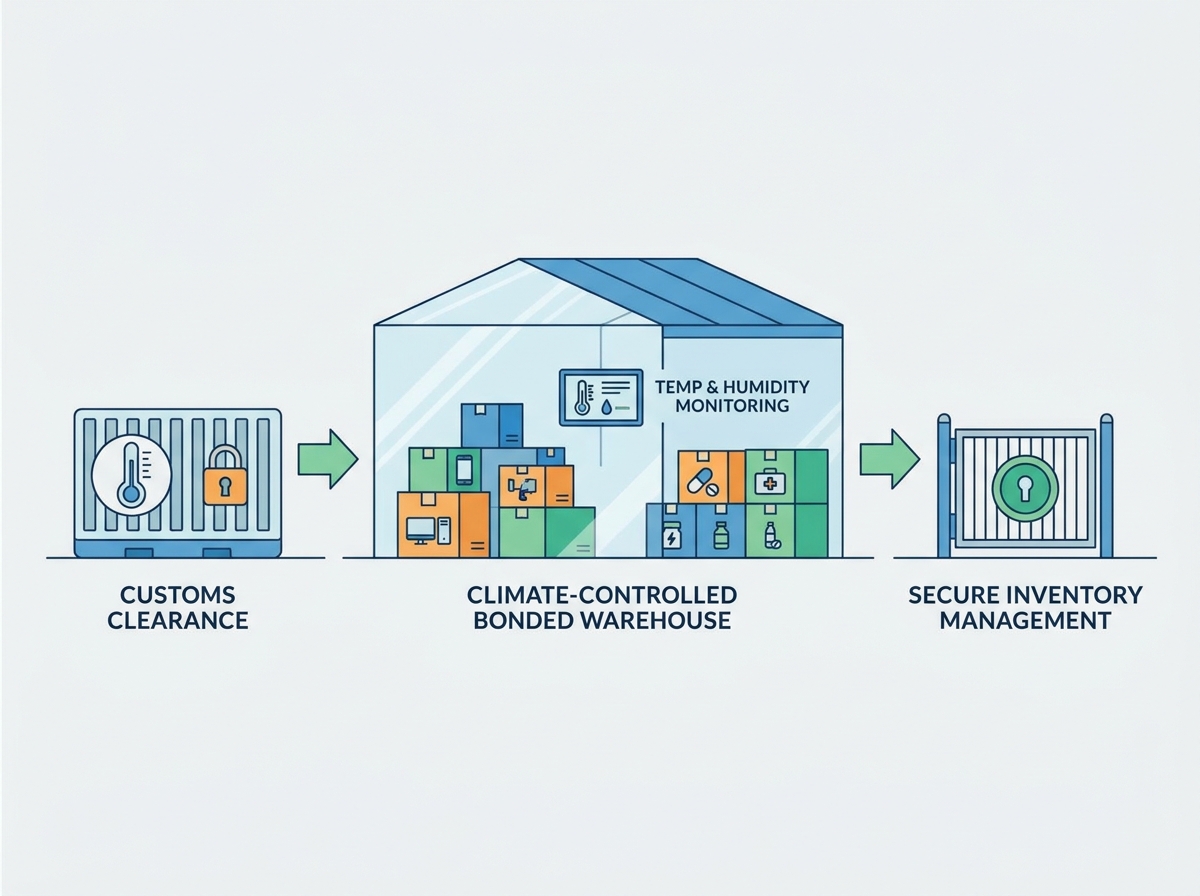
Combining these two distinct logistical concepts creates an unparalleled safe haven for international freight. In the modern global economy, goods often travel across multiple climate zones and face unpredictable customs processing times. A climate-controlled bonded warehouse acts as a secure buffer zone. By moving goods directly from a port of entry into this specialized facility, logistics providers ensure that the cold chain remains completely unbroken while administrative customs procedures are handled concurrently. This intersection is exactly where operational risk is minimized and financial efficiency is maximized.
Global Industry Trends Reshaping Cold Chain Logistics
Recent global supply chain analyses indicate a sharp upward trajectory in the demand for specialized cold-chain infrastructure. Driven by the rapid expansion of the biopharmaceutical sector and the ongoing complexities of global semiconductor distribution, market intelligence suggests that standard ambient warehousing is rapidly becoming obsolete for high-value sectors.
Corporations are increasingly prioritizing supply chain resilience over mere cost-cutting. They are actively shifting toward hybrid bonded models that insulate their inventory from unpredictable border bottlenecks, climate anomalies, and sudden geopolitical shifts. Relying on basic logistics protocols is now recognized as a critical operational vulnerability. For high-value or chemically unstable products, securing professional warehousing for sensitive goods has evolved from a luxury into an absolute necessity.
Why Your Supply Chain Demands Specialized Infrastructure
Several global industries rely entirely on specialized environments to maintain product viability and consumer safety. Imagine unloading a pallet of mRNA vaccines on a humid airport tarmac or storing precision optical lenses in a facility prone to static buildup. The physical and financial results would be catastrophic.
The primary sectors demanding this level of care include pharmaceuticals and healthcare, where products such as biological therapeutics, vaccines, insulin, and active pharmaceutical ingredients require strict temperature adherence. Any deviation can render the medication ineffective or dangerous. Advanced electronics like semiconductors and microchips are highly susceptible to moisture, where high humidity causes oxidation and overly dry environments generate destructive static electricity. Additionally, perishable foods, fine wines, and high-end cosmetics require precise climate management to prevent spoilage, separation, and degradation.
In contrast, standard warehouses lack the rigorous regulatory compliance frameworks required for these sensitive items. The hidden costs of standard warehousing often manifest as rejected shipments, lost revenue, and permanently damaged brand reputation. To illustrate this gap, consider the following technical comparison:
| Feature | Standard Warehousing | Climate-Controlled Bonded Storage |
|---|---|---|
| Temperature Control | Ambient only, subject to seasonal weather fluctuations. | Strict multi-zone control, e.g., 2°C to 8°C or 15°C to 25°C, with minimal variance. |
| Customs Status | Duties and taxes must be paid immediately upon entry. | Taxes deferred until goods enter the domestic market. |
| Power Redundancy | Basic municipal grid reliance. | N+1 backup generators activating within 10 seconds of grid failure. |
| Security & Monitoring | Standard CCTV and padlock systems. | 24/7 biometric access, continuous Internet of Things sensor logging. |
The Role of Precision in Modern Logistics
In the realm of specialized logistics, the term climate control is often misunderstood as merely keeping a room cool with standard air conditioning. In reality, protecting high-value freight requires exact, measurable, and documented precision. This is where advanced climate-controlled cargo storage and monitoring becomes the backbone of a resilient supply chain.
Precision is the differentiating factor between adequate storage and premium logistics. Different sensitive goods require vastly different environmental parameters. Ambient control is typically maintained strictly between 15°C and 25°C, making it ideal for certain electronics and stable cosmetics. Refrigerated storage must be locked between 2°C and 8°C, serving as the critical baseline for the majority of biological pharmaceuticals. Meanwhile, cryogenic or deep-freeze zones drop from -20°C down to -150°C for specialized cell therapies.
Fluctuating even one or two degrees outside of these specific parameters can trigger a temperature excursion. In highly regulated industries, a documented excursion often mandates the immediate destruction of the cargo, regardless of whether physical damage is visible.
To guarantee this uncompromising level of precision, modern facilities deploy a comprehensive technology stack. Leading warehouses are equipped with industrial-grade sensors strategically placed throughout the storage zones and directly on individual pallets. These sensors continuously measure temperature and humidity levels, transmitting data to a centralized Warehouse Management System in real-time. If a micro-fluctuation occurs, automated alert systems instantly notify facility engineers. Building on this foundation, premium facilities employ fully redundant systems, including secondary compressors and heavy-duty industrial backup generators that activate automatically within seconds of a grid power failure.
Financial and Operational Benefits of Hybrid Facilities
Beyond immediate physical protection, specialized warehousing offers substantial fiscal advantages that can transform a company balance sheet. Implementing robust bonded storage and inventory management provides stakeholders with granular control over their assets and working capital.
One of the most significant financial burdens in international trade is the upfront payment of import duties, taxes, and tariffs. When goods enter a standard warehouse, these fees must typically be paid immediately upon customs entry. For large volumes of high-value goods, this can tie up millions of dollars in working capital.
Bonded warehouses fundamentally alter this dynamic. By utilizing a bonded facility, businesses can legally defer paying these import duties until the cargo actually leaves the facility for distribution into the local market. If the goods are stored for several months, the company retains its cash on hand during that entire period. Additionally, if market conditions shift and the goods are ultimately re-exported to a third country, the domestic import duties are bypassed entirely.
Operating within a highly regulated customs environment requires exceptional organizational standards. Specialized systems provide companies with real-time control over their assets. Because sensitive goods often have strict shelf lives, advanced platforms track critical data points such as expiration dates, batch numbers, and lot codes. This enables automated First-In First-Out or First-Expired First-Out protocols, ensuring that older inventory is distributed before it degrades.
Navigating Border Checkpoints with Ease
The border checkpoint is historically the most dangerous phase of the international supply chain for sensitive goods. Traditional clearance procedures can easily become a death trap for high-value freight if not managed with absolute precision.
Goods are frequently unloaded onto hot airport tarmacs or held in unconditioned inspection warehouses while paperwork is processed. For a shipment of biologics requiring a strict 2°C to 8°C environment, a sudden customs hold lasting several hours can destroy millions of dollars worth of product. The lack of environmental control during standard government inspections represents a critical vulnerability.
Specifically, utilizing a bonded facility strategically bypasses these initial border bottlenecks. Because these warehouses are legally recognized extensions of customs territory, cargo can be transferred in-bond directly from the port to the specialized facility. Once safely inside the climate-controlled zone, expert logistics providers can manage the customs clearance for temperature-sensitive cargo on-site. Customs officials perform necessary physical inspections within the controlled environments, ensuring that the cold chain integrity is never compromised.
How to Choose the Right Logistics Partner
Selecting a logistics partner for sensitive freight requires rigorous due diligence. Decision-makers must look beyond pricing and evaluate the core competencies and technological infrastructure of the facility using a concrete set of standards.
The foundational metric for any specialized warehouse is its regulatory compliance. Stakeholders should demand proof of relevant certifications. ISO 9001 demonstrates a commitment to consistent quality management systems. Good Distribution Practice certification is non-negotiable for pharmaceutical logistics, ensuring products are consistently stored under specific conditions. Furthermore, Authorized Customs Broker status ensures the provider has the legal authority and expertise to handle in-bond transfers efficiently.
A thorough physical audit of the facility is required before signing a contract. You must verify that they possess physically separated multi-temperature zones to prevent cross-contamination. Evaluate their power redundancy capabilities; a premium facility must have diesel backup generators capable of restoring full cooling power within ten seconds of an outage. Finally, assess the physical security protocols, demanding 24/7 CCTV and biometric access controls for valuable commodities.
Step-by-Step Transitioning to a Specialized Logistics Partner
Migrating high-value inventory to a new logistics provider is a complex undertaking that requires meticulous planning to prevent supply chain disruptions.
The transition begins with a comprehensive audit of existing logistics operations. Supply chain managers must map out the current journey of their cargo, identifying historical temperature excursion events and areas where customs delays have previously caused financial loss. Documenting specific temperature parameters and average inventory volumes provides the baseline data needed to brief a new logistics partner.
Seamlessly moving inventory requires tight coordination. This involves establishing secure API connections between the company Enterprise Resource Planning software and the provider warehouse management system, ensuring real-time visibility into inventory levels and temperature logs. Next, both parties must draft Standard Operating Procedures that dictate exactly how goods should be received, inspected, and dispatched. Conducting small-scale pilot trial shipments is highly recommended to test the in-bond transfer process before committing to large-scale inventory migration.
Conclusion
For sensitive international freight, relying on standard storage is an unnecessary liability. Climate-controlled bonded storage is a strategic asset that protects product quality while simultaneously optimizing a company bottom line. By integrating exact environmental precision, modern sensor technology, and deep regulatory expertise, businesses can build a highly resilient supply chain. Stop leaving your high-value cargo exposed to ambient risks and border delays. Partner with JFSZ Logistics to transition to a specialized warehousing model, safeguarding your assets against unpredictable global bottlenecks and maximizing your operational cash flow.
Frequently Asked Questions
What is the difference between a standard warehouse and bonded warehousing services?
A standard warehouse is simply a commercial space for storage, where import taxes must usually be paid before goods enter. In contrast, a bonded warehouse is a customs-regulated facility. Here, you can store imported goods without immediately paying duties and taxes, which drastically improves cash flow and distribution flexibility.
What types of products require specialized climate monitoring?
Any product vulnerable to temperature or humidity shifts requires specialized storage. This broadly includes pharmaceuticals, biologics, medical devices, advanced electronics, specialty chemicals, high-end cosmetics, fine art, and perishable foods and beverages.
How does bonded storage help with customs clearance for sensitive freight?
It allows the cargo to be moved immediately from the port or airport into a temperature-controlled, customs-approved facility under an in-bond transfer. This prevents the goods from sitting on a hot tarmac or in an unconditioned government inspection warehouse while waiting for paperwork to be processed.
How do bonded warehouses handle temperature excursions during a customs hold?
Because the bonded warehouse is legally recognized as a customs territory, inspections and holds occur directly inside the temperature-controlled environment. If a customs hold is placed on a shipment, the goods remain securely in their designated 2°C to 8°C or 15°C to 25°C zone, ensuring zero risk of temperature excursion while administrative issues are resolved.
What is the cost difference between standard and climate-controlled bonded storage?
While the baseline storage rate for climate-controlled bonded warehousing is higher due to the energy costs of industrial HVAC systems and 24/7 monitoring technology, the overall financial impact is often positive. The upfront cost is offset by the complete elimination of spoilage, the deferment of massive import taxes, and the prevention of customs delay penalties.
How do facilities ensure the temperature remains exact during power outages?
Premium specialized warehouses utilize robust redundant systems. This includes heavy-duty industrial backup generators that activate automatically within seconds, secondary cooling compressors, and continuous monitoring alerts to ensure the internal climate remains perfectly stable even during catastrophic municipal power grid failures.
Related Blogs
-
 Door to door shipping from China simplifies international logistics. But how can you ensure smooth delivery from factory to destination? Choosing the right shipping method, preparing documents, and understanding customs responsibilities are essential. This guide explains each shipping step, compares sea, air, and express services, and clarifies DDP and DAP terms. Learn how to arrange reliable deliveries and avoid unexpected costs.
-
 When production stops, every delivery day matters. Delayed components can disrupt schedules and customer commitments. Air freight from China offers a practical solution for urgent commercial shipments. However, choosing the right service requires careful planning. This guide compares standard, priority, and express shipping. You will also learn about flight schedules, customs clearance, and cargo preparation.
-
 Air freight from China offers speed, but costs can vary significantly. Do you know what determines your final shipping bill? This guide explains air freight cost from China, including per-kilogram rates, chargeable weight, surcharges, and destination fees. Learn how to estimate costs and reduce shipping expenses.
