



Supply chain blind spots cost companies millions annually. Imagine the frustration of a delayed high-value shipment. Customer service teams are left scrambling. They simply do not know where the inventory is at that exact moment. Missing data leads directly to lost sales. It damages client relationships and creates severe operational bottlenecks. Modern commerce demands fully connected transparent systems to survive and thrive.
In this landscape, partnering with the right provider to upgrade your warehousing infrastructure is the fastest path to achieving end-to-end visibility. By integrating a sophisticated Warehouse Management System with cutting-edge tracking technologies, businesses transform their logistics network. It shifts from a reactive liability into a predictive asset. We will explore the underlying technologies driving this shift. We will analyze the financial return on investment. Furthermore, we will delve into specialized operational solutions like bonded storage and maritime tracking.
Key Takeaways
- End-to-End Visibility: Integrating a modern Warehouse Management System with real-time tracking eliminates critical blind spots. This offers comprehensive transparency from the point of origin to the final destination.
- Optimized Operations: Upgrading your warehousing framework bridges the gap between static traditional storage methods and agile data-driven fulfillment networks.
- Precision in Inventory: Mastering real-time cargo tracking prevents costly stockouts. It reduces unnecessary holding costs and systematically improves end-customer satisfaction.
- Global Trade Efficiency: Specialized operational solutions, including bonded inventory management and maritime tracking, are fundamental requirements for maintaining compliance in international logistics.
- High Returns for All Scales: Implementing real-time location data significantly lowers operational expenditures. This transforms logistics into a strategic competitive advantage for businesses of all sizes.
Current Industry Trends: The Shift to Predictive Logistics
Recent market analyses reveal a massive pivot in global supply chain strategies. Following years of unpredictable disruptions, industry leaders are aggressively moving away from fragile just-in-time models. Instead, the focus has shifted toward building resilient data-driven networks. Investment in cloud-based tracking software and sensor technologies has surged across the sector. Companies now realize that raw physical storage capacity is virtually useless without instantaneous data access. The prevailing trend is clear. Businesses are demanding platforms that offer predictive analytics, allowing logistics engineers to foresee port congestions or route delays days before they physically manifest.
The Evolution of Warehousing Services: Traditional vs. Modern Logistics
To truly grasp the value of supply chain visibility, we must first examine the stark contrast between legacy storage models and modern logistics frameworks. Historically, warehouses functioned merely as static holding facilities. Goods were received, placed on a rack, and eventually shipped based on fragmented manual documentation.
The inherent flaw in these legacy operations is data latency. Picture a facility manager relying on clipboard tallies and disconnected spreadsheets. By the time the data is entered into the system, it is already obsolete. This delay forces decision-makers to operate based on historical snapshots rather than current realities. Consequently, this disconnect creates massive tension across the supply chain. It leads to bloated safety stocks and a constant state of firefighting exception management.
Conversely, modern facilities act as the central nervous system of the global supply chain. By leveraging cloud computing, automation, and interconnected software ecosystems, these hubs process vast amounts of data instantaneously. Companies utilizing real-time data consistently achieve higher order-perfect rates and significantly lower overhead.
| Operational Metric | Legacy Storage Models | Modern Data-Driven Logistics |
|---|---|---|
| Data Capture | Manual entry, prone to human error and high latency. | Automated barcode and sensor scanning, instant synchronization. |
| Inventory Accuracy | Periodic cycle counts, frequent discrepancies. | Continuous real-time tracking, up to 99.9% accuracy. |
| Exception Handling | Reactive firefighting after delays occur. | Predictive alerts enable proactive route adjustments. |
| Space Utilization | Static slotting based on fixed rules. | Algorithmic putaway optimizing velocity and dimensions. |
What is a Warehouse Management System? Core Fundamentals
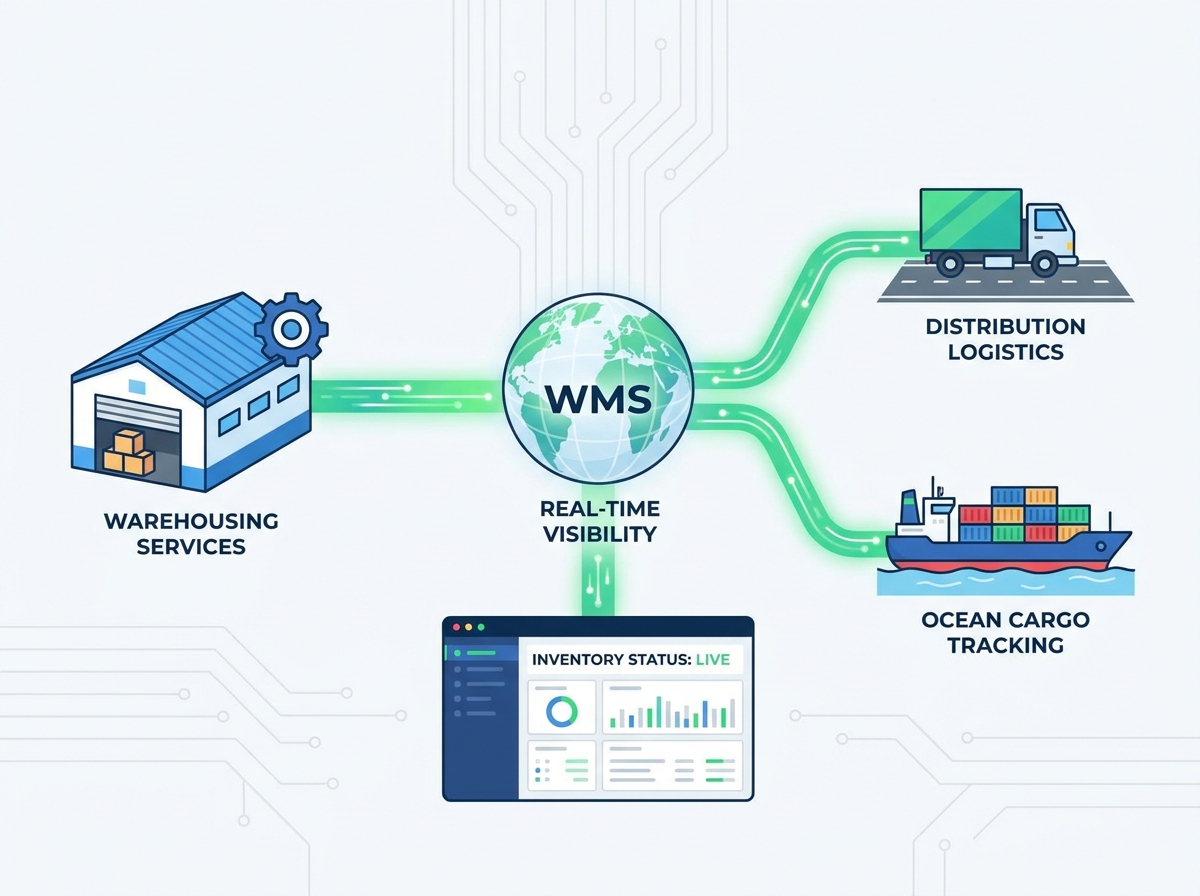
At the core of this operational shift is the Warehouse Management System. Far beyond a simple digital ledger, this highly specialized software application is engineered to orchestrate and optimize every microscopic movement within a facility. It meticulously manages inventory from the exact second materials hit the receiving dock until they are loaded onto an outbound trailer.
A robust system actively dictates the rhythm of the warehouse through several critical functions. Upon arrival, the software scans incoming goods. It then deploys algorithmic logic to pinpoint the most efficient putaway location. This calculation factors in product velocity, weight, and specific environmental requirements. During the fulfillment stage, it generates optimized wave or batch picking paths. This practical routing drastically reduces the physical miles warehouse staff walk each shift. It systematically minimizes human error and boosts throughput.
Crucially, modern platforms utilize Application Programming Interfaces to communicate fluidly with Enterprise Resource Planning software and Transportation Management Systems. This interconnectedness ensures the warehouse software serves as the ultimate single source of truth. By capturing data via barcode scanners or radio frequency readers at every physical touchpoint, executives are granted an objective panorama of labor productivity, order fulfillment statuses, and precise stock levels.
Integrating External Data with Internal Operations
While a central management system provides absolute authority within the four walls of a storage facility, global supply chains sprawl across continents and oceans. True visibility is only achieved when internal warehouse metrics merge seamlessly with external tracking telemetry. This powerful integration is what fundamentally transforms standard warehousing and distribution logistics into a dynamic uninterrupted flow of commerce.
Instead of relying on delayed milestone updates from third-party carriers, logistics managers can monitor the physical transition of assets the moment a pallet leaves the rack. This continuous stream of intelligence bridges the gap between the loading dock and the final delivery destination. It ensures a strictly documented chain of custody.
The mechanics of this extended visibility rely on sophisticated hardware and software synchronization. Global positioning trackers and smart sensors are affixed to shipping containers or individual high-value items. These devices continuously broadcast live geographic coordinates and environmental conditions directly back to the centralized hub. By analyzing this live transit data, the system calculates highly accurate predictive arrival times. If a delivery truck encounters an unexpected traffic anomaly, the receiving distribution center dynamically adjusts its outbound routing and dock door scheduling. This proactive risk mitigation prevents minor transit hiccups from cascading into expensive operational paralysis.
Mastering Precision in the Supply Chain
To maximize financial efficiency, organizations must zoom in on the micro-level movements of their physical goods. Achieving this requires a dedicated technological approach to mastering inventory status and real-time cargo tracking. It is no longer acceptable to lose sight of a shipment the moment the trailer doors close.
Historically, freight entering the transit phase plunged into a visibility black hole. It only re-emerged when manually scanned at the next checkpoint. Continuous tracking technologies eradicate this uncertainty. Logistics professionals are freed from the burden of guessing stock levels or blindly trusting carrier estimations. Modern tracking systems provide twenty-four-seven monitoring across multiple transit nodes. This ensures cargo integrity from origin to destination.
This continuous data feed unlocks the powerful financial concept of inventory in motion. Rather than writing off transit time as dead time, forward-thinking companies accurately count goods currently moving on rail networks or highways as part of their available sellable stock. This precise accounting tightens capital management. It empowers sales teams to execute more aggressive and confident strategies.
Whether fulfilling massive business-to-business wholesale orders or managing direct-to-consumer shipments, accurate tracking yields immediate dividends. Knowing the exact status of available stock prevents the nightmare of overselling and slashes backorder rates. Automatically sharing secure tracking links and milestone alerts builds profound commercial trust. It drastically reduces the burden on inbound customer service teams.
Specialized Solutions for Global Trade
For enterprises navigating the complexities of international trade, standard storage solutions often fall short. Cross-border logistics requires specialized infrastructure. This is particularly true when handling goods subject to heavy taxation and stringent regulatory compliance.
A bonded warehouse serves as a highly secure customs-controlled environment. Here, imported goods can be stored, consolidated, or manipulated without the immediate payment of import duties. These financial obligations are legally deferred until the cargo is officially withdrawn for domestic consumption. However, operating within this specialized environment demands exceptional precision, which is why bonded warehouse inventory management is so heavily reliant on top-tier tracking software.
Government customs agencies mandate meticulous error-free historical records for every unit entering and exiting the facility. A modern tracking system automatically generates these immutable digital audit trails. This ensures inventory counts are exact and compliance is never compromised. The financial upside is substantial. By leveraging a data-driven bonded facility, businesses optimize their cash flow. They pay taxes only when revenue is generated from a sale. Seamless data synchronization between the warehouse software and customs authorities radically accelerates final clearance processes.
Bridging the Global Gap in Maritime Transport
Despite impressive advancements in domestic freight monitoring, the most glaring blind spot in the global supply chain typically occurs on the water. Maritime transport is fraught with complex handoffs, unpredictable weather patterns, and volatile port operations. To conquer this challenge, integrating real-time ocean cargo tracking services has become a non-negotiable requirement for modern importers and exporters.
Today's ocean tracking relies on sophisticated API integrations. These pull live satellite data directly into the internal management system. Whether managing Full Container Loads or Less than Container Loads, logistics teams can monitor container statuses at a granular level. They know precisely when a container is loaded onto a vessel, discharged at the terminal, or gated out for final door-to-door delivery.
Advanced tracking platforms also analyze terminal wait times and vessel queuing. This delivers early warnings regarding port congestion. When a warehouse receives these highly accurate marine arrival estimates, facility managers shift from reactive scrambling to proactive planning. They optimize labor scheduling, arrange drayage transport days in advance, and allocate dock doors efficiently. This effectively neutralizes costly bottlenecks upon the cargo's arrival.
The ROI of Upgrading Your Warehousing Services
For Chief Financial Officers and Supply Chain Directors, the decision to overhaul legacy systems with advanced tracking technologies ultimately hinges on return on investment. The initial capital expenditure required for digital transformation is rapidly offset by systemic cost reductions across the entire operational spectrum.
Implementing real-time visibility directly impacts the bottom line. When a company lacks confidence in its transit times, it overcompensates by stockpiling excess buffer inventory. Real-time location data provides the empirical confidence necessary to execute lean inventory strategies. This significantly lowers warehousing footprints and frees up working capital.
In addition, predictive arrival times allow for pinpoint drayage scheduling. This drastically reduces exorbitant demurrage and detention penalties at congested ports. Inside the facility, algorithmic routing minimizes wasted walking time. It cuts unnecessary overtime pay and drives up unit picking metrics.
A common misconception is that enterprise-grade visibility is exclusively reserved for global conglomerates. In reality, scalable cloud-based warehousing technologies have leveled the playing field. By leveraging accurate data, smaller enterprises can deliver the same rapid delivery speeds, order accuracy, and transparency as their largest competitors. This capability transforms their supply chain from a basic operational necessity into a potent tool for customer acquisition.
How to Choose the Right Logistics Partner
Achieving true end-to-end visibility rarely happens in isolation. It requires collaborating with a sophisticated logistics provider or technology vendor. Decision-makers must look beyond basic storage rates. They must rigorously evaluate potential partners based on their technological maturity and operational engineering standards.
When vetting a provider, ensure they utilize a modern cloud-native system capable of processing high transaction volumes with zero latency. Their systems must offer seamless integration capabilities to connect flawlessly with your existing commerce platforms. Verify their competency in specialized offerings, such as efficient customs clearance, bonded storage, and comprehensive ocean freight tracking. Demand strict cybersecurity protocols to protect your proprietary supply chain data.
In today's volatile market, supply chain visibility is no longer a luxury. It is the baseline for survival. Eradicating blind spots prevents costly delays, optimizes working capital, and ensures your customers remain satisfied. By integrating robust tracking networks, businesses evolve their traditional logistics into a proactive resilient engine.
Take the time to evaluate your current logistics setup and identify the hidden gaps draining your profitability. Reach out to the experts at JFSZ Logistics to upgrade your warehousing distribution strategy. By leveraging our advanced tracking solutions, bonded warehousing capabilities, and seamless maritime transport services, you can build a supply chain designed to dominate your industry.
FAQ
How does real-time location data improve supply chain visibility?
Real-time location data acts as the critical bridge between physical cargo movement and digital management systems. By utilizing smart sensors and location trackers, live coordinates and status updates are fed directly into the central software. This continuous stream of intelligence eliminates guesswork. It enables logistics teams to proactively bypass transit disruptions and ensures all stakeholders share a single objective source of truth regarding inventory whereabouts.
What is the difference between standard warehousing and distribution logistics?
Standard warehousing primarily focuses on the static passive storage and preservation of goods over time. In contrast, distribution logistics encompasses a highly active dynamic operational process. It involves order processing, automated picking and packing, rapid inventory turnover, and the strategic routing of goods to the end consumer. Distribution is designed for high-velocity movement. It requires advanced software integrations to synchronize outbound shipments with fluctuating market demand.
Why is bonded warehouse inventory management important for international trade?
Bonded warehouse environments allow importing businesses to legally defer the payment of customs duties and taxes until the goods are officially withdrawn for domestic consumption. This strategic deferment significantly enhances working capital and cash flow. Because these facilities operate under stringent government oversight, specialized software is required to maintain flawless real-time records of inventory movement. Accurate tracking ensures strict compliance with customs regulations. It safeguards the business from severe legal penalties.
How do real-time ocean cargo tracking services reduce port delays?
Ocean cargo tracking services utilize live satellite data and direct carrier integrations to generate highly accurate predictive arrival times for maritime shipments. By accessing this real-time intelligence, logistics engineers are alerted to potential port congestion or vessel rerouting long before the ship docks. This early warning system allows managers to proactively adjust labor schedules and arrange drayage transport in advance. It ensures containers are picked up promptly, avoiding costly demurrage and detention fees.
How do Application Programming Interfaces enhance logistics tracking?
Application Programming Interfaces act as digital bridges that allow different software systems to communicate instantly. In logistics, they enable a warehouse system to automatically pull live data from shipping carriers, customs portals, and sales platforms without manual data entry. This creates a unified dashboard where engineers and managers can monitor the entire supply chain in real time, eliminating data silos and reducing response times to operational exceptions.
What role do smart sensors play in cold chain storage?
Smart sensors are critical for maintaining the integrity of temperature-sensitive cargo. Attached to pallets or shipping containers, these devices continuously monitor internal temperatures, humidity levels, and even physical shock. If a refrigeration unit fails during transit, the sensor instantly transmits an alert back to the central management system. This allows logistics teams to intervene immediately, preventing the total spoilage of high-value pharmaceuticals or perishable goods.
Related Blogs
-
 Door to door shipping from China simplifies international logistics. But how can you ensure smooth delivery from factory to destination? Choosing the right shipping method, preparing documents, and understanding customs responsibilities are essential. This guide explains each shipping step, compares sea, air, and express services, and clarifies DDP and DAP terms. Learn how to arrange reliable deliveries and avoid unexpected costs.
-
 When production stops, every delivery day matters. Delayed components can disrupt schedules and customer commitments. Air freight from China offers a practical solution for urgent commercial shipments. However, choosing the right service requires careful planning. This guide compares standard, priority, and express shipping. You will also learn about flight schedules, customs clearance, and cargo preparation.
-
 Air freight from China offers speed, but costs can vary significantly. Do you know what determines your final shipping bill? This guide explains air freight cost from China, including per-kilogram rates, chargeable weight, surcharges, and destination fees. Learn how to estimate costs and reduce shipping expenses.
