



Did you know a tiny static spark can destroy thousands of dollars in electronic inventory before it ever reaches the consumer? Imagine a pallet of next-generation AI processors sitting on a loading dock. A barely noticeable static discharge, generated simply by the friction of a forklift tire or a sudden jolt during container loading, can instantly wipe out a highly lucrative shipment.
Shipping sensitive technology involves hidden and costly risks. Drops, moisture ingress, and electrostatic strikes cause massive inventory losses daily across the global supply chain. Logistics is no longer just about moving boxes. It is about precision engineering. In this technical guide, we will break down exactly how specialized logistics frameworks solve these intricate challenges, securing your cargo from the factory floor to final delivery.
Key Takeaways for Supply Chain Engineers
- Electrostatic Protection is Mandatory: Without multi-layered shielding, sensitive components like Printed Circuit Boards face severe risk of permanent and undetectable degradation.
- Physical Integrity Requires Customization: Shockproof solutions go far beyond basic bubble wrap. They demand custom-engineered foams and vibration-tested palletization methods to survive multimodal transit.
- Strategic Storage Drives Profitability: Utilizing bonded facilities allows businesses to legally defer tariff payments. This drastically improves corporate cash flow and streamlines regional distribution.
- Expert Coordination Prevents Failure: A dedicated logistics partner seamlessly manages multimodal transport to balance transit speed, shipping costs, and cargo safety.
Current Industry Trends in Electronics Logistics
The global electronics supply chain is undergoing a massive structural shift. As the manufacturing costs of AI-driven hardware, electric vehicle components, and advanced semiconductors soar, the tolerance for transit damage has dropped to zero. Recent supply chain disruptions have forced manufacturers to abandon passive freight methods. Instead, the industry is rapidly adopting active, IoT-integrated transit grids.
Logistics providers are transitioning toward real-time environmental monitoring. Shippers now demand predictive analytics to foresee transit shocks or temperature spikes before they ruin a shipment. Consequently, specialized technological interventions—such as climate-controlled routing and military-grade shock absorption—are no longer premium add-ons. They are absolute necessities for high-stakes technology brands looking to maintain a competitive edge.
The Unique Physics of Shipping Electronic Products
Transporting electronic components requires surgical precision. Unlike durable consumer goods, microchips and fully assembled consumer tech are highly vulnerable to both microscopic and macroscopic environmental factors. Understanding these baseline vulnerabilities is the first step in building a fail-safe supply chain.
The Invisible Threat of Electrostatic Discharge
Electrostatic Discharge is a silent killer of circuitry. It occurs when two objects with different electrical potentials come into contact. In a fast-paced warehouse, simple friction from standard packaging materials can generate thousands of volts of static electricity. Humans typically only feel static shocks at around 3,000 volts. However, highly sensitive semiconductor components can be permanently fried by as little as 10 to 30 volts. This microscopic damage often bypasses routine transit inspections. It ultimately leads to latent hardware failures after the product is deployed in the field.
Kinetic Vulnerability and Vibration Fatigue
Modern electronic devices are physically fragile. Turbulence during air freight and wave impacts during ocean transit introduce severe shock and vibration forces. Solder joints on motherboards are highly prone to micro-fracturing under sustained low-frequency vibration. Delicate components like liquid crystal displays and mechanical hard disk drives require strict G-force limitations to prevent physical shattering or internal mechanical misalignment.
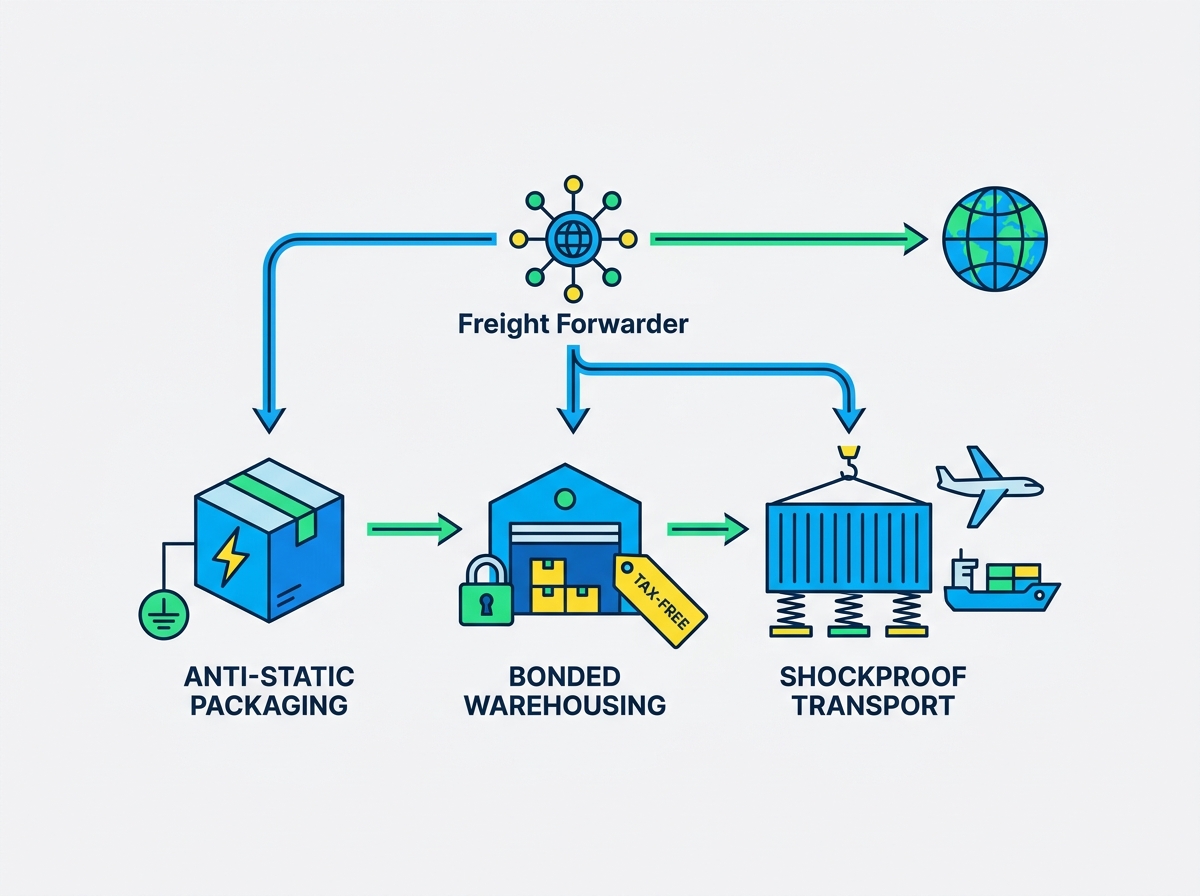
Anti-Static Packaging: A Non-Negotiable Engineering Standard
To neutralize the risks of stray voltage, specialized logistics engineers implement rigorous packaging protocols. Standard cardboard and conventional plastics are insulators that easily generate static charges. Therefore, they are entirely unsuitable for tech cargo.
The Science of Shielding Bags
It is a dangerous misconception that all pink plastic bags offer adequate protection. Standard dissipative bags merely prevent the buildup of static electricity from internal friction. They do not protect the contents from an external static strike. For high-value electronics, engineers specify metalized shielding bags. These feature a multi-layer construction comprising an inner static-dissipative polyethylene layer, a middle aluminum shield layer, and an outer polyester dielectric layer.
This construction creates a Faraday cage effect. It completely isolates the electronic component from external electrostatic fields, maintaining a surface resistance strictly between 10 to the 6th power and 10 to the 11th power ohms. Implementing proper anti-static packaging for electronics logistics is a fundamental requirement for maintaining component integrity across international borders.
Custom Corrugated Solutions for Circuit Boards
Flexible bags are often insufficient for large circuit boards due to the inherent risk of physical bending. In these scenarios, logistics providers employ custom-fitted corrugated boxes treated with a conductive carbon coating. These rigid containers safely dissipate any static charge away from the internal circuitry. By combining robust structural support with electrostatic dissipation, these custom boxes prevent both static buildup and physical flexing during turbulent transit.
Shockproof Solutions: Dispersing Kinetic Energy
While electrostatic packaging protects the micro-circuitry, shockproof solutions safeguard the physical architecture of the hardware. A competent logistics partner engineers the physical packaging to absorb and disperse kinetic energy long before it reaches the fragile product.
Core Comparison: Standard vs. Specialized Electronics Freight
| Logistics Feature | Standard Freight Forwarding | Specialized Electronics Logistics |
|---|---|---|
| Vibration Dampening | Basic bubble wrap and loose packing peanuts. | CNC-cut Expanded Polyethylene foams and anti-vibration pallet mounts. |
| Electrostatic Control | Standard cardboard boxes and stretch film. | Multi-layer Faraday cage bags and carbon-coated rigid containers. |
| Climate Management | Ambient dry containers subject to ocean temperature swings. | Active reefer containers maintaining 15 to 25 degrees Celsius with desiccants. |
| Handling Accountability | Standard fragile stickers. | Tilt indicators and ShockWatch sensors applied to every pallet. |
Advanced Cushioning Materials
Standard bubble wrap is woefully inadequate for heavy electronics. Instead, logistics experts utilize custom-molded Expanded Polyethylene and Ethylene Vinyl Acetate foams. Precisely cut using CNC machines to match the exact contours of the device, these closed-cell foams ensure zero internal movement. For larger infrastructure like server racks, heavy-duty anti-vibration mounts are deployed to absorb the low-frequency vibrations typical in long-haul ocean freight.
Climate and Moisture Control Engineering
Temperature fluctuations during transit frequently cause condensation inside shipping boxes. This phenomenon, often referred to as container rain, leads directly to short circuits and metal corrosion. To combat this maritime threat, electronics are vacuum-sealed in moisture-barrier bags alongside industrial-grade silica gel desiccants. Humidity indicator cards are included within the packaging to provide visual confirmation that internal humidity remained strictly below 40 percent throughout the journey.
Strategic Bonded Warehousing for Tech Brands
For supply chain executives, logistics is not merely about moving boxes from point A to point B. It is about optimizing cash flow and maintaining strict regulatory compliance. This is where strategic storage solutions become an invaluable corporate asset.
Tax Deferral and Cash Flow Optimization
Electronics are notoriously high-value items burdened with steep tariffs. By strategically utilizing bonded warehousing and labeling for electronics, tech brands can import massive bulk shipments into a target region and store them tax-free. Customs duties are only paid incrementally as individual units are sold and dispatched from the warehouse. This strategy prevents vital capital from being tied up in inventory taxes, allowing businesses to respond elastically to sudden shifts in market demand.
In-Warehouse Value-Added Services
Bonded facilities offer much more than static storage. Freight forwarders perform critical value-added services directly within the warehouse footprint. This includes compliance labeling, updating localized barcodes, and kitting localized power cables with motherboards. Performing these tasks in a secure, static-controlled environment ensures products are fully market-compliant before they cross the final customs border. This effectively eliminates the risk of port rejections or regulatory fines.
Multimodal Transport Coordination
Moving sensitive electronics across the globe requires a calculated balance between transit time, freight costs, and environmental control. An experienced logistics partner evaluates the entire lifecycle of the product to determine the optimal transport mode.
Balancing Speed and Thermal Dynamics
Air freight offers rapid transit times, making it the optimal choice for high-value consumer tech or critical semiconductor components during a shortage. However, ocean freight is highly cost-effective for bulk components. When ocean freight is selected, standard dry containers frequently fall short. Extreme temperature fluctuations on the open ocean can degrade lithium-ion batteries and warp plastic casings. Forwarders mitigate this risk by utilizing refrigerated containers configured to maintain a stable environment, ensuring the cargo is heavily insulated from the harsh maritime climate.
Executing Seamless Transitions
Global supply chains rarely rely on a single mode of transport. Effective air and sea cargo shipping coordination involves sophisticated multimodal logistics. This means seamlessly transitioning cargo from an ocean vessel to a rail network, and finally to a bonded warehouse via specialized air-ride trucking. The freight forwarder acts as the single point of contact, ensuring that the chain of custody and shockproof handling protocols remain completely unbroken during these highly vulnerable transfer points.
The Measurable ROI of Specialized Forwarding
Partnering with a generalist logistics provider for electronic goods often results in hidden costs and delayed shipments. Relying on specialized experts yields a measurable return on investment through proactive risk mitigation and operational efficiency.
The true cost of transit damage extends far beyond the manufacturing cost of the broken item. It encompasses reverse logistics shipping, repair labor, and severe damage to brand reputation. By enforcing strict engineering protocols, investing in electronics freight forwarding services drastically lowers Return Merchandise Authorization rates. This directly protects the manufacturer's bottom line.
Actionable Criteria for Choosing a Logistics Partner
Selecting a logistics partner for high-value technology components is a critical operational decision. Decision-makers must look beyond standard freight rates and rigorously assess the technical infrastructure of the provider.
- Verify Static Control Certifications: Do not accept verbal assurances. Require proof of ANSI/ESD S20.20 certification to guarantee proper static control during warehouse handling.
- Demand Quality Management Proof: Look for ISO 9001 certification for operational excellence and strict procedural adherence.
- Assess Security Infrastructure: Ensure the facility holds Transported Asset Protection Association certification. This indicates secure loading docks, continuous CCTV monitoring, and background-checked personnel to prevent cargo theft.
- Evaluate Bonded Capabilities: Ensure the provider operates heavily vetted bonded warehouses in key global tech hubs to execute tax-deferral strategies.
- Review Dangerous Goods Expertise: Request standard operating procedures for handling hazardous lithium batteries and clearing complex customs hurdles.
Final Thoughts on Supply Chain Resilience
Shipping sensitive electronics is an unforgiving endeavor. Success relies entirely on a strict, unyielding combination of anti-static packaging, shockproof engineering, and strategic bonded warehousing. The right freight forwarder acts as an extension of your engineering team, protecting your brand reputation and safeguarding your revenue. Select the right infrastructure for your supply chain by exploring specialized, compliance-driven solutions at JFSZ Logistics today.
Frequently Asked Questions
What does a specialized electronics freight forwarder do?
A specialized freight forwarder manages the entire supply chain specifically tailored for tech products. They handle complex multimodal routing, execute precise customs clearance, and ensure fragile goods are rigorously protected using specialized anti-static and shockproof packaging from the factory to the final destination.
Why is anti-static packaging for electronics logistics so important?
Electronic components are highly sensitive to Electrostatic Discharge. Specialized packaging creates a Faraday cage. This prevents invisible static electricity from permanently degrading or destroying the sensitive circuitry during transit.
What is the difference between anti-static and conductive packaging?
Anti-static packaging prevents the generation of static electricity from friction, usually through a dissipative coating. Conductive packaging, however, actively draws electric charge away from the component and provides a protective shield against external electrical fields. High-end electronics require a combination of both for total protection.
How do temperature fluctuations affect electronic shipments?
Rapid temperature changes cause condensation inside shipping containers. This moisture settles on bare circuit boards, leading to immediate short circuits or long-term metal corrosion. Furthermore, extreme heat can degrade lithium-ion battery chemistry and warp delicate plastic housings.
How does bonded warehousing save my business money?
Bonded warehousing allows you to store imported goods without immediately paying customs duties. You legally defer these taxes until the goods leave the facility for local delivery. This significantly improves operational cash flow.
Can a freight forwarder help with shipping lithium batteries?
Yes. Shipping electronics containing lithium batteries involves strict Dangerous Goods regulations. An experienced forwarder ensures proper shockproof packaging, applies mandatory certification labels, and maintains strict compliance with aviation and maritime codes to prevent hazardous incidents.
Related Blogs
-
 When production stops, every delivery day matters. Delayed components can disrupt schedules and customer commitments. Air freight from China offers a practical solution for urgent commercial shipments. However, choosing the right service requires careful planning. This guide compares standard, priority, and express shipping. You will also learn about flight schedules, customs clearance, and cargo preparation.
-
 Air freight from China offers speed, but costs can vary significantly. Do you know what determines your final shipping bill? This guide explains air freight cost from China, including per-kilogram rates, chargeable weight, surcharges, and destination fees. Learn how to estimate costs and reduce shipping expenses.
-
 Choosing the right shipping method can significantly affect your import costs. How do you select the best option for your cargo? China to Europe sea freight offers flexible FCL, LCL, and door-to-door solutions. This guide compares shipping options, transit times, costs, and customs requirements to help you make informed decisions.
