



Treating a warehouse as merely a static storage room exposes your supply chain to critical vulnerabilities. Global markets move incredibly fast today. Strict customs regulations and rising consumer expectations demand far more than traditional pallet storage. We have entered the era of dynamic fulfillment hubs. Modern logistics facilities now actively contribute to the product lifecycle. They handle everything from intricate assembly to stringent customs compliance.
Recent industry data reveals a massive shift in global logistics strategies. Supply chain disruptions have forced companies to rethink inventory management. Market analyses show a surge in demand for facilities equipped with automated sorting and integrated phytosanitary treatments. Shippers are no longer looking for mere square footage. They require processing centers that can instantly adapt to omnichannel fulfillment and tightening cross-border regulations. Integrating advanced processing tasks directly into your storage strategy streamlines daily operations. It ensures international regulatory compliance and maximizes the return on investment for import and export businesses.
The Shift to Value-Added Operations: Beyond Basic Storage
For decades, the standard warehousing model relied on a simplistic pallet-in, pallet-out approach. Goods were received, placed on a rack, and left untouched until a shipping order arrived. The complexities of modern e-commerce and global manufacturing have rendered this static model obsolete. Decision-makers need agile solutions. They need processes that add tangible value to the product before it ever reaches the loading dock.
Logistics experts note that modern facilities increasingly dedicate floor space to multi-functional processing zones rather than pure high-density storage racks. This shift allows brands to execute direct-to-consumer and wholesale orders from the exact same inventory pool. Picture a facility where inbound bulk materials are immediately broken down, repacked into retail-ready display units, and shipped out the same afternoon.
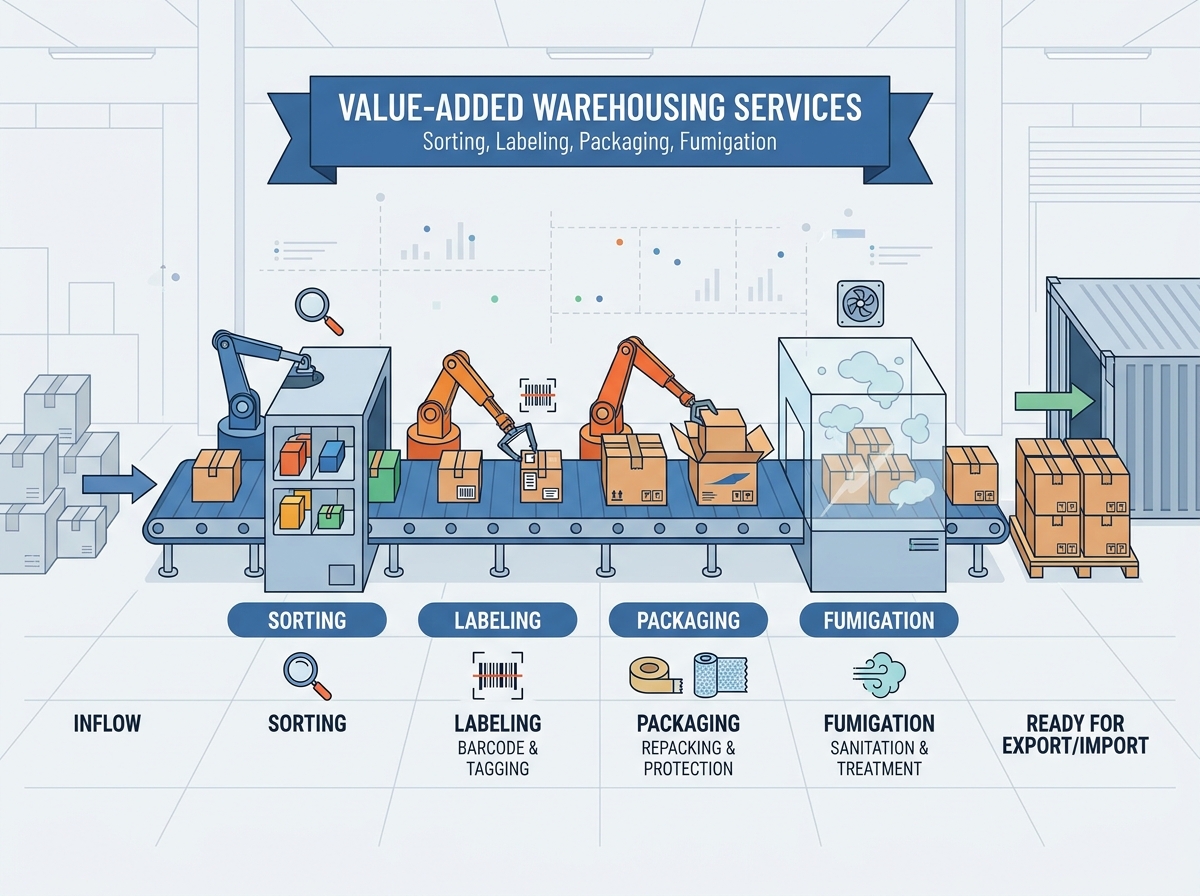
By implementing comprehensive value-added warehousing services, businesses bridge the gap between manufacturing and final delivery. Performing essential tasks directly within the storage facility reduces transit nodes. It minimizes the risk of product damage and accelerates speed-to-market.
Core Pillars of Modern Facility Processing
These operations encompass any activity enhancing a product's readiness for final distribution. Key functions include:
- Strategic sorting and inventory kitting.
- Precision labeling and barcoding.
- Custom packaging and volumetric optimization.
- Fumigation and international pest management.
- Rigorous quality control and compliance inspections.
Strategic Sorting: The Foundation of Supply Chain Visibility
Operational efficiency begins the exact moment a truck backs into the receiving dock. Advanced sorting techniques set the operational tone for the entire ecosystem. Meticulously categorizing inbound freight based on turnover rates significantly reduces operational friction.
When staff scan an inbound barcode, the Warehouse Management System instantly dictates the optimal storage zone. Fast-moving consumer goods go to rapid-pick aisles. Seasonal overstock heads to deep reserve. This real-time data alignment prevents costly stockouts and provides procurement teams with total inventory visibility.
A highly effective component here is inventory kitting. Floor workers no longer waste time traversing multiple aisles to pick individual components for a complex order. They pre-sort related items into ready-to-ship bundles. When an order drops, pickers simply grab a pre-assembled kit. This proactive step slashes fulfillment times and drastically cuts down on picking errors.
Comparing Traditional vs. Dynamic Fulfillment
| Operational Metric | Traditional Warehousing | Value-Added Warehousing |
|---|---|---|
| Inventory Handling | Static storage until dispatch | Active manipulation, kitting, and assembly |
| Space Utilization | Maximized for dense pallet racking | Optimized for processing and sorting zones |
| Compliance Readiness | Requires external third-party handling | In-house labeling, inspection, and fumigation |
| Order Fulfillment Speed | Slower due to separate picking steps | Rapid dispatch via pre-assembled kits |
Custom Packaging and Precision Labeling
In global freight, a label functions as a product's official passport. It serves as the critical data link between physical cargo and digital tracking networks. Accurate labeling ensures goods remain identifiable and fully compliant with destination market regulations. Missing allergen warnings or illegible expiration dates trigger immediate border quarantines. Advanced software automates these critical labels to ensure meticulous documentation.
Beyond tracking, packaging must optimize shipping economics. Major carriers aggressively penalize dead space through dimensional weight pricing models. Logistics providers leverage 3D cartonization software to match products with their optimal box size down to the millimeter. Eliminating excess volume translates directly to massive reductions in transportation expenditure.
Certain commodities demand specialized interventions. For perishable agricultural products and sensitive pharmaceuticals, warehouses frequently implement Modified Atmosphere Packaging. By altering the internal gaseous environment, facilities significantly extend shelf life and prevent microbial growth during long ocean transits.
Fumigation and Pest Management in Global Trade
International shipping introduces severe ecological risks. Transporting invasive pests across borders via wooden packaging is a threat that customs authorities take very seriously. Rigorous pest management becomes an absolute prerequisite for any export operation.
The legal framework governing this process is the ISPM-15 standard. It mandates that all solid wood packaging materials undergo specific heat or gas treatments. Treated materials then receive a recognized compliance stamp. Skipping this step carries heavy consequences. Non-compliant cargo faces immediate rejection, mandatory quarantine, or destruction at the port of entry.
Partnering with a facility that integrates warehouse sorting labeling packaging and fumigation into standard operating procedures eliminates these financial risks. Goods are treated and certified on-site before they ever reach the export vessel.
Expert Bonded Repacking and Quality Inspection
Managing cash flow while navigating complex tariffs challenges every international trader. Bonded warehouses provide a highly strategic solution. These secure facilities allow imported goods to be stored and processed without immediate duty payments. Financial liability is legally deferred until the merchandise officially enters the domestic market.
Leveraging a secure environment for bonded goods repacking and quality inspection offers a distinct commercial advantage. Consider an electronics importer receiving a bulk container. Within the bonded zone, workers break down pallets and test devices against strict quality limits. They replace damaged packaging and insert localized power adapters. Defective units are destroyed or re-exported before any tariffs apply. You only spend capital on pristine, market-ready goods.
Streamlining Import Export Clearance for Warehouse Cargo
A persistent vulnerability in global logistics is the disconnect between physical handling and administrative customs processing. When storage and customs brokerage operate in isolated silos, communication breaks down. This leads to stalled shipments, supply chain paralysis, and punitive carrier detention fees.
A unified logistics provider manages import export clearance for warehouse cargo systematically. Commercial invoices, packing lists, fumigation certificates, and tariff classifications are prepared alongside the physical sorting of the goods. Aligning facility readiness directly with customs documentation ensures a predictable, uninterrupted flow of inventory.
Practical Selection Guide: Outsourcing Your Operations
Attempting to manage complex value-added services internally often inflates capital expenditures. Purchasing automated labeling machines, maintaining software licenses, and training staff on changing phytosanitary regulations drains internal resources. Outsourcing fundamentally restructures your balance sheet. It converts rigid fixed costs into variable, volume-based expenses.
When selecting a logistics partner, look for specific operational parameters. A robust provider should offer real-time system integration, bonded storage capabilities, and certified fumigation zones on-site. They must demonstrate the ability to handle customized kitting for your specific industry sector. Choosing an all-in-one partner allows your business to redirect internal resources toward core product development and market expansion.
Frequently Asked Questions
What exactly are value-added warehousing services?
Value-added services go far beyond standard pallet storage. They include specialized hands-on activities like kitting, assembly, custom labeling, volumetric packaging, and quality control testing. These processes are designed to make products fully ready for final retail sale or international shipment directly from the warehouse floor.
Why is fumigation strictly necessary for international warehouse cargo?
Fumigation is mandated by international law under the ISPM-15 standard. It involves treating wooden packaging materials with heat or gas to prevent the spread of invasive insects across global borders. Without proper fumigation and the corresponding certification stamp, cargo faces immediate rejection and heavy fines at the destination port.
Can I manipulate or repackage goods inside a bonded warehouse?
Yes. Bonded facilities allow importers to legally manipulate, inspect, and repackage their inventory. You can break down bulk shipments, localize product manuals, or discard damaged items. The primary benefit is performing these tasks while deferring customs duties, providing significant cash flow flexibility.
How does dimensional weight pricing affect packaging strategies?
Carriers charge based on the volume a package takes up in a truck or plane, not just its actual weight. If you ship a small item in a large box filled with air, you pay for that empty space. Value-added warehousing uses 3D software to select the exact box size needed, eliminating dead space and drastically lowering shipping costs.
What is the core difference between bonded and non-bonded warehousing?
A non-bonded warehouse stores goods that have already cleared customs and had all duties paid. A bonded warehouse is a secure zone regulated by customs where imported goods can be stored, manipulated, and inspected before duties are paid. Duties are only collected when the goods leave the bonded facility to enter the local market.
Optimize Your Supply Chain Today
Stop letting inefficient storage drain your profit margins. Upgrading your logistics strategy requires a partner equipped with advanced processing capabilities and deep customs expertise. Evaluate your current fulfillment bottlenecks and explore tailored solutions designed to accelerate your global trade. Visit our comprehensive service portal to find the exact warehousing, freight forwarding, and customs clearance solutions that fit your business needs.
Related Blogs
-
 Door to door shipping from China simplifies international logistics. But how can you ensure smooth delivery from factory to destination? Choosing the right shipping method, preparing documents, and understanding customs responsibilities are essential. This guide explains each shipping step, compares sea, air, and express services, and clarifies DDP and DAP terms. Learn how to arrange reliable deliveries and avoid unexpected costs.
-
 When production stops, every delivery day matters. Delayed components can disrupt schedules and customer commitments. Air freight from China offers a practical solution for urgent commercial shipments. However, choosing the right service requires careful planning. This guide compares standard, priority, and express shipping. You will also learn about flight schedules, customs clearance, and cargo preparation.
-
 Air freight from China offers speed, but costs can vary significantly. Do you know what determines your final shipping bill? This guide explains air freight cost from China, including per-kilogram rates, chargeable weight, surcharges, and destination fees. Learn how to estimate costs and reduce shipping expenses.
