



Are unexpected customs fees ruining your global sales? Navigating the complexities of international trade often leaves businesses grappling with surprise costs and frustrated clients. Delivered Duty Paid shipping solves this exact friction by removing financial ambiguity at the border. While it presents the ultimate hassle-free solution for buyers, managing these intricate logistics is notoriously difficult for sellers who lack localized expertise.
In this comprehensive guide, you will learn precisely how this shipping model works, how it contrasts with other trade terms, and why mastering it is crucial for cross-border success. Furthermore, we will explore how partnering with an experienced logistics provider transforms a potential supply chain nightmare into a seamless competitive advantage.
Key Takeaways
- Maximum Seller Responsibility: Under these terms, the seller assumes all financial risks, transportation costs, and legal responsibilities until the merchandise arrives at the buyer's specified destination.
- Buyer Satisfaction: This model is highly attractive in B2B and e-commerce sectors because it provides a true landed cost, ensuring the buyer faces no unexpected customs bills upon delivery.
- The Core Difference: Unlike terms where the buyer handles import taxes, this framework requires the exporter to manage complex customs clearance and tax disbursements directly.
- The Role of a Freight Forwarder: Partnering with a logistics expert is non-negotiable. They provide the necessary infrastructure and local knowledge to prevent border rejections.
What is DDP Shipping?
Defining the Trade Term
Delivered Duty Paid is an internationally recognized trade standard published by the International Chamber of Commerce. In objective terms, it represents the maximum obligation for the seller and the minimum obligation for the buyer.
Specifically, when a contract dictates these terms, the vendor agrees to bear all costs and risks involved in bringing the cargo to the destination country. This comprehensive liability includes paying for the initial shipping, export duties, main carriage transit, import duties, and any applicable local taxes, such as Value Added Tax, before the freight is handed over. The buyer's only real obligation is to receive the inventory once it arrives at the agreed-upon location, such as a warehouse loading dock.
How It Differs from Standard Shipping
In contrast, standard shipping terms like Free on Board distribute the logistical and financial burdens between the buyer and the seller. Delivered Duty Paid fundamentally shifts this dynamic. It is not merely about moving physical boxes across borders; it involves strict financial and legal compliance within a foreign jurisdiction.
Under this structure, the seller essentially acts as the importer in the destination country. This requires a deep understanding of foreign customs regulations, tariff classifications, and tax structures. Ultimately, executing this shipment means providing a seamless international door-to-door freight forwarding experience for the end consumer, ensuring that the physical movement of goods is completely decoupled from the administrative burden of international trade.
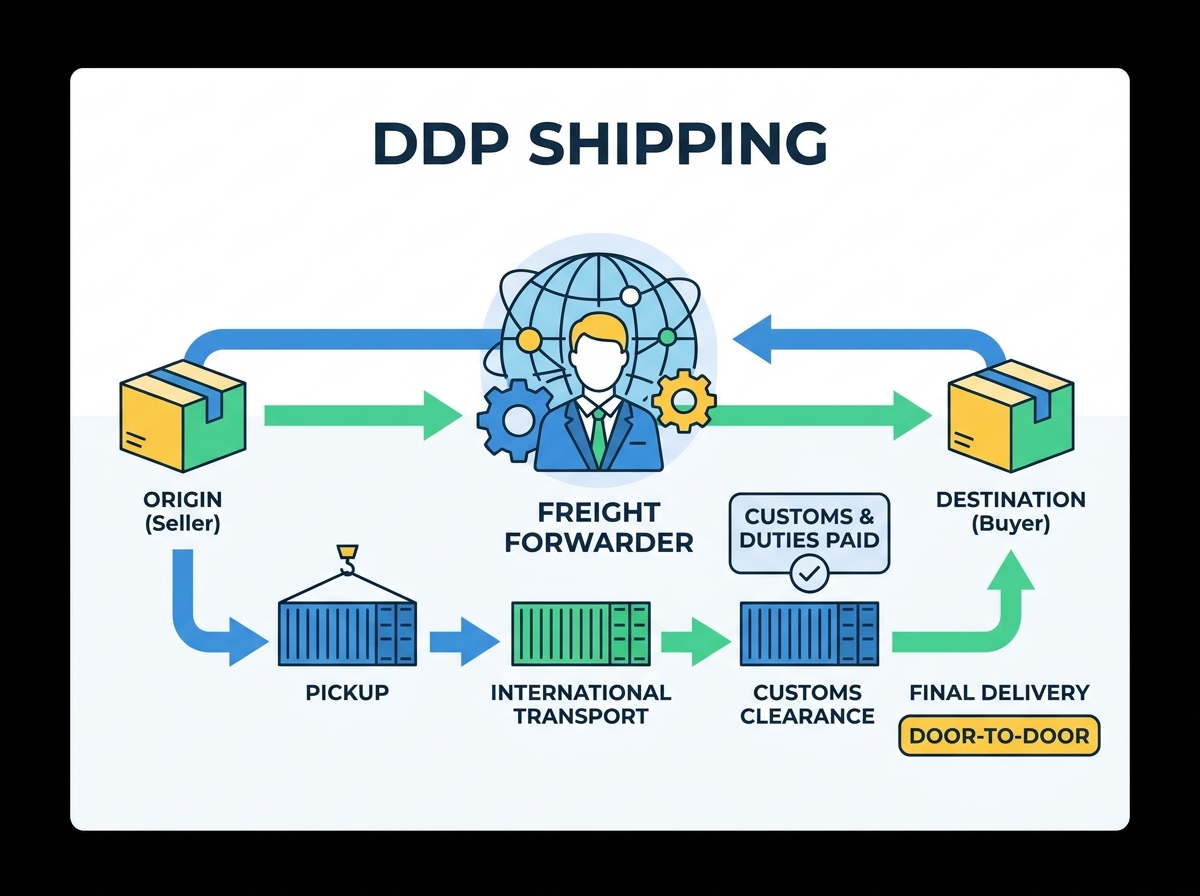
The Step-by-Step Process of Door-to-Door Shipping
Understanding the lifecycle of this shipment helps clarify why meticulous planning is required. As logistics architects, we break the journey down into four distinct phases. Each phase carries its own set of operational hurdles.
Origin Handling and Export Clearance
The logistical journey commences at the manufacturer's facility. The exporter is responsible for adequately packaging the goods to withstand turbulent ocean swells or air transit vibrations. Once securely packed, the logistics provider takes over to handle export documentation. This involves preparing the commercial invoice, finalizing the packing list, and securing any required export licenses. The cargo is then cleared through the origin country's customs and loaded onto the designated transport vessel, aircraft, or railcar.
Main Carriage Transit
This phase represents the primary transit leg. The seller absorbs all freight charges associated with moving the cargo from the origin port to the destination terminal. During this period, the vendor retains all risk of loss or damage. For instance, if a container is damaged in an air cargo hold during a severe storm, the financial liability rests entirely with the seller. This highlights the absolute necessity of comprehensive cargo insurance.
Destination Arrival and Import Customs
Widely considered the most critical and complex phase of the entire process, destination arrival introduces significant bureaucratic hurdles. Upon reaching the destination port, the goods must clear local customs. Because the term dictates duties are paid upfront, the seller must execute import customs brokerage and duty support through their logistics partner. The forwarder submits the necessary documentation to the destination country's customs authority, calculates the exact tariffs based on Harmonized System codes, and disburses funds to cover all duties and taxes on behalf of the exporter.
Final Mile Delivery
Once customs authorities release the freight, it is transferred from the port or bonded warehouse to a local regional carrier. The final mile delivery transports the goods directly to the buyer's facility, retail storefront, or residential address. Only when the merchandise is physically ready for unloading at this final destination does the risk finally transfer from the seller to the buyer.
Seller vs. Buyer Responsibilities
To fully grasp the mechanics of this trade term, it is helpful to clearly delineate the roles of both parties. The division of labor is heavily skewed, placing nearly all operational weight on the exporter.
| Logistical Phase | Seller's Responsibility | Buyer's Responsibility |
|---|---|---|
| Packaging & Labeling | Bears all costs and execution. | None. |
| Export Customs | Secures licenses and pays export fees. | None. |
| Main Freight Costs | Pays all ocean, air, or rail charges. | None. |
| Cargo Insurance | Bears the risk and arranges coverage. | None. |
| Import Customs | Manages clearance and tax payments. | Assists with documentation only if legally required. |
| Import Duties & Taxes | Pays all tariffs and local taxes. | None. |
| Final Delivery | Arranges transport to the final door. | Receives the goods. |
| Unloading | Delivers goods ready for unloading. | Physically unloads the goods. |
The Seller’s Obligations
The merchant's obligations are exhaustive and demand rigorous financial planning. They must calculate and absorb all transportation costs into their pricing model long before the transaction occurs. Assuming all risks during transit means any supply chain disruption directly impacts their bottom line. Furthermore, they must manage all export and import licenses, ensuring that the merchandise complies with the regulatory standards of the destination market. Most importantly, the seller is responsible for funding and executing all customs clearance and tax payment services, ensuring the government receives its due tariffs without bothering the end consumer.
The Buyer’s Obligations
Conversely, the buyer enjoys a largely passive role. Their primary obligation is simply to accept the delivery at the agreed-upon location. In some specific jurisdictions, local laws may require the buyer to provide a tax identification number or specific import permits. However, even in these rare regulatory instances, the seller is still responsible for covering any administrative costs associated with obtaining these documents.
Understanding the Key Trade Term Differences
In international trade, this maximum-liability term is frequently compared to terms where duties remain unpaid. Understanding the distinction is vital for optimizing supply chain strategies and maintaining healthy profit margins.
The Core Difference: Customs and Taxes
The fundamental difference lies in who interacts with destination customs authorities. In an unpaid duty shipment, the merchandise arrives at the border, and customs officials contact the buyer to demand payment for taxes. This creates a significant point of friction, particularly in e-commerce. If a consumer is unaware they owe import taxes, they may angrily refuse the package. This leads to shopping cart abandonment at the border, resulting in the goods being seized by customs or returned to the seller at an exorbitant cost. Paying duties in advance eliminates this friction entirely by settling all financial obligations beforehand.
Global Trade Trends Shaping Logistics Adoption
Recent shifts in global trade policies are fundamentally altering how cross-border transactions are structured. For instance, the tightening of European Union import regulations and heightened scrutiny on United States de minimis exemptions mean that border authorities are demanding stricter compliance and faster tax disbursements. Market data indicates a surging preference among major e-commerce platforms and B2B procurement portals for fully landed costs.
Buyers now demand absolute price certainty at checkout. Consequently, sellers who fail to offer transparent pricing are experiencing significant increases in cart abandonment rates. This shift makes paying duties upfront not just a logistical choice, but a critical competitive necessity. Shipping with duties unpaid is typically recommended only when delivering to countries with highly restrictive import laws where it is legally impossible for a non-resident foreign entity to pay local taxes.
The Pros and Cons for Global Commerce
Adopting this strategy requires a careful cost-benefit analysis, balancing customer satisfaction against operational complexity.
Advantages for Sellers
Buyers deeply appreciate pricing transparency. Ensuring there are no hidden fees or surprise invoices upon delivery fosters long-term brand loyalty. In addition, because duties are often handled swiftly by a dedicated logistics provider, goods spend significantly less time stalled at customs checkpoints. This results in faster transit times. For international merchants, offering a guaranteed landed cost at checkout has been empirically shown to boost overall sales conversions.
Disadvantages and Risks
Despite its benefits, this model carries notable risks. Sellers must possess the working capital to finance freight, duties, and taxes long before the goods are actually delivered and revenue is realized. Furthermore, accurately predicting duties across multiple countries is incredibly difficult. Miscalculations can severely erode profit margins. If a seller lacks proper customs support, minor paperwork errors can lead to cargo seizures, heavy demurrage fines, and severe delivery delays.
Why You Need Advanced Logistics Solutions
Given the legal and financial complexities involved, executing maximum-obligation shipments independently is highly impractical for most manufacturers and retailers. Partnering with a specialized logistics provider mitigates these cross-border risks through technical expertise and robust infrastructure.
Acting as Your Importer of Record
In many countries, customs authorities require an Importer of Record. This is a legally recognized entity responsible for ensuring the imported goods comply with local laws. For foreign sellers operating without a physical branch in the buyer's country, this presents a massive legal roadblock. A professional logistics partner resolves this by navigating these legalities, often utilizing their established local networks or third-party compliance services. This allows sellers to clear goods safely without needing to establish a physical corporate entity overseas.
Accurate Duty Calculation and Pre-clearance
Profitability relies entirely on accurate upfront forecasting. Logistics experts utilize advanced API integrations and deep regulatory knowledge to determine the exact Harmonized System codes for your specific products. For example, utilizing robust digital clearance networks can achieve up to 98 percent same-day release rates. This precise classification prevents sellers from undercharging buyers at checkout and protects them from retroactive fines imposed by aggressive customs auditors.
Optimizing Cash Flow with Bonded Facilities
For high-volume B2B sellers, advanced logistics strategies can drastically optimize cash flow. By utilizing end-to-end bonded forwarding and distribution, goods can be transported and stored securely in bonded warehouses within the destination country. In a legally recognized bonded facility, the payment of import duties and taxes is legally deferred. The vendor only pays these government fees when the goods are finally withdrawn from the warehouse for the final leg of delivery. This strategy allows sellers to position inventory geographically close to international buyers without tying up critical capital in premature tax payments.
How to Choose the Right Logistics Partner
The success of your shipping strategy is directly proportional to the operational competence of the selected logistics vendor. Instead of relying on superficial marketing claims, decision-makers must evaluate potential partners based on objective, actionable criteria.
Actionable Selection Criteria
When evaluating a potential partner for complex supply chain operations, rigorously assess the following standards:
- In-House Customs Brokerage: Ensure the provider does not outsource critical clearance steps. They should possess their own local licenses to guarantee rapid border processing.
- Transparent Landed Cost Engines: Demand digital tools that calculate precise tariffs and taxes upfront. Hidden surcharges indicate a severe lack of operational integrity.
- API Integration Capabilities: Prioritize technology that offers real-time tracking and connects seamlessly with your existing enterprise resource planning systems.
- Financial Deferment Accounts: Verify that the forwarder has established government duty deferment accounts to instantly disburse large-scale tax payments on your behalf.
Conclusion
While assuming maximum delivery responsibility undeniably places the heaviest logistical and financial burden on the seller, it remains the ultimate strategic tool for winning and retaining international customers. Modern buyers expect a frictionless delivery experience devoid of surprise tax bills or administrative headaches. Ultimately, your success in offering these terms depends entirely on the capabilities of your chosen logistics partner. They must execute customs clearance, tax disbursements, and multi-leg transport flawlessly.
If you are ready to eliminate border friction and protect your profit margins, contact our expert team at JFSZ Logistics today. Let us provide the comprehensive customs support, tailored product parameters, and seamless forwarding solutions your business needs to scale globally with absolute confidence.
Frequently Asked Questions
Who pays VAT in this shipping model?
The seller is strictly responsible for paying all Value Added Taxes, import duties, and local government levies. The buyer assumes zero financial responsibility for customs clearance or border taxes. The seller must meticulously factor these mandatory tax obligations into their initial product pricing strategy to maintain profitability and avoid unexpected financial losses.
Can a freight forwarder pay duties on my behalf?
Yes, a specialized logistics provider offers comprehensive customs brokerage support. They utilize their established local financial deferment accounts to pay destination customs authorities directly on your behalf. The provider then bills these exact duty and tax amounts back to the seller. This ensures seamless border transit without requiring the vendor to establish foreign bank accounts or legal entities.
Is this trade term the same as Door-to-Door shipping?
While these transactions usually result in a door-to-door delivery experience, the concepts are not legally interchangeable. Door-to-Door is a general logistics concept describing the physical movement of cargo from origin to destination. In contrast, the trade term is a legally binding framework established by the International Chamber of Commerce that specifically defines which party bears the financial costs, regulatory duties, and transit risks.
What happens if customs reject the shipment?
If customs authorities reject, delay, or seize a shipment under these terms, the seller bears the total financial loss. The exporter is legally responsible for resolving the compliance issue, paying any accumulated storage demurrage fines, or funding the return freight. This high-risk scenario underscores why securing highly competent customs professionals is a mandatory operational requirement for global trade.
Does the seller handle unloading at the destination?
No. According to standard international trade rules, the seller's obligation ends when the goods arrive at the named destination and are ready for unloading. The buyer is legally and financially responsible for the actual physical unloading process from the arriving delivery vehicle, unless a separate, explicit contractual agreement states otherwise.
Does this shipping method include cargo insurance?
Strictly speaking, standard rules do not legally obligate the seller to purchase cargo insurance. However, because the seller assumes one hundred percent of the risk during transit until the goods are delivered, purchasing comprehensive cargo insurance is an absolute operational necessity. Without it, the seller is fully liable for any loss, theft, or damage that occurs during the journey.
How do sellers calculate accurate landed costs?
Accurate calculation requires identifying the precise Harmonized System code for the product, determining the destination country's specific tariff rate, and adding applicable local taxes like Value Added Tax. Because these rates fluctuate based on trade agreements and local laws, professional sellers rely on advanced logistics partners equipped with digital landed cost calculators and API integrations to automate and guarantee pricing accuracy before shipping.
Related Blogs
-
 Door to door shipping from China simplifies international logistics. But how can you ensure smooth delivery from factory to destination? Choosing the right shipping method, preparing documents, and understanding customs responsibilities are essential. This guide explains each shipping step, compares sea, air, and express services, and clarifies DDP and DAP terms. Learn how to arrange reliable deliveries and avoid unexpected costs.
-
 When production stops, every delivery day matters. Delayed components can disrupt schedules and customer commitments. Air freight from China offers a practical solution for urgent commercial shipments. However, choosing the right service requires careful planning. This guide compares standard, priority, and express shipping. You will also learn about flight schedules, customs clearance, and cargo preparation.
-
 Air freight from China offers speed, but costs can vary significantly. Do you know what determines your final shipping bill? This guide explains air freight cost from China, including per-kilogram rates, chargeable weight, surcharges, and destination fees. Learn how to estimate costs and reduce shipping expenses.
