



Are skyrocketing shipping costs and unpredictable carrier rates draining your profit margins? For many supply chain managers, moving small batches of goods independently feels like a necessary evil. Shipping Less-than-Container Load, or LCL, on an ad-hoc basis is highly expensive. It often eats into the very profits those goods are meant to generate. How can you break this cycle?
There is a structural solution to this logistical bottleneck. By leveraging professional warehousing hubs, businesses can bundle smaller shipments into full, optimized loads. This strategy of cargo consolidation and deconsolidation slashes transportation expenses. Furthermore, it minimizes transit risks and boosts overall supply chain efficiency. In this technical guide, we will break down the exact mechanics of freight optimization and how you can implement it to protect your bottom line.
Key Takeaways for Supply Chain Optimization
- Massive Cost Reductions: Combining smaller shipments into full containers significantly lowers per-unit shipping costs by sharing overhead and fuel surcharges.
- The Power of Warehousing: Strategic facilities act as the essential hub for sorting, storing, and seamlessly routing grouped freight using advanced WMS technology.
- Risk Mitigation: Fewer manual handling touchpoints during transit naturally result in historically lower risks of cargo damage and loss.
- Eco-Friendly Logistics: Optimized container loads reduce empty miles and lower your supply chain overall carbon footprint.
- Specialized Solutions: Advanced operational frameworks offer tailored financial benefits for global traders looking to defer taxes or speed up transit.
Understanding the Mechanics: Freight Manipulation Explained
For logistics directors aiming to optimize their budgets, grasping the precise mechanics of freight manipulation is the foundational step. This approach is not merely about putting boxes together. It is a highly orchestrated method of moving goods efficiently across complex global networks.
Recent industry analyses reveal a structural shift in global supply chains. Following recent geopolitical disruptions in major shipping lanes and ongoing capacity constraints, freight rates have experienced severe volatility. Consequently, modern logistics engineers are aggressively pivoting away from reactive, ad-hoc shipping. Current market trends indicate a sharp surge in demand for shared freight networks. Companies are prioritizing volumetric load optimization to stabilize budgets against unpredictable market shocks.
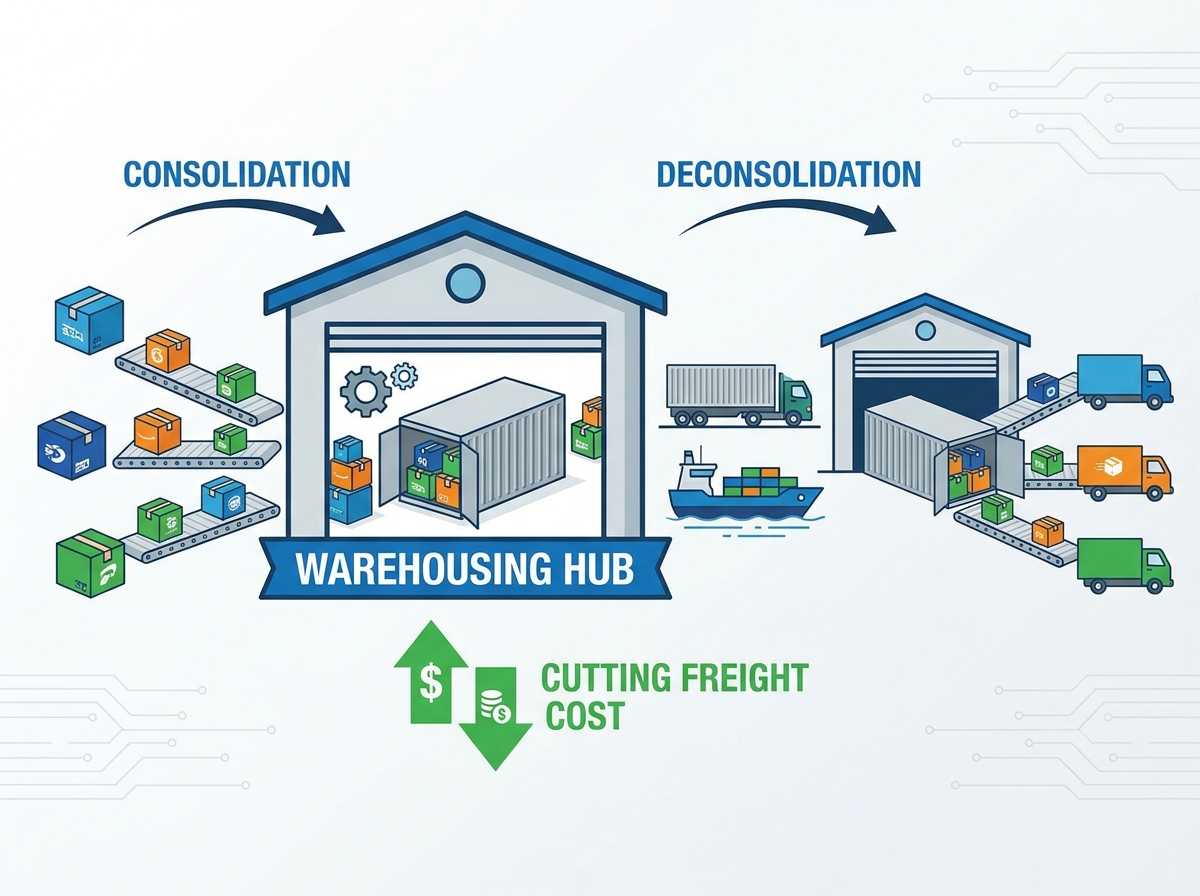
In essence, consolidation is the logistical process of merging multiple smaller shipments into a single, larger container load. Imagine a mid-sized electronics retailer waiting for components from three different factories in Shenzhen. Instead of shipping three fragmented consignments independently and paying premium rates for each, a logistics provider groups these goods. Because they are heading to the same geographical destination, they are transformed into one Full Container Load, maximizing cubic meter space and operational efficiency.
Conversely, deconsolidation is the exact reverse operation. Once the fully loaded container reaches its destination port or a regional distribution center, the bulk load must be dismantled. Facility operators carefully open the container, separate the grouped merchandise, sort the pallets by their final delivery addresses, and dispatch them onto individual local trucks. This crucial step bridges the gap between international ocean freight and final-mile delivery.
How Freight Consolidation Directly Cuts Costs
The financial mechanics behind this shift are straightforward yet powerful. When shipping internationally, purchasing an entire 40HQ container for a small volume of goods means you are essentially paying to ship empty air. Relying on standard parcel networks incurs exorbitant premium rates.
By utilizing LCL ocean freight consolidation, businesses pay strictly for the exact volume and weight their cargo occupies inside a shared container. Splitting the overhead costs among multiple shippers forces the per-unit transportation cost to drop dramatically. These shared expenses include fuel surcharges, chassis fees, and peak season ocean rates.
Furthermore, freight expenditures extend far beyond the physical movement of a vessel. Administrative and accessorial fees routinely inflate logistics budgets. When shipments are bundled, they move under a single master bill of lading rather than dozens of individual house bills. This paperwork reduction directly lowers customs entry processing charges, documentation fees, and port handling tariffs. Grouped loads also minimize the risk of incurring chassis split fees or paying for multiple, separate dock appointments.
The Crucial Role of Warehousing Infrastructure
In modern supply chain engineering, physical storage locations are no longer static cost centers. Instead, they function as dynamic, value-adding nodes that actively optimize the flow of inventory. Professional facilities form the structural backbone of any successful freight bundling strategy.
The internal operations of a consolidation facility require precise choreography. When multiple suppliers dispatch their partial shipments, these goods converge at a central hub. Here, expert warehouse consolidation services take over. The standard procedure begins with meticulous receiving protocols via barcode scanning, followed by immediate quality assurance checks to intercept damaged items before loading.
Once cleared, the inventory is sorted based on final destination, temperature requirements, and material compatibility. Heavy industrial parts, for instance, are palletized and strictly segregated from fragile consumer electronics. The final maneuver involves strategic container stuffing. Warehouse engineers calculate optimal weight distribution and volumetric efficiency to utilize every available cubic meter, ensuring cargo stability during rough ocean transits.
Advanced Financial Strategies: Customs and Tax Deferral
For international traders managing complex cross-border supply chains, standard storage is frequently insufficient. Integrating bonded cargo shipment consolidation becomes a critical financial lever. A bonded warehouse is a highly secure, customs-regulated environment where imported goods can be stored, manipulated, and grouped without the immediate payment of heavy duties and local taxes.
Specifically, utilizing these regulated facilities drastically improves cash flow. Duties are legally deferred until the exact moment the cargo is deconsolidated and officially enters the domestic market. If the grouped goods are intended for re-export to a third country, the shipper might bypass local duties entirely. This prevents working capital from being tied up in premature tax liabilities.
Weighing the Operational Pros and Cons
Decision-makers must approach logistics strategies with a balanced, engineering mindset. While bundling shipments offers undeniable financial advantages, evaluating objective merits against potential operational limitations is essential for sound supply chain planning.
The most prominent benefit is the substantial reduction in capital expenditure. By sharing space, shippers democratize access to premium shipping rates. Established consolidation programs also offer highly predictable shipping schedules. Shippers can align their factory production schedules with guaranteed weekly departures, smoothing out inventory flow.
In contrast, the primary drawback is the potential for increased transit times. Waiting for a container to reach maximum capacity at the origin warehouse can add days to the lead time. However, this risk is highly mitigable through vendor selection. By partnering with a high-volume logistics provider, the waiting period is practically eliminated. Large-scale forwarders process massive quantities of freight daily, ensuring that shared containers are filled and dispatched with high frequency.
| Shipping Model | Cost Efficiency | Transit Speed | Risk of Damage |
|---|---|---|---|
| Traditional Fragmented LCL | Low - High per-unit cost | Moderate | Higher - Multiple handling points |
| FCL with Empty Space | Very Low - Paying for air | Fast | Low |
| Optimized Consolidated Freight | High - Shared overhead costs | Moderate to Fast | Low - Secured at origin hub |
Minimizing Transport Risk and Enhancing ESG Compliance
Cargo safety remains a paramount concern. Damaged goods result in direct financial losses through complicated insurance claims and cause severe disruptions to customer satisfaction. Strategic consolidation inherently addresses these vulnerabilities by fundamentally altering how goods are physically handled.
In logistics engineering, risk is mathematically tied to the number of touchpoints. A touchpoint is every instance a pallet is lifted, shifted, or transferred by a forklift. Traditional shipping involves numerous touchpoints as cargo bounces between various regional hubs. The consolidation process intentionally minimizes these interactions. Once your goods are securely palletized and loaded into the shared container at the origin warehouse, the heavy steel doors are sealed. That specific cargo is not physically touched again until the seal is broken at the destination facility.
Additionally, optimizing your freight routing is an immediate, measurable way to reduce your ecological footprint. Shipping three partially empty containers requires the same amount of fossil fuel as shipping three completely full ones. By centralizing goods at strategic hubs and planning outbound routes based on dense volumes, logistics providers ensure that transport vehicles operate at peak capacity. This decreases empty miles and fosters a highly sustainable global transit loop.
Choosing the Right Partner for Consolidation Solutions
Recognizing the theoretical value of freight optimization is only the beginning. Executing it flawlessly requires a highly competent logistical partner. The effectiveness of your supply chain is directly proportional to the capabilities of the freight forwarder you select.
Your chosen partner must operate a robust network of warehouses at both the origin and destination ports. Ensure they possess high-density networks specifically in the geographical corridors where you manufacture and sell. Furthermore, decision-makers must demand advanced technology integration. Look for real-time tracking software, Electronic Data Interchange capabilities, and cloud-based Warehouse Management Systems. You must retain the ability to log into a portal and see exactly when your shipment was received, loaded, and its current coordinates.
Mastering this logistics strategy is a fundamental necessity for survival in today high-cost shipping environment. By transitioning away from fragmented shipments and embracing shared freight networks, companies can drastically cut transportation costs and minimize cargo damage. Ready to streamline your supply chain? Evaluate your current shipping volumes and explore comprehensive, tailored solutions at JFSZ Logistics to optimize your operations today.
What is the main difference between consolidation and deconsolidation?
Consolidation is the process of bundling multiple smaller shipments into one large, full-container load at the point of origin to maximize space and reduce costs. Deconsolidation is the exact reverse process. It occurs at the destination port or warehouse, where the large container is opened, and the bulk load is broken back down into individual shipments for final-mile delivery to separate addresses.
How do warehousing services impact the cost of consolidation?
Efficient warehousing facilities act as the operational engine for this process. By streamlining the receiving, sorting, and loading processes using advanced management systems, these facilities reduce manual labor costs and minimize the time cargo spends sitting idle. This prevents costly long-term storage fees and avoids demurrage charges at the port.
How is consolidated freight pricing actually calculated?
Pricing is typically calculated based on the cargo weight or volume, whichever is greater. Logistics providers use a metric known as Weight/Measure or CBM, which stands for Cubic Meters. You are charged a pro-rated amount for the exact space your goods occupy inside the shared container, plus a proportional share of origin and destination handling fees.
What documents are required for shipping consolidated cargo?
The primary document is the House Bill of Lading, issued by the freight forwarder to the individual shipper. The forwarder then consolidates all House Bills into one Master Bill of Lading for the ocean carrier. You will also need standard commercial invoices, packing lists, and any specific customs declarations required by the importing and exporting countries.
Will cargo consolidation delay my shipping times?
It can occasionally add a few days to the initial timeline due to the meticulous sorting process and waiting for a container to reach full volumetric capacity. However, working with a reputable, high-volume logistics partner ensures that containers are filled and dispatched rapidly, maintaining predictable and reliable lead times.
Related Blogs
-
 Door to door shipping from China simplifies international logistics. But how can you ensure smooth delivery from factory to destination? Choosing the right shipping method, preparing documents, and understanding customs responsibilities are essential. This guide explains each shipping step, compares sea, air, and express services, and clarifies DDP and DAP terms. Learn how to arrange reliable deliveries and avoid unexpected costs.
-
 When production stops, every delivery day matters. Delayed components can disrupt schedules and customer commitments. Air freight from China offers a practical solution for urgent commercial shipments. However, choosing the right service requires careful planning. This guide compares standard, priority, and express shipping. You will also learn about flight schedules, customs clearance, and cargo preparation.
-
 Air freight from China offers speed, but costs can vary significantly. Do you know what determines your final shipping bill? This guide explains air freight cost from China, including per-kilogram rates, chargeable weight, surcharges, and destination fees. Learn how to estimate costs and reduce shipping expenses.
