



Are delayed tax rebates suffocating your cash flow? Many exporters wrestle with sluggish refunds and messy material reconciliation. Bonded zone transit delivers a legal, high-speed solution to these bottlenecks. By shifting the regulatory boundary, you expedite financial returns safely. Proper compliance remains intact.
Key Takeaways
- Accelerated Cash Flow: Moving commercial goods into a designated special economic area triggers an export status immediately. This statutory framework allows businesses to claim VAT refunds weeks or even months before the cargo physically departs the country.
- Simplified Compliance: Utilizing professional trade compliance specialists ensures accurate material reconciliation. This systematically prevents costly regulatory audits and financial penalties.
- Strategic Warehousing: Leveraging bonded logistics allows trading companies to execute flexible cargo consolidation, customized packaging, and highly efficient global distribution.
- Professional Support is Non-Negotiable: Engaging specialized processing support through a licensed broker eliminates critical paperwork discrepancies and fast-tracks government approvals.
Global Supply Chain Shifts and Industry Trends
Recent shifts in global B2B trade reveal a massive pivot toward near-shoring and specialized warehousing. Supply chain managers no longer view special economic zones merely as tax deferral tools. Instead, they act as proactive buffers against port congestion and geopolitical shocks. Decoupling the legal export process from physical shipping timelines allows enterprises to maintain liquidity. This agility proves critical when ocean freight capacities tighten unexpectedly. By integrating bonded transit into their standard operating procedures, forward-thinking manufacturers insulate their cash flow from unpredictable logistics disruptions.
Understanding the Mechanics of Bonded Zone Transit
The Legal Definition of a Bonded Zone
What exactly is a bonded zone? In international B2B supply chains, it is a highly regulated special economic area. Its defining legal framework dictates operation within the national territory but outside customs territory. Customs authorities treat the facility as a foreign entity for tax purposes. When domestic goods cross the physical gate into this specific zone, they achieve legal export status. Conversely, foreign goods entering the zone avoid standard import duties and value-added taxes until they cross out of the zone and into the domestic market.
How Bonded Transit Actually Works
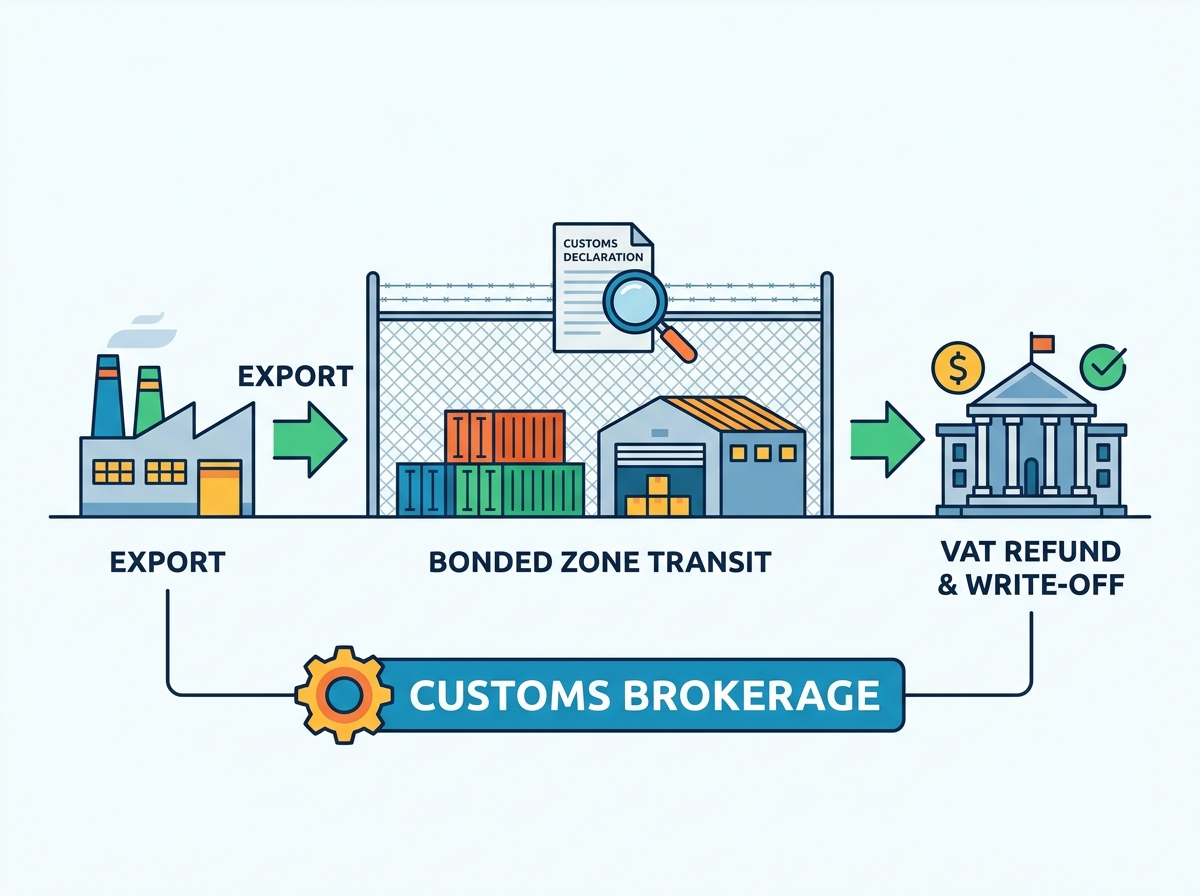
Bonded transit refers to the logistical and documentary process of moving goods from a domestic manufacturing facility into a bonded warehouse. Global supply chain managers favor this specific transit movement because it separates the legal act of exporting from the physical act of international shipping. Picture a loaded truck departing a manufacturing facility in the early hours, heading straight for the bonded zone gates. The physical flow is straightforward. However, the documentary trail running parallel is incredibly intricate. It demands submitting a pre-declaration to customs, verifying the cargo upon entry, and generating an official entry receipt.
The Vital Role of Export Brokerage in Trade
Bridging the Gap Between Logistics and Compliance
Navigating the regulatory environment of special economic zones demands highly specialized knowledge. This is precisely why utilizing professional customs brokerage for export trade forms the operational backbone of bonded zone logistics. A licensed broker acts as the critical liaison between the manufacturing exporter, the warehouse operator, and the national customs administration. Furthermore, they translate complex logistical movements into standardized data formats required by regulatory bodies. Commercial invoices, packing lists, and waybills must align perfectly with statutory requirements.
Risk Mitigation and Legal Protection
Handling bonded declarations without specialized support introduces severe operational risks. Authorities monitor these areas with intense scrutiny because they directly impact national tax revenues. Common risks include misclassified Harmonized System codes, incorrect cargo valuations, and mismatched weight declarations. Such errors trigger immediate shipment seizures, the suspension of export privileges, or severe financial penalties. An expert broker mitigates these risks by conducting rigorous pre-declaration audits. Every data point submitted becomes defensible, accurate, and fully compliant.
Achieving Faster VAT Refunds with Strategic Transit
The Entering the Zone Equals Export Rule
The most lucrative financial benefit of bonded transit is working capital acceleration. Under standard procedures, a manufacturer must wait for their cargo to load onto an international vessel. The shipping line must issue an onboard Bill of Lading before anyone applies for a rebate. During port congestion, this waiting period stretches into months. In contrast, the entering the zone equals export rule fundamentally rewrites this timeline. The moment domestic goods cross the gate and the system registers the entry, they achieve legal export status. Consequently, the financial department initiates the VAT refund process weeks before the goods actually leave the country.
Leveraging Export Tax Rebate Processing Support
Securing a rapid VAT refund demands flawless documentation. The tax bureau mandates a precise matching of commercial invoices, packing lists, domestic purchase VAT invoices, and declaration forms. By utilizing dedicated export tax rebate processing support from an experienced broker, businesses ensure seamless filings. Brokers deploy automated reconciliation systems to verify that quantities and values on the declaration perfectly match domestic tax invoices. This proactive data alignment fast-tracks the government approval process and optimizes corporate cash flow.
Navigating Customs Write-off for Processing Trade
What is a Customs Write-off?
For manufacturers engaged in processing trade, importing raw materials to manufacture goods for export, the customs write-off is a mandatory compliance procedure. Under this model, manufacturers import raw materials duty-free and VAT-free. These materials must strictly produce goods for international markets. Customs issues an imported material handbook or electronic ledger to track this inventory. The write-off process formally reconciles this ledger. The manufacturer must mathematically prove that the exact quantity of duty-free raw materials imported was consumed to produce the exported finished goods.
How Bonded Zones Simplify the Write-off Process
In traditional logistics, a factory cannot close its handbook until finished goods physically depart the national seaport. Imagine a scenario where a foreign buyer delays a shipment. The factory ledger remains stubbornly open, tying up bonded quotas and subjecting the business to prolonged, stressful customs supervision. Transiting finished goods into a bonded zone provides an immediate escape route. Entering the zone legally constitutes an export. The factory immediately applies to close and write off their ledger. This instantly frees up import quotas and removes the administrative burden of ongoing supervision.
Mastering Bonded Zone Declarations
Standard vs. Bonded Zone Declarations
Filing a bonded zone customs declaration differs fundamentally from a standard export clearance. While standard declarations primarily focus on border security and basic export statistics, bonded declarations face heavy scrutiny for tax implications and strict inventory control.
| Feature | Standard Export Declaration | Bonded Zone Declaration |
|---|---|---|
| Point of Export | Physical border Seaport or Airport. | Gate of the bonded warehouse or zone. |
| Tax Rebate Timing | After vessel departure and manifest confirmation. | Immediately upon goods entering the bonded zone. |
| Regulatory Scrutiny | Focus on export restrictions and security. | Intense focus on Harmonized System code matching and material quotas. |
Step-by-Step Bonded Zone Customs Declaration Process
Because the zone operates as an isolated inventory system, the customs declaration must precisely match the warehouse management system of the receiving facility. Mastering this process requires a systematic approach.
First, during pre-declaration preparation, the broker collects the commercial invoice and logistics waybill. They verify the Harmonized System codes against the zone permitted entry list. Next, the data enters the national Single Window system. The Trade Mode code demands special attention here. Once submitted electronically, the system cross-references the data with the warehouse pre-arrival notification. If selected, officers physically inspect the cargo at the gate. Finally, upon successful entry, the system generates the critical Export Declaration Form for Tax Rebate. The financial team receives this document immediately.
Optimizing Logistics and Warehousing Strategies
Consolidation and Value-Added Services
Savvy supply chain managers deploy export tax rebate logistics in bonded zones as a strategic warehousing solution rather than merely a tax compliance tool. Buyer consolidation represents a primary application. Instead of shipping five less-than-container-load shipments from different suppliers, all suppliers send their goods into the zone. Each supplier immediately secures their export status and applies for their respective VAT refunds. Meanwhile, the logistics provider consolidates the goods into a single full container load. This drastically reduces international ocean freight costs while permitting value-added services like relabeling and quality inspections.
Cross-Border E-commerce and Bonded Warehousing
The explosion of cross-border e-commerce elevates the importance of bonded logistics further. Large merchants bulk-ship their inventory from domestic factories into a bonded warehouse. This bulk transit triggers the upfront VAT refund, providing a massive cash injection. The inventory remains safely stored inside the zone, positioned close to international distribution hubs. Facilities dispatch the goods piecemeal via international parcels as overseas online orders roll in.
Common Pitfalls and Preventative Engineering
Data Discrepancies
Data discrepancy remains the most frequent cause of failed VAT refunds and rejected write-offs. Customs systems are highly automated and notoriously unforgiving. For instance, if the gross weight listed on the trucker logistics waybill reads 5,000 kg, but the customs declaration registers 4,950 kg due to a minor packaging miscalculation, the system instantly flags the shipment. A professional broker prevents this nightmare. They utilize automated data-scrubbing software that cross-checks all documentation before submission. Absolute alignment across all regulatory platforms is guaranteed.
Delayed Filing Deadlines
Tax authorities impose strict statutory deadlines for applying for VAT refunds after the declaration is issued. Furthermore, processing trade handbooks carry strict expiration dates. Supply chain disruptions or simple administrative oversights easily cause a company to miss these filing windows. This results in the permanent forfeiture of the tax rebate. Expert brokerage firms utilize automated compliance tracking systems. These systems monitor deadlines and send proactive alerts to financial teams to guarantee timely submissions.
Actionable Selection Guide: Choosing Your Compliance Partner
Key Technical Capabilities to Demand
Executing bonded zone transit is a high-stakes operation where the margin for error is virtually zero. Selecting the right logistics and compliance partner safeguards your supply chain. Decision-makers must evaluate potential brokers based on strict technical criteria.
First, look for Authorized Economic Operator Certification. This internationally recognized mark indicates highly efficient and secure customs procedures. Second, demand deep expertise specifically in bonded zone regulations, not just standard port clearances. Finally, prioritize partners with an integrated service infrastructure. They must handle the physical trucking, the warehouse management system, and the complex tax rebate paperwork seamlessly under one roof. Comprehensive customs clearance services ensure your documentation matches regulatory standards perfectly. Reliable freight forwarding capabilities guarantee that once goods clear the bonded zone, they secure priority vessel space for global distribution.
Conclusion and Next Steps
Bonded zone transit serves as a powerful financial instrument. It transforms regulatory compliance into a distinct cash-flow advantage. However, these customs rules are incredibly intricate. Attempting to navigate them without professional assistance poses a substantial risk. Minor data errors quickly snowball into severe financial penalties and locked supply chains.
To streamline your logistics and unlock faster tax rebates safely, consulting an experienced brokerage partner is imperative. They audit your exports and execute flawlessly on your behalf. Ready to optimize your cash flow and eliminate compliance bottlenecks? Explore the professional customs brokerage and freight forwarding solutions at JFSZ Logistics to secure your supply chain today.
FAQ Frequently Asked Questions
What is the difference between a standard export and bonded zone transit?
A standard export requires goods to physically leave the country borders via a seaport or international airport before customs officially classifies them as exported. This traditional route forces businesses to wait for vessel departure before applying for tax benefits. Bonded zone transit legally classifies the goods as exported the exact moment they enter a designated special economic zone. This allows manufacturers to initiate immediate VAT refunds and customs write-offs without waiting for international shipping schedules.
Can bonded zone transit help mitigate supply chain delays?
Absolutely. Global shipping often faces unpredictable port congestion, vessel delays, and equipment shortages. By moving goods into a bonded zone, you legally complete the export process and secure your tax rebates regardless of ocean freight schedules. Your cargo rests safely in a designated warehouse until shipping capacity becomes available, shielding your cash flow from logistical bottlenecks.
What specific documents are required to secure a bonded zone VAT refund?
Securing your refund requires absolute data consistency across multiple documents. The core requirements include the commercial invoice, detailed packing list, domestic purchase VAT invoices, logistics waybills, and the official Export Declaration Form for Tax Rebate generated by the customs system. Any slight mismatch in weight, value, or Harmonized System codes among these documents will trigger automatic rejections.
How long does the export tax rebate process take when using a bonded zone?
The timeline shrinks drastically compared to standard exports. With proper processing support from an experienced broker, businesses obtain the required declaration form within 24 to 48 hours of the cargo entering the zone. In many jurisdictions, this cuts the traditional multi-month waiting period associated with standard ocean freight down to just a few weeks.
Why is a specialized customs broker necessary for bonded zone customs declarations?
Bonded zones operate under a unique set of customs regulations often described as inside the border but outside customs. A specialized broker ensures exact Harmonized System code matching, accurate commercial valuation, and flawless reconciliation of processing trade handbooks. General freight forwarders often lack the specialized software and regulatory knowledge required to prevent data mismatches at the bonded zone gates.
What happens if my customs write-off fails?
A failed customs write-off is a severe compliance violation. If a business fails to accurately reconcile its imported bonded raw materials with its exported finished goods, authorities flag the account. Consequences include the freezing of corporate import and export privileges, heavy administrative fines, and retroactive charges for standard import duties and VAT on all previously imported raw materials.
Can individuals or tourists use bonded zones for travel VAT refunds?
No. Bonded zone transit is strictly a B2B commercial logistics process designed for manufacturers, exporters, and trading companies handling bulk freight. It operates strictly under commercial trade laws. Individual travelers looking for a VAT refund on personal shopping must process this at the designated customs desk at the airport before their departure flight.
Related Blogs
-
 Door to door shipping from China simplifies international logistics. But how can you ensure smooth delivery from factory to destination? Choosing the right shipping method, preparing documents, and understanding customs responsibilities are essential. This guide explains each shipping step, compares sea, air, and express services, and clarifies DDP and DAP terms. Learn how to arrange reliable deliveries and avoid unexpected costs.
-
 When production stops, every delivery day matters. Delayed components can disrupt schedules and customer commitments. Air freight from China offers a practical solution for urgent commercial shipments. However, choosing the right service requires careful planning. This guide compares standard, priority, and express shipping. You will also learn about flight schedules, customs clearance, and cargo preparation.
-
 Air freight from China offers speed, but costs can vary significantly. Do you know what determines your final shipping bill? This guide explains air freight cost from China, including per-kilogram rates, chargeable weight, surcharges, and destination fees. Learn how to estimate costs and reduce shipping expenses.
