



Are high tariffs hurting your global supply chain? Global trade is becoming increasingly complex. Optimizing your logistics network is no longer just about finding the cheapest shipping routes. It requires strategic storage and intelligent manufacturing. Many companies confuse Export Processing Zones with Bonded Zones. This critical mistake frequently causes severe delays, hidden storage fees, and massive compliance penalties.
Understanding the precise distinction between these two special customs areas is essential. It reduces overhead costs and improves lead times. In this comprehensive guide, we break down their key differences. We explore their unique cost implications and demonstrate how choosing the right logistics strategy insulates your business from unpredictable trade shifts.
Key Takeaways for Supply Chain Executives
- Primary Function: Export Processing Zones are primarily engineered for manufacturing, assembling, and processing raw materials into finished goods for export. In contrast, Bonded Zones focus strictly on duty-deferred storage, distribution, and minor manipulation.
- Time Limits: Bonded facilities operate under strict statutory time limits for storage. These limits often range from one to five years depending on local customs regulations. Export Processing Zones generally offer indefinite operational timeframes for established manufacturing entities.
- Cost Efficiency: Both areas offer robust tax and duty deferral benefits. The correct choice depends entirely on whether your inventory requires substantial value-added processing before sale or simply secure warehousing while awaiting domestic market demand.
- Expert Guidance: Navigating complex customs compliance requires the strategic oversight of an experienced logistics partner. This mitigates regulatory risks, avoids inventory discrepancies, and prevents unexpected tariff triggers.
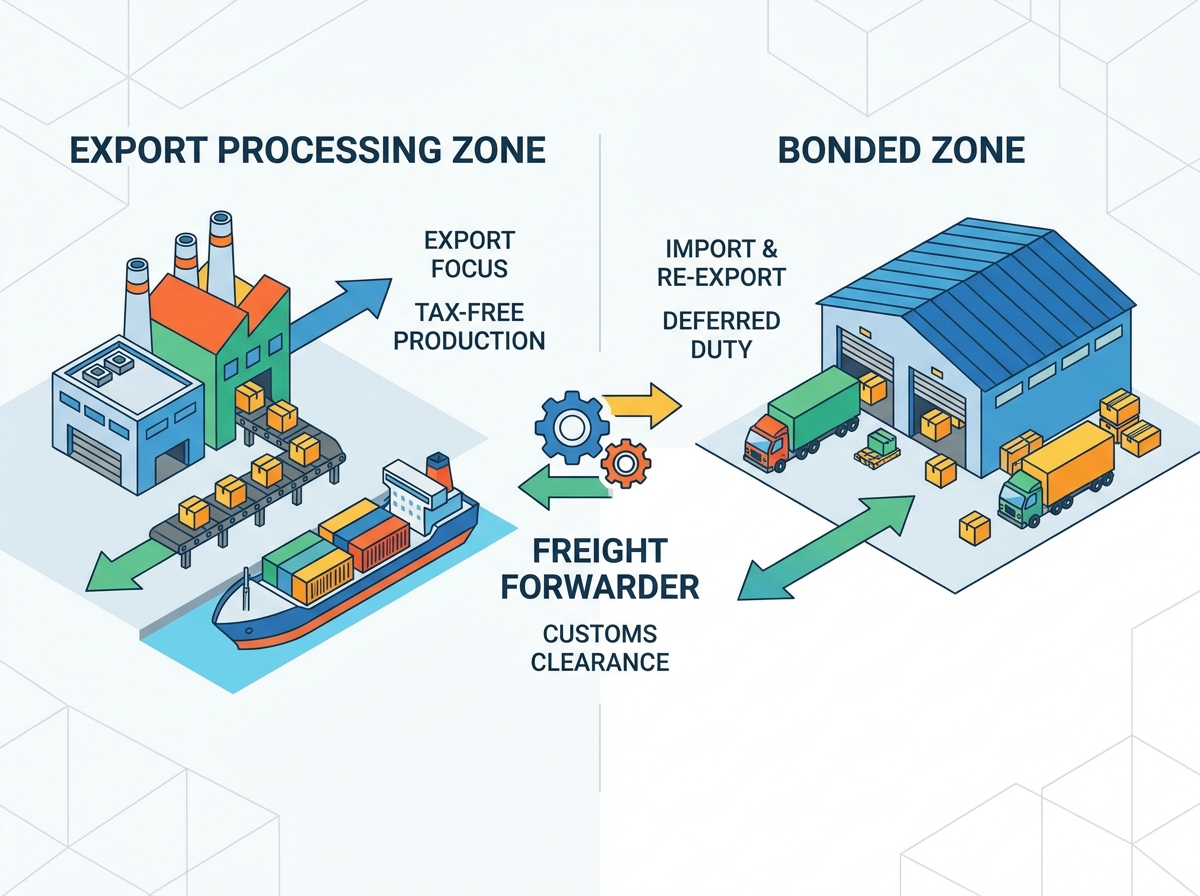
Industry Trend Analysis: The Shift Toward Hybrid Nearshoring
Recent supply chain data reveals a massive pivot in global trade strategies. With escalating geopolitical tensions and unpredictable tariff hikes projected for the coming years, industry leaders are abandoning traditional just-in-time inventory models. Instead, there is a pronounced shift toward hybrid nearshoring and just-in-case stockpiling.
Manufacturers are aggressively securing space in Southeast Asian Export Processing Zones to bypass direct duties on raw materials. Simultaneously, they are stockpiling finished goods in regional bonded facilities closer to the end consumer. This dual-node approach acts as a strategic buffer. It allows brands to wait out temporary trade barriers while maintaining rapid final-mile delivery capabilities. In this volatile environment, leveraging the correct customs zone is no longer just a tax-saving measure; it is a core survival strategy.
Understanding the Basics
Global trade relies heavily on special designated territories established by governments. These areas stimulate foreign direct investment, boost export volumes, and create specialized logistical hubs. While these zones offer distinct financial incentives, importers and manufacturers frequently misunderstand the terminology. To optimize a supply chain, decision-makers must first grasp the fundamental engineering behind these territories.
What is an Export Processing Zone?
An Export Processing Zone is a designated customs area where foreign raw materials and components can be imported without triggering immediate customs duties or value-added taxes. The core objective here is industrial transformation.
Governments engineer these zones to encourage companies to set up heavy machinery, assembly lines, and production facilities. Imagine you are importing raw aluminum and lithium-ion cells. In this zone, your factory floor can legally weld, assemble, and test these components to build electric vehicle batteries for export. You accomplish this without paying a dime in upfront raw material tariffs. Taxes are typically only levied if the finished product is diverted into the local domestic economy rather than shipped internationally.
What is a Bonded Zone?
A Bonded Zone encompasses highly secure, customs-controlled warehouses and logistics parks designed primarily for the storage of imported goods. Unlike a processing zone, it is not intended for heavy manufacturing.
Its core purpose is to provide a neutral space where goods can be stored, inspected, sorted, or repackaged without the immediate payment of import duties. Picture a pallet of high-end cosmetics arriving from Europe. In a bonded warehouse, workers can unbox the bulk shipment, apply localized warning labels, and repackage them into holiday gift sets while the importer waits for peak seasonal demand. The fundamental mechanism here is tax deferral. You only pay the applicable tariffs when the goods are formally cleared through customs and enter the domestic retail market.
Core Operational Differences
Choosing the right facility requires a meticulous evaluation of your operational needs. The differences dictate what you can legally do with your goods, how long they can stay, and when your tax liabilities mature.
| Feature | Export Processing Zone | Bonded Zone / Warehouse |
|---|---|---|
| Primary Purpose | Manufacturing, assembly, and industrial processing. | Duty-deferred storage, distribution, and preservation. |
| Permitted Activities | Heavy manufacturing, chemical processing, product transformation. | Sorting, repacking, labeling, kitting, and quality inspection. |
| Storage Time Limits | Generally indefinite, functioning as a permanent operational base. | Strictly regulated based on local jurisdiction. |
| Duty Trigger Point | Duties paid only if finished goods enter the domestic market. | Duties paid when goods leave the zone for domestic consumption. |
| Target Audience | Global manufacturers, industrial assemblers, raw material sourcers. | E-commerce retailers, distributors, and bulk importers. |
Permitted Activities: Manufacturing vs Storage
The most critical distinction lies in the scope of allowable physical manipulation. Substantial transformation is legally permitted and encouraged within a processing zone. A company can import raw steel and electronic microchips duty-free, utilize heavy machinery to build a commercial appliance, and then export it. Customs authorities classify this as a legitimate manufacturing operation.
Conversely, a bonded facility strictly limits activities to preservation and light manipulation. You cannot alter the fundamental nature or tariff classification of the product. Acceptable activities include breaking down bulk pallets, attaching local language compliance labels, replacing damaged packaging, or assembling a promotional kit. For example, you can place a bottle of shampoo and a conditioner into a single retail box. Executing any activity that resembles manufacturing in these facilities will result in severe compliance penalties and immediate audits.
Storage Time Limits and Restrictions
Functionally, bonded facilities act as temporary holding areas. Customs authorities monitor these spaces rigorously to ensure goods do not sit indefinitely without generating tax revenue. Depending on the country, strict statutory time limits apply. If cargo remains past this deadline, customs may demand immediate duty payment, forcibly auction the goods, or require mandatory re-exportation.
Processing zones operate under a completely different paradigm. Because companies invest heavily in physical infrastructure like factories and assembly plants, the government treats the inventory as part of an ongoing industrial process. Consequently, strict storage deadlines are rarely enforced. This provides greater flexibility for long-term operational planning.
Cost Implications and Strategic Tariff Planning
For supply chain executives, the decision is ultimately a financial calculation. Proper utilization of special customs areas dramatically lowers overhead, improves cash flow, and insulates businesses from geopolitical trade volatility.
Minimizing Warehousing Costs and Cash Flow Bottlenecks
Importing bulk inventory requires significant upfront capital. To illustrate, if a distributor imports two million dollars worth of electronics carrying a fifteen percent tariff, they immediately owe three hundred thousand dollars at the port of entry. If it takes six months to sell that inventory, that capital is trapped. This creates a severe cash flow bottleneck that stifles business growth.
By leveraging a bonded facility, the distributor effectively defers that massive payment. As they sell the electronics in smaller batches, they only pay the corresponding duties per batch. This strategic move aligns tax liabilities directly with revenue generation. It frees up vital capital for marketing, expansion, or rapid product development.
E-Commerce Fulfillment and Regional Logistics
The rapid expansion of cross-border e-commerce has fundamentally shifted how special customs areas are utilized. Direct-to-consumer brands require agile logistics networks capable of handling high-volume, low-value shipments while seamlessly managing complex returns processes.
Utilizing Regional Hubs for Rapid Distribution
For brands targeting the Asia-Pacific region, geographic location is just as important as the customs status of the facility. Hong Kong occupies a unique position in global logistics due to its status as a free port. Goods entering the territory are generally not subject to any tariffs. This eliminates the heavy administrative friction found in mainland facilities.
This lack of red tape makes warehousing and distribution in Hong Kong highly attractive for fast-moving consumer goods. E-commerce retailers can stage bulk inventory in the city, pick and pack individual orders, and inject them directly into global parcel networks. Top-tier logistics providers offer advanced Warehouse Management System integration, enabling twenty-four-hour turnaround times and drastically reduced documentation burdens.
Managing Reverse Logistics and Returns
Reverse logistics is a massive pain point for international e-commerce. When a customer returns a product across borders, brands risk paying import duties twice on the exact same item. This instantly erodes profitability.
To solve this, advanced supply chain engineers utilize bonded storage and re-import services. Returned goods ship directly back to a secure zone. Here, technicians meticulously inspect, refurbish, or repackage the items without triggering secondary customs duties. Once restored to sellable condition, the inventory is staged for future dispatch. This closed-loop system prevents margin erosion and ensures that cross-border returns do not become an unrecoverable sunk cost.
Navigating Regulatory Frameworks
While the financial benefits are undeniable, they come with rigorous administrative burdens. Customs authorities view these zones as high-risk areas for tax evasion and smuggling. The legal threshold for compliance is exceptionally high. Failing to maintain it can quickly erase any tax benefits gained through duty deferment.
Strict Compliance and Documentation Requirements
The foundation of operating in any special economic area is flawless documentation. Unlike standard domestic warehousing, every single movement of inventory is subject to government audit. Businesses must secure the appropriate customs bonds before transferring merchandise. This acts as a financial guarantee to the government that all applicable duties and taxes will eventually be paid.
Furthermore, inventory tracking systems must be capable of reporting at the individual SKU level. Successfully managing customs clearance in special customs areas requires deep regulatory expertise. You need Electronic Data Interchange integrated systems, accurate commercial invoices, packing lists, and precise Harmonized System code classifications. A minor administrative error can lead to significant delays, cargo freezes, and punitive financial penalties.
Avoiding Common Broker Pitfalls
The most common point of failure is inventory discrepancy. If a company imports ten thousand units into a facility, customs expects to see either ten thousand physical units on the warehouse racks, or a flawless paper trail proving they were legally cleared for domestic consumption, destroyed under supervision, or re-exported.
If an audit reveals that the physical stock does not match the declared digital records, authorities may assume the missing goods were illegally diverted. This triggers immediate duty demands and fines that often exceed the value of the goods. Flawless clearance is not merely an administrative task; it is a critical risk management function.
The Crucial Role of Specialized Logistics Partners
Selecting the appropriate customs zone is only the first step. Executing the physical and administrative movement of goods requires specialized engineering. This is where a professional logistics partner transitions from a simple transportation provider to a strategic supply chain consultant.
Streamlining Secure Transportation
Modern logistics involves strategic orchestration. When dealing with specialized zones, you must manage a seamless flow of goods under strict customs control. This specialized discipline, known as bonded zone freight forwarding, involves coordinating secure transportation from the port of entry directly to the designated facility.
Goods moving under a customs bond cannot be transported by standard commercial trucking. They require GPS-tracked bonded carriers legally authorized to move uncleared merchandise. A competent forwarder handles route optimization, secures climate-controlled or hazardous materials storage, and integrates tracking data directly with local customs portals. By managing these complex logistics, the forwarder mitigates the risk of cargo sitting idly at the port, thereby avoiding expensive demurrage and detention charges.
Actionable Selection Guide: Which Zone Fits Your Supply Chain?
The decision ultimately hinges on the physical lifecycle of your product and your overarching market strategy. There is no universal solution. Use the following criteria to engineer your logistics network.
Assess your primary physical operations:
- If your business model involves importing raw steel, electronic components, or textiles, and transforming them into a completely new finished product using heavy machinery, an Export Processing Zone is mandatory.
- If your goods are already manufactured and simply need sorting, labeling, or secure holding before entering the consumer market, a Bonded Zone is the correct choice.
Calculate your capital and cash flow constraints:
- Processing zones require high initial capital investment for factory setups, long-term leases, and labor forces.
- Bonded facilities require low to medium investment, typically operating on standard variable warehousing fees while protecting your cash flow through duty deferment.
Evaluate your final target market:
- Processing zones are specifically engineered for international export markets.
- Bonded facilities are tailored for agile domestic distribution, e-commerce direct injection, and regional wholesale operations.
Frequently Asked Questions
What are the penalties for unauthorized manufacturing in a bonded warehouse?
Conducting heavy manufacturing or substantial product transformation inside a bonded facility is a severe compliance violation. Customs authorities will immediately halt operations, issue massive financial penalties often exceeding the total value of the inventory, and potentially revoke your import licenses. You must move goods to a designated processing zone if industrial assembly is required.
How do I transition inventory from an Export Processing Zone to the domestic market?
While processing zones are designed for international export, you can sell goods domestically. However, the moment the finished product leaves the zone and enters the local economy, you must file a formal customs entry. You will then be required to pay all applicable import duties and value-added taxes on the finished goods, just as if they had arrived from a foreign country.
Can a logistics provider help me move goods between different special customs areas?
Yes. An experienced logistics provider can arrange bonded transportation and handle the complex customs declarations required to transfer goods between different zones. This process must be meticulously documented using authorized carriers to ensure the transfer does not accidentally trigger premature duty payments.
What happens if my goods stay in a bonded facility past the statutory time limit?
If inventory exceeds the maximum time limit enforced by local authorities, the consequences are immediate. Customs will demand full payment of all applicable duties and taxes based on the current market value. In extreme cases of non-compliance, authorities may legally confiscate the merchandise or force the business to re-export the goods at their own expense.
Optimize Your Logistics Network Today
Choosing between these facilities fundamentally impacts your operational bottom line. Export zones actively support heavy manufacturing and industrial transformation. Bonded facilities offer secure storage solutions and unparalleled cash flow protection. Selecting the wrong environment wastes valuable capital and invites compliance disasters.
Your choice depends entirely on your product lifecycle and target market. Do not let compliance blind spots drain your capital. Whether you require rapid e-commerce fulfillment, secure duty-deferred storage, or complex cross-border transportation, partnering with an expert team ensures your supply chain remains agile and cost-effective. Explore comprehensive freight forwarding and warehousing solutions at JFSZ Logistics to build a resilient, tax-optimized supply chain today.
Related Blogs
-
 Door to door shipping from China simplifies international logistics. But how can you ensure smooth delivery from factory to destination? Choosing the right shipping method, preparing documents, and understanding customs responsibilities are essential. This guide explains each shipping step, compares sea, air, and express services, and clarifies DDP and DAP terms. Learn how to arrange reliable deliveries and avoid unexpected costs.
-
 When production stops, every delivery day matters. Delayed components can disrupt schedules and customer commitments. Air freight from China offers a practical solution for urgent commercial shipments. However, choosing the right service requires careful planning. This guide compares standard, priority, and express shipping. You will also learn about flight schedules, customs clearance, and cargo preparation.
-
 Air freight from China offers speed, but costs can vary significantly. Do you know what determines your final shipping bill? This guide explains air freight cost from China, including per-kilogram rates, chargeable weight, surcharges, and destination fees. Learn how to estimate costs and reduce shipping expenses.
