


Introduction
The global supply chain is undergoing a rapid and structural transformation. Tariffs are rising unpredictably. Geopolitical decoupling strategies are reshaping traditional trade routes. Consequently, businesses can no longer rely on simplistic point-A-to-point-B shipping models. Today, companies face skyrocketing import duties, complex customs bottlenecks, and rigid routing options that systematically erode profit margins.
Enter the Shenzhen Bonded Zone. This highly strategic logistics hub operates as a geographic safe haven. Here, inventory can be consolidated, processed, and re-exported without triggering mainland Chinese import taxes. By utilizing this specialized economic area, supply chain managers can effectively suspend tariff applications while maintaining their merchandise in a geographically advantageous location.
Executing this strategy requires more than just leasing warehouse space. It demands a highly skilled logistics partner who implicitly understands the intricate nuances of cross-border routing and regulatory compliance. This playbook breaks down how to leverage southern China's infrastructure for transit trade. It compares alternative regional hubs and demonstrates how the right engineering approach can fundamentally build a more resilient supply chain architecture.
Global Supply Chain Trends: The Shift Toward Agile Transit Hubs
Recent industry analyses highlight a pronounced shift in global transit trade dynamics. As geopolitical decoupling accelerates and trade barriers fluctuate, forward-thinking enterprises are rapidly moving away from single-origin dependence. The "China Plus One" manufacturing strategy has fragmented production across Southeast Asia, creating a massive demand for centralized consolidation hubs.
Instead of shipping fragmented loads directly to destination markets, shippers are pivoting toward bonded zones to aggregate components. Emerging markets in the Middle East and Southeast Asia are becoming primary targets for rerouted cargo. Routing through a tax-exempt jurisdiction provides the ultimate agility. If a sudden tariff is imposed on goods entering a specific Western market, inventory held in a bonded facility is not trapped. Logistics operators can swiftly redirect that exact inventory to alternative global markets without navigating complex drawback procedures or paying exit taxes.
Key Takeaways
- Strategic Cost Reduction: Operating within a bonded environment allows businesses to legally suspend duties and taxes, significantly lowering upfront cash flow burdens.
- Flexible Routing: An experienced logistics partner utilizes the zone for consolidation, repackaging, and re-exporting, allowing shippers to navigate changing trade routes dynamically.
- Shenzhen vs. Hong Kong: While Hong Kong offers distinct free-port benefits, Shenzhen provides unparalleled physical proximity to mainland manufacturing at a fraction of commercial warehousing costs.
- Compliance is Key: Mastering customs clearance procedures is an essential operational requirement to avoid costly delays.
- Turnkey Solutions: Modern transit logistics is about strategic supply chain engineering and intelligent inventory positioning, not just moving boxes.
Understanding Transit Trade via the Shenzhen Bonded Zone
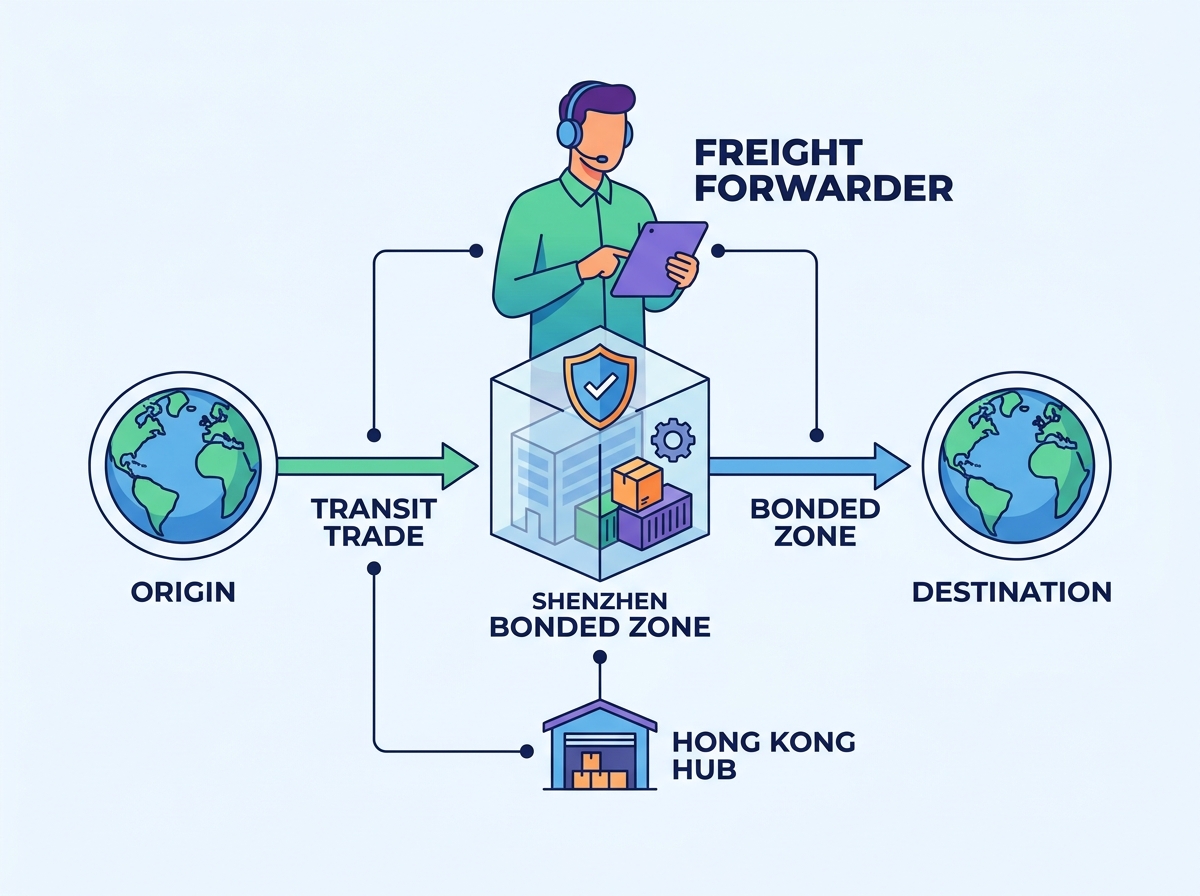
To fully capitalize on the operational advantages of southern China, decision-makers must first grasp the legal and physical framework of a special economic area. In practical terms, a bonded zone operates as a precise legal mechanism. It is a designated geographic footprint where freight is physically located within China's borders but remains legally outside its customs territory for tax and duty purposes.
What is Bonded Cargo Transit and Re-Export Logistics?
At its core, bonded cargo transit and re-export logistics refers to the strategic movement and storage of merchandise through a tax-exempt jurisdiction before reaching a final destination. The workflow typically begins when shipments arrive from overseas suppliers or mainland Chinese factories directly into the bonded facility. Because the zone sits outside the domestic customs territory, foreign materials entering the area are entirely exempt from import duties. Simultaneously, domestic goods entering the zone are instantly eligible for export tax refunds.
Once securely inside the facility, the cargo is either stored indefinitely or subjected to light processing. Workers might unpalletize bulk shipments to conduct quality control testing on electronics, apply destination-specific compliance labels, or kit components from multiple origins into a single retail box. After these value-added services are completed, the goods are dispatched to their final international destination, successfully deferring tax liabilities until the very last mile.
The Role of a Logistics Architect in the Zone
Operating within a highly regulated environment, logistics professionals do much more than book vessel space. They manage the physical allocation of bonded warehouse racks, orchestrate multi-modal transport connecting ocean freight with cross-border trucking, and handle the delicate legal transfer of goods between jurisdictions. Without a specialized partner, companies risk severe compliance failures, such as inventory discrepancies that could lead to cargo seizures.
Why Supply Chain Engineers Recommend Shenzhen for Global Routing
When evaluating global transit hubs, supply chain executives routinely analyze locations based on cost, connectivity, and proximity to suppliers. Shenzhen consistently ranks as a top-tier recommendation among on-the-ground engineers due to its unique macroeconomic benefits and robust physical infrastructure.
Proximity to the Manufacturing Heartland
Shenzhen is geographically embedded within the Pearl River Delta, widely recognized as one of the most concentrated manufacturing ecosystems on the planet. This immediate proximity allows a logistics provider to seamlessly consolidate raw materials sourced from overseas with finished goods manufactured in mainland China. For instance, an electronics brand can import specialized microchips from Taiwan duty-free into the zone. Concurrently, they can truck in plastic casings manufactured in neighboring Dongguan. Inside the warehouse, technicians kit these items together into a final retail package before re-exporting them to Europe, completely bypassing Chinese import tariffs on the Taiwanese components.
Significant Cost Arbitrage
Holding buffer stock in destination markets like the United States or Western Europe incurs massive real estate and labor overhead. By utilizing Shenzhen as a central transit hub, businesses capture significant cost arbitrage. While domestic warehousing in Western markets commands premium industrial rates and triggers immediate tariff payments, Shenzhen offers moderate storage costs. Furthermore, it provides highly cost-effective skilled labor for value-added services, keeping capital liquid until the goods reach their final market.
Shenzhen Bonded Zone vs. Hong Kong Transit Warehouse Services
A frequent dilemma for supply chain decision-makers is choosing between Shenzhen and Hong Kong for their regional distribution center. Both cities offer distinct operational advantages. Understanding their structural differences is critical for optimizing freight routes.
The Pros and Cons of Hong Kong
Historically renowned as a global free port, Hong Kong operates with minimal customs interference. Merchandise can flow in and out of the territory with exceptional speed, making it highly attractive for time-sensitive, high-value cargo. However, this convenience comes at a steep premium. Commercial real estate in the territory is among the most expensive globally. Consequently, utilizing Hong Kong transit warehouse services for labor-intensive tasks—such as repackaging, kitting, or long-term storage—is often economically unviable for low-to-mid margin consumer products.
The Shenzhen Advantage
In contrast, Shenzhen offers a compelling alternative by providing a massive warehouse footprint at a fraction of Hong Kong's real estate costs. Operational expenses, including forklift operations, manual sorting, and inventory auditing, are significantly lower. Beyond that, Shenzhen provides frictionless, overland integration with mainland Chinese manufacturing hubs. Freight moving from a factory in Guangzhou to a Shenzhen facility travels entirely on domestic road networks, completely avoiding the expensive cross-border trucking fees required to move those same goods into Hong Kong.
Core Comparison: Structuring the Right Hub
| Operational Metric | Shenzhen Bonded Zone | Hong Kong Free Port | The Hybrid Strategy |
|---|---|---|---|
| Real Estate & Storage Costs | Highly cost-effective, ideal for long-term buffer stock. | Premium pricing, suited only for rapid cross-docking. | Store bulk in Shenzhen, move to HK just-in-time. |
| Labor Costs for Processing | Low. Efficient for kitting, labeling, and quality control. | High. Labor-intensive tasks erode profit margins quickly. | Complete all processing in Shenzhen prior to export. |
| Customs Clearance Speed | 24-48 hours with AEO-certified forwarder and API integration. | Near-instantaneous free flow of goods. | Pre-clear goods electronically via EDI before border crossing. |
| Mainland Factory Integration | Frictionless domestic trucking directly to the warehouse door. | Requires expensive cross-border trucking and customs declaration. | Consolidate domestically in Shenzhen, export globally via HK. |
The Freight Forwarder’s Routing Playbook: Step-by-Step Execution
Implementing a transit strategy requires strict adherence to standard operating procedures. Below is a practical walkthrough of how freight physically and legally moves through this specialized system from an engineering perspective.
Step 1: Inbound Logistics and Consolidation
The operation commences when the forwarder coordinates the inbound movement of freight. For international origins, cargo arrives via ocean vessel at Yantian Port or by air at Bao'an International Airport. The logistics provider files a specialized bonded transfer declaration, seamlessly moving the container from the port terminal directly to the bonded warehouse without paying customs duties. Concurrently, domestic goods are trucked into the zone from mainland factories, triggering an immediate export status for the domestic supplier.
Step 2: Value-Added Services Inside the Zone
Once secured on the warehouse racks, the cargo undergoes permitted value-added services. Warehouse staff scan barcodes to update the Warehouse Management System, reconfigure bulk pallets into retail-ready packages, or flash firmware onto consumer electronics. By performing these tasks within the zone, companies ensure that only perfect, retail-ready products are shipped to the end consumer. This drastically reduces the rate of expensive international returns.
Step 3: Outbound Routing and Dispatch
After processing, the inventory is prepped for dispatch. The logistics partner analyzes real-time freight rates and transit schedules to select the optimal export route. Goods destined for North America might be loaded onto an ocean vessel at Shekou Port. Urgent e-commerce parcels might be trucked across the border for a direct flight out of Hong Kong. Alternatively, merchandise bound for Europe can be loaded onto the China-Europe Railway Express, providing a balanced solution between costly air freight and slower ocean transit.
Mastering Compliance and Customs Engineering
The primary barrier to entry for many enterprises considering this routing strategy is the perceived regulatory complexity. Strict compliance is non-negotiable. Any deviation can result in cargo holds, administrative fines, or the revocation of bonded privileges.
Navigating the Paperwork Maze
Operating within this framework requires a meticulous paper trail. Unlike standard imports, transit trade customs declaration requires undeniable proof that the goods entering the zone perfectly match the goods leaving it. Essential documents include detailed commercial invoices, granular packing lists, bills of lading, and specific electronic customs handbook data. Every single product code, weight metric, and description must align flawlessly across all platforms to satisfy rigorous customs audits.
Avoiding Common Customs Bottlenecks
The most common bottleneck in bonded logistics is the misclassification of product codes, which triggers unwarranted regulatory inspections. To mitigate this risk, dedicated logistics partners utilize advanced Electronic Data Interchange systems. These platforms interface directly with China Customs databases, allowing for the pre-clearance of goods and automated reconciliation of inventory ledgers. Working with a partner who holds an Authorized Economic Operator certification further ensures prioritized customs processing, typically achieving clearance within 24 to 48 hours.
Leveraging Global Transit Hubs for E-Commerce Fulfillment
The explosion of cross-border e-commerce has fundamentally altered how bonded zones are utilized. Modern retailers demand highly agile supply chains capable of supporting diverse, high-velocity fulfillment models.
Bonded Warehousing for Drop-Shipping and Amazon FBA
E-commerce sellers increasingly use Shenzhen as a central Regional Distribution Center. Instead of shipping bulk inventory directly to fulfillment warehouses in Western markets—where storage fees fluctuate wildly based on seasonality—sellers hold their global buffer stock in Shenzhen. As destination inventory levels deplete, the forwarder dispatches precisely calculated replenishments from the bonded zone. This strategy prevents overstocking at destination facilities and defers tariff payments until the last possible moment. For direct-to-consumer models, individual parcels can be picked, packed, and injected directly into global parcel networks right from the bonded facility.
Managing Reverse Logistics Cost-Effectively
Handling international returns is notoriously expensive and logistically frustrating. If a European consumer returns a product, shipping it back into mainland China typically triggers import duties, effectively taxing the seller twice. Bonded zones offer a highly cost-effective reverse logistics solution. Returned merchandise can be shipped back to the Shenzhen Bonded Zone duty-free. Once inside, technicians can inspect, repair, repackage, and restock the items for future global sales, salvaging profit margins that would otherwise be lost.
How to Choose the Right Partner for Your Transit Strategy
A routing playbook is merely theoretical without a capable team to execute it. Selecting the right logistics partner is arguably the most critical decision a supply chain executive will make in this process. You need a partner deeply integrated into international transit freight forwarding with verified on-the-ground assets.
The Engineer’s Selection Checklist
Not all logistics providers possess the infrastructure or legal standing to manage bonded operations. Decision-makers must verify specific capabilities before signing a contract:
- Direct Facility Control: Does the forwarder own or have long-term operational control over the bonded warehouse to guarantee priority space allocation?
- System Integration: Does their Warehouse Management System offer direct API integration with your enterprise software for real-time inventory visibility?
- Customs Certification: Do they hold an Authorized Economic Operator certification to ensure 24-48 hour rapid customs clearance?
- Cross-Border Assets: Do they operate their own cross-border trucking fleet to seamlessly route goods between Shenzhen and Hong Kong without relying on third-party brokers?
Conclusion
The Shenzhen Bonded Zone represents a powerful, strategic tool for navigating modern supply chain complexities. By utilizing this unique geographic and legal framework, businesses can legally avoid unnecessary tariffs, drastically reduce warehousing overhead, and maintain the agility needed to optimize global distribution. Whether you are managing complex manufacturing components or high-volume e-commerce retail, bonded transit logistics provides a definitive competitive edge.
Stop leaking profit margins to unnecessary tariffs and rigid routing structures. Success relies entirely on partnering with a specialized logistics provider capable of navigating the strict compliance landscape and engineering multi-modal routes. By aligning with a verified expert like JF SZ Logistics, you transform your supply chain from a vulnerable cost center into a resilient, strategic asset. Evaluate your current routing models today and upgrade your logistics architecture.
FAQ
What is the main difference between a standard warehouse and a bonded warehouse in Shenzhen?
A standard warehouse requires goods to clear Chinese customs and pay import duties immediately upon arrival. A bonded warehouse, managed by a licensed freight forwarder, allows goods to be stored duty-free until they are either officially imported into the mainland domestic market or re-exported to another country.
How does utilizing transit trade reduce the impact of global tariffs?
By keeping goods in a tax-exempt bonded zone, companies defer paying any duties until the product is shipped to its final buyer. If a specific destination country raises tariffs unexpectedly, the inventory is not trapped. The logistics provider can simply reroute the goods from the Shenzhen facility to a different country with favorable trade terms, completely avoiding the new tariff.
Can a freight forwarder help me move goods from a Shenzhen bonded zone to a Hong Kong port?
Yes. Expert forwarders frequently use dedicated cross-border trucking fleets to move inventory from Shenzhen bonded warehouses directly to Hong Kong ports or airports. This operational synergy combines Shenzhen's low storage costs with Hong Kong's extensive global flight and sailing schedules.
What specific documents are required for bonded transit customs clearance in Shenzhen?
Strict compliance requires a flawless paper trail. The essential documents include a detailed commercial invoice, a granular packing list, the original bill of lading, and specific electronic data generated through the customs handbook system. Every product classification code and weight metric must match perfectly to clear customs without delays.
How long does customs declaration take in Shenzhen?
With an experienced logistics partner utilizing advanced Electronic Data Interchange systems, bonded customs declarations can often be cleared within 24 to 48 hours. This rapid turnaround is highly dependent on having accurate commercial documentation and working with an Authorized Economic Operator certified broker.
Is bonded transit logistics only for large multinational corporations?
Not at all. While large corporations use it extensively to manage complex supply chains, mid-sized e-commerce sellers and independent trading companies increasingly rely on these strategies to consolidate shipments, defer taxes, and save on global shipping costs.
Can goods be manufactured or heavily altered inside the Shenzhen Bonded Zone?
Heavy manufacturing that fundamentally changes the nature or classification code of the product is generally restricted. However, light assembly, kitting, relabeling, quality inspection, and packaging are fully permitted and serve as standard value-added services offered by top-tier warehouse operators.
Related Blogs
-
 Door to door shipping from China simplifies international logistics. But how can you ensure smooth delivery from factory to destination? Choosing the right shipping method, preparing documents, and understanding customs responsibilities are essential. This guide explains each shipping step, compares sea, air, and express services, and clarifies DDP and DAP terms. Learn how to arrange reliable deliveries and avoid unexpected costs.
-
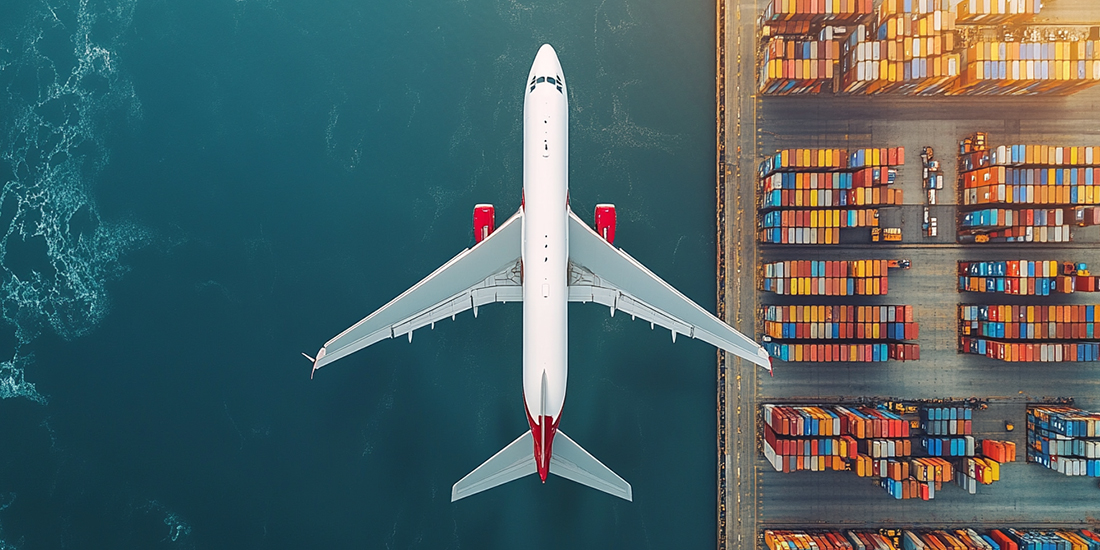 When production stops, every delivery day matters. Delayed components can disrupt schedules and customer commitments. Air freight from China offers a practical solution for urgent commercial shipments. However, choosing the right service requires careful planning. This guide compares standard, priority, and express shipping. You will also learn about flight schedules, customs clearance, and cargo preparation.
-
 Air freight from China offers speed, but costs can vary significantly. Do you know what determines your final shipping bill? This guide explains air freight cost from China, including per-kilogram rates, chargeable weight, surcharges, and destination fees. Learn how to estimate costs and reduce shipping expenses.
