



Is tied-up cash stalling your global growth? Delayed shipments and unexpected tariffs constantly drain working capital. This leaves importers struggling to balance regulatory compliance with financial liquidity. Imagine a mid-sized electronics importer with half a million dollars of inventory sitting at a port. It racks up demurrage fees simply because a single commercial document was misfiled. This is the harsh reality of global trade.
Here, we break down how to align your financing structures with expert logistics execution. We explore the mechanics of customs bonds, documentary financing, and clearance strategies. The goal is simple. Build a resilient, scalable, and financially optimized supply chain.
Key Takeaways
- Strategic Financing: Documentary financing instruments systematically mitigate transaction risks for both buyers and sellers while freeing up essential working capital.
- Compliance is Financial: Engaging reliable customs professionals prevents costly port delays and penalties that can severely disrupt trade finance agreements.
- Bond Selection Matters: The strategic choice between a continuous and a single-entry bond significantly impacts upfront operational costs and clearance speed.
- Cash Flow Optimization: Leveraging formal import duty deferral programs dramatically improves a company's financial health by keeping cash in the business longer.
- Holistic Trade Solutions: Partnering with industry experts ensures that physical logistics and financial strategies are perfectly synchronized for maximum efficiency.
Understanding Supply Chain Finance for Importers
Supply chain finance is not merely a banking function. It is a critical operational strategy enabling businesses to maintain healthy liquidity while procuring goods internationally. For decision-makers, grasping the mechanics of these financial structures is the foundational step toward safeguarding profit margins.
Bridging the Cash Flow Gap in International Trade
The fundamental challenge of cross-border commerce is the working capital gap. You purchase goods from an overseas supplier. That manufacturer typically demands payment upfront to mitigate their credit exposure. Meanwhile, you will not realize revenue until those goods arrive, clear border checks, enter domestic inventory, and finally sell. This transit and processing period can easily span 30 to 120 days.
During this extended timeframe, capital remains trapped in transit. Access to structured trade finance bridges this critical gap. By utilizing tailored financing facilities, businesses ensure suppliers are paid promptly. This often secures early payment discounts. Simultaneously, the importer defers their own cash outflow. This dynamic allows companies to scale purchasing volume without entirely draining internal cash reserves or relying on exorbitant unsecured loans.
The Intersection of Logistics and Finance
Moving commercial goods across international borders is as much a financial transaction as it is a physical logistics operation. The intersection of these two domains is precisely where supply chains either thrive or collapse. Physical delays equate directly to financial losses. If a container sits at a terminal due to missing documentation, the importer incurs daily detention fees. Furthermore, delayed inventory turnover extends the cash conversion cycle. This increases the interest burden on any utilized credit facilities. Consequently, logistics execution must be viewed as a direct determinant of financial performance.
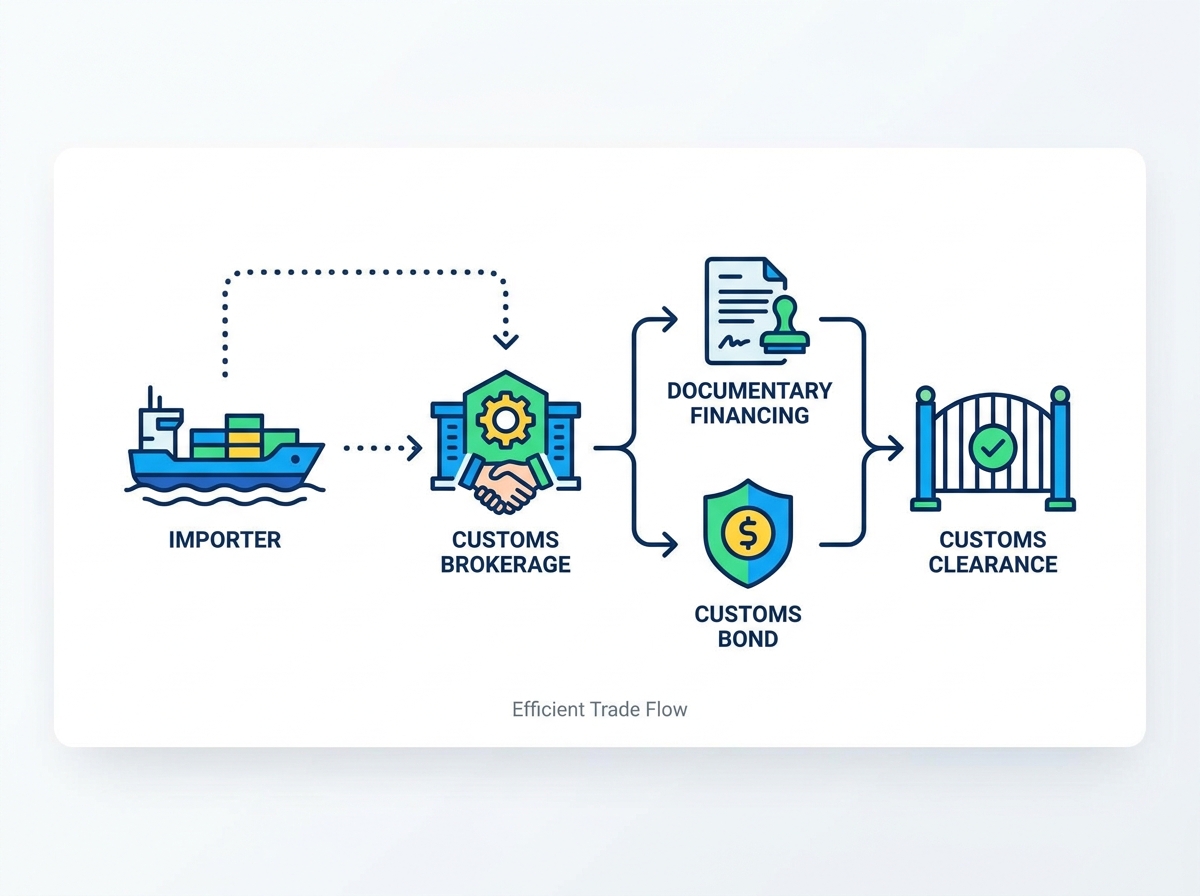
Why Expert Customs Brokerage is the Backbone of Import Financing
Financial strategies rely entirely on the successful physical execution of the supply chain. Without robust compliance management, even the most favorable financing terms will crumble under the weight of border delays.
Integrating Trade Customs Brokerage Services with Financial Strategy
The relationship between physical cargo and financial institutions is mediated by rigorous documentation. Banks require absolute proof of legal entry before they release funds or finalize the terms of a documentary credit. By integrating professional trade customs brokerage services into your overall financial architecture, you create a reliable and compliant bridge between your physical inventory and your banking partners.
Expert brokers ensure that Harmonized System codes are classified correctly. They verify that valuation is precise and all Partner Government Agency requirements are fulfilled prior to vessel arrival. For instance, top-tier forwarders utilize Authorized Economic Operator certified processes to slash clearance times from days to mere hours. This proactive compliance provides banks with the verified data they need to execute agreements without hesitation.
Preventing Delays that Impact Your Working Capital
Errors in entry filing remain one of the most common causes of supply chain friction. A simple misclassification or a missing certificate of origin triggers an intensive cargo exam by border authorities. When cargo gets flagged, the financial repercussions are immediate and severe. Importers face terminal demurrage and container detention fees. The disrupted sales cycle directly damages Return on Investment. If the goods are tied to a time-sensitive Letter of Credit, delays can result in breached covenants. Professional brokerage acts as a vital risk mitigation tool. It ensures flawless entries that protect working capital.
Demystifying Customs Bonds: Securing Your Imports
A customs bond is a mandatory requirement for commercial imports in many jurisdictions. It serves as a financial guarantee to the government that all applicable duties, taxes, and fees will be remitted. Beyond mere compliance, structuring your customs bonds correctly is a highly strategic financial decision.
Continuous Bonds vs. Single-Entry Bonds
Importers generally choose between a single-entry bond and a continuous bond. Selecting the correct type is paramount for optimizing upfront costs and daily operational efficiency. Below is a practical selection guide based on frontline logistics experience.
| Feature | Single-Entry Bond | Continuous Customs Bond |
|---|---|---|
| Coverage Scope | Covers one specific import transaction at a single port of entry. | Covers all import transactions across all domestic ports for a full year. |
| Cost Structure | Premium is based on the specific shipment value plus associated duties. | Annual flat premium. Vastly more cost-effective for multiple shipments. |
| Clearance Speed | Manual processing required per entry. Often results in slower cargo release. | Automated continuous validation. Enables rapid cargo release upon arrival. |
| Ideal Importer Profile | Infrequent shippers handling low-value goods. Less than three shipments annually. | Scaling businesses, multi-port operations, and companies utilizing duty deferral. |
For small operations with minimal volume, a single-entry bond minimizes initial commitment. In contrast, for businesses aiming to scale, the financial return of a continuous bond is undeniable. It eliminates the administrative friction of purchasing a new bond for every container. This accelerates the clearance process and supports a much faster cash conversion cycle.
Requirements for a Continuous Customs Bond
Securing a continuous bond requires thorough preparation and financial transparency. Surety companies rigorously evaluate an importer's risk profile before issuance. To establish this bond, importers must typically provide a Customs Power of Attorney alongside detailed financial statements to verify liquidity. The bond amount calculation is generally set at ten percent of the total duties and taxes paid in the previous twelve months.
Documentary Financing: Mitigating Risk for Buyers and Sellers
To navigate the inherent risks of international trade, businesses rely on structured financial instruments known as documentary financing. These methods guarantee that suppliers are paid securely while shielding the importer from paying for phantom shipments.
Letters of Credit for Importers
A Letter of Credit remains one of the most secure instruments in global trade. It is a binding commitment issued by the importer's bank. It guarantees payment to the exporter provided they submit strictly compliant shipping documents by a specified deadline. This process protects the buyer because funds are only released when the bank verifies that physical goods have been handed over to the ocean carrier. This is evidenced by the Bill of Lading.
For the exporter, a Letter of Credit replaces the buyer's credit risk with the creditworthiness of an international bank. While these instruments involve banking fees and require meticulous attention to formatting, they are unparalleled in mitigating risk when dealing with new or unverified overseas manufacturers.
How Documentary Collections Help Trade Finance
As business relationships mature and mutual trust is established, importers often transition from expensive Letters of Credit to Documentary Collections. This reduces banking overhead. In this scenario, the exporter's bank forwards shipping documents to the importer's bank. The instructions are to release them only upon payment, known as Documents against Payment. Alternatively, they release them upon acceptance of a time draft, known as Documents against Acceptance.
Negotiating Documents against Acceptance terms is a highly effective tactic to optimize working capital. It essentially provides the importer with supplier-backed credit. This allows them to take possession of the goods and potentially sell them before the draft matures in 30, 60, or 90 days.
Mastering Customs Duty and Clearance Documentation
The success of any documentary financing strategy is entirely dependent on the accuracy of the underlying paperwork. Financial institutions operate purely on documents, not on the physical inspection of cargo. Therefore, mastering the flow of information is non-negotiable.
The Link Between Accurate Paperwork and Financing Approval
In the realm of trade finance, banks adhere strictly to the doctrine of strict compliance. If the customs duty and clearance documentation contains even minor discrepancies, the bank will refuse to honor the Letter of Credit. A misspelled corporate entity or an incorrect gross weight on the Bill of Lading is enough to freeze funds.
Flawless documentation satisfies both government authorities and financing banks simultaneously. By ensuring these documents are meticulously prepared and perfectly aligned with financing terms, importers prevent payment delays that damage supplier trust. They also avoid customs holds that cripple inventory flow.
How Import Duty Deferral Impacts Business Finance
Import duties represent a massive cash outflow that occurs long before goods generate revenue. Fortunately, import duty deferral programs allow businesses to legally postpone the payment of these taxes. This acts as an indirect, zero-interest form of supply chain finance.
By utilizing mechanisms such as Foreign Trade Zones or bonded warehouses, importers can bring cargo into the country without immediately paying tariffs. Duties are only triggered when the goods exit the bonded environment and enter the domestic consumer market. This deferral strategy keeps substantial cash reserves in the business longer. It dramatically improves liquidity ratios and allows capital to be allocated toward growth initiatives.
The Value of Customized Consultation
Navigating the complex intersection of international banking covenants and border regulations is a daunting task. For decision-makers, attempting to manage these overlapping domains without specialized guidance often leads to inefficient capital allocation and severe compliance exposure.
Tailoring Financial Solutions to Your Supply Chain
No two supply chains operate identically. A high-volume automotive parts importer faces entirely different cash flow cycles and tariff structures than a seasonal footwear brand. Seeking professional customs bond and documentary financing consultation helps businesses design a bespoke, data-driven strategy. Experts audit your historical procurement cycles, supplier payment terms, and duty liabilities. They then recommend the exact right mix of Letters of Credit, continuous bonds, and duty deferral frameworks.
What to Look for in a Trade Partner
Executing a synchronized strategy requires partnering with service providers who possess cross-disciplinary expertise. A traditional freight forwarder may excel at moving ocean containers but lack the financial acumen to advise on documentary collections. Decision-makers should seek out holistic trade partners who integrate deep financial compliance knowledge with robust, licensed brokerage capabilities. This dual expertise ensures that your physical supply chain and your financial supply chain operate in perfect harmony.
Beyond Importing: Export Tax Rebate and Customs Brokerage
While optimizing import finance is critical, global trade is rarely a one-way street. Many mid-to-large enterprises operate bidirectional supply chains. They import raw materials, manufacture goods, and subsequently export finished products to international markets. For these organizations, financial optimization must encompass both cycles.
Maximizing Returns in Cross-Border Supply Chains
In many jurisdictions, governments incentivize international trade by offering tax refunds on exported goods. However, claiming these rebates is a highly bureaucratic process. It requires precise synchronization between customs declarations, commercial invoices, and foreign exchange receipts. Failing to claim these rebates efficiently results in trapped capital.
Integrating specialized export tax rebate and customs brokerage solutions is a strategic maneuver. It transforms a compliance department into a liquidity generator. A competent partner ensures export declarations are filed with the exact specifications required by tax authorities. This accelerates the retrieval of rebates. This recovered cash can then be recycled to fund Letters of Credit for future imports. The result is a self-sustaining, financially resilient operation.
Navigating Industry Trends in Supply Chain Finance
As global trade dynamics evolve, the mechanisms supporting supply chain finance are undergoing significant transformation. Based on recent industry analysis and cross-border trade data, there is a marked shift toward the digitalization of trade documents. Technologies such as blockchain and artificial intelligence driven document verification are replacing the archaic, paper-heavy processes traditionally associated with Letters of Credit. This digital transition drastically reduces the time required for banks to verify compliance. It accelerates the release of funds and minimizes discrepancy rates.
Specifically, fluctuating global interest rates are prompting importers to aggressively renegotiate payment terms. Many are moving away from traditional, fee-heavy Letters of Credit in favor of open account financing supported by modern supply chain finance platforms. Furthermore, financial institutions are increasingly tying financing rates to Environmental, Social, and Governance compliance. Importers who can prove their supply chains meet strict sustainability criteria are often rewarded with preferential financing rates. This makes end-to-end visibility and accurate customs data more valuable than ever.
Conclusion
Successful importing demands much more than simply moving boxes from point A to point B. It requires careful financial and logistical orchestration. You must harmonize the movement of money with the efficient, compliant clearance of cargo. Documentary financing and correctly structured customs bonds serve as the dual pillars securing your daily operations.
Navigating these overlapping complexities alone remains risky and highly capital-intensive. By partnering with experts for reliable brokerage and strategic financial consultation, you can mitigate risk, defer tax liabilities, and keep your working capital fluid. Streamline your global supply chain management strategy today. Turn logistics from a cost center into a competitive financial advantage. For robust, end-to-end customs clearance and trade finance synchronization, explore the tailored solutions at JFSZ Logistics to safeguard your profit margins.
Frequently Asked Questions
What is the difference between a Customs Bond and Trade Finance?
A customs bond is a mandatory financial guarantee provided to the government. It ensures that all import duties, taxes, and fees will be paid, protecting the government's revenue. Trade finance, which includes instruments like Letters of Credit, is a commercial mechanism used between businesses and banks to securely pay overseas suppliers. While a bond satisfies regulatory tax obligations, trade finance facilitates the actual purchasing transaction and manages supplier risk.
Do I need a customs broker to utilize documentary financing?
While a bank does not legally require you to hire a customs broker to issue a Letter of Credit, employing one is practically essential. Financial institutions operate under strict documentary compliance rules. They require precise, error-free clearance documentation to release funds to your supplier. A licensed broker ensures that all commercial invoices and entry summaries are perfectly aligned. This prevents document discrepancies that could freeze your financing.
How do I know if I need a continuous or single-entry customs bond?
The decision is based on empirical data regarding your import frequency and cargo value. A single-entry bond covers only one specific shipment. It is suitable for businesses that import infrequently, usually less than three times a year. A continuous bond covers all import transactions across all ports for a full year. If you import regularly, a continuous bond is significantly more cost-effective. It reduces administrative delays and is mandatory if you plan to utilize duty deferral programs.
How does import duty deferral work?
Import duty deferral is a government-approved mechanism allowing businesses to delay the payment of customs duties to a later date. This is typically achieved by transferring goods into a bonded warehouse or a Foreign Trade Zone. Duties are only paid when the goods exit the bonded facility and enter domestic commerce. This significantly improves a company's working capital by allowing them to potentially sell the inventory before paying the tax.
Can my logistics provider also help with export tax rebates?
Yes, provided you partner with a comprehensive logistics provider that offers integrated trade and financial compliance services. Claiming export tax rebates requires meticulous alignment between your export declarations, commercial invoices, and bank receipts. A sophisticated brokerage partner will manage this documentation flow to meet the strict requirements of tax authorities. This accelerates your refunds and injects crucial liquidity back into your operations.
What are the common discrepancies that delay Letter of Credit payments?
Common discrepancies include inconsistent product descriptions across documents, incorrect gross weights on the Bill of Lading, late shipment dates, and typographical errors in corporate names. Even a missing signature or an improperly formatted commercial invoice can cause a bank to reject the documents. Working with a precise customs broker ensures data uniformity across all filings, drastically reducing discrepancy risks.
How fast can a continuous customs bond be issued?
With accurate financial documentation and a properly executed Customs Power of Attorney, a continuous customs bond can typically be issued and activated within 3 to 5 business days. However, if the surety company requires additional financial statements to verify liquidity for high-value bonds, the process may take slightly longer. Proactive importers secure their bonds well before cargo departs the origin port.
Related Blogs
-
 Door to door shipping from China simplifies international logistics. But how can you ensure smooth delivery from factory to destination? Choosing the right shipping method, preparing documents, and understanding customs responsibilities are essential. This guide explains each shipping step, compares sea, air, and express services, and clarifies DDP and DAP terms. Learn how to arrange reliable deliveries and avoid unexpected costs.
-
 When production stops, every delivery day matters. Delayed components can disrupt schedules and customer commitments. Air freight from China offers a practical solution for urgent commercial shipments. However, choosing the right service requires careful planning. This guide compares standard, priority, and express shipping. You will also learn about flight schedules, customs clearance, and cargo preparation.
-
 Air freight from China offers speed, but costs can vary significantly. Do you know what determines your final shipping bill? This guide explains air freight cost from China, including per-kilogram rates, chargeable weight, surcharges, and destination fees. Learn how to estimate costs and reduce shipping expenses.
