



Did you know thousands of commercial trucks traverse the Shenzhen-Hong Kong border every single day? The geographic distance between these two hubs is incredibly short. Yet, moving goods across this critical checkpoint remains notoriously complex. Strict regulatory environments, dual-customs protocols, and unexpected bottlenecks frequently cost businesses significant time and money.
In this guide, we dive deep into the operational realities of routing and transit timing. We will illustrate precisely how an experienced logistics partner eliminates supply chain headaches and keeps your cargo moving smoothly.
Key Takeaways
- Cross-border trucking remains the fastest route. It often allows for rapid, same-day transit between Shenzhen manufacturing hubs and Hong Kong ports.
- Mastering dual-jurisdiction customs protocols is absolutely vital. A single missing document can trigger severe delays, high warehouse storage fees, and missed shipping vessels.
- Utilizing specialized bonded transit strategies significantly reduces tax burdens. This improves cash flow for goods destined purely for international export.
- A full-service logistics provider manages the entire ecosystem. They handle everything from mainland factory pickup to final distribution within Hong Kong's dense urban environment.
Why You Need a Professional Freight Forwarder for Cross-Border Shipments
Moving cargo between mainland China and Hong Kong requires far more than merely loading a trailer and driving south. Businesses must navigate a highly regulated logistical corridor. Partnering with a professional logistics expert is a strategic decision. It directly impacts your supply chain efficiency, legal compliance, and overall bottom line.
Navigating Cross-Border Complexities
The Shenzhen-Hong Kong border operates under a unique framework. Hong Kong maintains a completely separate customs territory, legal system, and currency from the mainland. Consequently, goods moving from a Shenzhen factory to a Kowloon warehouse are legally treated as international exports by mainland authorities.
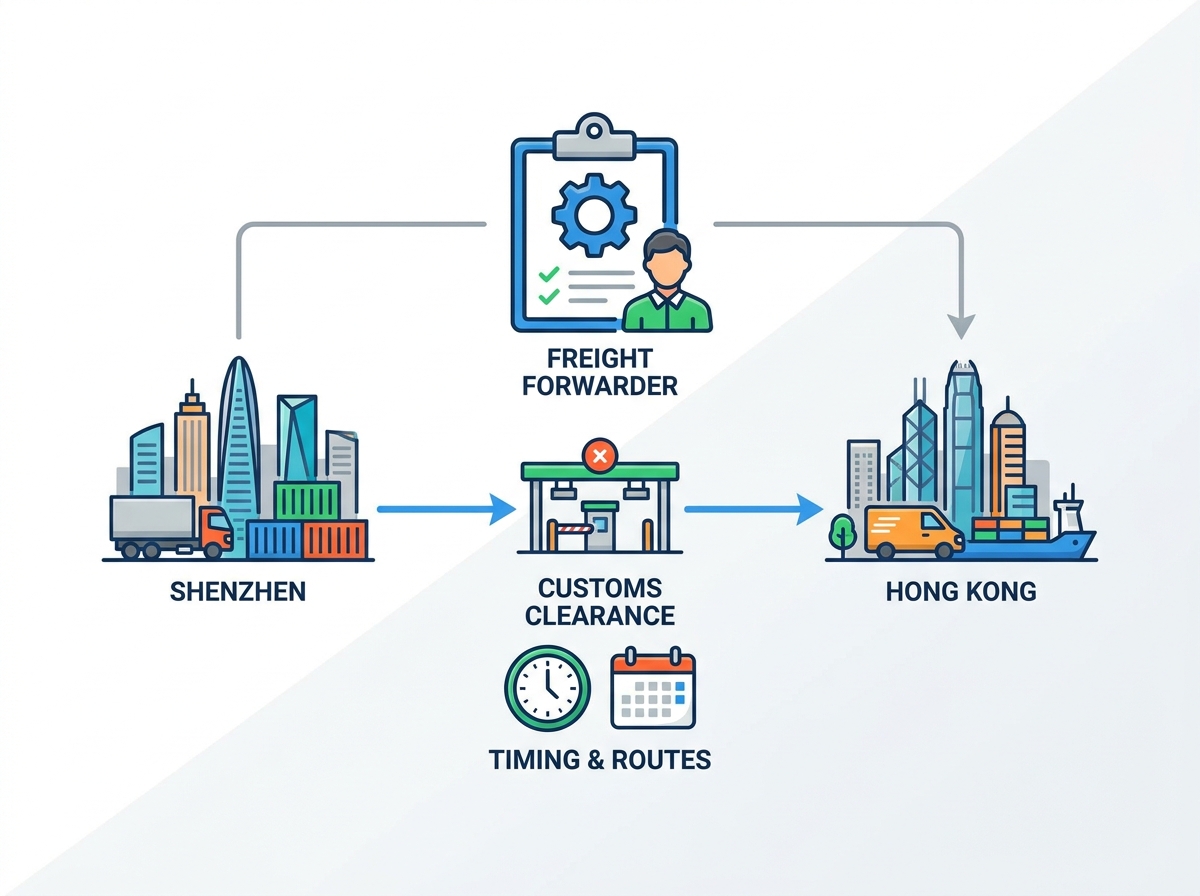
A professional logistics provider acts as your unified command center. Picture trying to independently coordinate a mainland trucking fleet, a separate customs broker dealing with HS code discrepancies, and a distinct local delivery crew. The logistical friction is staggering. Instead, a unified forwarder handles the entire sequence. They understand the specific operational nuances of different border checkpoints. For example, seasoned dispatchers know exactly when to leverage Huanggang's 24-hour commercial lanes versus Shenzhen Bay's capacity, ensuring cargo routing relies on real-time traffic data.
Industry Trends and Cost Optimization
From an operational standpoint, the regional logistics landscape is experiencing a massive shift. Driven by the explosive growth of cross-border e-commerce and direct-to-consumer brands, demand for high-frequency, smaller-batch shipments has surged. Concurrently, customs authorities are rapidly digitizing. The implementation of paperless Single Window systems means data accuracy is more critical than ever. Supply chains must be agile to survive.
To adapt to these market trends, forwarders bring crucial cost optimization through volume consolidation. Depending on the shipment size, experts mathematically determine the best strategy. Risk management also serves as a critical value-add. Cross-border transit involves physical handling and rigorous border inspections. A reputable forwarder conducts preliminary compliance audits on cargo manifests. This drastically reduces the risk of customs seizures or administrative fines.
Top Routes and Equipment Selection
Selecting the appropriate transportation route is a foundational step in cross-border logistics. The decision depends heavily on cargo volume, urgency, budget constraints, and the final destination. Let us look at the actual parameters and modalities utilized in this bustling trade corridor.
Cross-Border Trucking Road Freight
Road freight is the undisputed backbone of Shenzhen-Hong Kong logistics, offering unmatched flexibility and speed. This route utilizes specialized dual-plate trucks legally registered to operate in both jurisdictions.
| Transport Mode | Typical Equipment | Capacity / Volume | Best Suited For |
|---|---|---|---|
| Full Truckload | 3-ton, 5-ton, 12-ton Box Trucks | 12 CBM to 45 CBM | Time-sensitive, high-value, or fragile direct shipments. |
| Container Drayage | 20GP, 40HQ Trailers | 28 CBM to 68 CBM | Large volume factory exports heading directly to ocean terminals. |
| Less-Than-Truckload | Consolidated 45-foot Trailers | Priced per CBM / KG | Small to medium e-commerce batches requiring cost efficiency. |
Sea Freight and River Barges
While trucking is undeniably faster, sea freight via river barges is highly cost-effective for specific types of heavy cargo. Goods load onto barges at Shenzhen ports like Shekou or Yantian. They then travel across the Pearl River Delta directly to Hong Kong’s Kwai Chung Container Terminals.
This method is highly recommended for heavy industrial machinery, bulk raw materials, and oversized construction equipment. Sea freight effectively bypasses road congestion and offers a lower carbon footprint, though supply chain planners must account for longer lead times.
Understanding Timing and Transit Schedules
Time is a critical metric in supply chain management. Buyers and factory managers need predictable schedules to coordinate international shipping vessels or air freighters departing from Hong Kong. Transit times vary significantly based on the chosen service level and external conditions.
Express and Same-Day Delivery
For urgent shipments, dedicated cross-border trucking achieves remarkable speeds. If a dedicated truck is booked and customs paperwork is pre-cleared electronically, the vehicle can depart a Shenzhen warehouse, scan its plates at the border checkpoint, and arrive at a Hong Kong port in just 2 to 4 hours. This rapid transit is essential for fast-fashion exports and last-minute cargo racing to catch an international flight.
Standard Transit Times
For standard consolidated shipments, businesses should generally expect a transit time of 1 to 2 business days. The operational timeline includes receiving goods at the Shenzhen consolidation warehouse, loading the shared truck, executing the physical border crossing, unloading at a Hong Kong distribution center, and finally sorting the freight for local delivery.
Demystifying Shenzhen Hong Kong Customs Clearance
Navigating the border involves interacting with two distinct customs authorities. For supply chain managers, mastering Shenzhen Hong Kong customs clearance is often considered the most critical operational hurdle. An incorrect Harmonized System code can trigger extensive border delays, secondary inspections, and accumulating warehousing fees.
Export Declarations in Shenzhen
When moving goods out of mainland China, the customs authority requires strict adherence to export protocols. The process begins long before the truck reaches the checkpoint. Goods must be accurately classified. The standard documentation required includes a detailed Commercial Invoice, a precise Packing List outlining exact carton counts, and the official Customs Declaration Form. Depending on the cargo, special certificates for hazardous materials or batteries may also be mandatory.
Import Declarations in Hong Kong
Hong Kong operates as a free port, which significantly simplifies the import process compared to other global jurisdictions. However, a free port does not mean a document-free port. While there are no tariffs on most commercial goods, the customs department requires accurate data collection for trade statistics. Importers are legally obligated to lodge an accurate import declaration within 14 days of the cargo arriving. Failure to meet this deadline results in strict financial penalties.
The Strategic Advantage of Bonded Transit
For manufacturers and e-commerce sellers whose final customers are located overseas, paying standard mainland duties for goods merely passing through Hong Kong is financially inefficient. Specialized transit solutions have become invaluable for modern global trade.
What is Bonded Routing?
Utilizing bonded transit freight forwarding is a specialized logistics mechanism. It allows cargo to move from a bonded facility in mainland China, such as the Qianhai Comprehensive Bonded Zone, directly to Hong Kong without formally entering the mainland Chinese domestic market. The goods travel under strict customs supervision in sealed dual-plate trucks.
Benefits for Global Trade
Implementing a bonded strategy offers massive, quantifiable advantages. Primarily, it defers or entirely eliminates mainland import duties and value-added taxes, provided the goods are strictly destined for international export. This drastically improves cash flow. Companies no longer tie up capital paying taxes on goods just passing through. Additionally, bonded trucks often utilize dedicated green lanes at border checkpoints, avoiding the congestion of general trade lanes.
Seamless Hong Kong Local Delivery Services
Crossing the border is only part of the journey. Once the cargo clears the checkpoint, it enters one of the most densely populated and structurally complex urban environments in the world. Effective last-mile execution is critical to maintaining the integrity of your delivery schedule.
Last-Mile Delivery to Warehouses and Ports
The final destination for goods arriving from Shenzhen varies widely. A comprehensive forwarder manages routing to several key infrastructure nodes. This could mean a direct transfer to the container terminals for ocean freight consolidation, delivery to cargo terminals at the airport, or distribution to various fulfillment warehouses scattered across the city.
Navigating with Tail-Lift Trucks
Hong Kong's unique geography and vertical urban planning present specific challenges for freight vehicles. Narrow streets, strict parking regulations, and high-rise commercial buildings require a highly specialized fleet. Standard 45-foot cross-border trailers are often entirely unsuitable for final delivery within the city center.
To navigate this, Hong Kong local delivery and trucking operations rely on agile vehicles. Cargo is typically cross-docked onto 5.5-ton or 9-ton box trucks. Crucially, these local trucks must be equipped with hydraulic tail-lifts. When navigating the labyrinthine industrial estates of Kwun Tong or Tsuen Wan where proper loading docks are notoriously absent, tail-lifts allow drivers to safely unload heavy pallets directly at street level.
How to Choose the Right Freight Forwarder
The Shenzhen-Hong Kong corridor is saturated with logistics providers, but operational capabilities vary drastically. Selecting a partner solely based on the lowest quoted price often leads to hidden fees, delayed shipments, and poor communication during crises. A poorly equipped provider can cost a business far more in missed deadlines than they save in initial freight rates.
Key Capabilities to Evaluate
To ensure supply chain resilience, decision-makers should evaluate potential partners against a strict set of operational criteria. First, verify their ownership of dual-plate trucks. Asset-based forwarders with direct control over their fleet offer much higher reliability during peak seasons compared to those who entirely subcontract their driving. Second, look for comprehensive warehousing networks on both sides of the border to allow for flexible cargo staging.
The provider must also demonstrate deep knowledge of Shenzhen to Hong Kong freight forwarding regulations, including in-house customs brokerage expertise rather than outsourced teams. Finally, prioritize technological visibility. Modern supply chains demand transparency, so look for partners providing digital platforms for instant updates on customs status and proof of delivery.
Ultimately, successful cross-border logistics requires more than just booking a truck. It demands choosing the optimal route, executing flawless customs declarations, and actively managing transit times to prevent costly delays. Your logistics framework should serve as a competitive advantage rather than a constant operational headache. Do not let preventable supply chain bottlenecks slow your business growth. Partner with seasoned experts who can provide reliable, transparent transportation solutions. Evaluate your current cargo volume, required transit times, and customs needs, and choose a tailored logistics plan from a trusted provider to keep your supply chain running at peak efficiency.
Frequently Asked Questions
How much does cross-border trucking cost?
Pricing is highly variable and depends on several objective factors. Costs are generally calculated based on the chargeable weight or cubic meter volume of the cargo. The price differs significantly between a dedicated chartered truck and shared space. Additional variables include current fuel surcharges, peak season demand, and whether specialized handling like tail-lift delivery is required at the destination.
Do I need to pay customs duties when shipping to Hong Kong?
Because Hong Kong is a designated free port, the vast majority of commercial goods are not subject to any import tariffs or value-added taxes upon entry. However, mainland China's export regulations still apply. Depending on the specific commodity code of your goods, you may be subject to Chinese export taxes, or conversely, you may be eligible for export tax rebates. Accurate customs declarations are mandatory in both jurisdictions regardless of your specific tax liability.
What specific documents are strictly required for crossing the border?
To ensure a smooth crossing, you must prepare a comprehensive documentation packet. The absolute baseline requirements include a detailed Commercial Invoice, an itemized Packing List, a Waybill, and the official Customs Declaration Form. If you are shipping specialized goods, you will also need supplementary documents like safety data sheets for batteries or specific export licenses for restricted items.
Can a forwarder handle hazardous materials or electronic goods with batteries?
Yes, professional logistics providers can transport hazardous materials and battery-powered electronics. However, these shipments require strict compliance with international safety regulations. You must provide a valid safety data sheet and, for lithium batteries, a UN38.3 test report. The forwarder must follow specific customs clearance protocols and utilize appropriately licensed vehicles to ensure a safe and legal border crossing.
How do typhoons and severe weather affect cross-border freight schedules?
Severe weather is a major factor in southern China. During summer typhoons or sudden black rainstorm warnings, port operations and border checkpoints may temporarily suspend activities for safety reasons. When a Typhoon Signal No. 8 or higher is hoisted in Hong Kong, cross-border trucking halts entirely. A professional forwarder will proactively reroute cargo, secure goods in weatherproof warehouses, and adjust delivery schedules to minimize the impact of these unavoidable delays.
Do you provide local delivery to residential addresses?
Most commercial freight forwarders specialize in business-to-business deliveries, routing cargo to ports, airport terminals, and industrial warehouses. While delivery to residential addresses or commercial office buildings is possible, it often incurs additional gate charges or residential delivery surcharges. This is due to the difficulty of navigating heavy trucks in residential zones and the lack of standard loading docks, which necessitates specialized tail-lift vehicles and extra manual labor.
Related Blogs
-
 Door to door shipping from China simplifies international logistics. But how can you ensure smooth delivery from factory to destination? Choosing the right shipping method, preparing documents, and understanding customs responsibilities are essential. This guide explains each shipping step, compares sea, air, and express services, and clarifies DDP and DAP terms. Learn how to arrange reliable deliveries and avoid unexpected costs.
-
 When production stops, every delivery day matters. Delayed components can disrupt schedules and customer commitments. Air freight from China offers a practical solution for urgent commercial shipments. However, choosing the right service requires careful planning. This guide compares standard, priority, and express shipping. You will also learn about flight schedules, customs clearance, and cargo preparation.
-
 Air freight from China offers speed, but costs can vary significantly. Do you know what determines your final shipping bill? This guide explains air freight cost from China, including per-kilogram rates, chargeable weight, surcharges, and destination fees. Learn how to estimate costs and reduce shipping expenses.
