



Global e-commerce and international B2B trade are expanding at a rapid pace. However, this growth brings a hidden logistical challenge. Cross-border returns are escalating in volume, and the associated costs are staggering. For many merchants and manufacturers, managing rejected or defective inventory is a margin-eroding burden. Conventional returns processing frequently involves high international shipping fees, convoluted customs duties, and sluggish turnaround times. Consequently, vital operating capital becomes paralyzed in unsellable inventory.
How do we fix this bottleneck? Forward-thinking supply chain managers are shifting their focus. They are adopting reverse logistics via bonded zones as a strategic imperative. By routing returned goods into specialized warehousing infrastructure located within these special economic zones, businesses can receive, inspect, repair, and resell products. All of this happens without triggering immediate import taxes. Ultimately, this approach transforms a traditional cost center into a lucrative opportunity for asset recovery. In this technical guide, we break down the workflows, financial advantages, and selection criteria for mastering your global returns management process.
Key Takeaways
- Duty and Tax Savings: Processing returns within a customs-regulated bonded zone prevents the double taxation of goods. This preserves your baseline profit margins and enhances cash flow.
- End-to-End Processing: Premium facilities offer structured solutions. They seamlessly integrate initial receiving, advanced quality inspection, and technical repairs.
- Value Recovery: Strategic operational workflows empower brands to rapidly restore returned items to a sellable condition. This drastically minimizes inventory write-offs.
- Streamlined Compliance: Expert handling of cross-border documentation eliminates regulatory bottlenecks. Your recovered assets can be redistributed globally much faster.
- Future-Proofing: Aligning your reverse supply chain with a specialized logistics provider prepares your operations for the rigorous demands of modern global trade.
Industry Insights: The Paradigm Shift in Global Returns
Recent supply chain data indicates a stark reality for global trade. Cross-border return rates in key retail sectors now hover between 20 to 30 percent. If left unmanaged, this surging volume threatens to destroy forward fulfillment margins entirely. Industry analysts emphasize that traditional liquidation or landfill disposal is no longer financially viable. It also violates increasingly strict corporate sustainability mandates.
Specifically, we are witnessing a pronounced macro-level shift. Major enterprises are establishing circular reverse supply chains inside tax-neutral bonded environments. These offshore and nearshore hubs allow companies to consolidate global returns centrally. By assessing the condition of returned goods without the immediate financial penalty of import duties, brands are pivoting. They no longer treat returns as a pure financial loss. Instead, they view them as a structured value recovery opportunity.
The operational complexities fluctuate based on your business model. Business-to-Consumer returns feature high volumes of relatively low-value items, such as apparel. This demands rapid sorting and automated processing. Conversely, Business-to-Business returns involve lower volumes but significantly higher value and technical complexity. Think of heavy industrial equipment requiring rigorous diagnostic testing. A well-equipped logistics facility must provide scalable labor for unpredictable holiday peaks while maintaining technical expertise for high-value asset recovery.
How Bonded Zones Revolutionize Reverse Logistics
A bonded zone is a highly secure geographic area regulated strictly by local customs authorities. Inside this jurisdiction, imported goods can be stored, manipulated, and inspected without triggering standard import duties. From a legal standpoint, the cargo resides outside the customs territory of the host country until it officially crosses the threshold into the domestic market.
Why pay taxes twice on a product that failed to sell? You shouldn't. The foremost financial advantage of leveraging a bonded zone lies in duty deferment. Consider a scenario where a product is shipped internationally, and standard import duties are paid upon arrival. If the buyer rejects the shipment and returns it, the merchant often faces a second round of taxes. By routing that returned product to a bonded zone, the retailer sidesteps these unnecessary costs entirely. The refurbished item can then be sold to a buyer in a third country, bypassing domestic import duties and preserving critical working capital.
Traditional vs. Bonded Zone Returns Processing
| Processing Metric | Traditional Domestic Returns | Bonded Zone Reverse Logistics |
|---|---|---|
| Import Duties | Paid immediately upon border entry | Deferred legally until domestic sale |
| Double Taxation Risk | Extremely High | Completely Eliminated |
| Customs Clearance Speed | Slowed by standard commercial holds | Accelerated via pre-clearance protocols |
| Asset Recovery Potential | Low due to high processing overhead | High due to tax-neutral repair environments |
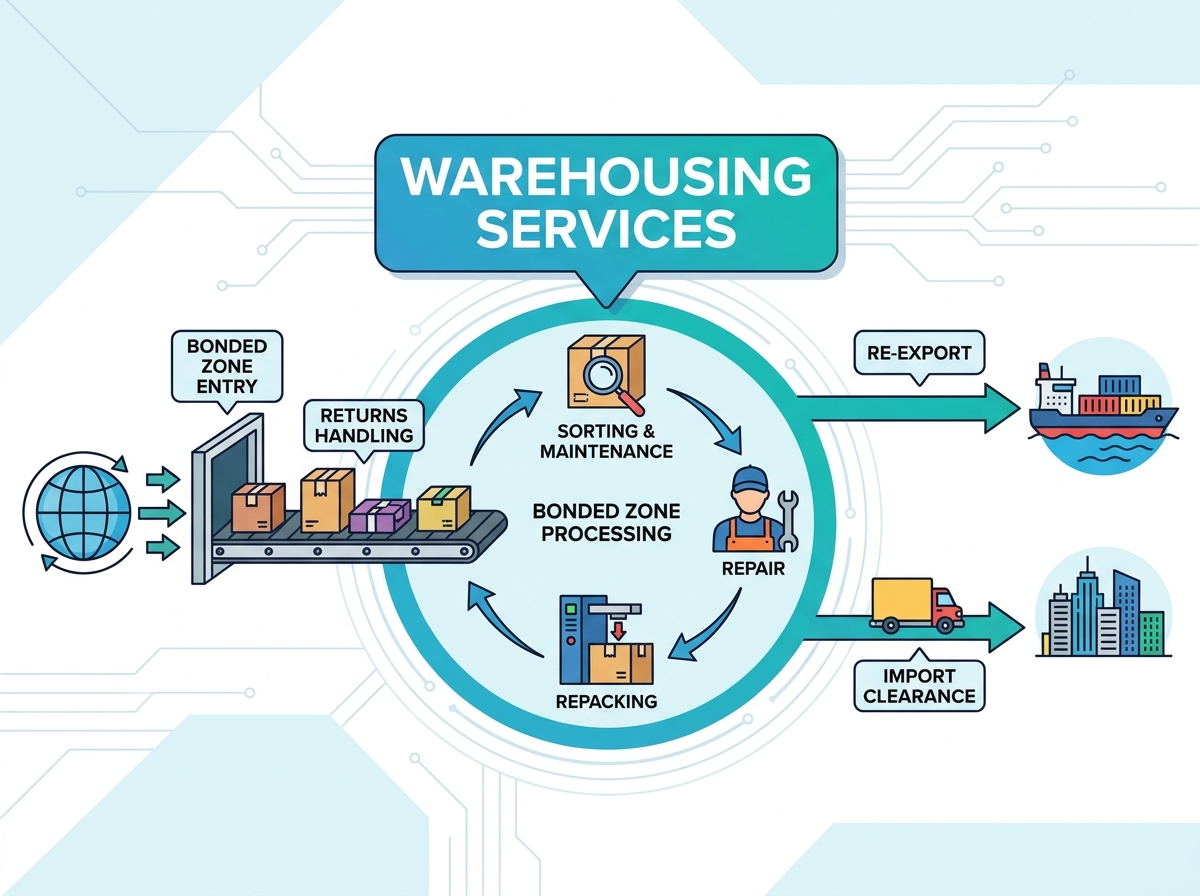
Core Workflows in the Reverse Supply Chain
The physical execution of reverse logistics demands meticulous precision. Unlike forward logistics, where goods arrive in uniform pallets, reverse logistics deals with mixed conditions and unpredictable quantities. Effective warehousing and returns handling begins the exact moment a shipment hits the loading dock. Advanced Warehouse Management Systems instantly log the incoming freight. This digital handshake cross-references the receipt against the original Return Merchandise Authorization. It provides real-time visibility to the merchant, ensuring consumer refunds trigger without delay.
Furthermore, items transition to a rigorous inspection phase once logged. Trained technicians evaluate each product against strict guidelines. They grade items into categories such as A-stock, B-stock, or salvage. For inventory falling short of immediate resale standards, the facility executes precise returned cargo sorting labeling and maintenance. In practical terms, a technician might receive a pallet of returned industrial sensors. They will meticulously perform firmware resets, swap out scratched casings, and apply fresh compliance stickers. This granular process prevents costly secondary returns.
Value-Added Solutions for Asset Recovery
Beyond basic storage, the true utility of a bonded warehouse lies in value-added transformation. The condition of retail packaging heavily dictates a product's perceived value. A perfectly functional drone returned in a crushed box cannot command full retail price. To resolve this, premium facilities offer bonded zone repacking and circulation processing. Operators extract the product from its damaged casing and place it into fresh, brand-approved packaging. By executing this inside the tax-neutral zone, brands restore a B-stock item to A-stock presentation standards for a fraction of the cost of manufacturing a new unit.
In addition, circulation processing refers to manipulating goods for entirely different regional markets. Because the inventory resides in a tax-neutral environment, merchants possess incredible agility. If a batch of electronics originally destined for the United States is returned to a bonded zone in Asia, warehouse operators can swap the US power adapters for EU plugs. They bundle the items with localized instruction manuals and prepare them for European distribution. This maximizes inventory agility without violating customs regulations.
Navigating Regulatory Compliance and Customs
The most formidable barrier to efficient cross-border reverse logistics is regulatory compliance. Cross-border returns require exhaustive documentation to prove the origin, value, and status of the goods. Mishandling this paperwork leads to trapped inventory and severe regulatory fines. Engaging experienced customs brokers bridges the critical gap between warehouse operations and government bodies. These experts ensure commercial invoices accurately classify goods under the correct Harmonized System codes.
The legal movement of goods into and out of the bonded zone involves two highly regulated phases. First, the facility must flawlessly execute the returned merchandise import and re-export clearance protocols. The import phase dictates how goods cross the border, requiring definitive proof that items are entering strictly for repair. Later, once refurbished and sold to a new international buyer, the re-export clearance logs the inventory out. Mastering these dual procedures ensures a frictionless flow of inventory. Failure to properly document the re-export can result in customs demanding retroactive payment of import duties.
Technical Checklist: Selecting Your Bonded Logistics Partner
Executing a profitable reverse logistics strategy requires partnering with a specialized third-party logistics provider. Not all warehouses possess the legal certifications to manage bonded returns. When evaluating a logistics partner, supply chain managers should verify specific, objective criteria rather than relying on marketing claims.
First, ensure the facility holds valid, government-issued bonded status with in-house customs brokerage experts. Second, verify their software capabilities. The warehouse management system must support API integration for real-time Return Merchandise Authorization syncing and SKU-level tracking. Third, evaluate their physical infrastructure. The facility must feature dedicated clean-room environments for technical maintenance. Finally, assess their freight consolidation capabilities. A strong partner will gather returns at a localized hub and transport consolidated cargo via Less than Container Load or Full Container Load shipments, drastically slashing per-unit transportation costs.
Conclusion
Reverse logistics no longer needs to be an inevitable sunk cost. By strategically leveraging bonded zones, businesses can efficiently defer taxes, repair damaged goods, and seamlessly re-export them to recover lost value. As global trade continues to expand, mastering these complex supply chain steps separates proactive industry leaders from reactive competitors. Optimizing your reverse supply chain requires a blend of regulatory expertise, physical infrastructure, and digital visibility. Take the necessary steps today to align with logistics experts. Explore tailored solutions at JFSZ Logistics to find the exact infrastructure and customs clearance support required for your unique global trade operations.
FAQ
What is the main difference between standard warehousing services and bonded zone warehousing?
The primary difference lies in the legal treatment of import duties. In a standard warehouse, imported goods are subject to immediate tax liabilities the moment they cross the border. In contrast, these taxes are legally deferred in a bonded zone warehouse. Businesses only pay duties if the goods are eventually sold into the local domestic market. This makes it a highly cost-effective environment for processing international returns.
How does targeted sorting and maintenance save money?
When a product is returned due to a minor defect or damaged packaging, writing it off as a total loss is a severe financial hit. By performing targeted maintenance, such as fixing a loose component or applying a new compliance label, businesses restore the product to a sellable condition. This restorative process is substantially cheaper than manufacturing a replacement unit or paying high freight costs to return the item to the original overseas factory.
What is involved in repacking and circulation processing?
This process involves the physical transformation of a product to make it retail-ready for a specific target market. It includes discarding damaged exterior boxes, placing the item in pristine branded packaging, kitting multiple items together, and adding regional power adapters. Ultimately, it ensures the product meets the exact expectations of the next buyer without incurring cross-border transit penalties.
Is import and re-export clearance difficult to manage?
Managing cross-border customs documentation is inherently complex due to fluctuating international trade laws. However, partnering with an experienced logistics provider and a certified customs broker streamlines this process. They handle the intricate regulatory paperwork, ensuring goods enter the bonded zone legally and are re-exported smoothly without incurring unnecessary delays.
Can B2B companies benefit from reverse logistics in a bonded zone?
Absolutely. While consumer retail deals with high volumes of smaller items, B2B returns often involve high-value equipment or bulk components. A bonded zone provides a highly secure, tax-free environment where these valuable assets can be safely stored, thoroughly inspected, and refurbished. Capital is not tied up in duties until a new international buyer is secured.
How long can returned goods stay in a customs bonded warehouse?
The storage duration varies depending on specific national customs regulations, but most bonded zones allow goods to be stored for up to five years. This extended timeframe gives merchants ample opportunity to repair, repackage, and find new international buyers for their inventory without the pressure of immediate tax liabilities.
What is the cost difference between direct return shipping and using a bonded zone?
Direct return shipping forces merchants to pay single-parcel international freight rates plus double import duties. By utilizing a bonded zone, companies consolidate returns into bulk container shipments and defer all customs taxes. This strategic combination typically reduces overall reverse logistics costs by 30 to 40 percent compared to traditional direct-to-origin return methods.
Related Blogs
-
 Door to door shipping from China simplifies international logistics. But how can you ensure smooth delivery from factory to destination? Choosing the right shipping method, preparing documents, and understanding customs responsibilities are essential. This guide explains each shipping step, compares sea, air, and express services, and clarifies DDP and DAP terms. Learn how to arrange reliable deliveries and avoid unexpected costs.
-
 When production stops, every delivery day matters. Delayed components can disrupt schedules and customer commitments. Air freight from China offers a practical solution for urgent commercial shipments. However, choosing the right service requires careful planning. This guide compares standard, priority, and express shipping. You will also learn about flight schedules, customs clearance, and cargo preparation.
-
 Air freight from China offers speed, but costs can vary significantly. Do you know what determines your final shipping bill? This guide explains air freight cost from China, including per-kilogram rates, chargeable weight, surcharges, and destination fees. Learn how to estimate costs and reduce shipping expenses.
