



The global shift toward green energy is accelerating at an unprecedented pace. Building the necessary infrastructure requires moving some of the largest and heaviest components on the planet. Maneuvering a 115-meter offshore wind blade through a congested terminal requires more than standard freight forwarding. It demands precise center-of-gravity calculations and multi-axle synchronization. Securing a massive solar farm transformer against the unpredictable dynamic forces of the open ocean is equally daunting. Transporting these colossal components across borders constitutes a logistical minefield. It involves extreme weight distributions, awkward dimensions, strict customs regulations, and high financial stakes.
Standard shipping methods simply fail for renewable energy parts. Success relies entirely on specialized handling and strategic financial planning. By leveraging expert maritime transit combined with bonded warehousing, project managers can streamline operations. They overcome complex customs hurdles and ensure these mega-projects are completed on time and under budget.
Key Takeaways
- Scale Requires Specialization: Conventional freight networks are inadequate for renewable components. Execution demands precise marine engineering and custom lifting solutions.
- Financial Efficiency: Utilizing bonded warehousing allows energy firms to defer massive customs duties and taxes. This strategy keeps project capital liquid during critical construction phases.
- The Ocean Advantage: Maritime transit remains the only viable, scalable, and cost-effective method for moving ultra-heavy industrial assets across the globe.
- Seamless Execution: Proactive administrative coordination prevents costly port congestion, mitigates demurrage fees, and guarantees regulatory compliance across multiple jurisdictions.
Navigating the Global Capacity Crunch in Green Energy Logistics
Recent market analyses reveal a critical bottleneck in the renewable energy supply chain. As nations aggressively pursue net-zero targets, the demand for offshore wind and utility-scale solar installations has skyrocketed globally. This surge has triggered a severe shortage of specialized heavy-lift vessels. Consequently, freight rates for mega-sized cargo have experienced significant volatility, and securing deck space requires booking quarters in advance.
Forward-thinking energy firms are adapting to this new reality. Instead of relying on rigid just-in-time shipping models, supply chain directors are shifting toward strategic buffering. By securing equipment in customs-controlled zones near project sites months ahead of schedule, companies insulate their construction timelines from unpredictable global shipping delays and vessel capacity shortages.
The Unique Challenges of Renewable Energy Supply Chains
The transition to renewable power requires physical infrastructure of a scale rarely seen in traditional manufacturing. Unlike consumer electronics or standard automotive parts, the components required for wind, solar, and hydroelectric generation present extraordinary logistical hurdles. Supply chain directors must navigate intricate engineering constraints, rigorous safety protocols, and complex international trade laws to ensure high-value assets arrive intact.
Defining Oversized in the Green Energy Sector
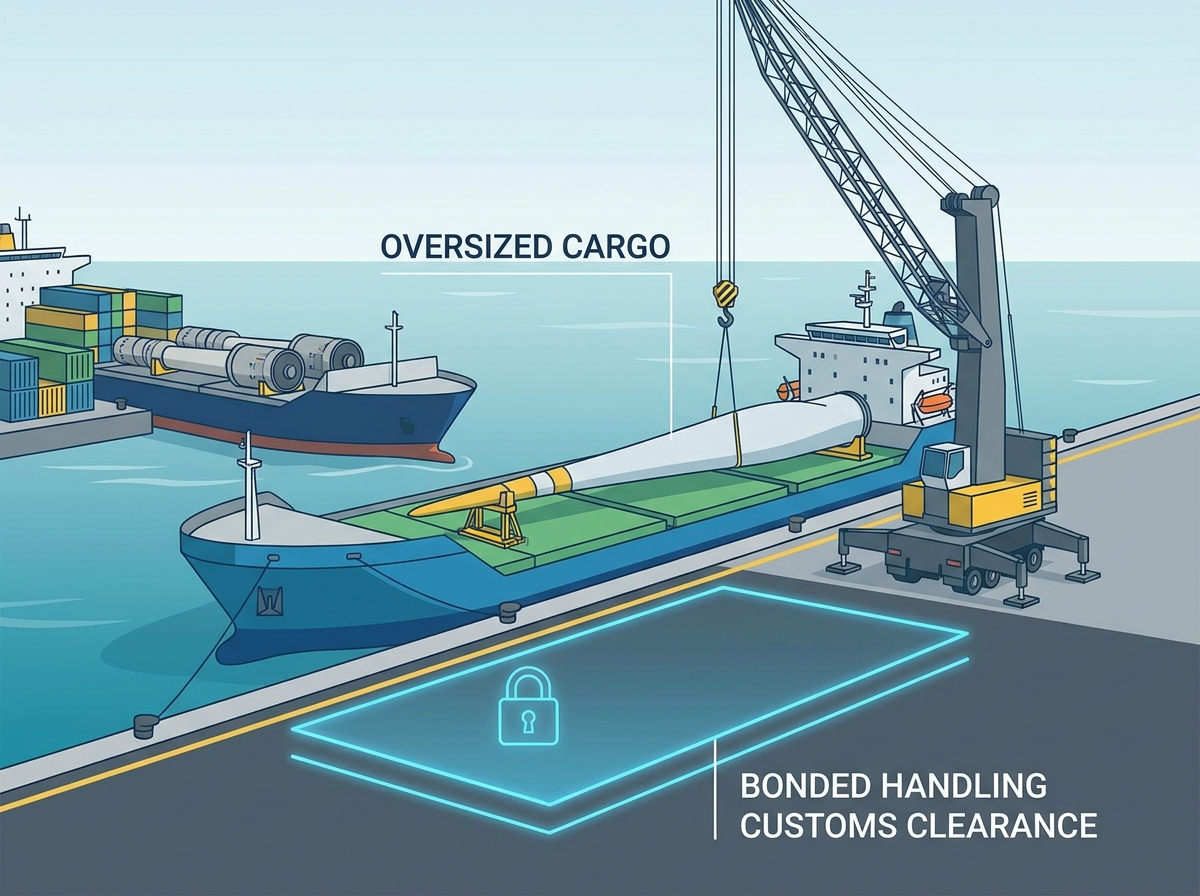
In the logistics industry, cargo exceeding the internal dimensions of standard 20-foot or 40-foot shipping containers is classified as Out of Gauge. Renewable energy equipment routinely shatters standard Out of Gauge classifications, entering the realm of ultra-heavy project cargo.
Consider modern offshore wind turbine blades. They frequently exceed 100 meters in length, requiring specialized multi-axle trailers that must be carefully steered around tight highway curves. The nacelles, which are the dense housings containing the generating components, can weigh upwards of 400 to 500 metric tons. Similarly, utility-scale solar transformers and hydroelectric turbine runners feature asymmetrical dimensions and extreme weight concentrations. These physical realities make containerization impossible.
The Risks of Inadequate Logistics Planning
Failing to properly plan for the movement of such colossal components introduces severe risks to project timelines. Inadequate preparation in special cargo and oversized load logistics can lead to catastrophic equipment damage. Custom-manufactured components have extensive lead times. Replacing a dropped transformer or a cracked turbine blade can paralyze a project for months.
Furthermore, poor logistical foresight often results in severe port congestion. If a receiving port lacks the required heavy-lift crawler cranes or adequate ground bearing capacity, cargo remains stranded on the vessel, racking up massive daily demurrage fees. To mitigate these risks, engineering teams must rely on customized stowage plans, specialized rigging, and precise lifting calculations long before the cargo leaves the factory floor.
Why Maritime Transport Services are the Backbone of Energy Projects
Given the extreme mass of green energy components, air freight is physically impossible and financially prohibitive. Long-haul rail is similarly restricted by tunnel clearances, bridge weight limits, and track curvatures. Consequently, the global green energy supply chain relies almost entirely on ocean transit.
Capacity and Specialized Vessel Capability
When evaluating ocean freight for oversized equipment, standard container ships are immediately disqualified. Logistics providers must deploy specialized fleets designed specifically for massive industrial components.
Breakbulk vessels serve as the industry standard. Many are geared, meaning they possess onboard heavy-lift cranes capable of hoisting hundreds of tons. This allows them to discharge cargo independently, even at remote ports lacking massive shore infrastructure. Roll-on/Roll-off ships feature reinforced ramps. Ultra-heavy components are loaded onto Self-Propelled Modular Transporters and driven directly into the ship hold, minimizing lifting risks and accelerating loading times. Executing a successful heavy-lift operation often requires geared vessels with combined tandem crane capacities exceeding 800 metric tons. High-deck-strength Roll-on/Roll-off vessels must support axle loads of up to 25 tons per square meter to accommodate heavy transport trailers.
Route Surveying and Port Infrastructure
Successful ocean transport begins well before vessel loading. Comprehensive route surveying is mandatory. Marine engineers conduct detailed bathymetric surveys to ensure the destination port has sufficient draft depth for heavy-lift vessels. Specifically, the load-bearing capacity of the quayside must be mathematically verified. A standard concrete pier can easily collapse under the combined weight of a 500-ton nacelle and the multi-axle trailers required to move it. Identifying these constraints early allows teams to reinforce infrastructure or select alternative discharge ports.
Core Comparison: Transport Modes for Renewable Equipment
| Transport Mode | Ideal Cargo Profile | Loading Mechanism | Max Weight Capacity | Route Flexibility |
|---|---|---|---|---|
| Geared Breakbulk | Nacelles, Heavy Transformers | Onboard Heavy-Lift Cranes | Up to 1,000+ Tons (Tandem) | High (Can discharge at remote ports) |
| RoRo Vessels | Turbine Blades, Tower Sections | SPMT Drive-On Ramps | Very High (Axle load dependent) | Moderate (Requires specific ramp infrastructure) |
| Standard Container | Spare Parts, Solar Panels, Cabling | Shore Gantry Cranes | Under 30 Tons per unit | Very High (Global port access) |
Strategic Bonded Handling: Protecting Project Cash Flow
Beyond the physical orchestration of cranes and vessels, the financial mechanics of international shipping play a critical role in project viability. Managing import duties and cash flow is often just as challenging as managing the cargo itself.
What is Bonded Handling and Warehousing?
Bonded warehousing refers to storing imported goods in a highly secure, customs-controlled zone. While the cargo remains within this designated area, it is legally considered outside the commerce of the destination country. As a result, the importer is not required to pay tariffs or value-added taxes until the goods are officially withdrawn and entered into the local market.
Financial and Operational Benefits
For multi-million-dollar installations, the financial implications are profound. Import duties on industrial equipment can represent millions of dollars in upfront costs. By utilizing bonded handling, energy companies defer these massive tax liabilities until the exact moment the equipment is needed at the site. This strategy keeps capital liquid, allowing project managers to allocate funds toward active construction rather than locking up cash in early tax payments.
Bonded zones also serve as strategic staging hubs. A wind farm might import blades from Europe, towers from Asia, and generators from North America. Companies can consolidate these disparate components in a single tax-free environment, synchronize their final delivery, and ensure just-in-time construction schedules are perfectly met.
Machinery Shipping and Customs Coordination: A Step-by-Step Approach
The administrative burden of moving oversized industrial assets is immense. A single documentation error can halt a shipment, triggering a cascade of delays. Meticulous machinery shipping and customs coordination is required to maintain momentum from origin to destination.
Accurate paperwork is the bedrock of project logistics. The Bill of Lading, Commercial Invoices, and Certificates of Origin must be flawless. The landscape of international trade shifts constantly, but many governments offer specific incentives, tariff exemptions, or reduced duty rates for equipment that directly supports green infrastructure.
Expert customs brokers meticulously classify components using the correct Harmonized Tariff Schedule codes. Misclassification not only leads to overpaying duties but can also trigger severe customs audits. Synchronizing the final port-to-site delivery is equally complex. The handover from the maritime vessel to heavy-haul trucking requires aligning vessel discharge schedules with the availability of police escorts and utility crews, who may need to temporarily raise power lines to let the cargo pass safely.
International Shipping for Industrial Equipment: Safety and Compliance
When executing international shipping for industrial equipment, safety is paramount. The extreme forces exerted on a vessel during an ocean voyage require rigorous engineering to prevent cargo shifting, which could endanger the crew and the multimillion-dollar assets.
Securing Components and Environmental Regulations
Lashing heavy-lift cargo is a highly specialized discipline. Components are subjected to dynamic rolling, pitching, and heaving. Marine engineers design custom stowage plans utilizing heavy-duty dunnage, high-tensile wire ropes, and customized welding stoppers. Every arrangement is mathematically verified to withstand the maximum anticipated weather conditions of the specific maritime route.
The maritime industry operates under strict frameworks like the International Maritime Organization and the Safety of Life at Sea conventions. The Verified Gross Mass regulation mandates that the exact weight of the cargo must be certified before loading. Accurate weight declaration is non-negotiable for maintaining the structural integrity of the ship.
Cargo Insurance and Risk Mitigation
Standard freight insurance is entirely inadequate for these assets. Project owners must secure comprehensive marine cargo insurance addressing specific maritime risks, including General Average. This is a principle where stakeholders proportionally share losses if cargo is sacrificed to save the ship in an emergency. Proper risk mitigation ensures the financial viability of the energy project remains shielded from maritime disasters.
Actionable Selection Guide for Heavy Equipment Logistics
Executing a renewable energy infrastructure project demands highly engineered project logistics. Selecting the right transport configuration directly impacts your bottom line. Use these practical guidelines to match your cargo with the optimal logistics solution:
- For ultra-long components exceeding 100 meters: Prioritize Roll-on/Roll-off vessels with multi-axle Self-Propelled Modular Transporter compatibility to eliminate high-risk tandem crane lifts.
- For high-density transformers over 300 tons: Select geared breakbulk vessels equipped with heavy-lift cranes capable of tandem lifting, ensuring safe discharge even at underdeveloped regional ports.
- For cash-strapped project phases: Utilize bonded warehousing solutions near the project site. This delays tariff payments until actual installation, preserving working capital during the most expensive construction phases.
Conclusion
Moving renewable energy equipment is far removed from standard freight forwarding. It is an exercise in extreme engineering and precise financial orchestration. By combining specialized ocean transit with smart bonded handling strategies, energy companies can defer massive tax liabilities, mitigate physical risks, and keep their infrastructure projects on time and under budget. The key to seamless execution lies in partnering with a logistics provider capable of handling the end-to-end complexities of mega-project supply chains. For your next renewable energy initiative, prioritize proactive route surveying, rigorous compliance, and engineered safety to ensure successful deployment. To configure a specialized transport plan tailored to your exact equipment specifications, visit JFSZ Logistics and explore our comprehensive maritime and heavy-lift solutions today.
Frequently Asked Questions
What qualifies as oversized cargo in renewable energy?
Cargo is classified as oversized, or Out of Gauge, when its dimensions or weight exceed the standard capacities of 20-foot or 40-foot shipping containers. Renewable energy infrastructure routinely shatters these limits. Modern onshore wind turbine blades frequently exceed 70 meters, while offshore blades can surpass 100 meters. Turbine nacelles are incredibly dense, often weighing between 200 and 400 metric tons. Because these components cannot fit inside standard containers, they require specialized handling, custom lifting frames, and transport via heavy-lift breakbulk vessels.
How does bonded handling save money on international shipping for industrial equipment?
Bonded handling serves as a strategic financial tool. When cargo arrives at the destination port, it typically becomes subject to immediate import duties, tariffs, and value-added taxes. For multi-million-dollar components, these upfront tax liabilities can severely deplete working capital. By utilizing a bonded warehouse, companies can legally store imported equipment without officially entering it into the local market. This defers all customs duties until the exact moment the equipment is dispatched to the construction site, providing unparalleled financial flexibility.
Why is machinery shipping and customs coordination so difficult for green energy projects?
The difficulty stems from high-value assets, extreme regulatory scrutiny, and complex international trade laws. Renewable energy components are highly specialized and do not always fit neatly into standard Harmonized System tariff codes. Misclassifying a part can result in severe financial penalties or cargo seizure. Claiming green energy tariff exemptions requires flawless documentation. A minor discrepancy across shipping documents can invalidate an exemption and cause the cargo to accumulate exorbitant daily port storage fees.
What type of ships are used in Maritime Transport Services for wind turbines?
Transporting wind turbine components requires specialized vessels engineered for extreme weight. Standard container ships are generally unsuitable. Logistics providers primarily rely on Heavy-Lift Breakbulk Vessels, which feature reinforced open cargo holds and their own high-capacity onboard cranes. Roll-on/Roll-off ships are also used for components pre-loaded onto multi-axle heavy transport trailers, allowing them to be driven directly into the ship hold to minimize lifting risks.
How do supply chain bottlenecks affect renewable energy project timelines?
Supply chain bottlenecks, such as a shortage of heavy-lift vessels or port congestion, can cause cascading delays across a project. If a critical component like a main transformer is delayed at sea, subsequent construction phases cannot proceed. This leads to idle labor costs, extended equipment rental fees, and potential penalties for missing grid-connection deadlines. Utilizing bonded staging areas helps buffer against these unpredictable delays.
What are the specific port infrastructure requirements for discharging heavy wind turbine components?
Discharging heavy components requires highly specialized port infrastructure. The quayside must have an exceptional ground bearing capacity, often requiring reinforced concrete to support the combined weight of a 500-ton component and the heavy transport vehicles. Additionally, the port must have adequate draft depth to accommodate deep-hulled breakbulk vessels, sufficient turning radius for 100-meter blades, and staging areas free of overhead obstacles like power lines or narrow gates.
Related Blogs
-
 When production stops, every delivery day matters. Delayed components can disrupt schedules and customer commitments. Air freight from China offers a practical solution for urgent commercial shipments. However, choosing the right service requires careful planning. This guide compares standard, priority, and express shipping. You will also learn about flight schedules, customs clearance, and cargo preparation.
-
 Air freight from China offers speed, but costs can vary significantly. Do you know what determines your final shipping bill? This guide explains air freight cost from China, including per-kilogram rates, chargeable weight, surcharges, and destination fees. Learn how to estimate costs and reduce shipping expenses.
-
 Choosing the right shipping method can significantly affect your import costs. How do you select the best option for your cargo? China to Europe sea freight offers flexible FCL, LCL, and door-to-door solutions. This guide compares shipping options, transit times, costs, and customs requirements to help you make informed decisions.
