



The global pharmaceutical industry operates in a high-stakes environment. Precision is not optional. It is a fundamental requirement for human safety. Every year, manufacturers, distributors, and clinical trial organizers transport billions of dollars worth of life-saving medications across international borders. In this complex network, a single temperature deviation can destroy the chemical efficacy of a drug. The result? Severe patient safety risks and catastrophic financial losses.
Simultaneously, these organizations face immense pressure to navigate intricate international trade laws, fluctuating tariffs, and stringent import regulations. The intersection of strict temperature control and complex customs compliance creates a massive logistical bottleneck. This bottleneck can easily paralyze an entire supply chain.
How do industry leaders overcome these hurdles? Pharma and healthcare cold-chain bonded storage emerges as the ultimate strategic solution. By utilizing specialized, legally designated warehousing facilities, businesses can legally defer customs duties and taxes. They ensure rigorous regulatory compliance while keeping highly sensitive medical products perfectly preserved in validated environments. This comprehensive guide explores the critical infrastructure, regulatory frameworks, and operational strategies required to secure the right logistics partner and optimize your global distribution network.
Recent market analyses reveal a structural shift in global pharmaceutical supply chains. The surge in advanced biologics and personalized medicines has pushed traditional logistics to their breaking point. Companies are rapidly abandoning fragile just-in-time shipping models. Instead, they are adopting decentralized bonded hubs. This strategic pivot buffers against geopolitical shocks and ensures thermal integrity closer to the end patient. By staging inventory in tax-deferred zones, pharmaceutical giants are effectively turning their supply chains from cost centers into competitive advantages.
Key Takeaways
- Strategic Cost Savings: Bonded storage allows pharmaceutical manufacturers to defer customs duties and local taxes until the products officially enter the consumer market. This significantly frees up corporate cash flow.
- Unbroken Cold Chain: Premium facilities guarantee strict, validated temperature ranges supported by relentless continuous monitoring systems.
- Regulatory Compliance: Integrated customs clearance protocols prevent devastating border delays. This ensures life-saving therapeutics do not degrade while awaiting regulatory approval.
- End-to-End Logistics: Reliable third-party logistics providers seamlessly connect static bonded storage with dynamic international transport. This creates a risk-free, closed-loop supply chain.
Understanding the Core of Bonded Cold-Chain Infrastructure
To truly grasp the value of this specialized logistics sector, we must examine its two foundational components. These are the customs-bonded framework and the cold-chain infrastructure.
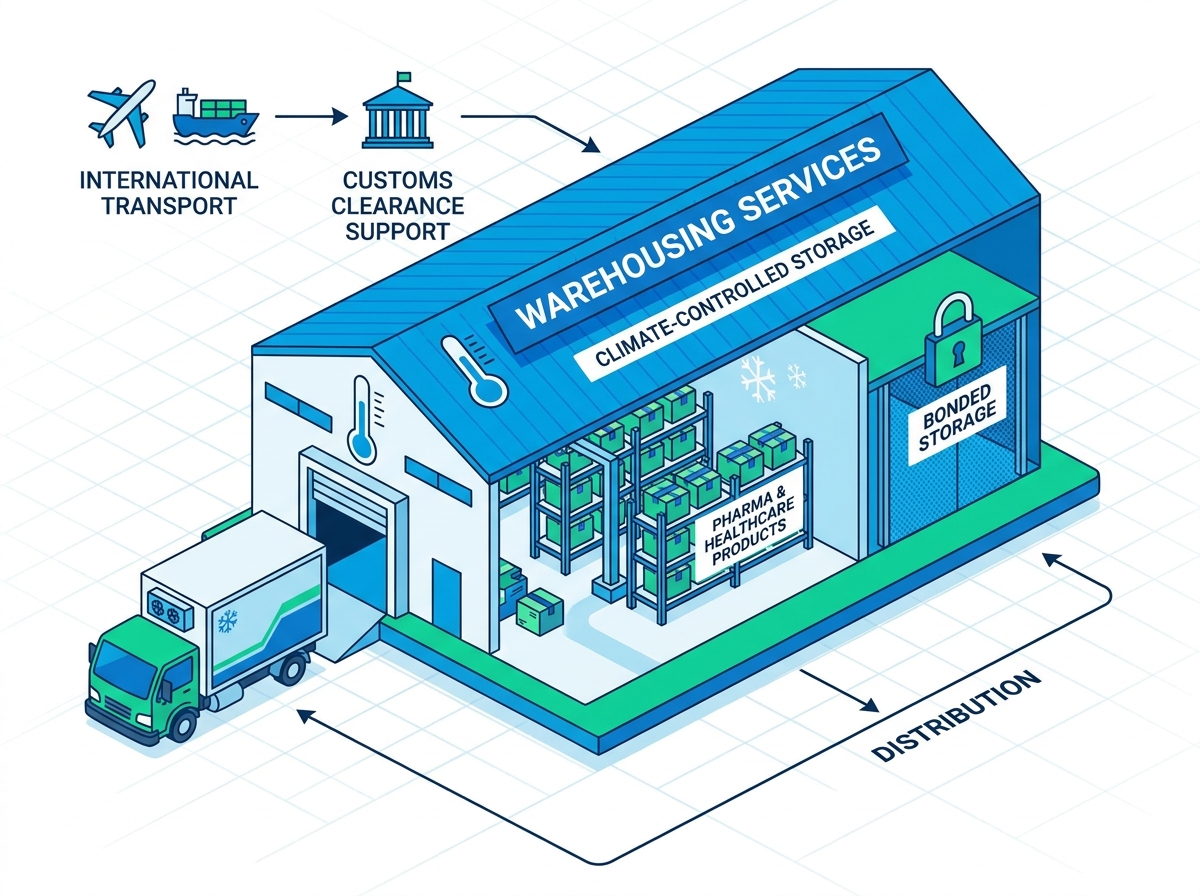
A customs-bonded warehouse operates as a highly secure, government-regulated haven. Within this designated zone, imported goods can be stored, manipulated, or undergo secondary packaging operations without the immediate payment of duties. The importer only absorbs these tax liabilities when the goods are formally withdrawn for domestic consumption. Furthermore, if the goods are eventually exported to another country, those duties are entirely bypassed.
When state-of-the-art refrigeration is integrated into this model, the facility transforms into a highly specialized hub tailored specifically for medical imports and exports. This combination creates a literal safe haven for pharmaceuticals. The products remain in a legally suspended state regarding customs, while physically residing in a meticulously controlled climate that prevents degradation.
Why the Pharma Industry Relies on Bonded Warehousing
Pharmaceutical distribution is rarely a straightforward journey. Manufacturers frequently produce active pharmaceutical ingredients in massive batches to achieve economies of scale. Bonded warehousing provides a distinct strategic advantage. It allows companies to position this bulk inventory globally, placing it dangerously close to target markets without incurring immediate, massive upfront tax liabilities.
For instance, an organization managing multi-national clinical trials can utilize regional bonded hubs to stage experimental drugs. This allows for rapid, decentralized deployment to trial sites across different countries the moment patient enrollment dictates. It completely eliminates the need to wait weeks for cross-border shipping.
Critical Elements of Warehousing Services for Sensitive Cargo
Safeguarding life-saving pharmaceuticals requires infrastructure engineered with absolute precision. This goes far beyond standard commercial storage. Modern warehousing services for sensitive cargo are governed by strict Good Distribution Practice guidelines. They utilize advanced physical builds and robust technological networks to eliminate environmental risks entirely.
Strict Temperature and Humidity Zoning
Different medical products demand vastly different thermal environments to maintain their chemical integrity. A validated facility must maintain multiple, physically isolated zones. This prevents cross-contamination and ensures exact thermal management.
| Temperature Zone | Thermal Range | Humidity Control | Typical Pharmaceutical Applications |
|---|---|---|---|
| Controlled Room Temp | 15°C to 25°C | Under 60% RH | Solid oral dose medications, medical devices, and baseline active ingredients. |
| Refrigerated Cold | 2°C to 8°C | Strictly Monitored | Biologics, insulin, traditional vaccines, and monoclonal antibodies. |
| Frozen | -20°C to -25°C | N/A | Plasma derivatives, specific varicella vaccines, and raw biological materials. |
| Ultra-Low Cryogenic | -70°C to -196°C | N/A | mRNA vaccines, cell and gene therapies, and clinical trial biosamples. |
Continuous Monitoring and Redundancy Systems
Infrastructure is ultimately only as reliable as its backup systems. Power failures or sudden equipment malfunctions are the primary culprits behind disastrous temperature excursions. To mitigate this, top-tier facilities employ comprehensive redundancy protocols.
Advanced Internet of Things sensors are deployed densely throughout the storage areas. These provide relentless real-time data logging. The systems conduct continuous thermal mapping to identify and eliminate potential hot or cold spots before they affect the product. If a parameter deviates by even 0.5 degrees Celsius, automated alert systems instantly notify on-call facility managers.
Specifically, N+1 redundancy in power generation is a non-negotiable standard. Should the municipal grid fail, heavy-duty diesel backup generators roar to life within 10 seconds. They seamlessly carry the load of commercial-grade compressors to ensure the internal climate remains undisturbed.
Expert Tips: Climate-Controlled Storage for Perishables and Biologics
While cutting-edge infrastructure lays the foundation, it must be paired with rigorous operational discipline. For pharmaceutical professionals, implementing data-driven best practices in climate-controlled storage for perishables and biologics is essential. This guarantees product efficacy from receipt to final dispatch.
Advanced Cold-Chain Packaging Solutions
Storage does not exist in a vacuum. It must integrate flawlessly with the packaging protecting the product. Logistics managers generally categorize packaging solutions into two distinct types. These are active and passive systems.
Active containers act as portable refrigerators. They utilize battery-powered or electric cooling systems to regulate internal temperatures dynamically. They are frequently deployed for high-value biologics where any thermal deviation carries catastrophic risks. In contrast, passive packaging relies on advanced phase change materials enclosed within highly insulated vacuum panels. When staging products in a bonded warehouse, operators must maintain dedicated, temperature-specific areas strictly for pre-conditioning these materials before they are packed with the outbound pharmaceuticals.
Standard Operating Procedures
Human error remains a significant vulnerability in logistics. This is exactly why technology must be governed by rigid Standard Operating Procedures. Pharmaceutical warehouses strictly enforce First-Expired, First-Out inventory protocols. This ensures that stock nearing its expiration date is picked and distributed first, drastically minimizing costly waste.
Furthermore, minimizing dock times is critical. The physical transition zone between the climate-controlled warehouse and the transport vehicle is the most vulnerable point in the cold chain. Strict protocols mandate rapid cross-docking operations. Facilities utilize sealed dock shelters and temperature-controlled anterooms to prevent thermal shock during loading.
Streamlining Global Trade with Healthcare Product Customs Clearance Support
Even the most advanced refrigeration technology is rendered useless if cargo is held up for weeks at a border crossing due to a missing signature. Regulatory red tape represents one of the most unpredictable and severe risks to the pharmaceutical supply chain.
Navigating International Health Regulations
International pharmaceutical trade involves navigating a labyrinth of complex regulations enforced by various national health ministries. Specialized logistics providers step in to manage this complexity by offering integrated healthcare product customs clearance support.
These compliance experts meticulously handle the preparation of commercial invoices, certificates of origin, and specific medical import licenses. By conducting preliminary compliance checks, they ensure that labeling, batch numbers, and product registrations align perfectly with the destination country's legal frameworks. This effectively mitigates the risk of sudden regulatory audits or cargo confiscation.
Accelerating Time-to-Market
Having customs clearance experts directly integrated on-site fundamentally accelerates the release of buffered goods. When documentation is pre-cleared by specialists who deeply understand pharmaceutical classifications, customs holds are drastically reduced. Processing times can often be compressed to within 24 to 48 hours. This speed prevents the dreaded scenario of sensitive cargo degrading while sitting in uncontrolled inspection zones. Ultimately, it ensures life-saving therapeutics reach patients faster.
Connecting Storage to Temperature-Sensitive International Cargo Transportation
A bonded warehouse is merely one node in a vast global network. The true test of a resilient logistics strategy is how effectively it moves goods out of the static facility and seamlessly into the dynamic transport environment.
Seamless Handoffs in Cold-Chain Logistics
The transition from static storage to dynamic transit requires meticulous, down-to-the-minute planning. Whether the cargo is destined for air freight, maritime transport, or long-haul refrigerated trucks, the handoff must be flawless.
For example, when utilizing temperature-sensitive international cargo transportation via ocean freight, active refrigerated containers are backed directly into the warehouse's sealed loading docks. The Warehouse Management System coordinates the exact moment of loading. This guarantees the container is powered, pre-cooled to the required set point, and ready. It creates an unbroken thermal corridor straight from the warehouse shelf to the shipping vessel.
Tracking and Traceability
In today's regulatory climate, end-to-end visibility is no longer an optional upgrade. It is a strict mandate. Once the cargo leaves the bonded warehouse, it must be continuously monitored. Advanced logistics providers utilize GPS and cellular-enabled temperature-tracking data loggers that travel directly with the payload.
These smart devices transmit real-time location and environmental data back to a central control tower. If a refrigerated truck experiences a compressor failure on a remote highway, the control tower receives an immediate alert. This allows for rapid intervention to save the cargo. Crucially, this traceability provides the documented chain of custody required by health authorities to prove the drug's efficacy was never compromised.
The Role of Bonded Warehouses in Clinical Trial Logistics
Clinical trials present entirely unique, high-stakes logistical hurdles. Unlike commercial distribution, which deals with predictable, large-scale volumes, trial logistics involve small batches of highly valuable, often irreplaceable experimental drugs. In addition, patient bases are frequently scattered globally, and timelines are dictated by rigid trial protocols.
Flexibility and Duty Deferment
Bonded warehousing provides the exact flexibility that Contract Research Organizations desperately require. A sponsor might manufacture an experimental biologic in Europe but conduct simultaneous trials in Asia and North America.
By utilizing bonded storage in strategic regional hubs, the research organization can position trial supplies near patient populations without officially importing them until a specific patient requires a dose. Deferring duties is vital here. Paying heavy import taxes on experimental drugs that may ultimately expire or go unused during a trial represents a massive, unrecoverable financial drain. The bonded environment allows for agile, highly cost-effective staging.
How to Choose the Right Partner for Pharma Warehousing Services
Selecting a logistics provider for pharmaceutical storage is a critical operational decision. It directly impacts product viability and corporate liability. The risks associated with substandard facilities demand a rigorous, uncompromising vendor selection process. Stop looking at generic storage providers and start evaluating engineering capabilities.
Actionable Selection Criteria
The foundational criterion for any potential partner is their certification portfolio and technical specifications. Supply chain decision-makers must demand absolute proof of compliance. Here is what you need to verify:
- System Integration: Look for a Warehouse Management System with real-time API integration. You need live visibility into your inventory levels and temperature logs.
- Power Resilience: Demand N+1 generator redundancy. Verify that their automatic transfer switch can restore full compressor power in under 10 seconds.
- Security Protocols: Ensure the facility operates with 24/7 CCTV surveillance featuring a minimum 90-day data retention policy, alongside biometric access controls for restricted drug zones.
- Quality Certifications: Require Good Distribution Practice and Good Manufacturing Practice certifications. ISO 9001 and ISO 13485 indicate a deep commitment to standardized, auditable operational processes.
Fewer handoffs inherently mean fewer opportunities for communication breakdowns, documentation errors, and temperature excursions. An integrated provider assumes total, unbroken accountability for the pharmaceutical product from the moment it leaves the manufacturing plant until it is safely administered at the healthcare facility.
Conclusion
The safe transport and storage of pharmaceuticals is a highly regulated, high-stakes endeavor where there is zero margin for error. Pharma and healthcare cold-chain bonded storage provides the perfect intersection of financial flexibility and rigorous physical quality control. By allowing companies to legally defer taxes while maintaining strict compliance in validated environments, it acts as the backbone of modern medical distribution.
Partnering with a trusted, fully integrated logistics provider minimizes risk, prevents border delays, and guarantees that life-saving therapeutics remain effective. Secure your supply chain and protect your bottom line by engaging with experts who understand the engineering nuances of medical logistics. Evaluate your current supply chain vulnerabilities today. Visit JFSZ Logistics to explore our comprehensive warehousing services, customs clearance support, and custom cold-chain solutions tailored specifically for the pharmaceutical industry.
Frequently Asked Questions
What is the main difference between standard warehousing services and bonded warehousing services?
Standard warehousing simply provides physical storage space for goods that have already legally entered the local economy, meaning all taxes have been paid. In contrast, bonded warehousing operates under strict customs control, acting as a legally designated safe zone for international trade. It allows importers to store goods securely while deferring the payment of customs duties and taxes until the products are officially released into the domestic market.
How do warehousing services for sensitive cargo handle power outages?
Premium facilities employ robust, multi-layered contingency plans to mitigate power failures. This includes heavy-duty N+1 backup diesel generators that activate automatically within seconds of a grid outage. Additionally, these facilities utilize continuous thermal mapping, redundant HVAC systems, and automated alert protocols that instantly notify off-site personnel of any temperature fluctuations, ensuring the climate remains stable.
Why is healthcare product customs clearance support critical for cold-chain logistics?
Delays at international borders are one of the primary causes of temperature excursions. If a shipment is held up due to incorrect paperwork or missing licenses, it may be left sitting in an uncontrolled inspection environment. Expert customs support ensures rapid, compliant processing and electronic pre-clearance, preventing regulatory bottlenecks and protecting the physical integrity of the medication.
Can climate-controlled storage for perishables accommodate ultra-low temperatures for vaccines?
Yes. While standard perishable storage typically covers refrigerated ranges or standard freezing, top-tier pharmaceutical facilities are equipped with specialized cryogenic and Ultra-Low Temperature freezers. These advanced units can reliably maintain temperatures as low as -80°C to -196°C, which is an absolute necessity for storing mRNA vaccines, stem cells, and sensitive biological samples.
How does a bonded warehouse integrate with temperature-sensitive international cargo transportation?
Integration relies on seamless, highly coordinated logistical handoffs. Products are packed using active or passive thermal packaging inside the climate-controlled warehouse. They are then moved through temperature-regulated dock anterooms directly into pre-cooled transport vehicles. This orchestrated movement ensures the cold chain remains completely unbroken during the physical transition from static storage to dynamic transit.
How long can pharmaceuticals be stored in a bonded warehouse?
The maximum duration goods can remain in a legally bonded state depends heavily on local customs authority regulations. In many major global jurisdictions, pharmaceutical products can be stored in a bonded warehouse for up to five years without penalty. However, the practical storage limit is always dictated by the specific expiration date and stability profile of the drug itself.
What are the GDP requirements for cold chain logistics?
Good Distribution Practice requirements mandate that medicines are obtained from the licensed supply chain and are consistently stored, transported, and handled under suitable conditions. For cold chain logistics, this means mandatory temperature mapping of storage areas, calibrated monitoring sensors, documented cleaning and pest control procedures, and rigorous training for all personnel handling the sensitive cargo.
Related Blogs
-
 Door to door shipping from China simplifies international logistics. But how can you ensure smooth delivery from factory to destination? Choosing the right shipping method, preparing documents, and understanding customs responsibilities are essential. This guide explains each shipping step, compares sea, air, and express services, and clarifies DDP and DAP terms. Learn how to arrange reliable deliveries and avoid unexpected costs.
-
 When production stops, every delivery day matters. Delayed components can disrupt schedules and customer commitments. Air freight from China offers a practical solution for urgent commercial shipments. However, choosing the right service requires careful planning. This guide compares standard, priority, and express shipping. You will also learn about flight schedules, customs clearance, and cargo preparation.
-
 Air freight from China offers speed, but costs can vary significantly. Do you know what determines your final shipping bill? This guide explains air freight cost from China, including per-kilogram rates, chargeable weight, surcharges, and destination fees. Learn how to estimate costs and reduce shipping expenses.
