



Supply chain volatility, fluctuating carrier rates, and tightening margins force logistics managers to continuously re-evaluate modal choices. Protecting profitability without sacrificing delivery service level agreements requires constant adaptation. The traditional heuristic—air for speed, sea for cost—fails complex supply chains. Relying on outdated assumptions leads to bloated freight spend, excessive inventory holding costs, or catastrophic stockouts. You need a technical, evidence-based framework for evaluating sea transit against air transit. We examine cost structures, risk profiles, capacity constraints, and cargo-specific requirements. You will learn how to architect a resilient logistics strategy that balances velocity with cost efficiency. We break down the exact mechanics of containerized shipping versus air cargo networks. You can then apply these principles directly to your routing guides, ensuring every shipment aligns with your margin requirements and delivery deadlines.
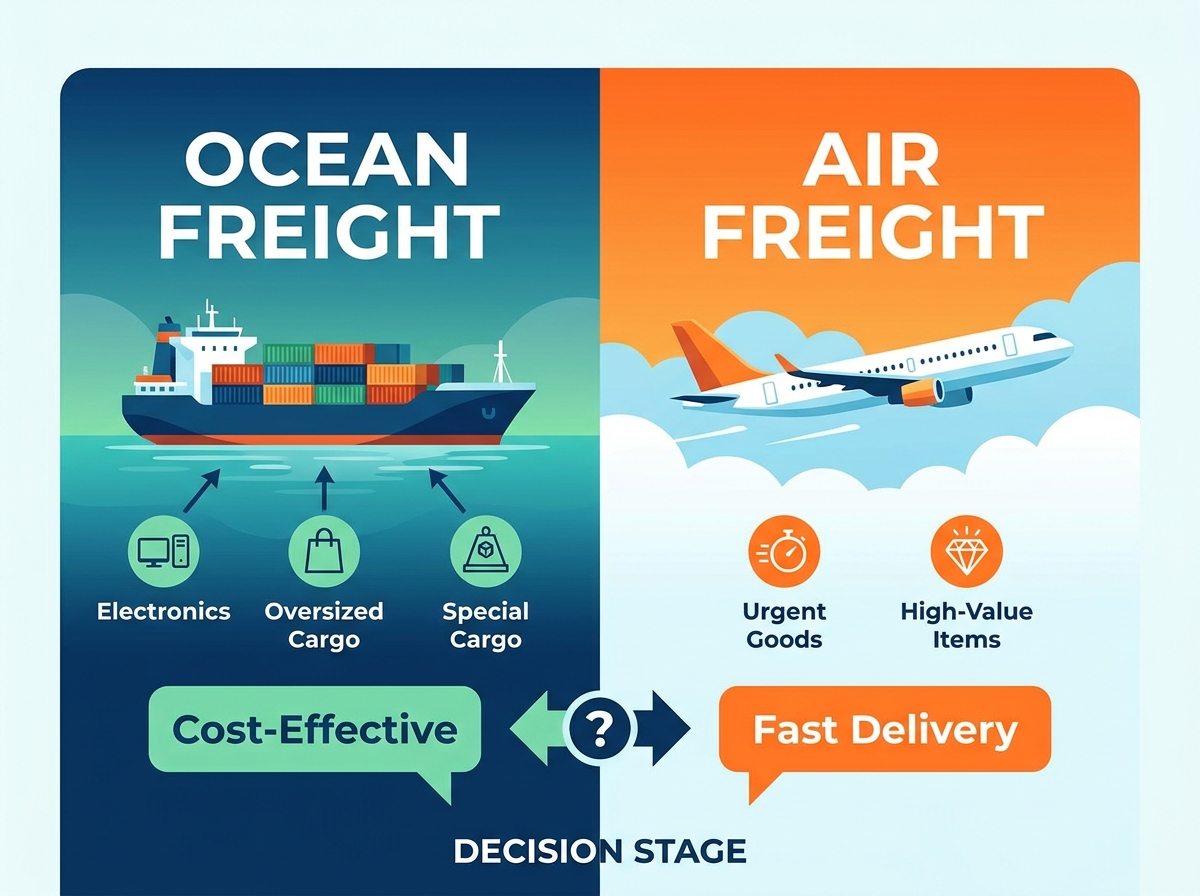
Cost Multiplier Reality: Air freight typically costs 4x to 6x more than ocean freight. For context, a baseline ocean shipment can easily scale to a massive premium by air, though this ratio fluctuates based on trade lanes, fuel surcharges, and chargeable weight calculations.
The Weight Threshold: Shipments under 100-500kg often favor air freight economically due to high base fees in sea freight. However, this threshold is highly route-dependent; heavier, denser shipments almost universally necessitate ocean transit.
Cargo-Specific Constraints: High-value, hazardous, or irregularly shaped goods dictate modal choice. Air freight has strict dimensional and restricted-item limitations, making specialized ocean routing mandatory for bulky or hazardous cargo.
Hybrid Viability: Sea-air multimodal solutions offer a strategic middle ground, cutting transit times by up to 50% compared to pure ocean transit while saving roughly 30% on pure air freight costs.
Fundamental Mechanics: Ocean Freight vs. Air Freight
Ocean Freight: Capacity, Cost-Efficiency, and Scale
Sea transit operates on massive economies of scale. Shippers utilize two primary containerized models: Full Container Load (FCL) and Less than Container Load (LCL). FCL grants exclusive use of a container, providing better security and faster routing since the box moves intact from origin to destination. Standard equipment includes 20-foot, 40-foot, and 40-foot High Cube containers. LCL consolidates cargo from multiple shippers into a single container. This requires additional handling at origin and destination Container Freight Stations (CFS). The CFS unloads trucks, measures cargo, and stuffs the container, adding several days to the transit timeline.
Baseline transit time expectations for sea shipping range from 20 to 45 days. This timeline depends heavily on the specific routing, the number of transshipment stops, and the efficiency of destination port infrastructure. Direct sailings reduce transit times, while hub-and-spoke transshipments through major ports like Singapore or Rotterdam introduce delays. Carriers also practice slow steaming, intentionally reducing vessel speed to conserve fuel and lower emissions, which extends the voyage duration.
The primary use case for ocean freight involves predictable demand cycles. It excels at moving high-volume commodities, heavy industrial goods, raw materials, and low-margin retail products. When inventory replenishment schedules are stable, the extended transit time becomes a non-issue, allowing companies to leverage the massive cost savings inherent to sea transport.
Air Freight: Velocity, Security, and Premium Pricing
Air cargo networks prioritize speed and reliability. The industry divides into Express courier services and Standard air cargo. Express services handle smaller parcels with door-to-door tracking and guaranteed delivery windows. Standard air cargo moves on passenger aircraft belly space or dedicated freighter aircraft. Dedicated freighters, like nose-loading Boeing 747s or 777Fs, handle larger pallets and heavier payloads than passenger planes. Cargo is built into Unit Load Devices (ULDs), which are specialized pallets and containers contoured to fit the aircraft fuselage.
Baseline transit times for air transport range from 1 to 7 days. Direct flights offer next-day delivery capabilities, while consolidated deferred routing takes slightly longer but reduces costs. This velocity makes air transit the default choice for Just-in-Time (JIT) manufacturing, high-margin goods, perishables, Aircraft on Ground (AOG) parts, and emergency stock replenishment.
Despite its speed, air transit carries inherent physical limitations. Aircraft have strict payload weight limits and cargo door dimensional constraints. A standard lower-deck cargo door restricts freight height to roughly 64 inches. Shippers must also navigate extensive restricted items lists. Specific chemicals, flammable liquids, and certain battery types face outright bans or require complex, expensive packaging to fly legally under International Air Transport Association (IATA) regulations.
Core Evaluation Dimensions: Structuring the Decision
Table: Modal Comparison Summary
Evaluation Metric | Sea Transit | Air Transit |
|---|---|---|
Primary Billing Metric | Per Container (TEU/FEU) or CBM | Chargeable Weight (Volumetric) |
Standard Transit Time | 20-45 Days | 1-7 Days |
Capacity Limits | Extremely High (Up to 24,000 TEU per vessel) | Strict Weight and Dimensional Limits |
Carbon Footprint | Lower emissions per ton-mile | Exponentially higher emissions |
Schedule Reliability | Subject to port congestion and weather | Highly precise, minute-by-minute schedules |
Cost Structures and Pricing Models
Sea transit billing relies on spatial metrics. Carriers bill FCL shipments per container, utilizing Twenty-foot Equivalent Units (TEU) or Forty-foot Equivalent Units (FEU) as the standard measure. LCL shipments incur charges based on volume, measured in Cubic Meters (CBM). The industry uses a Weight/Measure (W/M) ratio for LCL, typically equating 1 CBM to 1,000 kilograms. If an LCL shipment weighs 2,000 kilograms but only occupies 1 CBM, the carrier bills for 2 CBM based on the weight density.
Air transit utilizes a different mathematical approach called chargeable weight. Airlines calculate both the actual gross weight and the volumetric weight of a shipment. Volumetric weight accounts for the space a package occupies, calculated by multiplying length, width, and height, then dividing by a dimensional factor (usually 6000 for centimeters). Carriers charge based on whichever number is higher. Shipping lightweight, bulky items by air results in massive freight bills because you pay for the space, not the physical mass.
Both modes carry hidden costs and accessorial charges. Sea shipping invoices frequently include Terminal Handling Charges (THC), Bunker Adjustment Factors (BAF) to offset fuel fluctuations, and Currency Adjustment Factors (CAF). Destination warehousing fees, demurrage, and detention charges accumulate rapidly if cargo sits at the port beyond the allotted free time. Air shipping includes fuel surcharges (FSC), security screening fees (SSC), and specialized handling charges for dangerous goods.
Table: Common Accessorial Charges
Charge Type | Sea Transit Application | Air Transit Application |
|---|---|---|
Fuel Surcharges | BAF (Bunker Adjustment Factor) | FSC (Fuel Surcharge) |
Terminal Fees | THC (Terminal Handling Charge) | Terminal/Ground Handling Fees |
Delay Penalties | Demurrage and Detention | Storage Fees after free time expires |
Security Fees | ISPS (International Ship and Port Facility Security) | SSC (Security Surcharge) and X-Ray Fees |
Transit Times and Supply Chain Velocity
Evaluating transit times requires looking beyond port-to-port or airport-to-airport schedules. Door-to-door realities paint a different picture. Origin drayage, export customs clearance, and terminal gate-in procedures add several days before a vessel or aircraft departs. Upon arrival, import customs clearance, terminal unloading, and final mile delivery add further delays. A factory in inland China shipping to a warehouse in the American Midwest must account for truck transit to the coastal port, rail transit from the destination port, and chassis availability at the rail ramp.
Customs clearance impacts both modes, but sea ports generally experience higher congestion levels than airports. A 30-day ocean voyage easily stretches to 45 days when factoring in origin consolidation and destination port bottlenecks. Air transit minimizes these ground-level delays, moving cargo from origin factory to destination warehouse in under a week, assuming documentation is flawless.
Transit time directly impacts inventory holding costs and cash flow conversion cycles. Goods sitting on a vessel for 40 days represent tied-up working capital. Faster supply chain velocity frees up capital, allowing companies to reinvest in raw materials or marketing. Supply chain leaders must calculate whether the working capital freed by air transit offsets the higher freight invoice.
Cargo Capacity and Commodity Suitability
Physical cargo characteristics dictate the transportation mode before cost becomes a factor. Handling oversized cargo ocean freight requires specialized equipment. Shippers utilize Breakbulk vessels, Roll-on/Roll-off (RoRo) ships, and flat rack containers to move heavy machinery, vehicles, and industrial turbines. Flat racks lack side walls and roofs, allowing cranes to load out-of-gauge (OOG) cargo from the top or sides. Stevedores then secure the load using heavy-duty lashing chains and straps. Air freight cannot accommodate these bulky or overweight items due to aircraft structural limits and narrow cargo doors.
Managing electronics ocean freight introduces different challenges. Extended time at sea exposes sensitive components to moisture and temperature fluctuations. As temperatures drop at night, condensation forms on the container ceiling and drips onto the cargo, a phenomenon known as container rain. Shippers mitigate this using hanging desiccants, moisture-barrier bags, and specialized packaging. Strict aviation regulations regarding lithium-ion batteries frequently force electronics shippers to default to sea transit to maintain compliance and avoid grounded shipments.
Navigating special cargo ocean freight requires deep regulatory knowledge. Moving perishables or pharmaceuticals demands temperature-controlled reefer containers with active monitoring. These units require continuous power from the vessel and specialized gensets when mounted on truck chassis. Hazardous materials (HAZMAT) require strict segregation on vessels according to the International Maritime Dangerous Goods (IMDG) code. Many HAZMAT classes, including certain corrosives and flammable gases, face outright bans from air transit, leaving sea transport as the only legal option.
Reliability, Risk, and Security
Schedule integrity varies wildly between the two modes. Sea transit suffers from frequent blank sailings, where carriers cancel scheduled port calls to manage capacity. Port congestion, labor strikes, chassis shortages, and severe weather patterns routinely delay vessels by weeks. Cargo gets rolled to subsequent voyages if the vessel is overbooked. Air transit operates on minute-by-minute schedule adherence. Airlines prioritize strict slot times, making air cargo highly reliable for time-sensitive deliveries.
Damage and theft risks also differ. LCL sea shipping involves multiple handling touchpoints. Forklifts move pallets in and out of consolidation warehouses, increasing the risk of physical damage. Rough seas cause cargo shifting inside containers if blocking and bracing are inadequate. Air transit utilizes Unit Load Devices (ULDs). These specialized aluminum containers fit perfectly into aircraft contours, minimizing handling touchpoints and providing a highly secure, tamper-evident transit environment.
Environmental Impact and ESG Compliance
The carbon footprint disparity between the two modes is massive. Air transit emits exponentially more carbon dioxide per ton-mile than sea shipping. Burning aviation fuel at high altitudes creates a severe environmental impact, making air cargo the least sustainable transportation method available.
Regulatory pressures reshape logistics strategies globally. Initiatives like IMO 2023 enforce strict Carbon Intensity Indicators (CII) on maritime vessels, pushing the industry toward cleaner fuels and optimized routing. Corporate ESG mandates and regional carbon taxes force companies to reduce their Scope 3 emissions. Meeting these corporate sustainability targets requires a deliberate modal shift away from air transit toward optimized sea routing.
Strategic Trade-Offs and Value Influencing Factors
The Inventory Cost vs. Freight Cost Equation
Logistics professionals must balance the cost of holding inventory against the premium price of rapid transportation. Capital tied up in transit generates no revenue. If a company ships high-value components, the interest and opportunity cost of having millions of dollars sitting on the ocean for six weeks may exceed the cost of flying those components overnight.
Product lifecycle impacts further complicate this equation. Fast fashion garments lose market value rapidly. If a trend peaks while the inventory is halfway across the Pacific, the retailer faces massive markdowns upon arrival. Consumer electronics face similar obsolescence risks. For products with short, volatile lifecycles, the speed of air transit preserves profit margins by capturing peak market demand before competitors arrive.
Multimodal Solutions (Sea-Air Routing)
Combining sea and air transit mitigates risk and balances the speed-cost trade-off. Sea-air multimodal routing leverages the geographical advantages of major global transshipment hubs. This hybrid model cuts transit times significantly compared to pure sea routing while generating substantial savings against pure air routing.
Common sea-air transshipment hubs include Dubai, Singapore, and Los Angeles. A shipper might move cargo from a factory in Asia to Dubai via sea. Upon arrival in Dubai, ground handlers transfer the pallets directly to an airport for final delivery to Europe. Executing this requires precise operational logistics, synchronized customs documentation, and reliable forwarder partnerships to prevent bottlenecks at the transfer hub.
Implementation Risks and Mitigation Strategies
Packaging and Preparation Standards
Preparation standards diverge sharply based on the chosen mode. Air transit demands weight minimization. Shippers use lightweight plastic pallets and reinforced corrugated cardboard to reduce the chargeable weight. Every excess kilogram directly inflates the freight bill. Structural integrity remains important, but weight reduction takes priority to avoid paying for dead weight.
Sea transit demands rugged structural integrity and stacking strength. Cargo faces dynamic physical forces during a 30-day voyage, including pitch, roll, and heave. Shippers use heavy-duty wooden crates and heat-treated pallets compliant with ISPM-15 regulations. Moisture mitigation tactics are mandatory. Desiccants, Volatile Corrosion Inhibitor (VCI) packaging, and vacuum-sealed foil bags protect metal components and electronics from corrosive saltwater humidity.
Table: Packaging Standards Comparison
Packaging Element | Sea Transit Standard | Air Transit Standard |
|---|---|---|
Pallet Material | Heavy-duty ISPM-15 treated wood | Lightweight plastic or corrugated |
Moisture Protection | Mandatory (Desiccants, VCI, Foil) | Optional (Standard polybags) |
Structural Focus | Stacking strength and dynamic force resistance | Weight minimization and contour fitting |
Customs and Documentation Delays
Documentation workflows dictate the speed of customs clearance. Sea transit relies on the Bill of Lading (B/L). The B/L acts as a receipt, a contract of carriage, and a document of title. Releasing cargo at the destination port requires the proper transfer of this title, often involving original paper documents sent via courier. Air transit uses an Air Waybill (AWB). The AWB serves as a receipt and contract but does not convey title, simplifying the release process upon arrival.
To prevent bottlenecks, shippers must implement pre-clearance strategies. Submitting commercial invoices, packing lists, and accurate Harmonized Tariff Schedule (HTS) codes to customs brokers before the cargo arrives is mandatory. Failing to pre-clear air shipments completely negates the speed advantage of flying, leaving expensive cargo stranded in airport bonded warehouses accumulating storage fees.
Conclusion
Audit historical shipping data to identify specific lanes where air transit premiums erode product profit margins.
Establish hard weight and volume thresholds for your highest-velocity SKUs to trigger automatic modal shifts.
Update packaging standard operating procedures to include moisture mitigation and ISPM-15 compliant crating for all sea-bound freight.
Implement pre-clearance workflows with your customs broker, ensuring all HTS codes and commercial invoices are submitted prior to departure.
Consult with a specialized freight forwarder to model route-specific scenarios and test sea-air hybrid options through major transshipment hubs.
FAQ
Q: What is the average price difference between ocean freight and air freight?
A: Air transport typically costs four to six times more than sea transport. This multiplier fluctuates based on seasonal demand, fuel surcharges, and available capacity. Shippers must calculate chargeable weight to get an accurate comparison, as bulky items incur massive premiums when flown.
Q: At what weight threshold does ocean freight become cheaper than air freight?
A: Shipments under 150 kilograms often favor air transport due to the high flat-rate base fees associated with sea container handling. Once cargo exceeds 500 kilograms or takes up significant cubic volume, sea transit becomes exponentially more cost-effective. This threshold varies based on specific trade lanes.
Q: How do you calculate chargeable weight for air vs. ocean shipments?
A: Air carriers calculate chargeable weight by comparing the actual gross weight to the volumetric weight and charging the higher number. Volumetric weight uses a dimensional factor, typically 1:167. Sea LCL shipments are billed based on volume, measured in Cubic Meters, unless the cargo is exceptionally dense.
Q: Is ocean freight safe for shipping high-value electronics?
A: Yes, provided shippers use strict moisture mitigation tactics. Extended time on the water causes container condensation. Shippers must use desiccants, vacuum-sealed bags, and VCI packaging. Booking FCL reduces handling touchpoints, significantly lowering the risk of theft or physical damage compared to LCL consolidation.
Q: Why are certain items restricted from air freight but allowed in ocean freight?
A: Aviation safety regulations strictly prohibit materials that pose fire, explosive, or toxic risks at high altitudes and changing atmospheric pressures. Lithium-ion batteries, flammable liquids, and corrosive chemicals frequently face air bans. Sea vessels have specialized segregation zones and ventilation systems to handle these dangerous goods safely.
Q: What is the environmental impact difference between air and sea freight?
A: Air cargo emits significantly more carbon dioxide and greenhouse gases per ton-mile than maritime shipping. Moving goods by sea is the most carbon-efficient method of global transport. Companies facing strict environmental mandates actively shift their logistics to maritime routes to reduce their supply chain emissions.
Related Blogs
-
 Door to door shipping from China simplifies international logistics. But how can you ensure smooth delivery from factory to destination? Choosing the right shipping method, preparing documents, and understanding customs responsibilities are essential. This guide explains each shipping step, compares sea, air, and express services, and clarifies DDP and DAP terms. Learn how to arrange reliable deliveries and avoid unexpected costs.
-
 When production stops, every delivery day matters. Delayed components can disrupt schedules and customer commitments. Air freight from China offers a practical solution for urgent commercial shipments. However, choosing the right service requires careful planning. This guide compares standard, priority, and express shipping. You will also learn about flight schedules, customs clearance, and cargo preparation.
-
 Air freight from China offers speed, but costs can vary significantly. Do you know what determines your final shipping bill? This guide explains air freight cost from China, including per-kilogram rates, chargeable weight, surcharges, and destination fees. Learn how to estimate costs and reduce shipping expenses.
