



Global supply chains present massive operational bottlenecks for companies scaling international trade. Fluctuating carrier capacity, geopolitical disruptions, and tightening customs regulations expose shippers to severe financial risks. Managing multiple carriers, deciphering international trade laws, and handling exception management drains internal resources. You need to participate in global trade without mastering every logistical detail. This allows your team to focus on core competencies like product development and sales. A freight forwarder acts as a strategic risk-management partner and central coordinator. They handle the physical movement, documentation, and compliance required to move cargo across borders. We will define the exact operational boundaries of a forwarder, outline their tangible return on investment, and provide a framework for evaluating and selecting the right partner for your specific supply chain requirements.
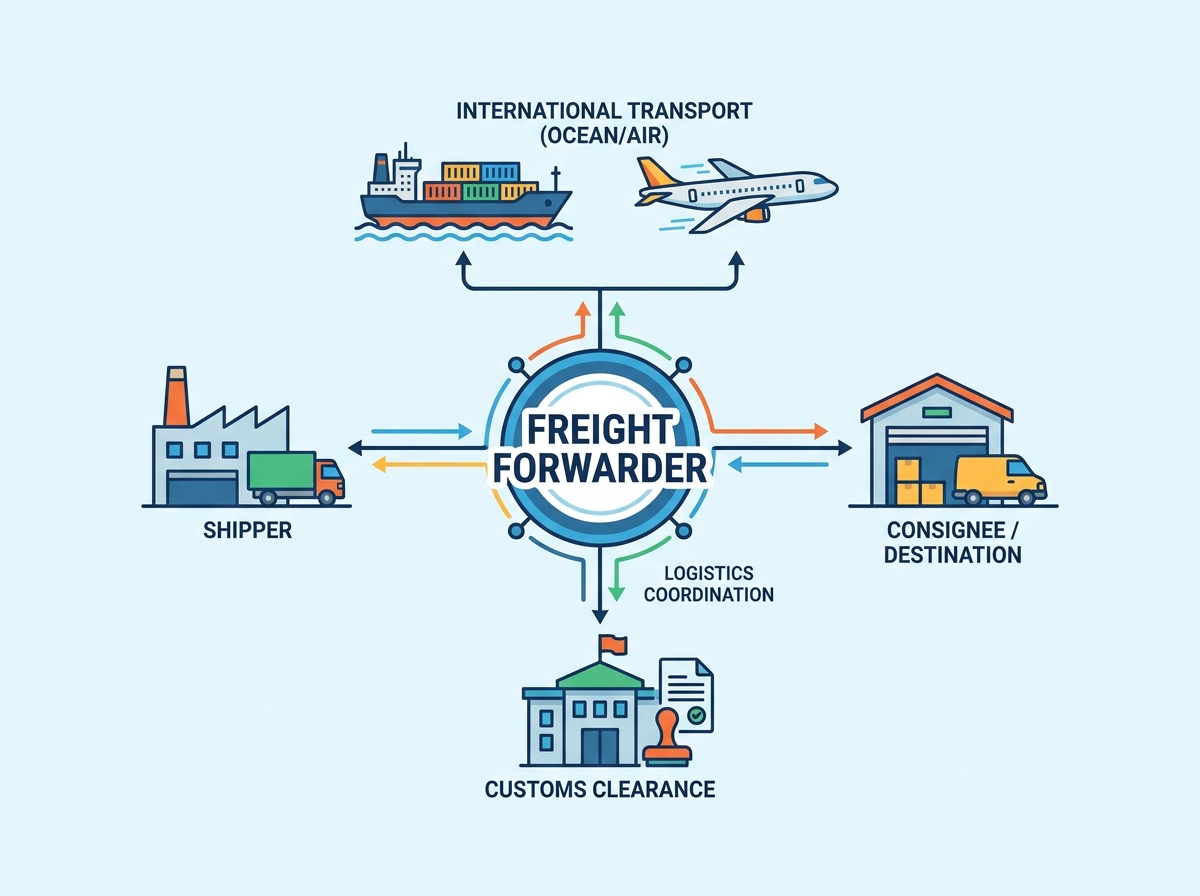
Operational Definition: A freight forwarder acts as the architect of your supply chain, organizing the movement of goods from origin to destination without physically moving the freight themselves.
Core Competencies: Their primary value lies in carrier negotiation, route optimization, risk mitigation, and managing complex international documentation.
Evaluation Criteria: Selecting a forwarder requires auditing their specific trade-lane expertise, technology stack (visibility), financial stability, sustainability reporting, and licensing credentials.
Risk Mitigation: The right partner shields shippers from compliance penalties and demurrage fees, acting as a single point of accountability during supply chain disruptions.
Defining the Operational Boundaries of a Freight Forwarder
Understanding the exact role of a forwarding agent begins with separating the coordination of logistics from the physical ownership of transportation assets. Shippers often misunderstand where a forwarder's responsibility begins and ends. Clarifying these operational boundaries ensures you align your supply chain expectations with the actual services provided on the ground.
The "Architect" vs. The "Asset Owner"
A fundamental distinction in global logistics is that forwarders typically do not own the ships, planes, or trucks that move your cargo. They operate as non-asset-based coordinators. Think of them as the architects and general contractors of your supply chain. An architect designs a building and hires specialized subcontractors to pour the concrete and frame the walls. Similarly, a forwarder designs the optimal shipping route and contracts with asset owners—ocean carriers, airlines, and trucking companies—to execute the physical movement.
Asset owners operate the heavy machinery. Maersk and MSC own the container vessels. Union Pacific runs the rail lines. Forwarders own the contracts, the global agent network, and the digital infrastructure. This asset-light model provides significant flexibility. Because they are not tied to filling their own ships or planes, forwarders remain objective. They leverage established global networks to secure capacity, negotiate favorable rates, and switch carriers instantly if a specific port becomes congested or a shipping line experiences delays. Their primary assets are their industry relationships, regulatory knowledge, and technological infrastructure.
Freight Forwarder vs. 3PL vs. NVOCC
The logistics industry relies heavily on acronyms, leading to frequent confusion between overlapping service providers. Distinguishing between a forwarder, a Third-Party Logistics (3PL) provider, and a Non-Vessel Operating Common Carrier (NVOCC) helps you build the right vendor network.
A standard forwarder focuses almost exclusively on the transportation of goods from point A to point B, managing the freight movement and associated documentation. In contrast, a 3PL provider typically handles broader, more comprehensive supply chain functions. While a 3PL might offer forwarding services, their core operations usually center around domestic warehousing, inventory management, order fulfillment, and reverse logistics. You hire a forwarder to move a container from Shanghai to Los Angeles. You hire a 3PL to unpack that container, store the goods, and ship individual parcels to end consumers.
The distinction between a forwarder and an NVOCC is strictly legal. An NVOCC acts as a carrier to the shipper and a shipper to the carrier. The critical difference lies in liability and documentation. An NVOCC issues its own House Bill of Lading (HBL) and assumes carrier liability for the cargo during transit, even though they do not own the vessels. A standard forwarder acts merely as an agent, facilitating the transaction while the actual ocean carrier issues the Master Bill of Lading. Many large logistics firms hold licenses to operate as both, switching roles based on the specific requirements of the shipment.
Logistics Provider Comparison Matrix
Provider Category | Primary Function | Asset Ownership | Bill of Lading Issuance |
|---|---|---|---|
Standard Forwarder | Transportation coordination and documentation | Non-asset based | Acts as agent; carrier issues Master BOL |
3PL Provider | Warehousing, inventory, and fulfillment | May own warehouses and domestic trucks | Varies based on forwarding capabilities |
NVOCC | Ocean freight consolidation and transport | Non-asset based (leases container space) | Issues House BOL; assumes carrier liability |
Core Responsibilities: What Does a Freight Forwarder Actually Execute?
The daily execution of global trade involves thousands of micro-transactions, regulatory checks, and physical handoffs. An effective logistics partner absorbs this complexity, translating a simple purchase order into a completed delivery. Their core responsibilities span the entire lifecycle of a shipment, from the factory floor to the final receiving dock.
Route Optimization and Carrier Negotiation
Moving cargo internationally is never a straight line. An international freight forwarder analyzes transit times, cost trade-offs, and carrier reliability to engineer the most efficient routing. They evaluate whether a shipment requires the speed of air freight, the economy of ocean freight, or a multimodal approach combining rail and truck. This optimization requires deep knowledge of carrier alliances, vessel schedules, and historical port congestion data.
They negotiate space allocations and freight rates directly with carriers. During peak season, ocean carriers frequently implement blank sailings—canceling scheduled voyages to artificially restrict capacity. A skilled forwarder anticipates these blank sailings and secures space on alternative vessels, ensuring your cargo actually boards the ship rather than sitting on the origin dock for weeks.
Door-to-Door vs. Port-to-Port Coordination
Supply chains break down during handoffs. Forwarders manage every stage of the journey, bridging the gap between origin facilities, departure ports, arrival ports, and final-mile delivery. While some shippers only require port-to-port service, most rely on forwarders for complete door-to-door coordination.
This involves dispatching an empty container to the factory, arranging drayage to the origin port, managing the main carriage across the ocean, and coordinating the final truck delivery to the destination warehouse. At congested destination ports like Los Angeles or New York, forwarders manage complex drayage operations. They coordinate chassis splits, where a trucker must pick up a bare chassis from one terminal before retrieving the loaded container from another. They also execute pre-pulls, moving containers out of the terminal just before the last free day expires, storing them in a secure drop yard to avoid massive terminal storage fees.
Documentation and Compliance Management
International borders operate on paperwork. A single missing document results in customs holds, massive storage fees, or cargo seizure. A specialized customs clearance freight forwarder prepares, audits, and submits the massive volume of required documentation. They ensure commercial invoices match packing lists, verify Harmonized System (HS) codes, process Certificates of Origin, and manage export licenses.
For shipments entering the United States, they manage the Importer Security Filing (ISF 10+2). This filing must be transmitted to Customs and Border Protection (CBP) at least 24 hours before the cargo is loaded onto the vessel at the foreign port. Failing to file the ISF on time triggers an immediate liquidated damage claim from CBP. By auditing these documents before the cargo ever leaves the origin facility, forwarders prevent border delays and ensure strict adherence to destination country import regulations.
Cargo Consolidation (LCL/LTL)
Not every shipment fills a standard 40-foot container. Forwarders provide immense value through cargo consolidation, specifically Less than Container Load (LCL) and Less than Truckload (LTL) services. They combine smaller shipments from multiple customers into a single container at an origin Container Freight Station (CFS).
The forwarder receives loose pallets from various factories, loads them strategically into a single ocean container, and ships it across the ocean. Upon arrival at the destination port, the container moves to a destination CFS. The forwarder strips the container, separating the freight, and routes the individual shipments to their respective owners via LTL trucking networks. This allows smaller shippers to access international markets without paying for empty container space, drastically reducing transportation costs per unit.
Value-Added Supply Chain Services
Modern forwarding extends beyond mere transportation. To keep supply chains fluid, forwarders coordinate supplementary services on behalf of shippers. This often includes short-term warehousing at origin or destination ports to buffer against inventory gluts. They arrange for palletizing loose cartons onto ISPM-15 heat-treated pallets, shrink-wrapping cargo for stability, and applying compliance labeling required by specific retailers or destination countries. These value-added services allow shippers to bypass intermediate distribution centers and route cargo directly to end-users.
Exception Management and Risk Mitigation
Global shipping is inherently volatile. Vessels break down, port workers strike, typhoons alter shipping lanes, and carriers routinely roll cargo to later voyages due to overbooking. Exception management is the true test of a forwarder's capability. When disruptions occur, they are responsible for securing alternative routing, expediting delayed freight, and communicating revised arrival times. Furthermore, they mitigate financial risk by facilitating cargo insurance policies and managing the complex claims process if goods are damaged or lost during transit.
The Strategic Value: Why Shippers Outsource to an International Freight Forwarder
Building an internal logistics department capable of managing global freight movements requires immense capital and headcount. Outsourcing this function delivers strategic advantages that directly impact a company's bottom line and operational agility.
Leveraging Volume for Cost Control
Ocean carriers and airlines dictate rates based on volume commitments. A mid-sized shipper moving fifty containers a year possesses zero negotiating leverage against a massive ocean carrier. Forwarders pool the freight volumes of thousands of clients, controlling tens of thousands of TEUs (Twenty-foot Equivalent Units) annually.
They use this aggregated volume to negotiate lower base rates, reduced peak season surcharges, and guaranteed space allocations through Named Account Contracts (NAC) or Freight All Kinds (FAK) agreements. Shippers tap into these tier-one rates simply by partnering with the forwarder, achieving cost control impossible to reach independently.
Navigating Regulatory Complexity
Customs authorities worldwide constantly update import tariffs, restricted party lists, and compliance mandates. Ignorance of these regulations is never a valid defense. The return on investment for hiring a forwarder often materializes in the penalties you do not pay.
Proactive compliance management avoids costly customs audits, prevents cargo from being seized, and eliminates demurrage and detention charges caused by paperwork delays. Demurrage occurs when a full container sits inside the port terminal beyond its allotted free time. Detention occurs when you hold the carrier's empty equipment outside the port for too long. A forwarder acts as a regulatory shield, tracking last free days meticulously to ensure your supply chain remains fully compliant and free of penalty fees.
Incoterms and Contractual Guidance
International Commercial Terms (Incoterms) define exactly when the risk, liability, and transportation costs transfer from the seller to the buyer. Misunderstanding these terms leads to stranded cargo and bitter financial disputes. Forwarders advise shippers on the most advantageous Incoterms for their specific commercial contracts. They ensure both parties understand who is responsible for origin drayage, main carriage freight, and destination customs duties.
Common Incoterms Responsibility Transfer
Incoterm | Origin Drayage & Customs | Main Ocean/Air Freight | Destination Customs & Delivery |
|---|---|---|---|
EXW (Ex Works) | Buyer | Buyer | Buyer |
FOB (Free on Board) | Seller | Buyer | Buyer |
CIF (Cost, Insurance, Freight) | Seller | Seller | Buyer |
DDP (Delivered Duty Paid) | Seller | Seller | Seller |
Single-Point-of-Contact Accountability
Moving a single container from a factory in Vietnam to a warehouse in Chicago requires interacting with a trucking company, an origin customs agent, an ocean carrier, a destination customs broker, a port terminal operator, and a domestic rail provider. Managing these disparate vendors internally causes communication breakdowns. Outsourcing replaces dozens of vendor relationships with one centralized partner. You receive one invoice, communicate with one account manager, and hold one entity accountable for the successful delivery of your freight.
Evaluation Framework: How to Select the Right Freight Forwarder
Not all logistics providers possess the same capabilities. Selecting a partner based solely on the lowest initial quote guarantees supply chain failure. You must evaluate forwarders through a rigorous framework that assesses their operational expertise, technological maturity, and financial health.
Assessing Trade Lane and Industry Expertise
A forwarder dominating the Trans-Pacific Eastbound trade lane might have zero infrastructure in Latin America. You must evaluate their established presence in your primary geographic markets. Demand proof of their volume and carrier allocations on your specific routes. Furthermore, assess their commodity-specific expertise. Moving standard consumer goods requires different skills than managing temperature-controlled cold chain logistics, hazardous materials, or oversized project freight. Verify they possess the specialized knowledge and carrier relationships required for your exact product type.
Evaluating the Technology Stack and Visibility
Visibility is a baseline requirement. Black-hole supply chains—where you lose sight of cargo the moment it leaves the factory—are unacceptable. Evaluate the forwarder's technology stack rigorously. Demand access to real-time tracking portals that provide milestone updates from origin to destination.
Assess their API and EDI integration capabilities. Their systems must communicate seamlessly with your internal ERP or inventory management software. They should be able to transmit EDI 315 (Status Details) messages directly into your system. Look for automated exception alerts that notify your team instantly if a container is rolled or delayed at customs.
Auditing the Global Agent Network
A forwarder is only as strong as its destination agents. While a provider may have a massive office in your home country, they rely on a network of independent agents to handle operations overseas. These agents execute origin customs, coordinate factory pickups, and manage local drayage. If their agent network is weak, your supply chain will fail at the borders. Ask how they vet their global partners. Verify the quality of their network for handling destination customs and final-mile delivery, ensuring these agents operate to the same standards as the primary forwarder.
Sustainability and Carbon Reporting
Environmental, Social, and Governance (ESG) mandates are reshaping global logistics. Enterprises now require strict accounting of their carbon footprint. Evaluate a forwarder's ability to provide accurate Scope 3 emissions data for your shipments. Ask if their technology platform calculates emissions per trade lane and if they offer sustainable routing alternatives, such as prioritizing newer, fuel-efficient vessels or shifting freight from air to ocean. A forwarder incapable of carbon reporting will quickly become a liability for ESG-conscious enterprises.
Verifying Financial Stability and Licensing
The logistics industry operates on tight margins. Forwarder bankruptcies leave shippers with stranded cargo and seized containers. Verify their financial stability before signing a contract. Check their credit rating and demand proof of adequate liability insurance, including errors and omissions coverage.
Validate their operational licenses. An ocean freight forwarder must hold an active FMC (Federal Maritime Commission) license to operate in the United States as an Ocean Transportation Intermediary (OTI). Verify their IATA certification for air freight and their membership in FIATA (International Federation of Freight Forwarders Associations).
Implementation Realities and Adoption Risks
Transitioning your freight volume to a new logistics partner involves inherent operational risks. Anticipating these challenges and establishing strict onboarding protocols prevents supply chain disruptions during the handover phase.
The Risk of Quote Opacity and Hidden Fees
The most common trap in logistics procurement is the artificially low initial quote. Unscrupulous forwarders omit standard surcharges to win your business, only to hit you with massive invoices once the cargo is in transit. Demand transparent, all-in pricing structures. Force the forwarder to itemize their quotes. Ensure the rate includes terminal handling charges (THC), documentation fees, customs clearance entry fees, Peak Season Surcharges (PSS), and fluctuating bunker adjustment factors (BAF). Compare quotes based on the total landed cost, not just the base ocean freight rate.
Over-Promising on Transit Times
Global shipping is highly volatile. Forwarders eager to secure your account will often quote best-case-scenario transit times that ignore port congestion, vessel blank sailings, and customs delays. Building your inventory planning around these optimistic schedules leads to stockouts. Evaluate forwarders based on their historical on-time performance and their contingency planning, rather than their marketing promises. Demand buffer days in their transit schedules and ask exactly how they handle expedited rerouting when the primary plan fails.
Transitioning Your Supply Chain
Migrating your entire global freight volume to a new vendor overnight is reckless. Outline a realistic, phased onboarding process.
Document comprehensive Standard Operating Procedures (SOPs) that dictate communication protocols, document cutoff times, and escalation paths for emergencies.
Establish and test EDI or API data feeds between your ERP and the forwarder's tracking system.
Conduct initial test shipments on secondary trade lanes to evaluate their execution and communication.
Review KPI scorecards after the first five shipments, focusing on invoice accuracy and milestone update speed.
Migrate your most critical, high-volume routes only after the pilot program succeeds.
Conclusion
Take the following steps to optimize your global logistics strategy and select the right forwarding partner:
Map your current supply chain nodes to identify exactly where communication breaks down between your existing vendors.
Audit your historical freight invoices to locate recurring demurrage charges, detention fees, and hidden terminal handling costs.
Draft a comprehensive Request for Proposal (RFP) focusing heavily on API tracking capabilities, trade lane expertise, and exception management protocols.
Verify the FMC, IATA, and FIATA licenses of your shortlisted candidates before sharing any proprietary shipping data.
Execute a pilot program using a low-risk trade lane to validate the forwarder's operational execution and customer service responsiveness.
FAQ
Q: What is the difference between a freight forwarder and a customs broker?
A: A forwarder manages the physical transportation, route optimization, and logistics of moving cargo internationally. A customs broker is a licensed professional specifically authorized to clear goods through customs, ensuring tariff compliance and filing entry documents. While their functions differ, many large forwarders hold brokerage licenses and offer both services internally.
Q: Do I need an ocean freight forwarder if I only ship a few pallets a year?
A: Yes, low-volume shippers benefit immensely from forwarding services. Forwarders provide Less than Container Load (LCL) consolidation, combining your pallets with other shippers' cargo into a single container. This allows you to pay only for the space you use, drastically reducing transportation costs.
Q: Do I need a freight forwarder if I am shipping under EXW or FOB Incoterms?
A: Absolutely. Under Ex Works (EXW), the buyer is responsible for the entire journey from the seller's factory door. Under Free on Board (FOB), the buyer assumes responsibility once the cargo is loaded onto the vessel. In both cases, buyers need a forwarder to manage the main carriage, destination customs, and final delivery.
Q: Can a freight forwarder issue a Bill of Lading?
A: A standard forwarder acts as an agent and facilitates the issuance of the Master Bill of Lading by the actual ocean carrier. However, if the forwarder operates as a Non-Vessel Operating Common Carrier (NVOCC), they are legally permitted to issue their own House Bill of Lading directly to the shipper.
Q: Who is liable if my cargo is damaged or lost while using a freight forwarder?
A: Forwarders operate under strict limited liability clauses, often capping payouts at a few dollars per kilogram. They are rarely liable for the full commercial value of damaged goods unless gross negligence is proven. Shippers must purchase supplemental cargo insurance to fully protect their financial interests during transit.
Q: Does a customs clearance freight forwarder pay import duties on my behalf?
A: Yes, forwarders with customs brokerage capabilities can advance import duties and taxes to customs authorities on your behalf to expedite clearance. They will then invoice you for the duty amount along with a disbursement fee for fronting the capital.
Related Blogs
-
 Door to door shipping from China simplifies international logistics. But how can you ensure smooth delivery from factory to destination? Choosing the right shipping method, preparing documents, and understanding customs responsibilities are essential. This guide explains each shipping step, compares sea, air, and express services, and clarifies DDP and DAP terms. Learn how to arrange reliable deliveries and avoid unexpected costs.
-
 When production stops, every delivery day matters. Delayed components can disrupt schedules and customer commitments. Air freight from China offers a practical solution for urgent commercial shipments. However, choosing the right service requires careful planning. This guide compares standard, priority, and express shipping. You will also learn about flight schedules, customs clearance, and cargo preparation.
-
 Air freight from China offers speed, but costs can vary significantly. Do you know what determines your final shipping bill? This guide explains air freight cost from China, including per-kilogram rates, chargeable weight, surcharges, and destination fees. Learn how to estimate costs and reduce shipping expenses.
