



The rapid shift toward electric vehicles is currently crushing global supply networks. Traditional import methods are largely obsolete for modern demands. For decades, these outdated models have forced manufacturers to lock up critical working capital in massive, upfront tariffs. Consequently, procurement teams are left scrambling. They face delayed production schedules and rigid inventory controls that leave zero margin for error. Imagine a Tier 1 supplier waiting on a critical shipment of microchips. If those components get stuck in a congested port awaiting general customs processing, the entire assembly line grinds to a halt.
How do we systematically resolve these bottlenecks? The answer lies in redesigning the logistics framework. Integrating a bonded zone directly into your supply chain is no longer optional; it is a structural necessity. Beyond simple storage, this strategy requires the precise execution of a specialized freight forwarding partner. We will break down exactly how this architecture works from a frontline logistics engineering perspective.
Key Takeaways
- Cost Efficiency: Utilizing a bonded zone defers duty and tax payments. This systematically improves operational cash flow for automotive manufacturers.
- Speed and Flexibility: Bonded zones facilitate Just-In-Time and Just-In-Sequence manufacturing. Critical components are positioned near assembly lines without triggering immediate customs duties.
- Expert Navigation: Partnering with a specialized logistics provider ensures strict regulatory compliance and eliminates border bottlenecks.
- Future-Proofing: Bonded logistics frameworks adapt seamlessly to industry shifts. This includes nearshoring initiatives and the complex storage parameters required for highly regulated lithium batteries.
The Complexities of Today’s Global Automotive Supply Chain
The modern automotive industry operates on one of the most intricate logistical frameworks in the global economy. Maintaining equilibrium requires supply chain managers to navigate multiple layers of dependencies across continents. A single misstep can cost millions.
The Tiered Supplier Network
Automotive manufacturing relies on a rigid, interconnected web of global suppliers. Tier 3 suppliers provide raw materials. Tier 2 suppliers manufacture specific components like wiring harnesses. Finally, Tier 1 suppliers assemble these into integrated systems delivered directly to the original equipment manufacturer. A single disruption at the foundational level can ripple upward instantly. For instance, a shortage of specialized alloys from Asia will ultimately halt an entire production line. Managing this sprawling network requires logistics solutions that offer absolute visibility alongside dynamic buffer capacities.
Industry Trends: Regionalization and EV Demands
Recent market intelligence reveals a massive pivot toward regionalized supply networks. Driven by ongoing geopolitical tensions and fluctuating ocean freight capacities, major automotive brands are aggressively nearshoring their operations. Industry data shows a sharp increase in demand for bonded facilities located strictly near manufacturing hubs, such as the US-Mexico border or Eastern Europe. Furthermore, the physical profile of automotive freight has fundamentally changed. Supply chains are no longer merely moving stamped steel. Today, they transport heavy, highly regulated, and temperature-sensitive lithium-ion batteries. These components demand stricter compliance, making traditional point-to-point shipping highly vulnerable.
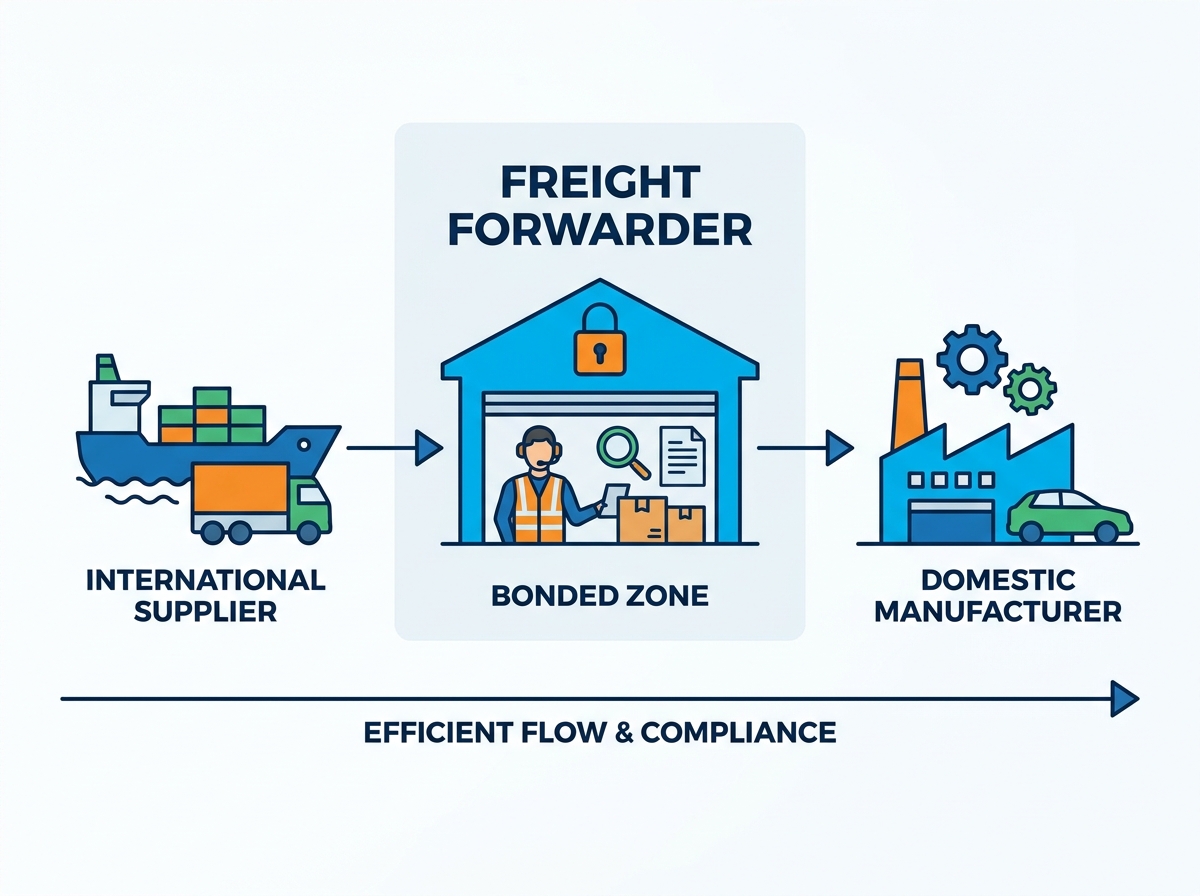
What is a Bonded Zone in Automotive Logistics?
To counter these systemic vulnerabilities, supply chain architects frequently integrate bonded zones into their operational blueprints. This approach transforms static warehousing into a dynamic financial tool.
Defining the Bonded Zone
A customs bonded warehouse is a highly secure, government-regulated facility. Here, imported goods can be stored, manipulated, or undergo specific manufacturing operations without the immediate payment of import duties and taxes. From a legal standpoint, goods inside a bonded zone are considered to be outside the commerce of the destination country until formally cleared.
How It Fits into the Automotive Sector
In the context of automotive manufacturing, the bonded zone acts as a strategic holding area. Rather than clearing a massive shipment all at once, the standard workflow operates iteratively. Parts arrive at the destination port from overseas suppliers. They are then moved under a customs bond directly into the facility. Inventory is stored tax-free for extended periods. Finally, parts are withdrawn and cleared through customs only in the exact quantities required for the assembly line.
| Process Phase | Traditional Import Model | Bonded Zone Logistics Model |
|---|---|---|
| Port Arrival | Goods held at port pending customs clearance. | Goods bypass port delays and move immediately to the bonded zone. |
| Duty Payment | Paid in full upfront upon port arrival. | Deferred. Paid only when parts leave the bonded zone for assembly. |
| Inventory Storage | Stored in domestic warehouse with taxes already paid. | Stored in bonded facility with taxes deferred. |
| Cash Flow Impact | Capital is tied up in inventory and tariffs immediately. | Capital remains liquid until parts are actively needed. |
Strategic Advantages of Bonded Storage for Imported Components
Implementing a bonded logistics strategy provides measurable financial and operational advantages. This is particularly true for high-volume, high-value component imports. The benefits extend far beyond simple warehousing.
Massive Cash Flow Improvements
The primary financial mechanism of a bonded zone is duty deferral. Automotive components often carry significant tariff rates that can cripple a manufacturer's quarterly budget. By utilizing bonded storage for imported industrial components, manufacturers avoid paying these tariffs upfront. Taxes are assessed solely when the parts are formally entered into the domestic market. Furthermore, if the components are eventually re-exported to another country for final assembly, the import duties are bypassed entirely. This protects precious profit margins.
Buffer Against Supply Chain Shocks
Lean manufacturing requires parts to be available instantly. However, global shipping remains inherently unpredictable. A bonded warehouse allows procurement officers to order bulk inventory ahead of schedule. This insulates the production line against ocean freight delays, port strikes, or severe weather events. Advanced facilities offer 24/7 CCTV monitoring, temperature-controlled zones, and API-integrated Warehouse Management Systems. The manufacturer gains the physical security of having months of inventory on hand without incurring immediate tax liabilities.
Streamlining Customs Clearance
The administrative burden of moving auto parts across borders is substantial. Bonded zones provide a structured, stress-free environment to manage these complex regulatory requirements efficiently.
Navigating Complex Automotive Regulations
Automotive parts are subject to stringent safety, environmental, and documentation standards. Depending on the jurisdiction, components must comply with specific transportation safety agencies. Ensuring that hazardous materials or safety-critical components meet these standards requires meticulous documentation. A bonded zone provides the necessary time to audit and finalize compliance paperwork without halting the physical movement of the freight.
The Clear-as-You-Go Advantage
One of the most powerful features of this framework is the ability to make partial withdrawals. Instead of clearing an entire shipping container at once, a manufacturer can execute automotive parts import customs clearance for a small batch of components. This batch is tailored specifically to that day's production schedule. Top-tier logistics providers utilize paperless customs declarations and pre-arrival clearance protocols. Consequently, the company pays only a fraction of the total duties at a time, aligning tax expenditures directly with actual production output.
Best Practices in Inventory Handling and Distribution
Maximizing the utility of a bonded zone requires sophisticated warehouse management protocols. It is not merely a static storage solution. It functions as an active, pulsating node within the supply chain network.
Supporting Just-In-Time Manufacturing
The automotive industry relies heavily on Just-In-Time methodologies to minimize the warehouse footprint at the assembly plant. Bonded distribution centers act as the ultimate enabler. By holding inventory just miles from the factory facility, logistics providers can execute high-frequency, low-volume deliveries. This feeds the production line with absolute precision timing.
Value-Added Services Inside the Zone
Legislation governing bonded zones often permits specific manipulations of the goods prior to formal customs entry. Effective bonded inventory handling and distribution encompasses value-added services. These include sorting mixed containers, kitting components for specific vehicle configurations, repackaging bulk items, and conducting quality control inspections. Performing these operational tasks pre-clearance streamlines the final manufacturing process. Most importantly, it ensures that costly duties are never paid on defective parts.
Why You Need a Specialized Freight Forwarder
Executing a bonded logistics strategy is not a task for a generalist carrier. It requires the precise orchestration of a specialized logistics partner. Supply chain managers must recognize that the seamless integration of bonded zones relies heavily on the expertise of the professionals managing the flow of goods.
The Difference Between General Logistics and Automotive Forwarding
Standard logistics providers focus merely on shuttling uniform pallets from origin to destination. In contrast, the automotive sector demands a far more granular approach. Handling fragile electronic control units requires strict climate controls to prevent degradation during transit. Securing oversized chassis components demands specialized heavy-lift equipment. Furthermore, moving volatile lithium-ion batteries requires strict adherence to international dangerous goods protocols. A specialized provider possesses the institutional knowledge to manage these diverse requirements simultaneously.
End-to-End Supply Chain Management
A fragmented supply chain introduces unnecessary risk, communication silos, and operational delays. Expert automotive parts freight forwarding eliminates these inefficiencies by providing comprehensive management. They oversee origin pickup at the overseas factory, secure ocean Full Container Load or Less than Container Load capacity, and manage the bonded zone entry. By maintaining control over the entire lifecycle, the forwarder can dynamically adjust routing to avoid port congestion.
How to Choose the Right Freight Forwarding Partner
Selecting the appropriate logistics partner is a critical decision. It directly impacts a manufacturer's bottom line and operational resilience. Procurement officers must evaluate potential partners against a strict set of technical criteria.
Key Technical Capabilities to Look For
When auditing potential logistics partners, decision-makers should evaluate specific infrastructural capabilities. Look for direct operation of certified bonded warehouses strategically located near major automotive manufacturing hubs. Subcontracting bonded storage introduces an additional layer of risk. Secondly, demand an in-house team of licensed customs brokers with specific experience in automotive compliance. Your partner should offer robust sea and air freight options, seamless Delivered Duty Paid handling, and proper dangerous goods cargo certifications.
Global Reach versus Local Expertise
An effective forwarding partner must possess a strategic dual competency. They need expansive global reach to negotiate favorable freight rates out of major manufacturing hubs in Asia or Europe. Simultaneously, they require profound local expertise at the destination. They must thoroughly understand specific municipal regulations, domestic transportation networks, and precise compliance expectations of regional customs authorities.
Conclusion
Building a resilient automotive supply chain is paramount in today's volatile economic landscape. By integrating a bonded zone into your logistics blueprint, you systematically reduce upfront costs, guarantee timely delivery, and build a robust buffer against global trade pressures. However, this sophisticated strategy demands the nuanced expertise of a specialized logistics provider. Their deep understanding of automotive compliance, dangerous goods handling, and end-to-end routing makes the entire process function flawlessly.
If you are looking to optimize your supply chain, enhance your cash flow, and completely eliminate border bottlenecks, taking action is your next step. We highly recommend partnering with an expert team that understands the exact technical parameters of automotive logistics. Explore the specialized freight forwarding, warehousing, and customs clearance solutions at JF SZ Logistics to build a future-proof supply chain today.
FAQ
What is the main difference between a standard warehouse and a bonded zone for auto parts?
The primary difference lies in customs jurisdiction and duty deferral. In a standard warehouse, all imported automotive parts must clear customs immediately. All applicable tariffs and taxes must be paid in full before the goods can be stored, tying up working capital. Conversely, a bonded zone is a highly secure area recognized by customs authorities where goods can be stored without immediate payment of duties. Tariffs are only assessed and paid when the parts are formally withdrawn for assembly.
Can a freight forwarder handle both the shipping and the bonded storage?
Yes. An integrated, specialized freight forwarder is specifically designed to offer end-to-end supply chain solutions. Rather than utilizing disparate companies for ocean freight, drayage, and warehousing, a capable forwarder manages the entire lifecycle. They seamlessly transition the automotive parts from the arrival port directly into their operated bonded facilities. This eliminates communication silos and drastically reduces transit delays.
How does bonded storage benefit electric vehicle battery supply chains?
Electric vehicle batteries are exceptionally high-value components that often attract substantial import tariffs. Furthermore, they are classified as hazardous materials, requiring highly specialized, climate-controlled storage environments. Bonded storage allows manufacturers to safely stockpile these critical, heavily regulated components near the assembly line without incurring immediate, massive tax liabilities. The duties are deferred until the exact moment they are needed on the production floor.
Does using a bonded zone slow down import customs clearance?
No. Utilizing a bonded zone actually accelerates the overall supply chain velocity. Under traditional import models, goods can be delayed at the port of entry for days or weeks due to congestion. By utilizing a bonded zone, shipments bypass standard port customs bottlenecks and move immediately to the secure facility. Once inside, the clearance process can be executed rapidly in smaller, on-demand batches.
What are value-added services in bonded inventory handling?
Value-added services refer to authorized operational activities that can be legally performed on automotive parts while they remain inside the bonded zone. Because automotive manufacturing requires precise sequencing, forwarders can perform activities such as kitting, relabeling, repackaging, and rigorous quality control inspections. This streamlines the final manufacturing process and ensures manufacturers do not pay tariffs on defective components.
How do bonded zones mitigate risks during semiconductor shortages?
During periods of severe component shortages, bonded zones act as a strategic buffer. Procurement teams can purchase microchips or electronic control units in bulk whenever they become available on the global market, regardless of immediate production needs. By storing these bulk purchases in a bonded facility, the manufacturer secures the physical inventory against future shortages without draining their cash flow on immediate import taxes.
What specific documentation is required to move auto parts into a bonded facility?
Moving parts into a bonded facility requires precise documentation to satisfy customs authorities. Standard requirements include a commercial invoice, a detailed packing list, a bill of lading or airway bill, and a specific customs bond entry form. For automotive parts, additional documentation may include certificates of origin to leverage free trade agreements, and hazardous materials declarations if you are transporting items like lithium batteries or airbag inflators.
Related Blogs
-
 Door to door shipping from China simplifies international logistics. But how can you ensure smooth delivery from factory to destination? Choosing the right shipping method, preparing documents, and understanding customs responsibilities are essential. This guide explains each shipping step, compares sea, air, and express services, and clarifies DDP and DAP terms. Learn how to arrange reliable deliveries and avoid unexpected costs.
-
 When production stops, every delivery day matters. Delayed components can disrupt schedules and customer commitments. Air freight from China offers a practical solution for urgent commercial shipments. However, choosing the right service requires careful planning. This guide compares standard, priority, and express shipping. You will also learn about flight schedules, customs clearance, and cargo preparation.
-
 Air freight from China offers speed, but costs can vary significantly. Do you know what determines your final shipping bill? This guide explains air freight cost from China, including per-kilogram rates, chargeable weight, surcharges, and destination fees. Learn how to estimate costs and reduce shipping expenses.
