



Who really pays your import taxes? It is a costly shipping question that frequently catches businesses off guard. Many buyers and sellers face surprise border fees simply because they misunderstood their shipping contracts. This misstep leads to massive delays and completely erodes profit margins.
Navigating international trade often feels like walking through a maze. Your cargo finally reaches the border, and suddenly, operations grind to a halt. One of the most common points of friction is understanding exactly who bears the financial burden of taxes and clearance fees. This is where Incoterms, formally known as International Commercial Terms, come into play. They act as the universal language of global trade. They legally dictate the responsibilities, risks, and costs between transacting parties. Simply selecting a three-letter acronym on a commercial invoice is never enough. You must deeply understand how that choice dictates your border compliance strategy.
In this comprehensive guide, we explain how shipping terms assign tax duties. We outline the customs rules clearly. We also demonstrate how partnering with frontline logistics experts streamlines your entire supply chain.
Key Takeaways
- Shipping Terms Dictate Financial Responsibility: Your chosen term legally defines whether the buyer or the seller handles border compliance and tax payments.
- Delivered Duty Paid Means the Seller Pays: Under this specific arrangement, the seller assumes all risks and costs, including import duties and taxes.
- Most Other Terms Default to the Buyer: Under popular agreements like Ex Works, Free on Board, and Delivered at Place, the buyer generally pays import duties and taxes upon arrival.
- Expert Help is Crucial: Professional intervention prevents costly border delays, unexpected fees, and severe compliance violations.
- Rebates are Possible: Proper documentation helps you navigate specialized programs to recover eligible duty costs.
What Are Incoterms and How Do They Impact Customs?
The Universal Language of Trade
These standardized rules are published by the International Chamber of Commerce. Imagine a buyer in Chicago ordering heavy machinery parts from a manufacturer in Shenzhen. Differing local commercial laws and language barriers easily derail the transaction. Standardized shipping terms step in as the universal playbook. They eliminate confusion by clearly defining the tasks, costs, and risks associated with the transportation of goods. Updated every decade, these terms establish a legally binding shipping framework worldwide.
The Crucial Link to Customs
These terms dictate who arranges the physical freight. More importantly, they determine regulatory responsibilities. Crossing an international border requires formal declarations, tariff classifications, and tax payments. Your chosen term explicitly assigns the responsibility of the import and export customs brokerage process at the destination port to either the buyer or the seller. Failing to grasp this connection often results in seized cargo. Storage fees accumulate rapidly. One party inevitably receives an unexpected, margin-destroying tax bill.
Transfer of Risk vs. Transfer of Cost
A frequent point of friction in international shipping is confusing the transfer of risk with the transfer of cost. The transfer of risk refers to the exact moment when responsibility for physical loss or damage shifts from the seller to the buyer. Conversely, the transfer of cost dictates who is financially responsible for specific charges like freight, insurance, and import taxes. In field operations, we see these two elements rarely transfer simultaneously. Understanding this distinction remains vital for accurate financial forecasting.
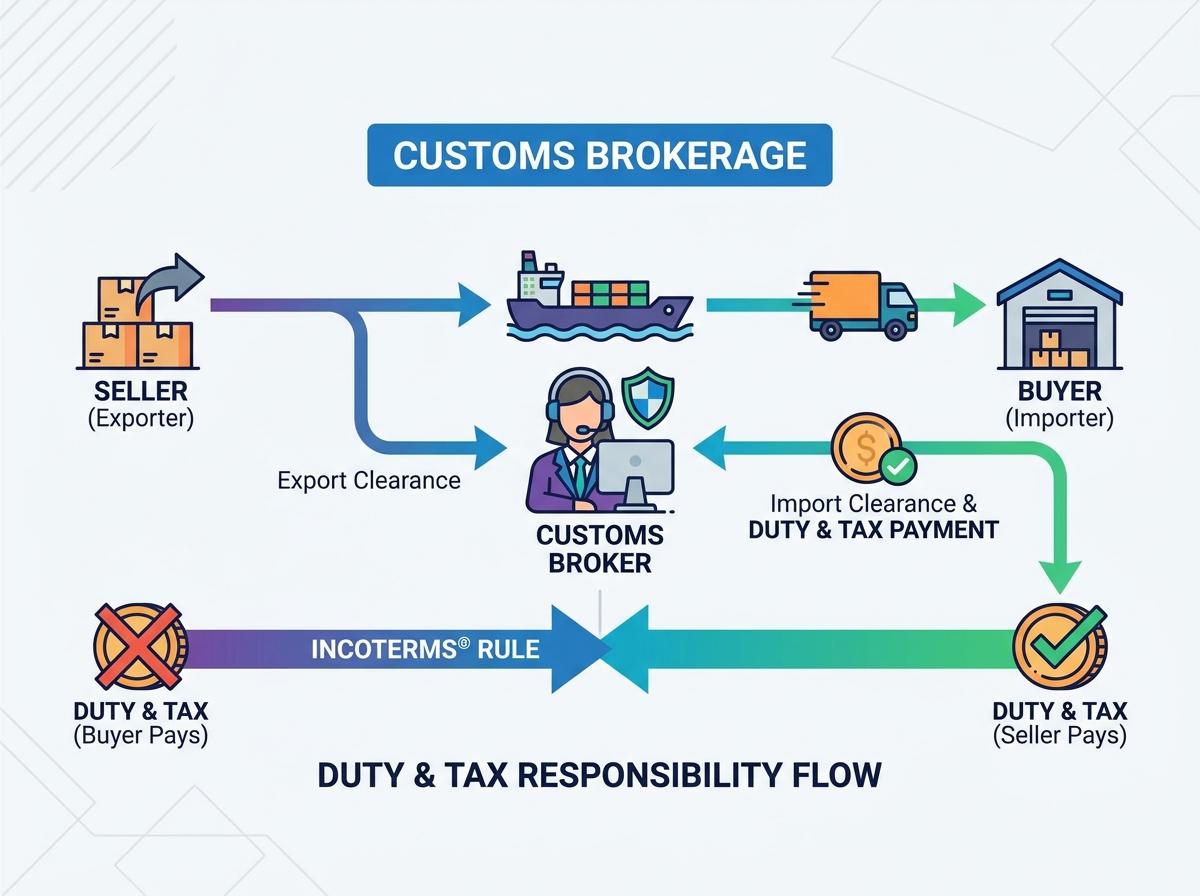
Breaking Down the Terms: Who Pays the Duties and Taxes?
To manage supply chain costs effectively, businesses must understand exactly which terms place the tax burden on the buyer and which place it on the seller. The table below breaks down the core operational differences.
| Shipping Term | Duty & Tax Payer | Clearance Responsibility | Best Operational Use Case |
|---|---|---|---|
| EXW | Buyer | Buyer | Highly experienced buyers managing their entire logistics chain. |
| FOB / CIF | Buyer | Buyer at destination | Standard ocean freight where buyers control destination costs. |
| DAP | Buyer | Buyer | Sellers wanting control over main freight without taking on foreign tax liabilities. |
| DDP | Seller | Seller | Maximum buyer convenience, often used in e-commerce or premium B2B sales. |
When the Buyer Pays
In the vast majority of cross-border trade agreements, the buyer acts as the importer of record. They are fully responsible for handling import clearance, paying duties, and settling local taxes. Ex Works, commonly known as EXW, places maximum responsibility on the buyer. It requires them to handle everything from origin export clearance to destination taxes.
Similarly, terms frequently utilized in international maritime freight services, such as Free on Board and Cost, Insurance, and Freight, default the tax burden to the buyer. Under Free on Board, the seller clears the goods for export and loads them onto the vessel. Once on board, the buyer assumes all subsequent costs, including destination tariffs. Even under Cost, Insurance, and Freight, where the seller pays to move the goods to the destination port, the buyer is still responsible for unloading, clearance, and duty payment upon arrival.
When the Seller Pays
Delivered Duty Paid, widely known as DDP, stands alone as a unique arrangement. It is the only term where the seller takes absolute responsibility for paying import duties, local taxes, and managing the destination clearance process. The seller must deliver the goods directly to the buyer's specified location, fully cleared for import. This creates a frictionless experience for the buyer. It does, however, place a massive administrative and financial burden on the seller. The seller must actively navigate foreign tax systems and regulatory frameworks.
The Delivery Confusion
Delivered at Place, or DAP, and Delivered Duty Paid are frequently mixed up. This confusion leads to bitter disputes when cargo arrives at the destination port. The operational distinction is critical. Under DAP, the seller pays for the main carriage and delivers the goods to a specific location. The buyer must handle the clearance and pay the import duties. Assuming a DAP shipment includes tax coverage is a fast track to delayed deliveries and frustrated clients.
Industry Trends: The New Era of Border Compliance
Recent industry data reveals a massive shift in global trade compliance. Geopolitical landscapes are shifting rapidly. Trade wars and tariff volatility are becoming the new normal. Customs authorities worldwide are responding by deploying advanced, AI-driven algorithms to scrutinize entry declarations.
What does this mean for frontline logistics? A minor paperwork discrepancy no longer just causes a slight delay. It frequently triggers comprehensive, company-wide audits. Environmental regulations, such as carbon border adjustment mechanisms, are introducing entirely new layers of financial liability. Relying on a robust, proactive compliance strategy is no longer just a best practice. It is a critical survival mechanism for international traders.
The Vital Role of Professional Brokerage
Why You Should Never Clear Customs Alone
Border clearance is a highly regulated, legally binding procedure. Attempting to navigate it without professional assistance exposes your business to severe operational risks. Government authorities require precise Harmonized System codes to classify goods. A single-digit error in this code drastically alters the duty rate applied to your cargo. Valuation rules dictate exactly how the value of goods must be calculated for tax purposes. Misrepresenting this value results in heavy fines, cargo confiscation, or exhaustive audits.
Bridging the Compliance Gap
A licensed customs broker acts as a specialized intermediary between the trading business and government agencies. Authorities demand accurate, timely, and compliant data regardless of the shipping term used. Brokers possess the specific regulatory knowledge required to translate commercial invoices, packing lists, and bills of lading into standardized government declarations. By pre-clearing goods or preparing documentation while the cargo is still in transit, they ensure smooth transitions. They minimize port congestion and keep supply chains highly predictable.
Common Mistakes When Assigning Duty and Tax Responsibilities
In international commerce, assumptions lead to significant financial hemorrhaging. Misaligning the chosen term with actual logistical capabilities is a primary cause of disrupted shipments.
Choosing DDP Without Local Knowledge
Many sellers offer Delivered Duty Paid to make their products more attractive to overseas buyers. Agreeing to this without having a reliable local partner in the destination country is a major operational hazard. Picture a seller in Asia shipping electronics to Germany. They suddenly realize they lack the required European registration number to act as the Importer of Record. The cargo ends up stranded at the Port of Hamburg. It racks up hundreds of euros a day in demurrage fees while the seller frantically searches for an indirect representative to legally clear the goods.
Hidden Costs at the Border
Buyers often default to Ex Works or Free on Board because the initial unit price of the goods appears significantly lower. The critical mistake here is failing to calculate the true landed cost. This comprehensive cost includes the product price, freight, insurance, and all border fees like import duties, Value Added Tax, and port handling charges. If buyers do not accurately forecast these expenses, their anticipated profit margins vanish the moment the cargo touches down.
Documentation Errors
The allocation of tax responsibility is only as effective as the paperwork accompanying the shipment. Customs officers rely strictly on the provided documents. Submitting commercial invoices with vague product descriptions forces officers to guess the tariff classification. For example, listing generic parts instead of specifying steel ball bearings for automotive assembly creates immediate ambiguity. This usually results in the application of a higher default tax rate. Massive tax overpayments follow, which are notoriously difficult and time-consuming to recover.
Navigating Duties and Tax Rebate Services
Can You Get Your Taxes Back?
Paying import taxes is not necessarily a permanent sunk cost for many supply chain models. Governments frequently offer duty drawbacks and tax rebates to encourage domestic manufacturing and international exports. If your business imports raw materials, uses them to manufacture a finished product, and then re-exports that product, you might be eligible to claim back the import duties paid on those initial materials. Goods imported temporarily for repair or exhibition also frequently qualify for substantial tax relief.
The Importance of Accurate Brokerage
Claiming these refunds is a rigorous, evidence-based process. Authorities require an unbroken, highly detailed paper trail. You must prove the initial importation, the payment of duties, and the subsequent exportation of the exact same goods. Attempting to claim a rebate is nearly impossible without perfect initial documentation. If the original import entry was filed incorrectly, the right to claim a refund is often permanently forfeited.
How Professionals Recover Your Costs
Utilizing specialized customs duties and tax rebate services through your broker is the most effective way to manage this complex bureaucratic hurdle. Professionals audit your historical import and export records. They identify eligible drawback opportunities and file the complex legal petitions required by the government. Recovering this lost revenue significantly improves your overall return on investment. It helps you maintain a sharper competitive pricing edge.
Managing Payment and Clearance Efficiently
The Step-by-Step Clearance Process
Understanding the mechanics of what happens when goods arrive at the border helps businesses prepare for their financial obligations. The process follows objective steps. First, authorities conduct a thorough document review. They examine the entry summary, commercial invoice, and transport documents. Next, based on the declared code and shipment valuation, the system calculates the exact taxes owed. Following this, the payment must be remitted. Finally, once funds are secured and physical inspections are passed, a release notification is issued. The cargo is then allowed to leave the port facility.
Methods of Payment
How duties are physically paid depends heavily on the importer's operational setup. Some importers pay directly via government portals upon arrival. Bank processing times often cause frustrating delays here. Frequent importers utilize deferment accounts. This allows them to delay duty payments until a specific date each month to aid cash flow. In fast-paced scenarios, the broker advances the payment to the government on behalf of the client to ensure immediate cargo release. They invoice the client shortly afterward.
Speeding Up the Process
Delays at the terminal are incredibly expensive. Ports and shipping lines charge demurrage for full containers and detention for keeping the physical equipment too long. Integrating professional customs duty payment and clearance solutions into your logistical workflow ensures funds are routed correctly. Paperwork is pre-filed before the vessel even docks. This proactive approach eliminates unnecessary dwell time. It protects your business from accumulating daily storage penalties.
How to Choose the Right Logistics Partner
End-to-End Solutions
Navigating the intersection of shipping terms, physical freight, and tax liabilities requires flawless synchronization. Fragmented supply chains often lead to severe communication breakdowns. One company handles the ocean freight while a completely separate entity handles the border compliance. When documents are delayed between the forwarder and the broker, the importer pays the price in storage fees. An end-to-end provider ensures the commercial invoice matches the bill of lading perfectly. This enables seamless pre-clearance.
Tailored Commercial Advice
A proficient logistics partner does more than just process paperwork. They act as a strategic commercial advisor. They evaluate your specific product line, risk tolerance, and cash flow requirements. They recommend the most cost-effective shipping term. They advise a seller whether offering Delivered Duty Paid is a safe competitive advantage or a massive compliance risk based on a specific country's tax laws. They might recommend Delivered at Place as a much safer alternative.
Stop Guessing About Tax Liabilities
International trade margins are far too tight to rely on guesswork. Misunderstanding whether the buyer or seller pays the duties leads to eroded profits, abandoned cargo, and damaged commercial relationships. Secure your supply chain. Ensure absolute legal compliance. Accurately forecast your true landed costs. Partnering with a certified logistics expert is the first critical step toward a more efficient and profitable global operation.
Conclusion
Understanding shipping terms is non-negotiable if you want to avoid surprise bills and delayed shipments in international trade. Whether you are a buyer bringing in goods under Free on Board or a seller trying to provide a seamless door-to-door experience for your customers, knowing exactly who pays the duties and taxes is the absolute foundation of a profitable supply chain. Knowing the rules is only half the battle. Ensure full compliance, avoid overpaying, and keep your cargo moving swiftly by partnering with a professional brokerage. Stop letting border bureaucracy eat into your margins. Explore our comprehensive logistics solutions and reliable services at JFSZ Logistics today to optimize your next shipment.
FAQ
What is the best Incoterm for a buyer who wants zero customs involvement?
Delivered Duty Paid is the most secure and hands-off option for buyers. Under this term, the seller is legally obligated to manage all shipping logistics, handle the clearance process, and deliver the goods directly to the buyer's specified facility. The buyer assumes no risk or financial responsibility for border taxes.
Does the customs broker pay the duties and taxes?
A broker facilitates the transaction but does not bear the legal financial liability for the taxes. Brokers often advance the payment to the government authorities to expedite the release of the cargo. They subsequently invoice the responsible party for full reimbursement based on the agreed-upon shipping term.
Who pays customs on DAP shipments?
Under the Delivered at Place term, the buyer assumes full responsibility for all import duties, taxes, and destination clearance fees. The seller pays for the transportation to the destination. The buyer must settle the tax liabilities with the local government before the final delivery is completed.
Can I get a refund if I overpaid on import duties?
Yes, recovering overpaid taxes is possible under specific circumstances. If your goods were assigned an incorrect tariff classification, or if you are importing materials strictly to manufacture goods for re-export, you might be eligible for a refund. Utilizing professional rebate services is the most reliable method to ensure your claim meets the strict evidentiary standards required by government auditors.
Do I need a customs broker for ocean freight?
While it is not strictly legally mandated for every single transaction, engaging a professional is highly recommended for ocean freight. The sheer volume of goods, the complexity of maritime port procedures, and the rigorous documentation required by border agencies make expert intervention essential. Attempting to navigate ocean freight clearance independently often results in severe delays and costly demurrage penalties.
What happens if customs duties are not paid on time?
If duties remain unpaid, customs authorities will withhold the release of your cargo. This immediately triggers daily storage and demurrage penalties at the port. In severe cases of prolonged non-payment, the government may seize, auction, or destroy the goods to recover the owed taxes.
Can a buyer refuse to pay import duties upon arrival?
Yes, a buyer can technically refuse to pay. Abandoning the shipment does not erase the financial liability, however. The cargo will be stuck at customs, accumulating massive fees. Ultimately, the freight forwarder or the seller may be forced to cover the costs or pay for the return shipping. This leads to severe commercial disputes and breached contracts.
Related Blogs
-
 Door to door shipping from China simplifies international logistics. But how can you ensure smooth delivery from factory to destination? Choosing the right shipping method, preparing documents, and understanding customs responsibilities are essential. This guide explains each shipping step, compares sea, air, and express services, and clarifies DDP and DAP terms. Learn how to arrange reliable deliveries and avoid unexpected costs.
-
 When production stops, every delivery day matters. Delayed components can disrupt schedules and customer commitments. Air freight from China offers a practical solution for urgent commercial shipments. However, choosing the right service requires careful planning. This guide compares standard, priority, and express shipping. You will also learn about flight schedules, customs clearance, and cargo preparation.
-
 Air freight from China offers speed, but costs can vary significantly. Do you know what determines your final shipping bill? This guide explains air freight cost from China, including per-kilogram rates, chargeable weight, surcharges, and destination fees. Learn how to estimate costs and reduce shipping expenses.
