



Global trade relies heavily on efficient logistics. Choosing the right container model dictates your profit margins. Importers and exporters constantly struggle to balance cost, speed, and security based on specific cargo volumes. Are you moving a few pallets of seasonal goods? Or are you restocking a massive distribution center? Deciding between full or shared containers remains a persistent supply chain challenge.
In this guide, we break down the fundamental differences between FCL and LCL container shipping. You will learn to optimize your maritime transport strategy. We will help you navigate hidden fees and make confident, cost-effective choices that strengthen your global operations.
Key Takeaways
- FCL, or Full Container Load, is optimal for large shipments typically exceeding 15 Cubic Meters. It offers significantly faster transit times, simplified logistics, and superior cargo security.
- LCL, or Less than Container Load, serves as the primary solution for smaller shipments. Businesses maintain lean inventory by paying only for the exact space they utilize.
- The standard tipping point between the two methods generally falls between 13 to 15 Cubic Meters. Beyond this volume, booking an entire container becomes more cost-effective than paying variable shared rates.
- Receiving, sorting, and packing are critical steps in shared shipping. These necessary procedures require slightly longer transit times due to complex terminal handling.
- Partnering with an experienced logistics provider ensures you secure the most efficient routing options tailored to your budgetary constraints.
Understanding the Basics of Container Shipping
To make informed logistical decisions, supply chain managers must understand the structural differences between these primary modes of ocean transport. Your choice dictates immediate freight costs and shapes your broader inventory management strategy.
What is FCL?
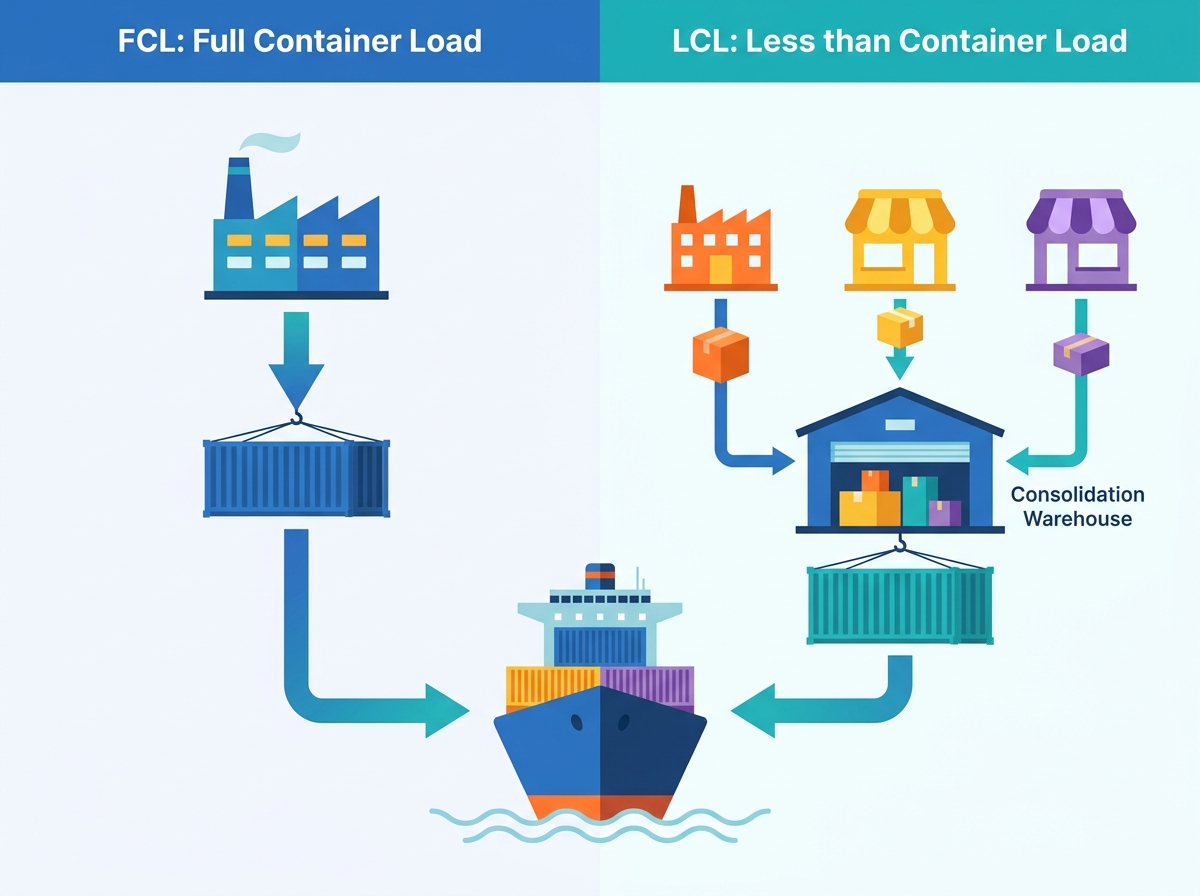
FCL refers to an ocean shipping arrangement where a single shipper rents an entire container exclusively. Common sizes utilized in global trade include the 20-foot standard, the 40-foot standard, and the 40-foot High Cube.
A widespread misconception among new importers is that a container must be filled to absolute maximum capacity to qualify for this mode. In reality, it simply means you have exclusive legal and physical rights to the interior space. Whether you load it to full capacity or only utilize half the available volume, the container is sealed at your supplier facility. It remains unopened until reaching the final destination. This exclusivity provides a predictable, flat-rate pricing structure based on the box size rather than the exact cargo volume inside.
What is LCL?
Conversely, LCL is an ocean freight model designed for shipments lacking the volume to justify an entire container. You share the interior space with goods belonging to multiple other shippers.
Because various shipments combine into one unit, this method relies heavily on the expertise of a freight forwarder. These entities collect smaller shipments heading toward the same geographic destination. They group them together at a specialized facility and load them into a single container. Once the vessel arrives at the destination port, the process reverses. Workers manually separate the individual shipments before final delivery.
Pros and Cons of Dedicated Container Services
For businesses managing substantial order volumes, booking a dedicated container is the default shipping method. However, this logistical model carries specific operational advantages and financial drawbacks that demand careful evaluation.
The Advantages of Full Containers
Dedicated shipments experience vastly superior transit speeds. The container belongs to a single consignee. Therefore, it entirely bypasses time-consuming consolidation and deconsolidation processes at both origin and destination ports. Picture a bustling terminal in Los Angeles or Rotterdam. A dedicated container swings directly from the vessel onto a waiting railcar or truck chassis. This seamless transfer shaves crucial days off your lead time.
On the security front, this method drastically reduces cargo damage. The container is loaded and sealed at the factory. This unbroken chain of custody minimizes physical handling by warehouse staff. Your goods remain insulated from the risk of theft, misplacement, or accidental forklift damage. When shipping large quantities, the flat-rate pricing model causes the cost per unit to drop significantly. It becomes the most economically efficient method for bulk inventory replenishment.
The Disadvantages of Full Containers
The primary drawback is the necessity to pay for the entire box, regardless of empty space. If your factory output drops unexpectedly, you remain responsible for the full rate. This flat fee can quickly erode profit margins on smaller shipments. Utilizing this method efficiently requires purchasing and holding larger quantities of stock. This approach ties up substantial working capital in inventory and necessitates adequate warehouse space upon arrival.
Pros and Cons of Shared Container Services
For small to medium enterprises or companies testing new markets, shared containers offer a vital lifeline. They provide immense flexibility but introduce logistical complexities that demand precise planning.
The Advantages of Shared Space
The standout benefit is operational flexibility and improved cash flow. Instead of waiting months to accumulate enough orders to fill a whole box, companies ship smaller quantities frequently. This enables a Just-In-Time inventory model. You keep warehouse storage costs lean and free up liquid cash for other business operations.
You pay strictly for what you use. The pricing model is highly variable and proportional. Costs calculate based on the exact volume or weight of your cargo. By leveraging professional container freight consolidation services, you avoid penalties for shipping empty air. This makes it a highly cost-effective strategy for small batches.
The Disadvantages of Shared Space
Shared shipments inherently take longer to reach their final destination. Cargo must arrive at a consolidation facility days before the vessel departs to allow for strategic packing. Upon arrival, the container moves to a deconsolidation facility where workers manually unpack and separate the mixed goods. This extra handling typically adds 5 to 10 days to the overall timeline.
There is also an elevated risk of cargo damage. Your cargo shares space with other goods. It undergoes frequent handling via forklifts and manual labor. If another shipper packages their cargo improperly, such as leaking liquids or heavy machinery shifting during rough seas, it poses a direct physical risk to your adjacent goods.
The Role of Cargo Warehousing in Shared Shipping
The success of a shared shipment depends heavily on physical infrastructure and procedural efficiency at the ports. The consolidation phase dictates the safety and legality of the entire oceanic voyage.
How Consolidation Works
The journey begins when your goods arrive at a Container Freight Station. Facility staff meticulously measure and weigh the cargo to verify booking dimensions. Next, the shipment undergoes cargo warehousing and consolidation. Logistics experts strategically plan the loading sequence. They balance weight distribution inside the container and ensure incompatible goods remain strictly separated. Once optimally stuffed, the container is sealed and transferred to the port terminal.
Why Modern Warehousing Matters
Secure and robust warehousing facilities are non-negotiable. Top-tier logistics providers operate modern parks equipped with 24/7 CCTV surveillance and advanced Warehouse Management Systems. Before packing, your goods may sit in a warehouse for several days. A high-quality environment protects inventory from adverse weather and unauthorized access. Facilities utilizing real-time barcode scanning and automated dimensioning ensure your specific pallets are accurately cataloged. This prevents administrative errors during the outbound loading process.
Head-to-Head Comparison
To facilitate a clear decision-making process, evaluate these models across core logistical metrics. Understanding these operational differences is critical for forecasting landed costs.
Cost Structure and Pricing Models
The primary distinction lies in how space is commoditized. Dedicated containers operate on a flat-rate pricing model. You lease the entire box for a fixed price, making cost forecasting highly predictable. Conversely, shared containers operate on a variable rate based on a Weight or Measure calculation. Forwarders charge based on whichever metric is greater: actual weight or volumetric weight. While you pay strictly for consumed space, the per-unit cost is inherently higher due to the intensive labor involved in consolidation.
Customs Clearance Dynamics
Customs clearance is a critical bottleneck. In a dedicated shipment, you are solely responsible for the contents. If your commercial invoice and customs declarations are accurate, your container clears customs without delay.
Shared shipments carry a shared risk. Imagine a scenario where your seasonal inventory stalls at customs because another shipper submitted incomplete paperwork. This is a very real risk. If a container holds cargo from ten different shippers, and just one has undeclared hazardous materials, authorities will halt the entire container. Your perfectly compliant cargo remains delayed until the offending shipment is investigated.
| Evaluation Metric | Dedicated Container (FCL) | Shared Container (LCL) |
|---|---|---|
| Cost Structure | Flat rate per container | Variable rate based on volume or weight |
| Transit Time | Faster direct routing | Slower due to stuffing and destuffing |
| Cargo Security | High security with minimal handling | Moderate security with frequent handling |
| Customs Risk | Independent risk profile | Shared risk with co-shippers |
| Ideal Volume | 15+ Cubic Meters | 1 to 14 Cubic Meters |
Cost Analysis: Finding the Tipping Point
Understanding the mathematical threshold between these models is the most effective way to optimize your logistics spend. Shippers must look beyond the base freight rate and account for the total landed cost.
The Volume Breakdown
The decision matrix is largely driven by cargo volume measured in Cubic Meters. While freight rates fluctuate based on market demand, volumetric guidelines remain relatively stable.
For shipments ranging from 1 to 10 Cubic Meters, shared space is empirically the most cost-effective choice. The variable rate is significantly lower than the flat rate of a 20-foot container. The 11 to 14 Cubic Meters range is the gray area requiring careful calculation. A standard 20-foot container holds roughly 33 Cubic Meters. However, the flat rate might actually equal or undercut total shared costs in this volume range once destination fees are factored in. At 15 Cubic Meters and above, booking the entire box universally becomes the more economical choice. Even though the container remains half empty, the flat ocean freight rate makes it cheaper than paying cumulative variable rates.
Hidden Fees to Watch Out For
When comparing quotes, do not look solely at the base ocean freight rate. Shared shipments often incur higher ancillary charges at the ports. These include Terminal Handling Charges, documentation fees, and manual labor fees for packing and unpacking. A slight overhang on a poorly packed pallet can bump up the volumetric weight, leading to unexpected charges. When aggregated, a seemingly cheap ocean rate can quickly inflate and push the total cost higher than a dedicated booking.
Current Global Shipping Trends
Looking at current market dynamics, global supply chains increasingly prioritize resilience over pure cost-cutting. Recent industry analyses highlight that fluctuating ocean carrier capacities, geopolitical disruptions, and the rise of nearshoring are reshaping logistics. We observe a massive shift toward hybrid shipping strategies. Sophisticated enterprise supply chains rarely rely on just one model anymore. Instead, they use dedicated containers for base-load inventory. These are the predictable, high-volume goods forming the core of their sales. Simultaneously, they utilize shared containers for urgent stock replenishments or testing new product lines. This agile approach mitigates the risk of blank sailings and port congestions.
How to Choose the Right Container Model
Selecting the appropriate shipping method requires evaluating each shipment individually against empirical data and internal business objectives.
Questions to Ask Before Booking
First, determine the exact volume and weight of your cargo. Calculate total volume by multiplying the length, width, and height of your packaged goods. This hard data forms the foundation of your decision. Second, evaluate delivery urgency. If your supply chain faces stockouts, the days saved by bypassing consolidation can easily justify extra freight costs.
Third, consider the nature of the goods. Highly fragile items, high-value electronics, or hazardous materials often require dedicated space. Many consolidators refuse hazardous cargo due to the risk it poses to other shippers. Finally, assess your working capital strategy. Can you afford to tie up funds in a bulk order, or is it financially prudent to order a smaller batch to maintain liquidity?
Why Partnering with a Reliable Freight Forwarder is Crucial
The complexities of international trade require precise coordination, regulatory compliance, and real-time problem-solving. Attempting to navigate fluctuating carrier alliances without professional guidance often leads to costly delays.
Navigating Complex Logistics
A reputable freight forwarder acts as the architect of your supply chain. They possess the proprietary software and industry relationships required to perform real-time cost analyses. Instead of spending hours calculating volumes and destination fees, a logistics partner does the empirical math for you. They present the most reliable ocean freight shipping services. Premium providers leverage NVOCC certifications and direct carrier contracts to secure container space even during peak seasons when capacity is scarce.
End-to-End Transport Solutions
The true value of a freight forwarder lies in comprehensive, door-to-door solutions. A premium forwarder manages the entire lifecycle of the shipment. They handle the initial factory pickup, warehousing processes, complex export and import customs clearance, and final mile trucking delivery. This end-to-end oversight mitigates risk and ensures regulatory compliance. It allows your internal team to focus on core business growth rather than logistical troubleshooting.
Conclusion
Choosing between dedicated and shared containers depends on your specific cargo volume, budget limits, and delivery deadlines. Neither shipping model is inherently perfect for every situation. You must find the strategic fit for each individual shipment. Improving your supply chain is an ongoing, dynamic business process that requires constant evaluation.
Need help navigating your next global ocean freight shipment? Partner with JFSZ Logistics. Contact our logistics experts today for a custom cost analysis. We provide seamless, end-to-end shipping services meticulously tailored for your unique business requirements.
Frequently Asked Questions
Can I track my shared shipment as easily as a dedicated shipment?
Yes, tracking visibility has improved dramatically with modern logistics technology. While multiple shippers share a single physical container, your specific cargo is tracked independently. Freight forwarders achieve this by issuing a House Bill of Lading specifically for your goods. The entire container is tracked via the carrier Master Bill of Lading. Premium forwarders utilize digital platforms that link these documents, providing real-time GPS tracking of the vessel and automated milestone updates.
Are there specific goods that cannot be shipped via shared containers?
Absolutely. Consolidators enforce strict compliance rules to protect all cargo within the container. Highly hazardous materials governed by strict international codes are frequently rejected. Perishable goods requiring active temperature control are extremely difficult to ship this way, as finding multiple shippers requiring the exact same temperature settings is highly improbable. Extremely fragile items or oversized machinery that cannot be safely stacked typically require dedicated space.
How is volumetric weight calculated for shipping?
Calculating volumetric weight is a straightforward mathematical process, but accuracy is vital to avoid billing discrepancies. The formula requires measuring the extreme outer dimensions of your packaged cargo, including the pallet itself. Multiply the length, width, and height in meters. For example, if your pallet measures 1.2 meters in length, 1.0 meters in width, and 1.5 meters in height, the calculation is 1.2 x 1.0 x 1.5, which equals 1.8 Cubic Meters. Multiply this by the total number of identical pallets.
Does shared shipping require special packaging?
Yes, shared cargo demands much more rigorous packaging. In a dedicated scenario, you control how the container is loaded, and the cargo is rarely touched until it reaches your warehouse. In contrast, shared cargo undergoes extensive handling. It is unloaded from a truck, moved via forklift, packed tightly next to diverse cargo, and unpacked again at the destination. To withstand this rigorous process, goods should be heavily palletized, shrink-wrapped, and edge-protected.
What happens if my cargo gets damaged by another shipper?
This is a primary risk factor in shared transport. If another shipper leaks liquid cargo or heavy machinery shifts during transit, the liability process becomes highly complex. While the consolidator takes rigorous precautions during loading, they are protected by limited liability clauses. The only empirical way to protect your financial interests is by purchasing comprehensive Marine Cargo Insurance. A robust policy covers physical damage and loss, ensuring your business is fully protected.
What is the difference between CFS and CY in container shipping?
CFS stands for Container Freight Station. This is the specialized facility used for consolidating and deconsolidating shared cargo. CY stands for Container Yard. This is the port facility where full, dedicated containers are stored before loading onto the vessel or immediately after discharge. Understanding these terms helps clarify exactly where your cargo responsibility begins and ends during the transit process.
How do fuel surcharges affect shared versus dedicated freight rates?
Ocean carriers apply a Bunker Adjustment Factor to account for global fuel price fluctuations. For dedicated containers, this is typically a flat fee per box. For shared shipments, the surcharge is prorated based on your specific cargo volume. During periods of high oil prices, variable fuel surcharges can significantly inflate the total cost of shared shipments. This dynamic can sometimes shift the mathematical tipping point in favor of booking a full container.
Related Blogs
-
 Door to door shipping from China simplifies international logistics. But how can you ensure smooth delivery from factory to destination? Choosing the right shipping method, preparing documents, and understanding customs responsibilities are essential. This guide explains each shipping step, compares sea, air, and express services, and clarifies DDP and DAP terms. Learn how to arrange reliable deliveries and avoid unexpected costs.
-
 When production stops, every delivery day matters. Delayed components can disrupt schedules and customer commitments. Air freight from China offers a practical solution for urgent commercial shipments. However, choosing the right service requires careful planning. This guide compares standard, priority, and express shipping. You will also learn about flight schedules, customs clearance, and cargo preparation.
-
 Air freight from China offers speed, but costs can vary significantly. Do you know what determines your final shipping bill? This guide explains air freight cost from China, including per-kilogram rates, chargeable weight, surcharges, and destination fees. Learn how to estimate costs and reduce shipping expenses.
