



Balancing tight profit margins against the demand for rapid market fulfillment is the ultimate supply chain challenge. You face constant pressure to move products faster without eroding your bottom line. In the past, deciding between air freight vs ocean freight was a simple debate. You weighed pure speed against base costs. Today, this decision involves complex, overlapping variables.
Logistics managers must look beyond simple freight rates. You must evaluate inventory holding costs and navigate unpredictable geopolitical routes. Modern supply chains also demand strict ESG (Environmental, Social, and Governance) compliance. Ocean disruptions and volatile air capacity make this choice more critical than ever.
You need a clear strategy. We designed this article to provide procurement teams and logistics managers with a concrete evaluation framework. You will learn how to identify financial break-even points for different cargo profiles. We will help you determine the most cost-effective and reliable shipping method for your specific global operations.
Key Takeaways
- Weight Breakpoints: Shipments under 100-150 kg often reach a financial break-even point where air freight becomes competitive with ocean freight due to dimensional weight calculations and lower base fees.
- Inventory Economics: The premium paid for air transit is frequently offset by reduced warehousing needs, lower buffer stock requirements, and faster cash conversion cycles for high-value goods.
- Risk Profile: Ocean freight (both FCL and LCL) offers superior cost-scaling for bulk but requires rigorous lead-time buffering to absorb port congestion and blank sailings.
- Hybrid Solutions: Multi-modal approaches (Sea-Air combinations) are emerging as viable middle-ground strategies for balancing strict budgets with moderate urgency.
The Financial Break-Even Point: Air vs Sea Freight
Understanding pricing models is crucial when evaluating air vs sea freight. Carriers price these two modes using entirely different metrics. Air freight typically penalizes volume. Ocean freight mostly penalizes heavy weight.
Airlines calculate chargeable weight based on dimensional (DIM) weight or actual gross weight, whichever is higher. They use a standard divisor to convert volume into a weight equivalent. Ocean carriers charge primarily by volume for LCL (Less-than-Container Load), using cubic meters (CBM). For ocean shipping, weight rarely impacts the LCL price unless the cargo is exceptionally dense.
Freight Pricing Variables Comparison
| Metric | Air Freight | Ocean Freight (LCL) |
|---|---|---|
| Primary Billing Unit | Chargeable Weight (DIM or Gross KG) | Volume (CBM) |
| Standard DIM Factor | 1 CBM = 167 KG | 1 CBM = 1,000 KG |
| Cost Penalty | Bulky, lightweight goods | Extremely dense, heavy goods |
Industry veterans often rely on the 150 kg rule of thumb. Shipments below 150 kilograms frequently hit a break-even point. Air transit becomes surprisingly competitive here. Ocean freight carries high minimum base fees. Seaport handling, document fees, and customs clearance charges add up quickly. These fixed origin and destination costs easily swallow up the savings of a cheap ocean base rate for small shipments.
You must also compare hidden storage costs. Airport storage fees accrue fast, but goods clear quickly. Seaport demurrage and detention (D&D) charges can devastate your budget. Port congestion often delays container retrieval. These D&D penalties can wipe out any initial ocean freight savings.
Ocean Freight (FCL & LCL): Maximizing Margins for Scalable Cargo
Ocean freight remains the backbone of global trade. It offers massive scalability for businesses moving large quantities. We see it used primarily for low-margin, high-volume commodities. Heavy machinery and non-perishable consumer goods also fit perfectly. If your demand forecasts are predictable, ocean routing maximizes your profit margins.
However, performance realities require careful planning. Schedule volatility is an inherent risk in maritime shipping. Ocean transit times vary wildly, typically ranging from 20 to over 45 days. Blank sailings happen when carriers cancel scheduled routes to manipulate capacity. Port bottlenecks further disrupt these timelines. You must build significant buffer stock into your supply chain to absorb these delays.
LCL introduces even more complexity. Less-than-Container Load shipping consolidates your goods alongside other shippers. This process happens at a Container Freight Station (CFS). Consolidation at the origin and deconsolidation at the destination takes time. It often adds five to seven days to your overall lead time. You must factor this CFS handling into your production schedules.
Best Practices for Ocean Shipments:
- Book FCL (Full Container Load) whenever your cargo volume exceeds 15 CBM to avoid CFS delays.
- Negotiate extended free time for D&D charges during contract renewals.
- Monitor carrier schedule reliability indexes before committing to long-term contracts.
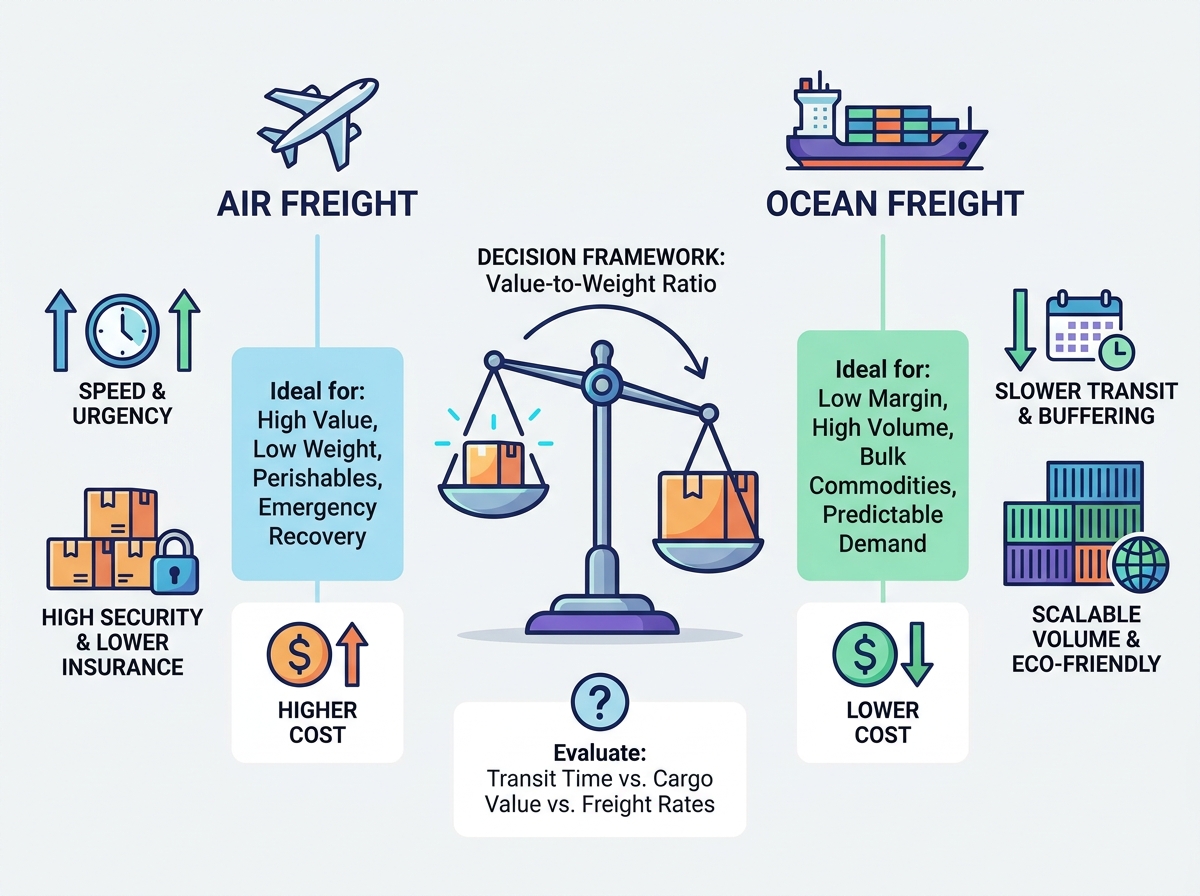
Air Freight: Velocity, Security, and Lowering Holding Costs
Air transit provides unmatched velocity. It serves as a critical lifeline for specific industries. The primary use cases include high-tech components, fashion, perishables, and pharmaceuticals. Companies also rely on airplanes for emergency supply chain recovery. When a manufacturing line halts, air transit is the only solution.
Many procurement teams view air transport strictly as an expensive line item. We encourage you to frame it differently. Consider the "Cost of Capital" argument. Air shipping is a powerful tool for reducing inventory holding costs. Faster transit means you hold less buffer stock. Your goods spend days, not months, in transit. This velocity dramatically shortens your cash conversion cycle. It minimizes stockout risks during peak seasonal demand.
Security represents another major advantage. Airport handling facilities operate under strict aviation security protocols. Cargo undergoes minimal handling compared to seaport operations. The transit time is brief. This reduces the likelihood of cargo damage, spoilage, and theft. Consequently, cargo insurance premiums for air transit are usually much lower than maritime insurance.
The Decision Framework: How to Evaluate Your Next Shipment
Choosing the right method requires a disciplined approach. You should evaluate every shipment against three core criteria.
Cargo Value-to-Weight Ratio
This ratio is the most reliable indicator for mode selection. High-value, low-weight items belong on an airplane. Think of smartphones or semiconductor chips. The high retail value absorbs the premium freight cost effortlessly. Conversely, low-value, high-weight goods require ocean transport. Moving cheap furniture or raw steel by air destroys profit margins instantly.
Strict Lead Time Requirements
You must assess the financial penalty of a delayed shipment. Calculate the cost of lost seasonal sales. Measure the financial impact of a halted manufacturing line. If a factory line stoppage costs $50,000 per day, a $10,000 premium for air transit is a highly profitable investment. Compare this penalty directly against the freight premium.
Environmental and Compliance Factors
ESG compliance is reshaping logistics. You must factor in carbon footprint auditing. Ocean shipping emits significantly less CO2 per ton-mile compared to aviation. Maritime transport is highly carbon-efficient for heavy cargo. This metric is critical for companies tracking Scope 3 emission targets. If your corporate mandate requires drastic carbon reduction, you must prioritize ocean routing and adjust your lead times accordingly.
Strategic Alternatives: Sea-Air and Multi-Modal Routing
Logistics is rarely black and white. Sometimes, extreme urgency meets strict budget constraints. When you are forced to decide whether to use air freight or sea freight, neither might fit perfectly. Multi-modal routing offers a compelling middle ground.
We often introduce Sea-Air freight as the ultimate compromise. It mitigates the extremes of both methods. You avoid the massive cost of direct flights while bypassing the agonizingly slow transit of pure ocean routing.
Consider a standard Asia-to-Europe supply chain. A Sea-Air hybrid moves cargo by ocean from a Chinese port to a Middle Eastern hub, like Dubai. The cargo then shifts to an airplane for the final leg into Europe. This strategy often cuts standard ocean transit times in half. Simultaneously, it saves roughly 30% to 40% off direct air freight costs.
You must acknowledge the trade-offs. Multi-modal solutions increase handling touchpoints. Every transfer introduces a slight risk of delay. Weather disruptions at the transfer hub can cascade through the rest of the journey. However, for mid-urgency cargo, this hybrid approach provides excellent flexibility.
Procurement Next Steps: Shortlisting and Requesting Accurate Quotes
Executing your strategy requires precise procurement tactics. Vague inquiries yield fluctuating, unreliable quotes. You must ensure your data is immaculate before engaging forwarders.
Data preparedness is your first line of defense. Always provide exact cargo dimensions and gross weight. Include accurate HS (Harmonized System) codes. Clearly define the commodity type. Airlines and shipping lines need this exact data to determine chargeable weight and compliance requirements. Guessing dimensions leads to massive invoice discrepancies later.
Incoterms clarity is equally critical. Terms like FOB (Free on Board), EXW (Ex Works), or DAP (Delivered at Place) dictate who pays what. They shift the financial burden of origin and destination fees between buyer and seller. An ocean FOB quote looks cheap until you realize you must pay extensive destination terminal handling charges. Clarify your Incoterms upfront.
We recommend requesting strictly itemized quotes. Refuse lump-sum pricing. Ask forwarders to break down the base freight rate, fuel surcharges, and security fees. Demand visibility into terminal handling charges (THC). This transparency allows you to conduct a true apples-to-apples comparison across competing logistics providers.
Conclusion
There is no universal "better" option in global logistics. The right choice relies on shipment-specific math. You must constantly balance transit times, total cargo value, and fluctuating freight rates. Your goal is to align the shipping mode with your immediate business objectives.
Supply chain agility remains your ultimate competitive advantage. We encourage businesses to build flexible operations. Do not lock yourself into a single transport mode. Utilize a diverse portfolio approach that leverages both aviation and maritime channels. This flexibility allows you to pivot when market disruptions occur.
Take action on your next supply chain cycle. Utilize a proprietary freight calculator to map out your breakpoints. Submit your upcoming packing list to a forwarder for a comparative quote. Alternatively, consult an in-house logistics architect to optimize your routing strategy for the next quarter.
FAQ
Q: At what weight does it make sense to choose air vs sea freight?
A: The standard break-even point sits around 150 kg. For shipments below this weight, air transit is frequently cheaper. Ocean shipments carry high minimum base fees and fixed port handling charges. However, dimensional volume (CBM) also dictates this threshold. Highly voluminous but light cargo might still be cheaper via ocean.
Q: How much faster is air freight or sea freight in real-world conditions?
A: Air transit typically takes 3 to 8 days door-to-door, depending on direct flights and customs speed. Ocean transit ranges from 25 to 45+ days. You must factor in real-world clearance delays, port congestion, and truck drayage wait times, which heavily impact ocean timelines.
Q: Are there hidden fees I should expect when switching from ocean to air?
A: Yes. Air transport includes specific aviation surcharges. Expect strict security fees, X-ray screening charges, and terminal handling fees at the airport. Additionally, aviation fuel surcharges fluctuate much more rapidly and aggressively than maritime bunker adjustment factors (BAF).
Q: Does cargo insurance cost the same for both methods?
A: No. Air cargo insurance premiums are generally lower. The rapid transit time and highly secure airport facilities significantly reduce the risk of theft, water damage, and mishandling. This lower insurance cost helps offset a small fraction of the higher air shipping rate.
Related Blogs
-
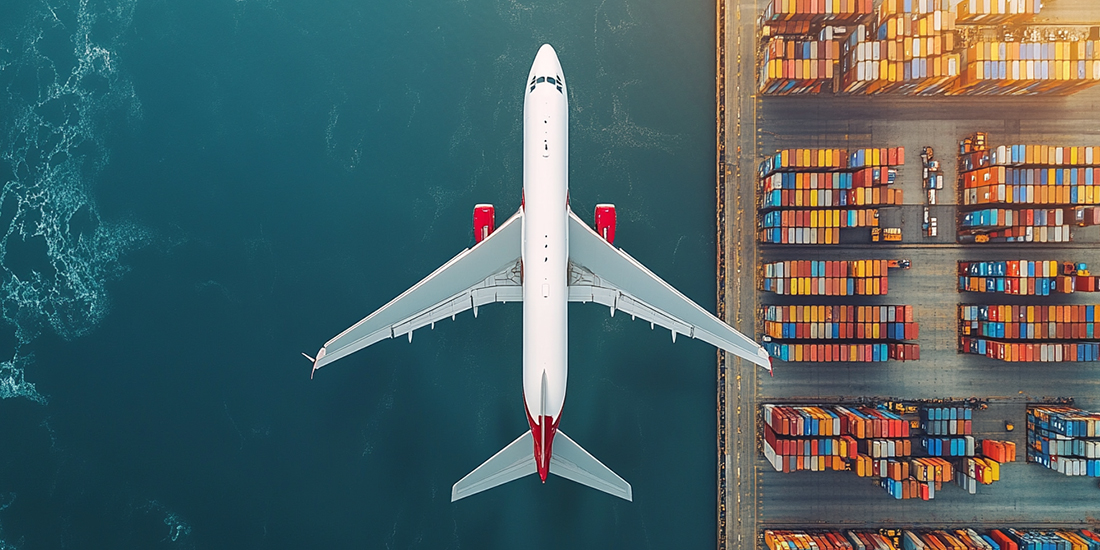 When production stops, every delivery day matters. Delayed components can disrupt schedules and customer commitments. Air freight from China offers a practical solution for urgent commercial shipments. However, choosing the right service requires careful planning. This guide compares standard, priority, and express shipping. You will also learn about flight schedules, customs clearance, and cargo preparation.
-
 Air freight from China offers speed, but costs can vary significantly. Do you know what determines your final shipping bill? This guide explains air freight cost from China, including per-kilogram rates, chargeable weight, surcharges, and destination fees. Learn how to estimate costs and reduce shipping expenses.
-
 Choosing the right shipping method can significantly affect your import costs. How do you select the best option for your cargo? China to Europe sea freight offers flexible FCL, LCL, and door-to-door solutions. This guide compares shipping options, transit times, costs, and customs requirements to help you make informed decisions.
