



Shenzhen exports billions of dollars in hardware and consumer goods annually. It has rightfully earned its reputation as a global manufacturing powerhouse. Sourcing cutting-edge products from this bustling metropolis is relatively straightforward. However, getting those products out of China efficiently remains a massive struggle for many global buyers.
At the bottom of the procurement funnel, importers frequently face a critical choice. Should they partner with a standard freight forwarder, contract a Non-Vessel Operating Common Carrier, or attempt to book directly with an ocean carrier? Navigating this logistics hierarchy incorrectly often leads to severe supply chain bottlenecks. It can trigger hidden fees and disastrous customs delays.
In this comprehensive guide, we break down the exact operational and legal differences between these entities. Furthermore, we provide an actionable framework. This will help you choose the right logistics partner to protect your bottom line and streamline your cross-border trade.
Key Takeaways
- Freight Forwarders act as comprehensive logistics architects for your cargo. They offer end-to-end supply chain management. NVOCCs operate as virtual carriers capable of issuing their own Bills of Lading. Meanwhile, Carriers are the asset-heavy entities that physically own and operate the vessels.
- Partnering with local experts provides a distinct operational advantage. They offer localized warehouse consolidation, direct factory communication, and deep regional port expertise across Yantian, Shekou, and Bao'an.
- Credential verification is non-negotiable. Always look for recognized licensing, Federal Maritime Commission registration for United States-bound cargo, and global network memberships to ensure financial stability.
- For seamless cross-border trade, prioritize logistics partners that provide comprehensive customs clearance. They must maintain capabilities to defer duties during the staging process.
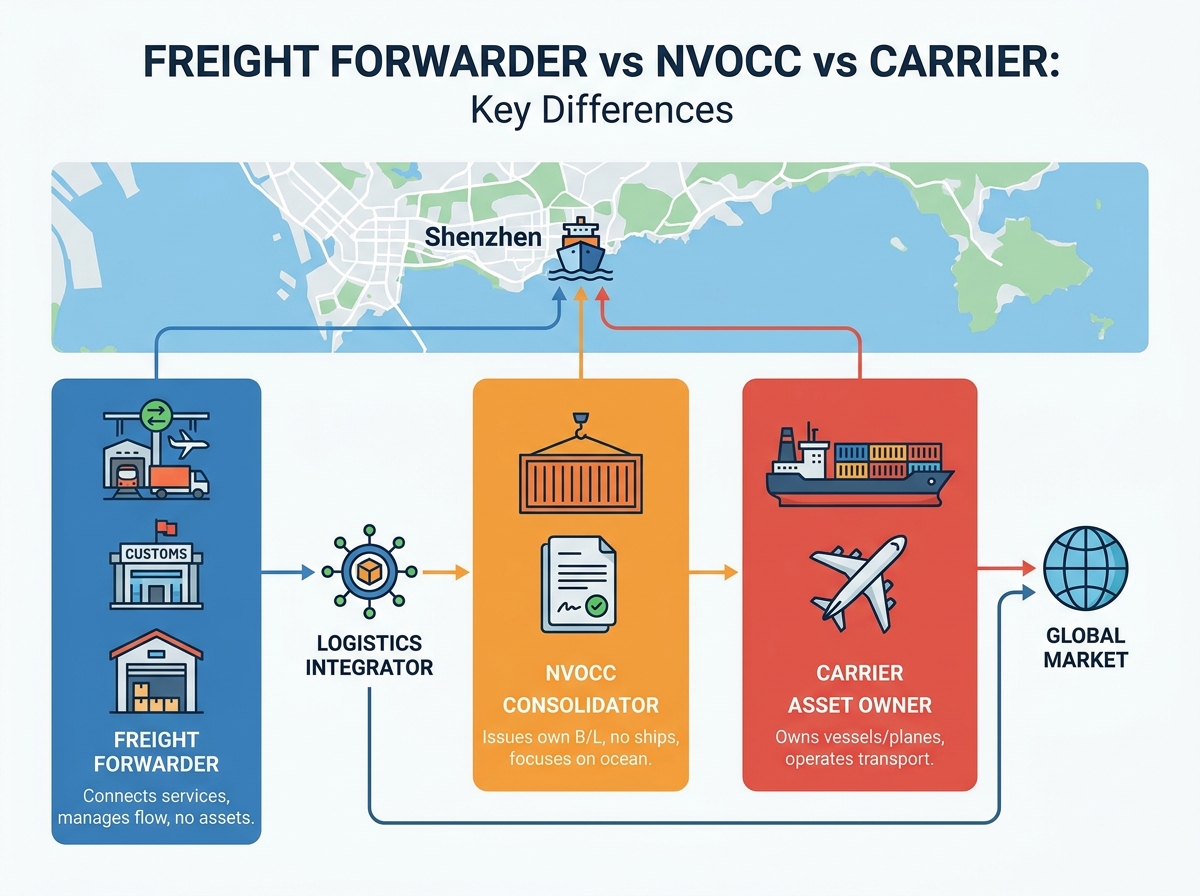
Freight Forwarder vs. NVOCC vs. Carrier: Structural Differences
Understanding the structural differences in the logistics hierarchy is critical. It helps optimize supply chain costs and mitigate risks. To simplify this complex ecosystem, consider an analogy to the travel industry. Ocean carriers are the commercial airlines. Forwarders and NVOCCs operate as specialized travel agents with varying degrees of legal authority and bulk-purchasing power.
The Role of a Freight Forwarder
A freight forwarder functions as a master logistics architect. They arrange the entire supply chain journey from a manufacturing facility in Shenzhen to the final destination warehouse. Standard freight forwarders operate on an asset-light model. They do not physically own the container ships, cargo planes, or cross-border trains. Instead, they leverage extensive global networks to negotiate freight rates. They manage complex export documentation and coordinate multi-modal transport. Their primary value proposition lies in designing customized routing solutions. They handle the heavy lifting of origin services, such as picking up goods from multiple dispersed suppliers and consolidating them into a single shipment.
The Function of an NVOCC
A Non-Vessel Operating Common Carrier shares many operational similarities with a freight forwarder. However, there is a crucial legal distinction. Under maritime law, an NVOCC is legally recognized as a carrier, even though they do not physically own the ships. They purchase container space from actual ocean carriers in massive bulk quantities. They then resell that space to independent shippers. Because of this legal status, an NVOCC assumes carrier liability for the cargo. They are authorized to issue their own House Bill of Lading. Consequently, this provides importers with a direct legal contract of carriage with the NVOCC, rather than the underlying vessel owner.
The Actual Ocean Carrier
A Vessel Operating Common Carrier is the actual asset owner. These are the global maritime conglomerates that own, maintain, and operate the physical vessels and the shipping containers. They are strictly responsible for the physical movement of cargo across the ocean from the Port of Loading to the Port of Discharge.
| Feature | Standard Freight Forwarder | NVOCC | Ocean Carrier |
|---|---|---|---|
| Asset Ownership | Asset-light network based | Asset-light bulk space buyer | Asset-heavy physical ship owner |
| Bill of Lading | Operates under Carrier Master Bill | Issues own House Bill | Issues Master Bill |
| Legal Liability | Agent liability | Carrier liability | Carrier liability |
| Core Client Base | Small-to-medium enterprises | Forwarders and Large Shippers | NVOCCs and Massive Volume Shippers |
Why Localized Shenzhen Logistics Expertise Matters
Choosing a logistics partner physically located near your manufacturing base is a strategic imperative. It is not just a matter of convenience. Shenzhen is a sprawling megacity deeply integrated into the massive manufacturing ecosystem of the Pearl River Delta. Relying on an offshore broker lacking a local footprint often leads to communication breakdowns when factory-level issues arise.
Proximity to Manufacturing Hubs and Major Ports
Shenzhen is home to world-class logistics infrastructure. This includes the Yantian Port in the east, the Shekou Port in the west, and the Bao'an International Airport. Engaging localized Shenzhen freight forwarding services provides an immediate tactical advantage. Local forwarders maintain established, long-term relationships with regional trucking syndicates and warehouse operators. For instance, imagine a scenario where a factory in Dongguan delays your production run by a full day. A local Shenzhen forwarder can rapidly deploy expedited inland trucking. They navigate local traffic patterns to ensure your cargo still meets the vessel terminal cut-off time. Furthermore, localized agents effectively bridge the cultural and linguistic gap. They resolve factory disputes and facilitate pre-shipment quality control inspections before the cargo ever leaves Chinese soil.
The Role of Bonded Logistics in Supply Chain Agility
Shenzhen boasts several specialized free trade and bonded zones. Notable areas include the Futian Free Trade Zone and the Qianhai Shenzhen-Hong Kong Modern Service Industry Cooperation Zone. Operating within these specific geographic areas, a bonded logistics freight forwarder offers immense value. Bonded logistics means that goods can be stored, consolidated, or minimally processed in these zones without immediately incurring export taxes or import duties.
For B2B importers and global e-commerce sellers, this serves as a powerful cash-flow management tool. Buyers can source diverse products from multiple factories across Guangdong. They stage them in a Shenzhen bonded warehouse and defer duty payments until the consolidated container is officially exported. This operational flexibility is vital. It helps maintain lean inventory models, relabel packaging for specific regional markets, and stage goods prior to international export.
Industry Trend Analysis: The Shift Toward Digital and Integrated Logistics
Recent market analyses highlight a significant evolution within the South China logistics sector. Following the extreme volatility of recent years, global ocean freight capacity has largely stabilized. Consequently, the primary competitive differentiator among Shenzhen logistics providers has pivoted. They are moving away from merely securing vessel space to prioritizing digital visibility and end-to-end supply chain resilience.
Modern importers increasingly demand real-time tracking portals, automated milestone alerts, and predictive analytics to manage inventory flows. In addition, with the rise of nearshoring and diversified manufacturing strategies, forwarders in Shenzhen are adapting. They now offer highly integrated, multi-country consolidation services. The trend is clear. Businesses are moving away from fragmented, transactional bookings with traditional operators. They heavily favor holistic partners capable of navigating complex geopolitical trade compliance and deep digital integration.
Actionable Framework for Choosing Your China Logistics Partner
Selecting a logistics partner requires a systematic, evidence-based approach. Relying solely on the cheapest quote frequently results in rolled cargo, hidden terminal fees, and catastrophic customs delays. Follow these concrete standards to vet potential partners effectively.
Assess Specific Shipping Volume and Routes
Before evaluating external partners, importers must precisely quantify their own supply chain metrics. Are you consistently shipping Full Container Loads, or do your orders necessitate Less than Container Load consolidation? Different forwarders have varying volume thresholds and regional strengths. A forwarder that secures exceptional full container rates on the Transpacific Eastbound route may have entirely uncompetitive rates for the Asia-Europe trade lane. Always request historical transit data from prospective forwarders to verify their core competencies on your specific geographical routes.
Evaluate Comprehensive Maritime Services
Securing space on a container ship is only a fraction of modern logistics. Importers must evaluate the comprehensive suite of international ocean freight forwarder services a partner provides. Look for specific technical parameters. Can they handle Out of Gauge cargo or Roll-on/Roll-off shipments? Reliable forwarders offer extensive origin warehousing, professional palletizing, and compliance labeling. They should provide flexible delivery terms including Delivered Duty Paid and Delivered at Place. Additionally, technological infrastructure is a critical evaluation metric. The ability to access a digital portal for document management separates modern logistics providers from outdated operators relying on manual spreadsheets.
Check for Integrated Customs Capabilities
Customs clearance remains the leading cause of international supply chain delays. Discrepancies in Harmonized System codes, improper commercial invoices, or missing export licenses can result in cargo being detained at the Port of Shenzhen. To mitigate this severe risk, importers should prioritize partners that offer integrated customs brokerage solutions. A provider must handle the Chinese export customs declaration, commodity inspection, and the destination country import clearance under a unified operational umbrella. This dual-side competency ensures that documentation is perfectly aligned before the vessel departs. It prevents costly demurrage and detention fees upon arrival.
Verify Licenses, Certifications, and Financial Stability
The freight forwarding industry has a relatively low barrier to entry. This makes credential verification essential. Importers must demand proof of operational legitimacy. In China, verify that the entity holds a valid operating license issued by the Ministry of Commerce. If you are shipping to the United States, it is a strict legal requirement that the forwarder is registered with the Federal Maritime Commission and holds a valid bond. Membership in recognized global networks, such as the World Cargo Alliance, also serves as an excellent indicator of financial stability. These organizations require rigorous background checks prior to admission.
NVOCC vs. Freight Forwarder: Which is Better for Your Business?
Making the choice between a Non-Vessel Operating Common Carrier and a standard freight forwarder depends heavily on your specific liability requirements and supply chain complexity.
Importers should opt for an NVOCC when securing the absolute lowest ocean freight rate on a specific, high-volume route is the primary objective. Because NVOCCs commit to purchasing thousands of container units from carriers annually, they offer highly competitive tier-one pricing. Additionally, businesses that require strict legal protection prefer NVOCCs. Because they issue their own House Bill of Lading, they assume direct carrier liability for the cargo while it is in transit. This simplifies the claims process if goods are lost or damaged at sea.
In contrast, standard freight forwarders are the superior choice for importers with fragmented or highly complex supply chains. If a business needs to consolidate raw materials from a factory in Guangzhou, electronics from Shenzhen, and packaging from Dongguan into a single shipment, a forwarder provides the necessary hands-on origin services. Forwarders also excel in multi-modal transport. They seamlessly combine inland trucking, ocean freight, and destination rail transport into a single, cohesive itinerary.
Bypassing the Middleman: Going Direct to a Carrier
In an attempt to reduce logistical overhead, some growing importers consider bypassing forwarders entirely. They attempt to book directly with ocean carriers. While theoretically possible, this strategy is generally unadvisable for the vast majority of businesses.
The sole advantage of booking direct is the potential for reduced baseline ocean freight costs. However, this pricing advantage is almost exclusively reserved for enterprise-level shippers. Multinational retailers can guarantee the carrier thousands of containers per year under a Minimum Quantity Commitment contract.
Conversely, ocean carriers operate strictly port-to-port. They do not offer origin consolidation, factory pickups, warehousing, or customs clearance services. You are entirely responsible for delivering cleared cargo to the terminal. Furthermore, carriers are notorious for providing inadequate customer service to smaller enterprises. If a vessel is overbooked and a container is rolled to a later sailing, the carrier offers little recourse. A specialized freight forwarder possesses the agility to immediately pull the container and book it onto a different vessel to keep the supply chain moving.
Top Red Flags When Evaluating a China Freight Forwarder
Identifying incompetent or deceitful logistics operators early in the procurement process protects importers from severe financial losses. When vetting potential partners in Shenzhen, watch out for these critical warning signs.
The most common deceptive practice in the logistics sector is the bait and switch pricing model. A forwarder may offer an ocean freight rate significantly below the current market index to win your business. However, once the cargo is physically possessed at the Shenzhen port, they suddenly invoice exorbitant hidden charges. These include inflated Bunker Adjustment Factors, unverified document fees, or excessive destination terminal handling charges. Always demand a fully itemized quote.
Global shipping operates across multiple time zones and requires rapid crisis management. If a prospective forwarder takes several days to reply to a basic request for quotation, they will be entirely unreachable during an actual shipping crisis. Effective partners must demonstrate prompt, clear, and highly proficient communication.
The digital era allows operators to create sophisticated websites without maintaining actual infrastructure. Ensure that the forwarder has a registered corporate office and a physical warehouse footprint in Shenzhen. Relying on a ghost broker who is merely managing shipments from a laptop in a different country introduces unacceptable risks regarding cargo security and origin quality control.
Essential Questions to Ask Before Signing a Contract
To formalize the vetting process and protect your supply chain, require prospective logistics partners to answer the following operational questions in writing:
- Do you hold valid operating licenses and required regulatory bonds? This establishes legal legitimacy and confirms liability structures.
- Can you provide a fully itemized, binding quote? Ensure the quote explicitly details origin fees, Destination Delivery Charges, and fuel surcharges to prevent hidden costs.
- Do you provide in-house customs clearance at my specific destination port? Confirm they have licensed brokers in your home country, ensuring a smooth import process.
- What is your exact Standard Operating Procedure for handling cargo damage or marine insurance claims? A reliable partner will have a documented, transparent claims resolution framework.
- Do you operate a physical warehouse facility in Shenzhen for consolidation and pre-shipment staging? This verifies their capability to handle origin logistics independently without outsourcing to unreliable third-party sub-contractors.
Conclusion
Choosing the correct logistics entity in Shenzhen ultimately dictates the efficiency, legality, and profitability of your entire supply chain. The ideal decision hinges on your specific annual shipping volume, your requirement for legal liability, and your need for hands-on origin consolidation services.
Importers must remember that prioritizing the absolute cheapest freight forwarder frequently results in thousands of dollars lost to rolled cargo, hidden terminal fees, and crippling customs penalties. Sustainable cross-border trade requires prioritizing operational reliability, pricing transparency, and deep local expertise.
By rigorously vetting licenses, demanding itemized quotes, and ensuring dual-side customs competency, businesses can secure a logistics partner that actively protects their bottom line. Take the time to evaluate your current logistics setup. If you are seeking a highly capable partner to streamline your global shipments, explore the professional, end-to-end solutions provided by JFSZ Logistics to safeguard your international trade operations.
FAQ
Is it cheaper to use a freight forwarder or an NVOCC?
There is no universal answer. Pricing depends entirely on your specific shipping profile. NVOCCs often provide better baseline ocean freight rates because they purchase container space in massive bulk directly from vessel owners. However, a standard freight forwarder might offer better overall door-to-door pricing. Forwarders leverage their vast, flexible network of warehouse operators, inland trucking companies, and customs brokers to optimize the entire route. This can yield lower total landed costs despite a slightly higher ocean freight baseline.
What is the difference between a Master Bill of Lading and a House Bill of Lading?
The core difference lies in who issues the document and who assumes liability. The actual Ocean Carrier issues a Master Bill of Lading to the NVOCC or Freight Forwarder. The NVOCC or Forwarder then issues a House Bill of Lading to you, the actual importer. The House Bill is your critical document of title and serves as the legal receipt for your goods.
Do I need a bonded warehouse if I am just shipping standard electronics from Shenzhen?
While it is not strictly mandatory for standard, single-factory shipments, it is highly beneficial for complex operations. If you need to consolidate electronics from multiple suppliers over several weeks without paying immediate export duties, a bonded warehouse is invaluable. It is also a critical requirement if you are running a cross-border e-commerce business and need to stage inventory for rapid fulfillment without triggering tax liabilities prematurely.
Can a freight forwarder clear customs for me?
Yes, top-tier freight forwarders employ licensed in-house customs brokers or partner with trusted local agencies. They provide end-to-end customs solutions. This means they handle all necessary compliance paperwork, calculate duties and taxes, and interface with government agencies for both the Chinese export process and the destination country import process. This ensures your cargo moves across borders without unnecessary friction.
What is the average transit time from Shenzhen to major global ports?
Transit times vary significantly based on the destination and the chosen routing. Generally, ocean freight from Shenzhen to the United States West Coast takes approximately 14 to 20 days. Shipments to the US East Coast typically require 25 to 30 days. For European destinations, such as Rotterdam or Hamburg, transit times range from 28 to 35 days. A reliable forwarder will provide accurate schedule forecasts and direct routing options to minimize these transit times.
How do I verify if a freight forwarder in Shenzhen is legitimate?
Verifying legitimacy requires checking official credentials. First, request their Chinese business license and verify their registration with the Ministry of Commerce. If shipping to the United States, check the Federal Maritime Commission database to ensure they hold a valid bond. Additionally, ask for references from current clients and check if they have a physical office and warehouse footprint in Shenzhen, rather than just a digital presence.
Related Blogs
-
 Door to door shipping from China simplifies international logistics. But how can you ensure smooth delivery from factory to destination? Choosing the right shipping method, preparing documents, and understanding customs responsibilities are essential. This guide explains each shipping step, compares sea, air, and express services, and clarifies DDP and DAP terms. Learn how to arrange reliable deliveries and avoid unexpected costs.
-
 When production stops, every delivery day matters. Delayed components can disrupt schedules and customer commitments. Air freight from China offers a practical solution for urgent commercial shipments. However, choosing the right service requires careful planning. This guide compares standard, priority, and express shipping. You will also learn about flight schedules, customs clearance, and cargo preparation.
-
 Air freight from China offers speed, but costs can vary significantly. Do you know what determines your final shipping bill? This guide explains air freight cost from China, including per-kilogram rates, chargeable weight, surcharges, and destination fees. Learn how to estimate costs and reduce shipping expenses.
