



The global logistics industry is notorious for opaque fee structures. A laundry list of line-item charges often obscures the true cost of moving cargo. Supply chain managers and procurement teams struggle to forecast landed costs accurately. Hidden accessorial fees, fluctuating carrier rates, and inconsistent quote formatting across different vendors cause constant budget overruns. This lack of standardization makes it incredibly difficult to budget for international shipments or compare service providers on an equal footing.
To evaluate logistics partners effectively, shippers must deconstruct the operational billing model. You need to separate base transportation rates from management fees, customs clearance, and specialized handling costs. Understanding the mechanics behind these charges empowers your procurement team to identify inflated margins and negotiate better terms. This guide provides a transparent framework for auditing quotes, understanding market benchmarks, and avoiding unexpected expenses when partnering with a reliable freight forwarder.
Macro Cost vs. Micro Fees: While total shipment costs can range anywhere from $100 for small consolidated loads to $5,000+ for full containers, a freight forwarder typically charges a flat management/service fee ranging from $50 to $200 per shipment. The bulk of the quote consists of direct carrier costs passed through to the shipper.
Mode and Volume Dictate Pricing: Total costs are heavily dependent on the transportation mode (ocean vs. air) and the pricing system utilized (actual weight, dimensional/volumetric weight, or per-pallet rates).
The Danger of Incomplete Quotes: Artificially low initial quotes often omit critical accessorials—such as terminal handling charges, government duties, or customs clearance—making apples-to-apples vendor comparisons difficult without a standardized RFQ process.
Risk Mitigation is a Cost Factor: Evaluating a forwarder requires looking beyond the initial rate to assess their ability to proactively manage and mitigate volatile costs like demurrage, detention, and General Rate Increases (GRIs).
Understanding the Freight Forwarder Pricing Model
Carrier Pass-Through Costs vs. Forwarder Service Fees
The fundamental business model of forwarding relies on acting as an intermediary. These companies do not typically own the vessels or aircraft. Instead, they negotiate volume discounts with asset-based carriers like ocean shipping lines and commercial airlines. They secure bulk capacity at a lower rate and sell it to individual shippers. The revenue generated comes from a combination of the margin applied to these negotiated carrier rates and standard administrative fees.
When reviewing an invoice, you will typically see a dedicated service fee. This represents the administrative cost of managing the shipment, coordinating with various stakeholders, and processing the file. The baseline expectation for this management fee depends on the complexity of the routing and the volume of shipments you award to the provider. The vast majority of the remaining costs on the invoice are direct carrier pass-through costs, which the intermediary pays to the shipping line or airline on your behalf. Shippers must understand this distinction to negotiate effectively. You cannot negotiate the pass-through costs heavily, but you can negotiate the service fees and the margin applied to the base freight.
Volume, Weight, Dimensional, and Per-Pallet Pricing Systems
Transportation costs are rarely based solely on the physical weight of the cargo. Carriers must account for the space a shipment occupies. This introduces the concept of dimensional, or volumetric, weight. If you ship a large box of foam insulation, it takes up significant space but weighs very little. Carriers will charge based on the dimensional weight rather than the actual gross weight to ensure they maximize revenue for the space utilized inside the container or aircraft.
Air and ocean operations calculate chargeable weight differently. For Less than Container Load (LCL) ocean shipments, the standard metric is the Cubic Meter (CBM). The general rule is that one CBM equals a specific weight threshold. You are charged based on whichever metric yields the higher revenue. In air transport, the standard dimensional divisor is much stricter. Less than Truckload (LTL) and consolidated ground shipments often utilize per-pallet pricing models, where a flat rate is applied to standard pallet dimensions regardless of the exact weight, provided it falls under a specific maximum threshold.
Inefficient packaging directly inflates costs across all these models. Dead space inside cartons or pallets that extend beyond standard dimensions will trigger higher dimensional weight charges. We see this frequently when shippers use oversized boxes for small components. Optimizing your carton dimensions to fit perfectly on a standard pallet without overhang reduces your chargeable weight and lowers your freight spend.
Standard Dimensional Weight Divisors by Mode
Transportation Mode | Standard Divisor Concept | Chargeable Weight Metric | Typical Cargo Profile |
|---|---|---|---|
Ocean Freight (LCL) | 1 CBM = 1,000 kg | W/M (Weight or Measure) | Heavy machinery, dense industrial goods. |
Air Freight | 1 CBM = 167 kg | Dimensional Kilogram | Electronics, apparel, lightweight consumer goods. |
Domestic LTL | Density-based freight class | Pounds per cubic foot (PCF) | Palletized mixed freight, retail distribution. |
Core Transportation Costs by Mode
Ocean Freight Rate Benchmarks
Ocean transport remains the most cost-effective method for moving large volumes of goods internationally. The pricing structure is primarily divided into Full Container Load (FCL) and Less than Container Load (LCL). FCL rates are charged as a flat fee for the entire container, regardless of whether it is completely full. LCL rates are variable, based on the specific CBM or weight of your cargo consolidated with other shipments.
Providing realistic baseline budgeting requires understanding container types. A standard 20-foot container (TEU) will cost less than a 40-foot high cube (FEU), but the cost per unit of goods is often lower in the larger container if fully utilized. Specialized equipment like refrigerated containers (reefers) or open-top containers command a significant premium due to limited availability and specialized handling requirements. These base ocean rates are highly susceptible to market manipulation. Ocean alliances frequently implement blank sailings—intentionally canceling scheduled voyages—to create artificial capacity constraints. This immediately drives up base rates on high-demand routes, forcing shippers to pay premium surcharges just to secure space on a vessel.
Air Freight Rate Benchmarks
Air transport is the premium mode of international logistics, utilized primarily for high-value, time-sensitive, or perishable goods. The cost reflects the speed and reliability of the service. This range fluctuates heavily based on the specific routing, fuel costs, and the type of service selected. Shippers must differentiate between standard consolidated air freight and express or priority routing.
Consolidated air involves holding cargo until enough volume is gathered to build a full unit load device (ULD). This offers a lower rate but adds transit days while you wait for the consolidation to build. Priority routing guarantees space on the next available flight at a significant premium. Furthermore, air pricing is highly volatile because a massive percentage of global cargo flies in the belly capacity of commercial passenger planes. Seasonal demand spikes, such as the Q4 holiday rush or new consumer electronics launches, directly impact available cargo space. When passenger travel is disrupted, belly capacity vanishes, and shippers are forced to rely on dedicated freighter aircraft, which drives up per-kilogram costs exponentially.
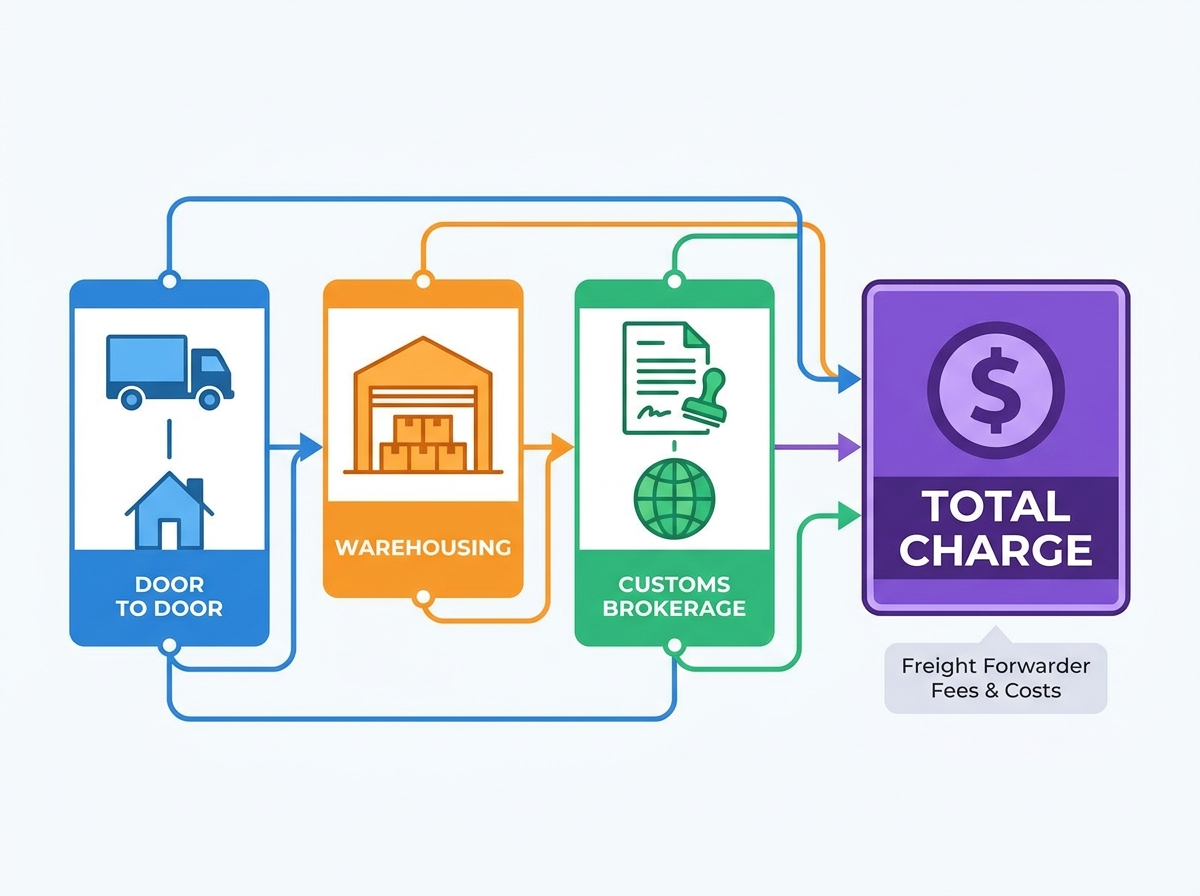
Breakdown of Standard Freight Forwarder Fees
Documentation and Administration Fees
International trade requires rigorous documentation to satisfy customs authorities, carriers, and financial institutions. Providers charge specific fees to generate, verify, and transmit these documents. Standard paperwork costs typically include the issuance of the Bill of Lading (BOL) or Air Waybill (AWB), export declarations, and various origin or destination documents. If you are shipping hazardous materials, expect additional fees for processing Dangerous Goods declarations.
While they may seem like minor administrative add-ons, they are absolutely required for legal compliance and establishing a verifiable chain of custody. Errors in documentation can lead to customs holds, fines, or the inability to claim the cargo at the destination port. Filing the Importer Security Filing (ISF) late, for example, can result in massive customs penalties. Precise document management is a critical service that protects your supply chain from regulatory interference.
Terminal Handling Charges (THC), CFS, and Port Fees
Moving cargo through a port or airport infrastructure incurs facility usage costs. Terminal Handling Charges (THC) are applied at both the origin (OTHC) and the destination (DTHC). Port authorities and terminal operators assess these fees for the physical labor and equipment required to lift containers on and off vessels, move them through the yard with straddle carriers, and load them onto chassis for final delivery.
For LCL shipments, a Container Freight Station (CFS) fee is applied. This covers the labor-intensive process of receiving multiple smaller shipments, consolidating them into a single ocean container at the origin, and deconsolidating them at the destination. The intermediary does not invent these fees. They are direct infrastructure costs passed on to the shipper. The exact amount varies significantly depending on the specific port's union labor rates, equipment availability, and local infrastructure investments.
Cargo Insurance Premiums
A common misconception in international shipping is that the carrier is fully responsible for the value of the goods if they are lost or damaged. In reality, carrier liability is severely limited by international conventions, such as the Carriage of Goods by Sea Act (COGSA). Under COGSA, ocean carrier liability is often capped at a minimal amount per customary freight unit, which is typically a single shipping container, regardless of the millions of dollars of cargo inside.
To mitigate this massive financial risk, shippers must purchase comprehensive cargo insurance. Providers calculate this premium based on the total risk exposure. The standard calculation formula is typically a percentage of the commercial value of the goods, plus the total freight cost, plus an additional percentage to cover anticipated lost profits or administrative recovery costs. The actual premium rate depends on the commodity type, the routing, and the historical claim rates for similar cargo. You also need insurance to protect against General Average declarations, a maritime law principle where all cargo owners on a vessel must proportionally share the financial loss if the ship suffers a major casualty or must jettison cargo to save the vessel.
Specialized Services: Where Value Meets Cost
The Cost Structure of a Door-to-Door Model
Port-to-port quotes only cover the main transit leg, leaving the shipper responsible for getting the goods to the origin terminal and recovering them from the destination terminal. End-to-end logistics pricing covers the entire journey from the manufacturer's loading dock to the final receiving warehouse. This requires utilizing a door to door freight forwarder to manage the disparate regional carriers.
This structure breaks down into pre-carriage (origin drayage or trucking) and on-carriage (destination delivery) costs. Drayage rates depend on the distance from the port, fuel costs, and chassis rental fees. You will also encounter fees for pre-pulls, where a trucker pulls a container from the port at night to avoid daytime congestion, or drop-and-pick operations, where a driver drops an empty container and picks up a loaded one. While an end-to-end quote will inherently look more expensive than a port-to-port quote, shippers pay a premium for single-vendor accountability. Managing multiple regional trucking companies independently often results in communication breakdowns, missed cut-off times, and higher overall operational costs compared to centralizing the process.
Utilizing In-House Customs Capabilities
Crossing international borders requires formal entry processing. Standard customs clearance service fees depend on the complexity of the commercial invoice, the number of distinct tariff classifications (HTSUS codes) required, and the specific government agencies involved. Importing medical devices or food products requires clearance from Partner Government Agencies (PGAs) like the FDA or EPA, which adds complexity and cost to the entry process.
It is vital to strictly differentiate the provider's brokerage service fee from government-mandated pass-through costs. Import duties, taxes, Merchandise Processing Fees (MPF), and Harbor Maintenance Fees (HMF) are collected by the government, not the logistics provider. Utilizing a customs brokerage freight forwarder offers a strong return on investment. Having the same entity manage both the physical movement and the regulatory clearance reduces communication delays, streamlines continuous or single-entry bond processing, and minimizes the risk of costly storage penalties caused by paperwork errors.
Fees Associated with Storage and Distribution
Many supply chains require intermediate storage, cross-docking, or inventory distribution. Integrating these needs with your transportation provider involves specific 3PL and storage-related fees. These include pallet-in and pallet-out handling fees, inventory management system costs, and variable rates for short-term versus long-term storage. You may also incur fees for value-added services like shrink-wrapping, labeling, or repalletizing damaged cargo.
Partnering with a warehousing freight forwarder allows shippers to execute advanced logistics strategies like buyer's consolidation. Instead of shipping multiple LCL loads from different suppliers in the same region, the provider receives all the goods at their origin facility, stores them temporarily, and consolidates them into a single FCL shipment. This significantly lowers overall ocean or air freight costs and reduces destination handling fees. Another strategy is transloading, where cargo is moved from a standard ocean container into a larger domestic trailer at the port, reducing the number of trucks needed for the inland delivery leg.
Hidden Fees, Surcharges, and Implementation Risks
Demurrage, Detention, and Per Diem Charges
The most significant financial risks in a shipment lifecycle are equipment and facility penalties. Demurrage refers to port storage charges incurred when a full container sits inside the terminal beyond the allotted free time. Detention refers to equipment usage charges incurred when the container is taken outside the port for unloading but is not returned empty to the depot within the agreed timeframe. Per diem is often used interchangeably with detention, specifically referring to the daily rental fee for the chassis.
These charges accumulate rapidly, often costing hundreds of dollars per day per container. They destroy profit margins and inflate landed costs exponentially. Mitigation strategies require proactive management. Shippers must negotiate extended free time during the initial contract phase and rely on providers with robust tracking technology to monitor container milestones. You must prioritize drayage dispatch before free time expires and ensure your receiving warehouse has the labor capacity to unload containers immediately upon arrival.
Peak Season Surcharges (PSS) and General Rate Increases (GRI)
Base rates are rarely static. Carriers implement Peak Season Surcharges (PSS) during high-volume periods, such as the months leading up to the winter holidays or immediately before the Lunar New Year, when capacity is tightest. These surcharges are applied on top of the contracted base rate to capitalize on the surge in demand.
Similarly, carriers utilize General Rate Increases (GRI) to adjust pricing across specific trade lanes in response to market conditions. Carriers typically announce GRIs 30 days in advance, but they often mitigate or cancel them at the last minute if demand softens. Providers must communicate these increases clearly. Shippers reviewing long-term quotes must watch for "subject to GRI" clauses. A quote that appears highly competitive in April may become significantly more expensive in August if the carrier implements consecutive GRIs that the intermediary passes directly to the shipper.
Common Freight Surcharges Summary
Surcharge Type | Acronym | Application Mode | Trigger Condition |
|---|---|---|---|
Bunker Adjustment Factor | BAF | Ocean Freight | Fluctuations in global marine fuel prices. |
Fuel Surcharge | FSC | Air & Ground | Increases in aviation or diesel fuel costs. |
Currency Adjustment Factor | CAF | All Modes | Volatility in exchange rates between origin/destination currencies. |
Peak Season Surcharge | PSS | Ocean & Air | High demand periods exceeding standard carrier capacity. |
Low Sulfur Surcharge | LSS | Ocean Freight | Compliance with IMO 2020 environmental fuel regulations. |
Fuel Surcharges and Currency Adjustment Factors
Fuel is the largest variable cost for asset-based carriers. To protect themselves from crude oil market volatility, they apply fuel surcharges. In ocean freight, this is known as the Bunker Adjustment Factor (BAF). For air and trucking, it is simply termed a Fuel Surcharge (FSC). These rates are typically adjusted monthly based on global fuel indices. You will also see Low Sulfur Surcharges (LSS) applied to ocean freight to cover the cost of compliant marine fuel required by environmental regulations.
International trade also involves currency risk. The Currency Adjustment Factor (CAF) is a surcharge used to hedge against exchange rate volatility. If the carrier's operational costs are in Euros but the freight is paid in US Dollars, a weakening Dollar will trigger a CAF to ensure the carrier does not lose money on the currency conversion. These surcharges are non-negotiable pass-through costs, but you must audit your invoices to ensure they align with the current market indices.
Framework for Evaluating a Freight Forwarder Quote
Establishing Baseline Metrics and Incoterms
Before soliciting quotes, shippers must define their baseline metrics and operational parameters. The most critical element is the selection of Incoterms (International Commercial Terms). Incoterms like FOB (Free on Board), EXW (Ex Works), or DDP (Delivered Duty Paid) legally dictate exactly where the transfer of risk occurs and which fees the logistics provider will charge the buyer versus the seller. Quoting an EXW shipment will look vastly different from an FOB shipment because EXW includes origin trucking and export customs clearance.
Beyond Incoterms, shippers must define their success criteria. This includes maximum acceptable transit times, specific routing preferences, and required service levels for communication and milestone tracking. Do you need direct sailings, or are transshipments acceptable? Without these baselines, providers will quote the cheapest, slowest routing to win the business, which will ultimately disrupt your production schedule or inventory availability.
Normalizing Quotes for Apples-to-Apples Comparison
The greatest challenge in procurement is normalizing disparate quotes. Provider A might offer a low base ocean rate but hide origin handling and documentation fees in the fine print. Provider B might offer a higher base rate but include all THC and customs clearance fees. To identify omitted line items, shippers need a strict audit checklist.
The most effective strategy is to standardize the Request for Quote (RFQ) process. Do not allow vendors to submit pricing in their own proprietary formats. Provide a standardized RFQ spreadsheet template that forces uniform itemization of every potential fee: pre-carriage, origin THC, export clearance, base freight, destination THC, import clearance, and on-carriage. This forces transparency and allows procurement teams to compare vendors accurately.
Conclusion
Standardize your RFQ templates to force all logistics vendors to itemize base rates, accessorials, and surcharges in a uniform format.
Map out your specific Incoterms for every supplier to ensure you are not double-paying for origin handling or export clearance fees.
Negotiate extended free time for demurrage and detention upfront during the contracting phase to mitigate the highest-risk penalties.
Audit final invoices rigorously against the initial quotes to identify unauthorized GRIs or inflated administrative service fees.
FAQ
Q: Why do freight quotes fluctuate so frequently?
A: Freight rates fluctuate due to supply and demand dynamics, seasonal volume spikes, carrier capacity constraints, and variable costs like fuel prices. Ocean alliances frequently adjust capacity through blank sailings, while air freight is impacted by passenger travel disruptions, causing rapid shifts in base pricing.
Q: What is the difference between actual weight and volumetric weight?
A: Actual weight is the physical scale weight of the cargo. Volumetric weight is a calculation based on the dimensions of the package, representing the space it occupies. Carriers charge based on whichever number is higher to maximize revenue for the space utilized on the vessel or aircraft.
Q: Are customs duties included in a standard freight quote?
A: No, standard freight quotes typically do not include government-mandated customs duties or taxes. While a quote may include the provider's administrative fee for processing the customs entry, the actual duties are a separate pass-through cost based on the commercial value and tariff classification of the goods.
Q: How can I avoid demurrage and detention charges?
A: Avoiding these charges requires proactive supply chain management. Negotiate extended free days in your initial contract, ensure all customs documentation is filed flawlessly before arrival, and utilize tracking technology to dispatch drayage trucks immediately once the container is discharged from the vessel.
Q: Is cargo insurance mandatory for international shipping?
A: While not strictly mandatory by law, cargo insurance is highly recommended. International conventions severely limit a carrier's financial liability for lost or damaged goods. Comprehensive insurance protects the full commercial value of your shipment against catastrophic loss or General Average declarations.
Q: What does a subject to GRI clause mean on a quote?
A: A subject to GRI clause means the quoted base rate is vulnerable to General Rate Increases implemented by the carrier. If the shipping line raises rates before your cargo departs, the forwarder will pass that increase directly to you, altering the final invoice amount.
Related Blogs
-
 Door to door shipping from China simplifies international logistics. But how can you ensure smooth delivery from factory to destination? Choosing the right shipping method, preparing documents, and understanding customs responsibilities are essential. This guide explains each shipping step, compares sea, air, and express services, and clarifies DDP and DAP terms. Learn how to arrange reliable deliveries and avoid unexpected costs.
-
 When production stops, every delivery day matters. Delayed components can disrupt schedules and customer commitments. Air freight from China offers a practical solution for urgent commercial shipments. However, choosing the right service requires careful planning. This guide compares standard, priority, and express shipping. You will also learn about flight schedules, customs clearance, and cargo preparation.
-
 Air freight from China offers speed, but costs can vary significantly. Do you know what determines your final shipping bill? This guide explains air freight cost from China, including per-kilogram rates, chargeable weight, surcharges, and destination fees. Learn how to estimate costs and reduce shipping expenses.
