



Global supply chains rely on a massive network of vessels, ports, and inland logistics to keep trade moving. At the center of this network is ocean freight, carrying over 80% of global trade by volume. It serves as the primary lever for controlling supply chain margins. Moving goods across oceans represents a complex strategic operation where logistics managers balance competing priorities.
Supply chain professionals face constant tension. They weigh the cost-efficiency of sea transport against the risks of longer transit times, unpredictable port congestion, and rigorous international compliance requirements. Relying on basic definitions of sea shipping falls short for modern logistics operations.
Optimizing international logistics requires a deep understanding of operational mechanics, volatile cost structures, and proactive risk mitigation strategies. Mastering these elements allows shippers to select the right freight forwarding partners, maintain cargo visibility, and protect their bottom line against unexpected disruptions.
Key Takeaways
Mode Selection is Data-Driven: The choice between FCL and LCL ocean freight hinges on specific volumetric thresholds (typically 15 CBM) and transit time sensitivities.
Cost Visibility is Critical: True ocean freight costs extend far beyond the base rate, requiring strict management of surcharges, Incoterms, and potential demurrage/detention fees.
Risk Mitigation Requires Proactive Strategy: Delays, rolled cargo, and customs holds are inherent risks; successful implementation relies on robust cargo insurance and selecting forwarders with strong carrier allocations.
Partner Evaluation Centers on Visibility: The most effective freight partners provide API-driven track-and-trace capabilities, proactive exception management, and integrated customs brokerage.
What Is International Ocean Freight?
Defining the Core Mode of Global Trade
international ocean freight is the transportation of goods by cargo vessels across international waters. It stands as the most widely used method for moving large volumes of global trade between continents. Specialized vessels, ranging from standard container ships to massive bulk carriers, facilitate the movement of raw materials, components, and finished goods across established maritime routes.
The primary use case for sea transport is cost-efficiency. It provides the most economical solution for transporting heavy, bulky cargo over long distances. When shipment volumes reach a certain threshold, or when cargo weight makes air freight economically prohibitive, sea transport becomes the mandatory choice. Shippers trade longer transit times for significantly lower transportation costs per unit, making it the backbone of global inventory replenishment strategies. You load containers at the origin, secure them on a vessel, and track them across weeks of transit to feed distribution centers on the other side of the world.
Strategic Port Selection and Routing
Ocean freight routing requires precise strategic planning to minimize inland transport distances and avoid congested transit hubs. Selecting the right ports of departure and arrival depends heavily on geographic proximity to manufacturing hubs at the origin and final distribution centers at the destination. You must analyze the entire door-to-door transit time, not just the port-to-port vessel schedule.
Routing decisions rely on established shipping routes and available vessel loops. Carrier alliances operate specific schedules. Some ports offer direct sailings while others require transshipment. Transshipment introduces additional handling and increases the risk of delays. Logistics managers evaluate port draft depths, terminal handling capacities, and the reliability of hinterland connections like rail and truck networks when planning their maritime routes.
Key Factors for Port Selection
Proximity to the origin manufacturing facility to reduce drayage costs.
Availability of direct vessel sailings versus transshipment requirements.
Terminal throughput capacity and historical congestion metrics.
Draft depth to accommodate larger, more efficient vessels.
Access to reliable inland rail and highway networks for final delivery.
The Mechanics of International Ocean Freight
The End-to-End Shipping Process
The chronological workflow of sea freight involves multiple distinct phases. Each phase requires precise documentation and physical handling. The process begins with origin haulage. Empty containers are delivered to the shipper's facility for loading, then transported back to the port. Export customs clearance must be completed before the cargo can legally leave the country of origin. Next, origin handling occurs at the port terminal. The container is received, staged in the yard, and loaded onto the vessel using massive gantry cranes.
Ocean transit represents the physical movement across the water. Upon arrival, destination handling takes over. The container is discharged from the vessel and moved to a container yard. Import customs clearance follows, requiring the submission of commercial invoices, packing lists, and bills of lading to local authorities. Finally, destination haulage delivers the cleared cargo to the ultimate consignee. Liability and costs shift between buyer and seller at critical handover points throughout this journey, dictated entirely by the agreed-upon shipping terms.
Key Stakeholders in the Ecosystem
Understanding the players involved helps you manage your supply chain effectively. Vessel Operating Common Carriers (VOCCs) are the actual shipping lines that own and operate the cargo ships. They control the physical assets, maintain the containers, and dictate sailing schedules. Non-Vessel Operating Common Carriers (NVOCCs) do not own ships. They purchase block space from VOCCs at wholesale rates and resell it to individual shippers, issuing their own House Bill of Lading.
Freight Forwarders act as logistics architects. They coordinate the entire door-to-door movement, managing customs, inland transport, and documentation. Leveraging an NVOCC or a capable freight forwarder significantly impacts a shipper's pricing leverage. These intermediaries pool volume from multiple clients to negotiate better rates. They provide routing flexibility by utilizing multiple carrier alliances, ensuring you are not locked into a single vessel operator's limited schedule.
Stakeholder Roles in Sea Transport
Stakeholder | Asset Ownership | Primary Function | Bill of Lading Issued |
|---|---|---|---|
VOCC (Carrier) | Owns vessels and containers | Physical transportation of goods | Master Bill of Lading (MBL) |
NVOCC | No vessels, may own containers | Buys and resells vessel space | House Bill of Lading (HBL) |
Freight Forwarder | No vessels, owns warehouses/trucks | Coordinates door-to-door logistics | House Bill of Lading (HBL) |
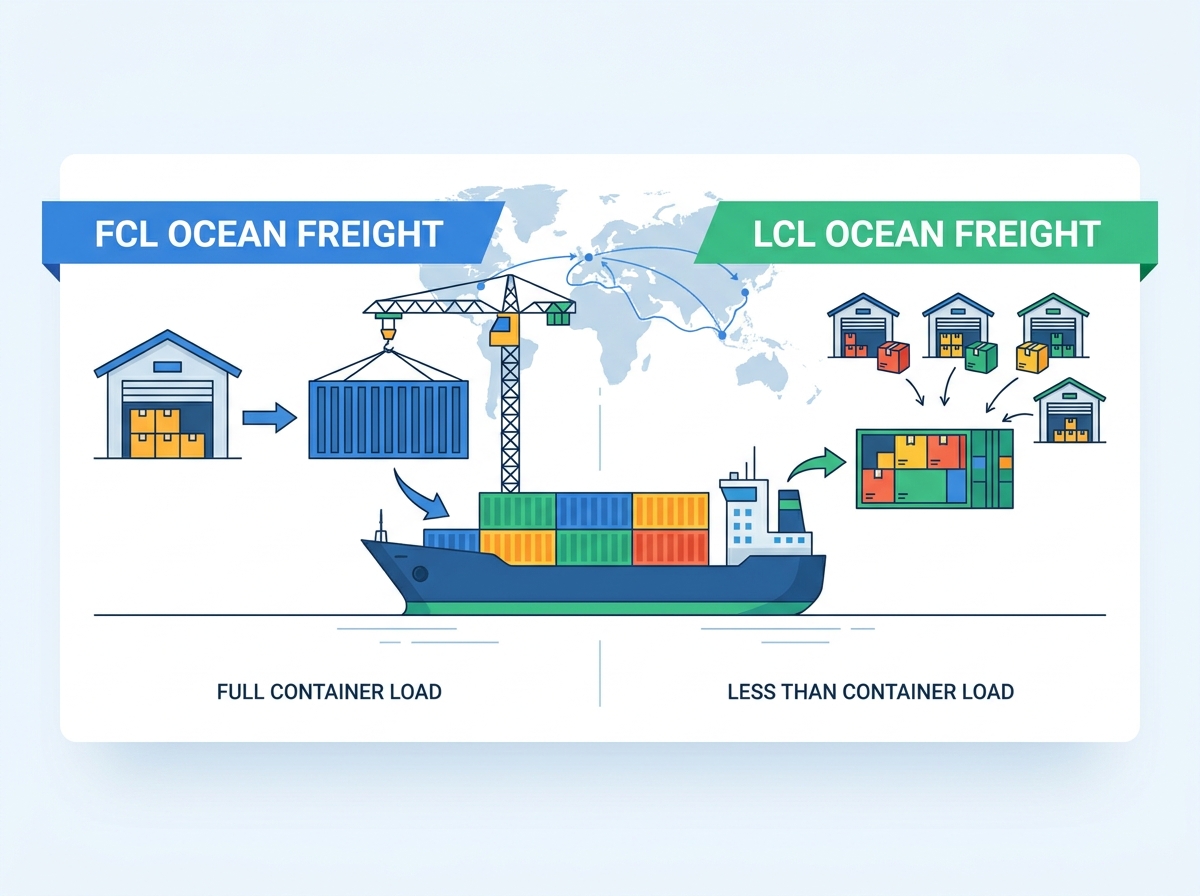
FCL Ocean Freight vs. LCL Ocean Freight: Selecting the Right Mode
FCL Ocean Freight (Full Container Load): Use Cases and Economics
fcl ocean freight grants a shipper the exclusive use of a shipping container. The cargo is loaded and sealed at the origin and remains unopened until it reaches the final destination. This exclusive use eliminates the need to share space with other shippers. It drastically reduces physical handling and lowers the risk of cargo damage or loss. You pack the container at your facility, lock it, and the seal stays intact until it hits your receiving dock.
FCL becomes economically viable when shipments hit specific volumetric and weight thresholds. Shipping more than 15 to 20 cubic meters (CBM) in a standard 20-foot container (TEU) justifies the cost of a full container. Even if the container is not filled to maximum capacity, the flat rate of FCL often undercuts the variable costs of consolidated shipping at this volume. FCL offers superior transit time predictability. Because the container bypasses consolidation hubs, it moves directly from the port to the consignee, minimizing terminal dwell times.
LCL Ocean Freight (Less than Container Load): Consolidation Realities
lcl ocean freight provides a solution for smaller shipments that do not require a full container. Multiple shippers share space within a single container, paying only for the exact volume or weight their cargo occupies. This mode allows businesses to maintain leaner inventories and ship smaller batches without absorbing the cost of empty container space.
LCL involves clear operational trade-offs. While absolute costs are lower for small volumes, the per-CBM rate is significantly higher than FCL. Transit times are inherently longer due to the Container Freight Station (CFS) consolidation process at origin and the deconsolidation process at destination. LCL introduces shared risk factors. If another shipper's cargo in the same container triggers a customs hold or inspection, your cargo will be delayed alongside it. Cross-contamination and increased handling damage are higher risks in shared environments.
Specialized Cargo and Vessel Types: Reefer, RoRo, and Breakbulk
Standard dry containers cannot accommodate all global trade. Specialized cargo requires specific vessel types and equipment. Temperature-sensitive goods, such as pharmaceuticals, fresh produce, and chemicals, rely on refrigerated containers known as Reefers. These units maintain precise temperature and humidity controls throughout the entire supply chain journey. They require continuous power supplies on the vessel, at the port, and on the chassis during inland transport.
Vehicles and heavy machinery utilize Roll-on/Roll-off (RoRo) vessels. These ships feature built-in ramps, allowing cars, trucks, and tractors to be driven directly into the ship's hold. For massive, out-of-gauge (OOG) cargo that exceeds standard container dimensions—such as wind turbine blades or industrial generators—breakbulk shipping is required. Evaluating breakbulk involves complex engineering assessments, specialized lifting equipment, and custom securing methods to ensure the heavy cargo remains stable during ocean transit.
Mode Comparison Matrix
Feature | Full Container Load (FCL) | Less than Container Load (LCL) |
|---|---|---|
Volume Threshold | Typically > 15 CBM | Typically < 15 CBM |
Container Usage | Exclusive to one shipper | Shared among multiple shippers |
Handling Risk | Low (Sealed at origin) | Moderate (Multiple handling points) |
Transit Predictability | High (Direct routing) | Lower (Subject to CFS consolidation delays) |
Customs Hold Risk | Isolated to your own cargo | Shared (Affected by co-loaders) |
Evaluating Ocean Freight Costs and Rate Structures
Deconstructing the Freight Quote: Base Rates vs. Surcharges
A standard freight quote is rarely a single, static number. It consists of a base ocean freight rate combined with a complex array of volatile surcharges. The base rate covers the physical port-to-port transportation, but surcharges dictate the final invoice. Shippers must deconstruct these quotes to accurately forecast logistics spend and compare forwarder proposals effectively.
Critical surcharges fluctuate based on global economic and operational factors. The Bunker Adjustment Factor (BAF) accounts for volatile marine fuel costs. The Currency Adjustment Factor (CAF) protects carriers against exchange rate fluctuations on international trade lanes. During high-demand periods, carriers implement a Peak Season Surcharge (PSS) to capitalize on tight capacity. Carriers apply a General Rate Increase (GRI) across specific routes to establish new baseline pricing. Ignoring these surcharges leads to severe budget overruns.
The Impact of Incoterms on Freight Spend
International Commercial Terms (Incoterms) dictate which party—the buyer or the seller—is responsible for specific segments of the shipping journey. They define exactly where liability transfers and who pays for origin handling, ocean transit, insurance, and destination duties. Misunderstanding Incoterms results in duplicate billing, stranded cargo, or unexpected liability during transit damage.
Choosing the right Incoterm depends on the desired level of control over shipping costs and risks. Under EXW (Ex Works), the buyer assumes maximum responsibility, managing the entire process from the seller's factory floor. FOB (Free On Board) splits the responsibility; the seller loads the goods onto the vessel, and the buyer pays for the ocean transit and destination charges. CIF (Cost, Insurance, and Freight) requires the seller to cover transit and insurance to the destination port. DDP (Delivered Duty Paid) places maximum liability on the seller, who must deliver the goods to the buyer's facility, fully cleared of customs.
Common Incoterms and Responsibilities
Incoterm | Origin Charges Paid By | Ocean Freight Paid By | Destination Charges Paid By |
|---|---|---|---|
EXW (Ex Works) | Buyer | Buyer | Buyer |
FOB (Free On Board) | Seller | Buyer | Buyer |
CIF (Cost, Insurance, Freight) | Seller | Seller | Buyer |
DDP (Delivered Duty Paid) | Seller | Seller | Seller |
Spot Market vs. Contract Rates: Strategic Trade-offs
Procuring sea freight capacity involves choosing between the spot market and long-term contract rates. Spot rates offer agility. They fluctuate daily based on immediate supply and demand, allowing shippers to capitalize on sudden market dips. Spot rates provide zero capacity guarantees during peak seasons, exposing shippers to extreme volatility and the risk of rolled cargo when space tightens.
Contract rates, often referred to as Named Account Contracts (NAC), provide predictability. Shippers commit to a specific volume over a set period, usually a year, in exchange for locked-in rates and guaranteed space. Businesses with consistent, high-volume baselines should secure contract rates for their core lanes. A blended procurement strategy—securing a majority of volume on contract and floating the remainder on the spot market—allows logistics managers to maintain budget stability while retaining the flexibility to exploit short-term rate drops.
Operational Risks and Mitigation Strategies in Sea Freight
Navigating Port Congestion and Rolled Cargo
Port congestion remains a persistent threat to global supply chains. Labor strikes, equipment shortages, and extreme weather create massive bottlenecks at major terminals. When vessels fall behind schedule, carriers execute blank sailings—canceling a scheduled port call entirely to recover their timelines. This directly leads to rolled cargo, where containers are left on the dock and bumped to subsequent, often delayed, voyages.
Mitigating these disruptions requires proactive planning. Shippers must improve forecasting accuracy to secure space well in advance. Implementing booking windows of 3 to 4 weeks prior to the desired departure date is required during peak seasons. Diversifying carrier alliances prevents total supply chain paralysis. If one carrier alliance skips a port, having allocations with a competing alliance ensures alternative routing options remain available.
Demurrage and Detention: Avoiding Hidden Penalties
Hidden penalties erase the cost benefits of sea transport rapidly. Demurrage and Detention are two distinct charges levied for the extended use of carrier equipment and port facilities. Demurrage refers to fees incurred inside the port terminal when a full container sits beyond the allotted free time before being picked up. Detention refers to fees incurred outside the port when the empty container is not returned to the carrier's designated depot within the agreed timeframe.
Avoiding these penalties requires tight operational synchronization. Shippers should pre-clear customs while the vessel is still on the water, ensuring immediate release upon discharge. Optimizing drayage operations by securing reliable trucking capacity ahead of arrival prevents containers from idling at the terminal. High-volume shippers negotiate extended free time directly into their carrier or forwarder contracts, providing a buffer against unexpected inland delays.
Cargo Insurance and Carrier Liability Limitations
Many shippers falsely assume the carrier will fully reimburse them if a container is lost at sea or damaged during transit. Carrier liability is strictly limited by international conventions like the Carriage of Goods by Sea Act (COGSA). Under standard terms, a carrier's liability is capped at $500 per customary freight unit, regardless of the actual commercial value of the goods inside the container.
This massive coverage gap necessitates comprehensive all-risk cargo insurance. Maritime law includes the principle of General Average. If a vessel encounters a catastrophic emergency and the crew must jettison cargo to save the ship, all surviving cargo owners must proportionally share the financial loss of the discarded goods. Without supplementary cargo insurance, a business faces severe balance sheet impacts, paying out of pocket just to retrieve their own undamaged cargo.
How to Vet and Select an Ocean Freight Partner
Assessing Carrier and Forwarder Reliability
Selecting the right logistics partner determines the resilience of your supply chain. When evaluating potential forwarders or NVOCCs, historical transit time adherence is a primary metric. A partner that consistently meets estimated times of arrival (ETAs) demonstrates strong operational control. Shippers must verify space allocation guarantees. A forwarder with established, high-volume contracts across major carrier alliances secures space even when the market tightens.
Financial stability is equally critical. The logistics industry experiences frequent market fluctuations. Partnering with an undercapitalized forwarder risks cargo being held hostage if the intermediary fails to pay the underlying vessel operators. Requesting references, reviewing financial health indicators, and assessing their global network footprint ensures the partner has the infrastructure to handle complex international routing.
Technology and Visibility Capabilities
Modern supply chain management requires moving past manual spreadsheets and reactive email updates. Digital freight forwarding capabilities are a mandatory requirement for partner selection. Effective partners offer robust API integrations that feed shipment data directly into the shipper's ERP or Transportation Management System (TMS).
Real-time track-and-trace functionality provides granular visibility down to the container level. Automated document management systems streamline the flow of commercial invoices and bills of lading, reducing manual data entry errors. Advanced partners utilize predictive ETA analytics, leveraging satellite tracking and historical port congestion data to alert shippers of potential delays days before they occur, allowing for proactive inventory adjustments.
Customs Brokerage and Compliance Expertise
Border delays frequently disrupt otherwise perfect transit schedules. Using a freight forwarder that offers integrated, in-house customs brokerage significantly reduces these risks. Consolidating transportation and customs clearance under one provider eliminates operational handoffs. Data flows seamlessly from the booking phase to the customs declaration, ensuring all regulatory requirements are met before the vessel arrives.
Compliance expertise is non-negotiable. A qualified partner demonstrates deep knowledge of Harmonized System (HS) codes, regional trade agreements, and specific commodity restrictions. They proactively audit commercial documents for accuracy, preventing costly customs holds, intensive exams, or unexpected duty assessments that derail supply chain budgets.
Conclusion
Audit your historical freight invoices to identify recurring demurrage penalties and unauthorized surcharges.
Review your current Incoterms with suppliers to ensure you are not absorbing hidden origin handling fees.
Request a customized routing and rate analysis from a qualified logistics provider to secure capacity for the upcoming peak season.
Implement an API-driven tracking system to monitor container milestones and improve inventory forecasting accuracy.
FAQ
Q: What is international ocean freight?
A: It is the transportation of heavy, bulky goods across international waters using specialized cargo vessels. This method serves as the backbone of global trade, offering the most cost-effective solution for moving large volumes of raw materials and finished products between continents.
Q: What is the difference between FCL and LCL ocean freight?
A: FCL grants a single shipper exclusive use of a container, ideal for volumes over 15 CBM, offering better security and faster transit. LCL allows multiple shippers to share container space, reducing costs for smaller shipments but increasing handling and transit times.
Q: How long does international ocean freight take?
A: Transit times vary widely based on the trade lane, ranging from 15 to 45 days. Total duration must factor in origin haulage, terminal handling, customs clearance, and destination delivery, not just the port-to-port vessel sailing time.
Q: What factors influence ocean freight rates the most?
A: Rates are heavily influenced by volatile marine fuel costs, seasonal demand spikes, global container availability, currency fluctuations, and geopolitical events that force vessels to reroute around conflict zones or congested canals.
Q: How is ocean freight calculated?
A: FCL is calculated as a flat rate per container regardless of how full it is. LCL is calculated based on a Weight/Measure (W/M) ratio, where you pay for whichever is greater: the actual weight of the cargo or the volumetric space it occupies.
Q: What are demurrage and detention charges in sea freight?
A: Demurrage is a penalty fee charged for leaving a full container inside the port terminal beyond the allotted free time. Detention is a fee charged for keeping the carrier's empty container outside the port longer than permitted before returning it.
Q: Do I need cargo insurance for ocean freight?
A: Yes. Standard carrier liability is legally capped at very low amounts, often just $500 per customary freight unit. The law of General Average requires all shippers to share the cost of lost cargo if a vessel faces a catastrophic emergency, making supplementary insurance essential.
Related Blogs
-
 Door to door shipping from China simplifies international logistics. But how can you ensure smooth delivery from factory to destination? Choosing the right shipping method, preparing documents, and understanding customs responsibilities are essential. This guide explains each shipping step, compares sea, air, and express services, and clarifies DDP and DAP terms. Learn how to arrange reliable deliveries and avoid unexpected costs.
-
 When production stops, every delivery day matters. Delayed components can disrupt schedules and customer commitments. Air freight from China offers a practical solution for urgent commercial shipments. However, choosing the right service requires careful planning. This guide compares standard, priority, and express shipping. You will also learn about flight schedules, customs clearance, and cargo preparation.
-
 Air freight from China offers speed, but costs can vary significantly. Do you know what determines your final shipping bill? This guide explains air freight cost from China, including per-kilogram rates, chargeable weight, surcharges, and destination fees. Learn how to estimate costs and reduce shipping expenses.
