



Choosing between Hong Kong and Shenzhen for your staging area is not just a minor administrative detail. It is a critical decision that directly impacts your transit times, overhead costs, and bottom-line margins. Global e-commerce trade is experiencing unprecedented acceleration, and at the heart of this transformation lies the Greater Bay Area—a vital, buzzing hub for international freight. Making an uninformed choice here triggers severe shipment delays and inflates your operational overhead.
Recent shifts in global trade dynamics, particularly the surge in direct-to-consumer fulfillment and tighter tariff regulations, have forced supply chain directors to rethink their strategies. We are seeing a massive pivot towards data-driven inventory routing. In this comprehensive guide, we will explore how to align your logistics infrastructure with your specific operational needs, ensuring you select the optimal warehousing strategy tailored to your target market, product profile, and budget.
Key Takeaways
- Hong Kong operates as a global free trade port. It delivers unmatched operational agility and zero tariffs on the vast majority of goods, though it commands premium pricing for commercial space and manual labor.
- Shenzhen Bonded Zones provide highly cost-effective storage solutions. Positioned directly adjacent to Chinese manufacturing hubs, they are the optimal choice for staging inventory bound for the Mainland Chinese consumer market.
- Strategic transit facilities function as a middle-ground within Hong Kong, offering proximity to the Shenzhen border for accelerated freight transfers.
- The ultimate choice depends strictly on empirical data: your end-customer geographical location, your product value-to-weight ratio, and your specific requirements for regulatory compliance.
Understanding Bonded Warehousing Services in South China
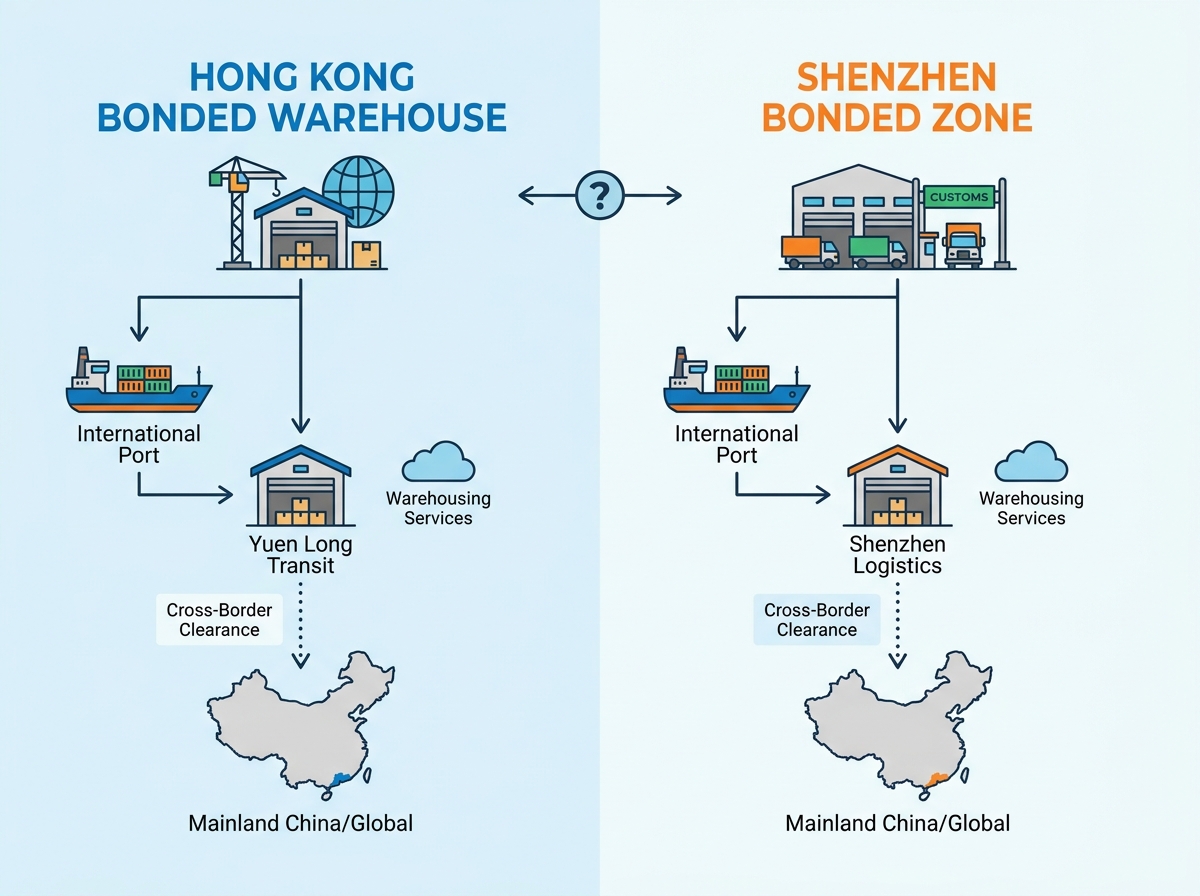
To make an informed supply chain decision, logistics managers must first grasp the fundamental mechanics of bonded storage within the South China corridor. A bonded warehouse functions as a highly secure, customs-controlled environment. Here, imported goods can be safely stored, manipulated, or undergo basic assembly without the immediate burden of import duties or standard taxation.
Industry analyses of the Greater Bay Area logistics landscape reveal a distinct shift in how global enterprises utilize these hubs. Rather than viewing them as interchangeable, modern supply chain architectures increasingly treat the region as a bifurcated ecosystem. High-velocity, premium stock keeping units are being pushed towards free ports for immediate global dispatch. Meanwhile, bulk components remain in mainland bonded areas to hedge against supply chain disruptions. This strategic bifurcation underscores why selecting the appropriate infrastructure is a core component of overall business resilience.
Although geographically adjacent, Hong Kong and Shenzhen operate under entirely different customs, legal, and economic frameworks. When executed correctly, staging goods in the appropriate jurisdiction shaves several days off international transit times and optimizes cash flow through strategic tax deferment.
Hong Kong Warehouse Storage Services: The Global Transit Hub
For decades, Hong Kong has maintained its formidable status as a premier global logistics epicenter. Because it functions as an independent customs territory and a free port, standard duties simply do not apply to the overwhelming majority of goods entering the region. This creates an incredibly frictionless environment for international freight forwarders and brands alike.
The Advantages of Hong Kong Warehousing
The most prominent advantage of utilizing Hong Kong warehouse storage services is the complete absence of tariff friction. Importers can pivot inventory in and out of the territory with virtually zero regulatory interference. Furthermore, the city boasts world-class infrastructure. Facilities are strategically clustered near Hong Kong International Airport, ensuring that a pallet packed in the morning can be airborne by midnight. Top-tier providers integrate automated barcode scanning and API-driven warehouse management systems, guaranteeing real-time inventory visibility. The administrative burden here is notably lighter, requiring minimal paperwork compared to the stringent documentation demanded across the border.
Spotlight: Strategic Transit Facilities
While coastal areas like Kwai Chung are traditional logistics centers due to their proximity to the seaport, the New Territories have become increasingly vital for modern e-commerce. Facilities located just minutes from major border crossings provide a distinct geographic advantage. Cross-border trucking fleets heavily utilize these specific zones for daily freight consolidations. Imagine a scenario where goods manufactured in Dongguan are trucked across the border in the afternoon, staged in the New Territories for rapid sorting, and immediately dispatched to the airport for global fulfillment by evening.
Best Use Cases for Hong Kong
Hong Kong is empirically the superior choice for specific operational models:
- High-Value Goods: Electronics, luxury apparel, fine jewelry, and high-end cosmetics where the premium storage cost is negligible compared to the overall product margin.
- Global Fulfillment: Brands utilizing dropshipping or direct-to-consumer models targeting North America, Europe, or Southeast Asia.
- Time-Sensitive Freight: Supply chains that require fast, frictionless global transit without the risk of unexpected customs holds.
Shenzhen Bonded Zone Logistics: The Cost-Effective Gateway to China
For businesses deeply integrated with Chinese manufacturing or actively targeting domestic consumers, Shenzhen offers a compelling alternative that prioritizes baseline cost efficiency and direct proximity to the source. Special Economic Zones in Shenzhen operate under highly specialized customs regulations. When a shipping container of raw materials arrives from overseas into one of these zones, the import taxes and Value-Added Tax are entirely deferred until those goods officially cross the zone boundaries into the domestic Chinese market.
The Advantages of Shenzhen Bonded Warehouses
The most persuasive argument for adopting Shenzhen bonded zone logistics is undeniable cost efficiency. Commercial real estate rental rates and manual labor costs are drastically lower in Shenzhen compared to its neighbor. Consequently, this allows international brands to consolidate raw materials or finished goods directly from multiple regional suppliers into a single bonded facility before exporting them globally. Shenzhen is also highly competitive for value-added services. Labor-intensive tasks such as kitting, applying compliance labels, conducting rigorous quality control inspections, and repackaging can be executed at a fraction of the cost, often supported by 24/7 CCTV monitoring and dedicated quality assurance lines.
Navigating Cross-Border Clearance
Operating effectively in Shenzhen requires strict adherence to customs protocols. However, these systems are highly streamlined when managed by experienced professionals. For e-commerce brands selling into China, understanding specific customs clearance codes like the 1210 model is essential. By utilizing these frameworks, international brands can import bulk inventory into a Shenzhen warehouse. When a Chinese consumer places an order, the specific item is cleared through customs individually, often benefiting from preferential tax rates and expedited processing.
Best Use Cases for Shenzhen
Shenzhen bonded facilities are the logical choice for:
- Inbound E-commerce: Brands whose primary target audience resides in Mainland China.
- Export Consolidation: Businesses sourcing from multiple Chinese factories that need a central hub to assemble and load shipping containers.
- Bulky or Heavy Goods: Furniture, industrial equipment, or heavy apparel where the volumetric weight would make island storage costs prohibitive.
Head-to-Head Comparison: Hong Kong vs. Shenzhen Warehousing Services
When evaluating logistics hubs in South China, supply chain directors must look beyond basic geographic proximity. A direct comparison across key operational metrics is essential for determining which infrastructure aligns with your specific commercial objectives.
| Evaluation Metric | Hong Kong Free Port | Shenzhen Bonded Zone |
|---|---|---|
| Customs Status | Free Trade Port with zero tariffs on most goods | Tax-deferred with taxes paid upon domestic entry |
| Storage & Rent Costs | High due to premium real estate pricing | Low to Medium offering highly cost-effective scaling |
| Labor & Handling | High | Low and ideal for value-added services |
| Processing Speed | Extremely fast with minimal documentation | Moderate requiring meticulous customs declarations |
| Air Freight Connectivity | World-class with highest global frequency | Growing with strong regional and expanding global reach |
Cost Analysis and Labor Dynamics
The most immediate differentiator is the baseline operational expense. Hong Kong is globally recognized for its premium real estate market, driven by severe land scarcity. Securing space requires a much higher capital allocation. In contrast, Shenzhen offers a significantly more affordable real estate landscape. The lower cost per square meter empowers businesses to hold larger volumes of inventory for longer periods, safeguarding profit margins during seasonal fluctuations.
Customs, Compliance, and Speed
From a practical engineering standpoint, Hong Kong consistently outpaces mainland alternatives when raw transit speed is the primary metric. The seamless entry and exit freedom translates to unparalleled velocity. Meanwhile, Shenzhen bonded zones exist within the stringent legal framework of Mainland China. Moving inventory into or out of these zones requires accurate Harmonized System code classifications and detailed commercial invoices, demanding rigorous administrative oversight from your logistics partner.
Transportation and Freight Connectivity
Both cities boast world-class transportation infrastructure, yet their strengths cater to different models. If your business relies on rapid, next-day air freight to North America or Europe, Hong Kong provides superior capacity. Conversely, for ocean freight, the Port of Yantian and the Port of Shekou in Shenzhen are massive global gateways. They are often situated much closer to the actual manufacturing bases, thereby reducing initial drayage costs.
How to Choose the Right Warehousing Services for Your Supply Chain
Selecting the optimal location is not about finding the universally best warehouse. It is about identifying the facility that precisely matches your operational parameters. This requires a strategic audit of your end-consumers, product characteristics, and required fulfillment activities.
Where is Your Final Customer Located?
The geographic distribution of your customer base should dictate your primary staging area. A standard industry rule applies here. If your primary objective is shipping goods out to a global market, the free port status of Hong Kong makes it the superior launching pad. Alternatively, if you are importing goods with the intention of selling them into the Mainland Chinese market, staging your inventory in Shenzhen is the logical choice. This optimizes cash flow by deferring tax payments until the exact point of sale.
What is Your Product Profile?
The physical and financial characteristics of your inventory heavily influence storage economics. High-value and low-weight items like smartphones, microchips, and fine jewelry generate sufficient profit margins to easily absorb premium storage costs. The priority for these items is market responsiveness. On the other hand, products with a low value-to-weight ratio like home furnishings or bulk textiles demand the spatial affordability that only Shenzhen can provide.
What Value-Added Services Do You Require?
Modern fulfillment often requires more than simple storage and dispatch. If your supply chain relies heavily on activities such as extensive quality control testing, complex product assembly, firmware flashing, or customized repacking, labor costs become a critical factor. In these scenarios, Shenzhen emerges as the clear winner. It allows businesses to perform complex pre-fulfillment processing without drastically inflating operational expenditures.
The Hybrid Supply Chain Model: Using Both Hubs
For enterprise-level brands and sophisticated cross-border sellers, the decision between these two logistical powerhouses is rarely binary. Advanced supply chain strategies often employ a hybrid model, actively leveraging the distinct advantages of both jurisdictions to create a highly optimized and resilient network.
How the Hybrid Model Works
In a practical hybrid setup, a company utilizes Shenzhen as its primary, long-term holding facility. Bulk inventory is shipped directly from Chinese assembly lines into a Shenzhen bonded zone. Because storage costs are remarkably low, the company can comfortably hold months of safety stock without tying up excessive capital in real estate overhead.
Simultaneously, the logistics team maintains a smaller, highly agile fulfillment footprint across the border. Based on predictive sales analytics, they transfer precisely calculated, fast-moving batches of inventory into a Yuen Long international transit warehouse. Located geographically adjacent to the mainland border crossings, this facility acts as a high-speed staging ground. Once the goods arrive, they are immediately picked, packed, and routed to the airport for rapid global dispatch. This perfectly marries mainland cost-savings with island transit speeds.
The Role of a Competent Logistics Partner
Executing a hybrid model requires seamless synchronization between two different customs territories. This strategy cannot be managed effectively with fragmented vendors. It necessitates partnering with a sophisticated third-party logistics provider that maintains physical infrastructure on both sides of the border, coupled with a dedicated fleet of cross-border trucks to ensure daily, uninterrupted transit schedules.
Common Pitfalls to Avoid in South China Logistics
Even with a meticulously planned strategy, cross-border trade in the Greater Bay Area presents unique operational hurdles. Analyzing historical logistics data and customer pain points reveals several common pitfalls that decision-makers must proactively circumvent.
Underestimating Customs Paperwork in Shenzhen
A frequent cause of stalled shipments is underestimating the rigid compliance required by Chinese Customs. Because the bonded zone is heavily regulated, any minor discrepancy between the physical cargo and the commercial invoice can trigger immediate customs holds. A slightly inaccurate weight declaration or a misclassified Harmonized System code is enough to cause severe delays. For e-commerce brands, mastering cross-border bonded goods clearance is absolutely critical. Failing to seamlessly integrate your digital order management system with the official customs declaration portal will inevitably lead to operational bottlenecks and frustrated end-consumers.
Hidden Fees in Hong Kong
While Hong Kong does not impose tariffs, the operational environment is heavily monetized. Businesses transitioning from mainland facilities are often caught off guard by the diverse range of accessorial charges. Common hidden fees include gate charges just to have a truck enter a facility, specialized handling fees for non-palletized cargo, and significant labor surcharges during peak global shopping events like Black Friday. Supply chain directors must negotiate comprehensive, all-inclusive rate cards to prevent unexpected budget overruns.
Choosing the Wrong Logistics Partner
The logistics market in South China is saturated with brokers and intermediaries who market themselves as asset-based providers. A major pitfall is partnering with a vendor who sub-leases space and outsources labor rather than owning or directly managing their facilities. When urgent operational issues arise, brokers lack the direct authority to resolve the problem swiftly. Decision-makers must conduct rigorous due diligence, verifying that their chosen partner physically controls the warehouse space and employs dedicated compliance personnel.
Conclusion
Neither location is universally better for every business model. Your choice depends entirely on the unique contours of your supply chain strategy. Hong Kong offers unmatched speed and global trade freedom, while Shenzhen provides excellent cost savings and manufacturing proximity. The right logistics setup acts as a formidable competitive advantage, not just another operational cost center. Stop leaving money on the table with inefficient staging. Whether you need the lightning-fast dispatch of Hong Kong or the cost-effective consolidation of Shenzhen, partnering with an asset-based expert is non-negotiable. Explore comprehensive warehousing and freight solutions at JF SZ Logistics to align your infrastructure with your actual business goals today.
FAQ
What is the main difference between a Hong Kong bonded warehouse and a Shenzhen bonded zone?
Hong Kong operates as a comprehensive free trade port where almost all commercial goods can enter and exit tax-free with minimal customs intervention, focusing heavily on absolute speed. In contrast, Shenzhen bonded zones are located inside Mainland China. Goods stored there are tax-deferred rather than tax-free. They require strict, detailed customs declarations to enter or exit the zone, making them highly cost-effective for storage but slightly more complex administratively.
Are Hong Kong warehouse storage services always more expensive than Shenzhen?
Generally, yes. The baseline costs for commercial real estate and warehouse labor are significantly higher in Hong Kong due to land scarcity and higher living costs. However, for high-value goods that require immediate global air freight, the speed and complete lack of customs friction in Hong Kong can easily offset the higher daily storage costs, resulting in a better overall return on investment.
How long does cross-border bonded goods clearance take between Shenzhen and Hong Kong?
When managed by a licensed and experienced logistics provider utilizing modern digital declaration systems, cross-border transit and clearance can typically be completed in one to two business days. In highly optimized hybrid supply chains, same-day transit is achievable, depending on the specific customs codes utilized, the accuracy of the commercial documentation, and the type of goods being transported.
What is a Yuen Long international transit warehouse used for?
Located in the New Territories of Hong Kong, just miles from the Shenzhen border crossings, these specific warehouses serve as critical staging grounds for cross-border trade. They are primarily used to receive daily consolidated truckloads of goods coming out of Chinese factories or Shenzhen bonded zones. The goods are quickly sorted and routed directly to the airport or the seaport for immediate global export, minimizing expensive storage time in the city center.
Do I need a registered Chinese business entity to utilize a Shenzhen bonded warehouse?
No, you do not necessarily need a local Chinese entity to store goods in a Shenzhen bonded zone. Many international brands leverage the legal entity of their qualified third-party logistics provider to act as the importer of record for bonded storage. However, specific sales models into the domestic market may require localized registration depending on the e-commerce platforms used.
What is the practical difference between 1210 and 9610 customs clearance models?
These are specific Chinese customs supervision codes for cross-border e-commerce. The 1210 model applies to bonded warehouse imports, where bulk goods are stored in a zone like Shenzhen and cleared individually upon a customer order. The 9610 model applies to direct retail exports, designed for fast-moving B2C parcels shipping directly from China to overseas consumers without bulk bonded storage.
Related Blogs
-
 Door to door shipping from China simplifies international logistics. But how can you ensure smooth delivery from factory to destination? Choosing the right shipping method, preparing documents, and understanding customs responsibilities are essential. This guide explains each shipping step, compares sea, air, and express services, and clarifies DDP and DAP terms. Learn how to arrange reliable deliveries and avoid unexpected costs.
-
 When production stops, every delivery day matters. Delayed components can disrupt schedules and customer commitments. Air freight from China offers a practical solution for urgent commercial shipments. However, choosing the right service requires careful planning. This guide compares standard, priority, and express shipping. You will also learn about flight schedules, customs clearance, and cargo preparation.
-
 Air freight from China offers speed, but costs can vary significantly. Do you know what determines your final shipping bill? This guide explains air freight cost from China, including per-kilogram rates, chargeable weight, surcharges, and destination fees. Learn how to estimate costs and reduce shipping expenses.
