



Hidden shipping costs quietly destroy profit margins every single day. Unforeseen supply chain delays frequently leave containers stranded at terminals. When this happens, heavy daily penalty fees trigger and compound at an alarming rate. For businesses operating on tight margins, a single delayed shipment can easily erase the profitability of an entire quarter.
In this comprehensive guide, we provide actionable strategies to mitigate these financial risks. From a frontline logistics perspective, we will show you exactly how to navigate complex carrier regulations. By optimizing your logistics workflow, you can eliminate these punitive charges entirely.
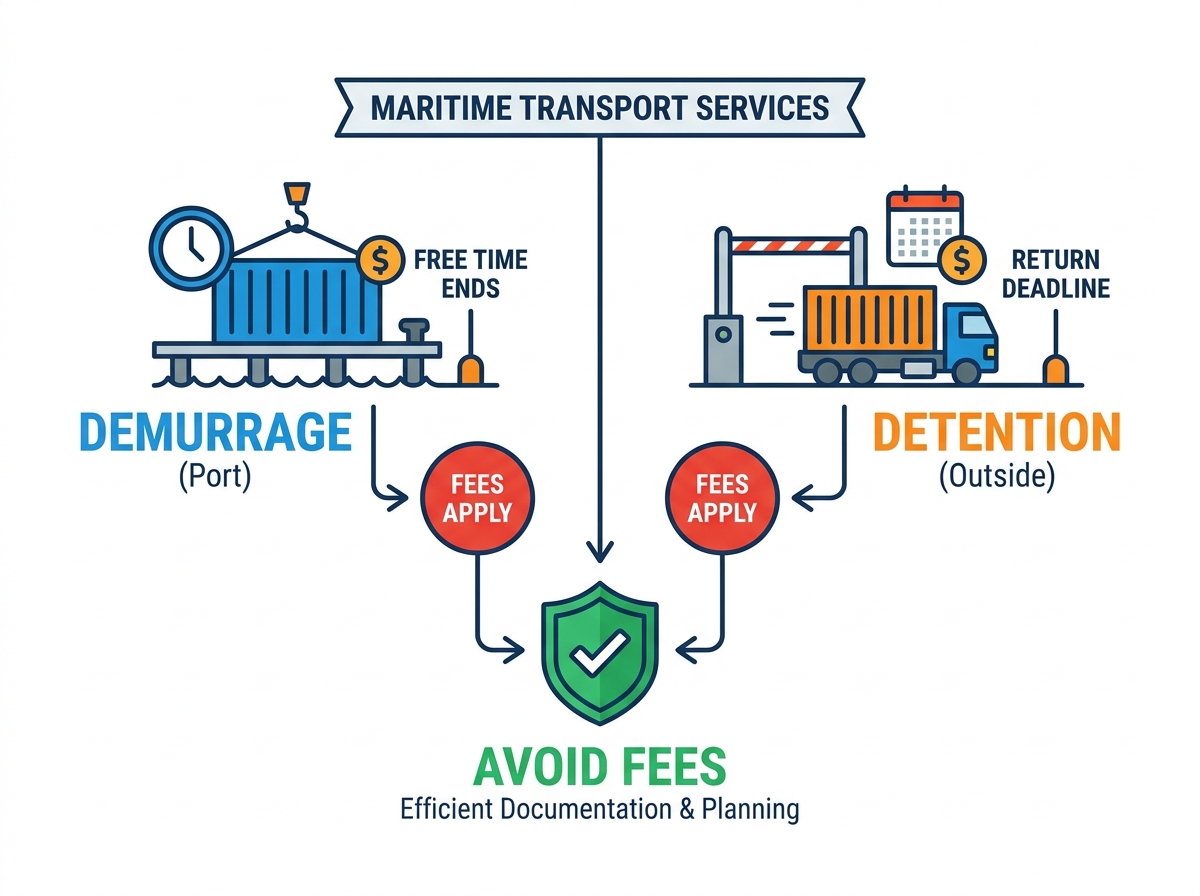
- Demurrage is a fee applied when a loaded container remains strictly inside the port terminal after the allotted free time expires.
- Detention is a fee charged when a container is taken outside the port but is not returned to the carrier within the agreed timeframe.
- Preparing perfectly accurate paperwork remains the most effective method to prevent administrative cargo holds.
- Implementing pre-arrival customs strategies ensures your freight is ready to leave the terminal immediately upon discharge.
- Using strategic transloading provides a critical time buffer. This allows you to return empty containers quickly and stop the detention clock.
- Engaging integrated logistics providers grants the operational visibility required to navigate carrier rules seamlessly.
Understanding the Basics: Demurrage vs. Detention in Maritime Transport Services
To effectively control logistics costs, supply chain managers must first master the specific terminology used in shipping contracts. These terms are often grouped together casually as D&D. However, demurrage and detention actually represent two entirely distinct penalty phases in the lifecycle of a container shipment. Both fees are designed by shipping lines to ensure the rapid turnaround of their equipment. Yet, they occur in different locations and are triggered under varying circumstances.
What is Demurrage? Inside the Terminal
Demurrage is the financial penalty charged by the ocean carrier when a full container sits at the port or terminal facility beyond the agreed-upon free time. This charge is strictly related to the time the container occupies physical space inside the boundaries of the terminal.
For importing shippers, demurrage typically occurs when cargo arrives at the destination port but cannot be picked up. This delay might happen because the goods are awaiting customs release. Alternatively, there might be a severe lack of available drayage trucks to move the container. On the export side, demurrage can occur if a loaded container is delivered to the departure terminal too early. Delivering well before the vessel is ready to accept cargo triggers these fees. Furthermore, if a vessel departure is unexpectedly delayed, terminals that strictly enforce storage limits will apply charges.
What is Detention? Outside the Terminal
In contrast, detention is the fee charged when the receiver of the goods holds onto the physical container outside of the port beyond the allocated free time. Once the container is picked up and gated out of the terminal, the demurrage clock stops. Immediately, the detention clock begins.
Think of detention as an equipment rental penalty. Shipping lines own the containers. They desperately need them back in circulation to serve other customers. If you transport the container to your inland distribution center but take too long to unload the goods, penalties apply. Failing to return the empty box to the designated depot on time guarantees a detention bill.
How Free Time Works in Ocean Freight
Free time refers to the specific number of days a shipping line allows a container to be used for loading, unloading, or storage before punitive fees apply. This crucial period is explicitly written into your freight contract.
Typically, carriers offer between three to five days of free time for both demurrage and detention. However, this is far from a universal standard. Free time rules and calculation methods vary significantly. Some carriers include weekends and national holidays, while others do not. Daily penalty rates also fluctuate depending on the shipping line, the specific port of call, and the type of equipment used. Specifically, refrigerated reefer containers usually have much shorter free time windows compared to standard dry vans.
| Feature | Demurrage | Detention |
|---|---|---|
| Location | Inside the port or terminal | Outside the port or terminal |
| Trigger Event | Container is not picked up from the port on time. | Empty container is not returned to the depot on time. |
| Primary Cause | Customs holds, missing documents, truck shortages. | Slow unloading at the warehouse, lack of return transport. |
| Purpose of Fee | To prevent terminal congestion. | To ensure equipment is returned for reuse. |
Common Causes of D&D Fees for Shippers
Understanding the root causes of D&D fees is the first critical step toward preventing them. Most delays in global shipping are not random acts of bad luck. Rather, they are the direct result of specific operational bottlenecks or administrative oversights. By identifying these common friction points, importers and exporters can implement targeted preventative measures.
Incomplete Documentation and Administrative Errors
The administrative side of global shipping is highly rigid. The most frequent cause of cargo being held at a terminal is incomplete, inaccurate, or late paperwork. Imagine your cargo arrives on a Friday evening. If your documentation is flawed, the weekend burns through your free time before you can even reach an official on Monday to resolve the discrepancy.
Common documentation errors include mismatches on the Bill of Lading, missing commercial invoices, or inaccurate packing lists. For example, if the weight declared on the packing list differs slightly from the weight recorded at the terminal, the cargo is flagged automatically. Failing to manage port delay and ocean freight documentation proactively guarantees that your container will consume its free days while sitting idle at the port.
Customs Holds and Inspections
Government customs agencies operate entirely independently of shipping lines and terminal operators. They possess the authority to hold any container for inspection. These regulatory holds are a major driver of unexpected demurrage fees.
Customs holds can range from simple document reviews to intensive physical examinations. A standard X-ray exam might delay a container by a few days. However, if customs mandates a full intensive exam, the container must be physically moved to an authorized examination station. This arduous process can take weeks. During this entire period, the shipping line demurrage clock continues to tick mercilessly, even though the delay is entirely out of the shipper control.
Port Congestion and Truck Shortages
Sometimes, D&D fees occur despite perfect documentation and smooth customs clearance. Physical supply chain limitations frequently trap containers. When terminals operate over their designed capacity, retrieving a specific container from the bottom of a stack becomes logistically difficult. This leads to unavoidable delays.
Furthermore, a severe shortage of drayage capacity can leave cargo stranded. A lack of available truck drivers or specialized chassis trailers makes movement impossible. If you cannot secure a truck to pick up the container before the free time expires, demurrage fees accrue. Similarly, if there are no trucks available to return the empty container after unloading at your warehouse, detention fees apply.
The Financial Impact and Shifting Industry Trends
Demurrage and detention fees are not minor administrative surcharges. They are punitive penalties designed to force immediate action. For businesses operating in highly competitive markets, accumulating these fees can quickly erase the profitability of an entire shipment.
Current Industry Trends and Regulatory Shifts
Recent industry analyses reveal a rapidly shifting landscape regarding container dwell times. In the wake of major global disruptions, ranging from Red Sea vessel diversions to erratic port labor negotiations, supply chain predictability has plummeted. Routing changes force vessels to arrive off-schedule, causing sudden terminal congestion spikes. Consequently, regulatory bodies like the Federal Maritime Commission have intensified scrutiny on unfair billing practices. They are pushing for greater transparency and shifting the burden of proof onto carriers regarding inaccessible containers.
Despite these regulatory tailwinds, the ultimate responsibility for avoiding fees rests heavily on the operational agility of the shipper. Carriers continue to use D&D as a primary tool to enforce equipment velocity. Shippers must adapt with smarter logistics engineering or face steep financial consequences.
Calculating the Escalating Costs
D&D charges are rarely static. Shipping lines typically structure these fees on an escalating, tiered basis. The longer the container is delayed, the higher the daily penalty becomes. This compounding effect causes costs to spiral out of control within a matter of days.
While rates vary by carrier and location, a standard tiered structure often looks like this:
| Delay Period | Daily Charge | Cumulative Cost Example |
|---|---|---|
| Days 1-4 | Free Time $0 | $0 |
| Days 5-8 | $150 per day | $600 for 4 days |
| Days 9-14 | $275 per day | $600 + $1,650 = $2,250 |
| Days 15+ | $400 per day | $2,250 + $400/day ongoing |
As demonstrated, a container delayed by just two weeks easily accumulates thousands of dollars in penalties. For shippers moving high volumes of containers, these fees represent a massive financial risk.
Why Cheap Freight Rates Can Be Deceiving
Many procurement teams make a critical mistake. They select a maritime transport provider based solely on the lowest base ocean freight rate. This narrow approach ignores the total landed cost.
A carrier offering a heavily discounted freight rate might offset that discount by providing exceptionally short free time windows. They might offer only two days instead of five, while enforcing aggressive penalty rates. If your supply chain is not optimized for rapid turnaround, the cheap freight rate will ultimately cost your business significantly more. Evaluating the free time terms is just as important as evaluating the base rate.
Proven Strategies to Avoid Demurrage and Detention Fees
Mitigating these charges requires a proactive, systematic approach to supply chain management. Rather than reacting to delays after cargo arrives at the destination port, successful managers implement preventive measures during the transit phases. Below are empirically proven strategies to minimize exposure to these costly penalties.
Negotiate Extended Free Time Upfront
The most direct method to reduce risks is securing additional free days during the initial freight procurement phase. Standard ocean freight contracts typically allocate three to five free days for container discharge and return. However, shippers with consistent volume can often negotiate extended free time. Depending on the trade lane and carrier capacity, securing up to ten or fourteen days is possible.
It is critical to formalize these terms within the service contract before the cargo is loaded. Relying on spot market rates often means accepting default, minimal free time. This significantly increases the risk of penalties if port congestion occurs.
Flawless Documentation Submission
Administrative discrepancies are among the leading causes of cargo holds at destination terminals. Customs authorities and terminal operators require precise alignment between the Master Bill of Lading, House Bill of Lading, commercial invoices, and packing lists. Any mismatch in weight, piece count, or Harmonized System codes triggers an automatic hold.
By ensuring flawless documentation well before vessel arrival, shippers prevent administrative bottlenecks. Standard operating procedures should mandate that all paperwork is verified and submitted electronically at least 72 hours prior to the vessel docking.
Pre-Clear Cargo with Customs Authorities
Waiting until a vessel arrives to initiate the customs clearance process is a high-risk strategy. Modern customs systems allow brokers to file entry summaries while the cargo is still in transit across the ocean.
Utilizing proactive customs clearance to reduce port delays ensures that cargo is released by regulatory authorities the exact moment it is discharged from the vessel. Pre-clearing goods minimizes the time a container spends sitting in the terminal yard. This allows drayage providers to retrieve the container immediately upon availability, acting as a powerful firewall against demurrage charges.
Utilize Short-Term Cargo Warehousing as a Buffer
When destination facilities lack the capacity to immediately receive and unload incoming containers, shippers often hold the carrier equipment on-site. This rapidly accumulates detention fees. Implementing a strategic buffer is the best engineering workaround.
Instead of delivering the ocean container directly to a congested final destination, route the container to a nearby port-centric facility. By utilizing short-term cargo warehousing, the cargo is quickly transloaded into a domestic trailer or storage facility. The empty ocean container is then immediately returned to the terminal. This completely halts the detention clock while allowing the shipper to distribute the goods at their own operational pace.
Optimize Trucking and Drayage Scheduling
The availability of drayage capacity is highly volatile. Assuming a truck will be available on the exact day a container is discharged often leads to stranded cargo. Best practices dictate that drayage appointments should be scheduled weeks in advance. Use the vessel Estimated Time of Arrival as a baseline.
Furthermore, utilize dual-transaction drayage. This occurs when a driver drops off an empty container and picks up a full import container in the same trip. This method increases operational efficiency and ensures empty equipment is returned well within the allotted free time.
How Integrated Maritime Transport Services Eliminate Supply Chain Friction
Managing international freight through a fragmented network of independent vendors creates massive communication gaps. When the ocean carrier, customs broker, drayage provider, and warehouse operator operate in silos, D&D fees breed rapidly. Transitioning to integrated logistics solutions centralizes control and data flow, significantly reducing supply chain friction.
End-to-End Visibility and Real-Time Tracking
Data latency is a severe liability in global shipping. If a supply chain manager is unaware that a container has been discharged, the free time clock begins ticking unnoticed. Integrated logistics providers utilize advanced Transportation Management Systems equipped with API and EDI connections directly to ocean carriers and terminal operating systems.
This technology provides real-time tracking of vessel arrivals, exact container discharge timestamps, and automated countdowns for free days. Engaging maritime transport services for shippers ensures stakeholders receive automated alerts regarding impending risks. This allows teams to allocate resources dynamically and prioritize the retrieval of aging containers before penalties apply.
Streamlining the Import and Export Process
When a single entity orchestrates the entire lifecycle of a shipment, operational handoffs become seamless. For instance, an integrated provider automatically synchronizes the customs release with the drayage dispatch. This ensures a truck is dispatched the exact moment the terminal shows the container as available.
Partnering with experts eliminates the need to coordinate between disparate vendors. This unified approach ensures documentation flows seamlessly from origin to destination. Customs entries are filed proactively, and warehouse capacity is reserved in advance. Ultimately, this engineers D&D fees completely out of the supply chain equation.
Choosing the Right Logistics Partner to Protect Your Margins
The selection of a logistics partner is a critical financial decision. A vendor chosen solely based on the lowest base ocean freight rate may ultimately cost the organization significantly more. If they lack the operational infrastructure to prevent delays, penalties will mount. Decision-makers must evaluate potential partners based on their capacity to provide holistic, preventive solutions.
What to Look for in a Freight Forwarder
When auditing potential logistics partners, organizations should look far beyond standard freight forwarding capabilities. Key evaluation criteria should include:
- Carrier Relationships: The ability to leverage volume to negotiate favorable free time conditions and secure space during peak seasons.
- In-House Customs Brokerage: Direct control over the customs clearance process to ensure proactive pre-arrival filings and immediate resolution of regulatory holds.
- Port-Adjacent Infrastructure: Access to strategically located cross-docking and warehousing facilities. This facilitates rapid transloading and the immediate return of empty containers.
- Technological Maturity: The provision of client-facing dashboards that display real-time container statuses, free time tracking, and automated risk alerts via API integration.
The Integrated Logistics Advantage
Objective analysis of supply chain resilience indicates that providers with integrated asset networks and localized expertise offer superior risk mitigation. By integrating customs clearance, drayage coordination, and warehousing into a singular operational flow, top-tier providers maintain tight control over the cargo lifecycle. This structured methodology demonstrates a proven capacity to keep cargo moving efficiently. It protects profit margins from the unpredictable variables that typically trigger demurrage and detention penalties.
Conclusion
Unexpected fees severely harm your shipping budget, but they do not have to be an accepted cost of doing business. Proactive planning prevents these massive daily charges from eating into your bottom line. Accurate paperwork stops terminal delays before they even start. Meanwhile, strategic storage helps you return empty containers fast.
By treating logistics as a true strategic partnership rather than a mere transactional expense, you build lasting supply chain resilience. Stop losing money to unexpected port delays and administrative bottlenecks. Protect your profit margins by auditing your current supply chain processes. For tailored, integrated solutions that prioritize velocity and visibility, explore the comprehensive offerings at JFSZ Logistics to safeguard your global shipments.
FAQ
What is the difference between demurrage and port storage charges?
Demurrage is a fee assessed by the shipping line for the prolonged use of their shipping container beyond the allotted free time while it remains inside the terminal. Conversely, port storage charges are levied directly by the terminal operator or port authority for the physical ground space the container occupies at the facility. Both fees can, and often do, accrue simultaneously.
Who is responsible for paying D&D fees?
The liability for Demurrage and Detention fees depends strictly on the International Commercial Terms agreed upon in the sales contract. Generally, the party responsible for the freight during the segment where the delay occurs is liable. Most commonly, this is the importer at the destination.
Can demurrage and detention fees be waived or disputed?
Yes, but successful disputes require rigorous empirical evidence. If a delay is demonstrably caused by the carrier, port strikes, or terminal congestion that renders the container inaccessible, shippers can dispute the charges. Maintaining a meticulous audit trail of timestamps, emails, and terminal screenshots is absolutely mandatory for a successful waiver.
How does short-term cargo warehousing help avoid detention?
Instead of holding a shipping line container at your own facility while slowly unloading it over several days, you route the container to a short-term warehouse near the port. The goods are quickly transloaded into domestic trailers. This allows the empty ocean container to be returned to the port immediately, stopping the detention clock instantly.
How many free days are standard for ocean freight?
Standard free time usually ranges from three to five days for standard dry containers. However, specialized equipment like refrigerated containers often receive much less free time, sometimes only two days. Shippers with high volumes can often negotiate extended free time up to ten or fourteen days during the contract phase.
Does customs clearance time count towards demurrage?
Yes, the demurrage clock continues to tick while a container is undergoing customs clearance or inspections. Because customs authorities operate independently of shipping lines, carriers do not pause free time for regulatory holds. This makes pre-arrival customs filing a critical strategy to avoid fees.
Related Blogs
-
 Door to door shipping from China simplifies international logistics. But how can you ensure smooth delivery from factory to destination? Choosing the right shipping method, preparing documents, and understanding customs responsibilities are essential. This guide explains each shipping step, compares sea, air, and express services, and clarifies DDP and DAP terms. Learn how to arrange reliable deliveries and avoid unexpected costs.
-
 When production stops, every delivery day matters. Delayed components can disrupt schedules and customer commitments. Air freight from China offers a practical solution for urgent commercial shipments. However, choosing the right service requires careful planning. This guide compares standard, priority, and express shipping. You will also learn about flight schedules, customs clearance, and cargo preparation.
-
 Air freight from China offers speed, but costs can vary significantly. Do you know what determines your final shipping bill? This guide explains air freight cost from China, including per-kilogram rates, chargeable weight, surcharges, and destination fees. Learn how to estimate costs and reduce shipping expenses.
