



Are defective imports draining your logistics budget? Rejected goods at customs cause severe delays. Returning them overseas often incurs exorbitant freight costs. This guide breaks down strategic solutions to salvage non-compliant inventory. You will learn how to optimize your supply chain resilience and turn compliance disasters into manageable workflows.
Key Takeaways
- Cost Efficiency: Utilizing specialized storage facilities eliminates the need for costly international return shipping. Businesses execute repairs directly at the port of entry.
- Brand Protection: Swift interventions prevent defective packaging from reaching the consumer market. This safeguards brand equity and mitigates product liability risks.
- Streamlined Customs: Expert management of returned inventory ensures legal handling of re-exports. It prevents unnecessary tariff burdens and compliance penalties.
- Strict Compliance: Industry-specific procedures ensure highly regulated items meet stringent local regulatory standards before final distribution.
Global Supply Chain Shifts and Bonded Manipulations
Analyzing the current landscape of global logistics reveals a sharp upward trend in utilizing duty-free zones for inventory manipulation. Volatile global supply chains and complex tariff environments drive this operational shift. Increasingly stringent compliance mandates, such as rigorous environmental and social governance labeling requirements, force companies to adapt rapidly. Supply chain leaders proactively use bonded facilities as strategic compliance buffers. This approach reflects a broader industry movement towards agile, nearshored inventory management. Brands can now adapt to sudden regulatory changes without absorbing catastrophic cross-border return costs.
What is Bonded Zone Rework and Relabeling?
Defining the Process within Specialized Facilities
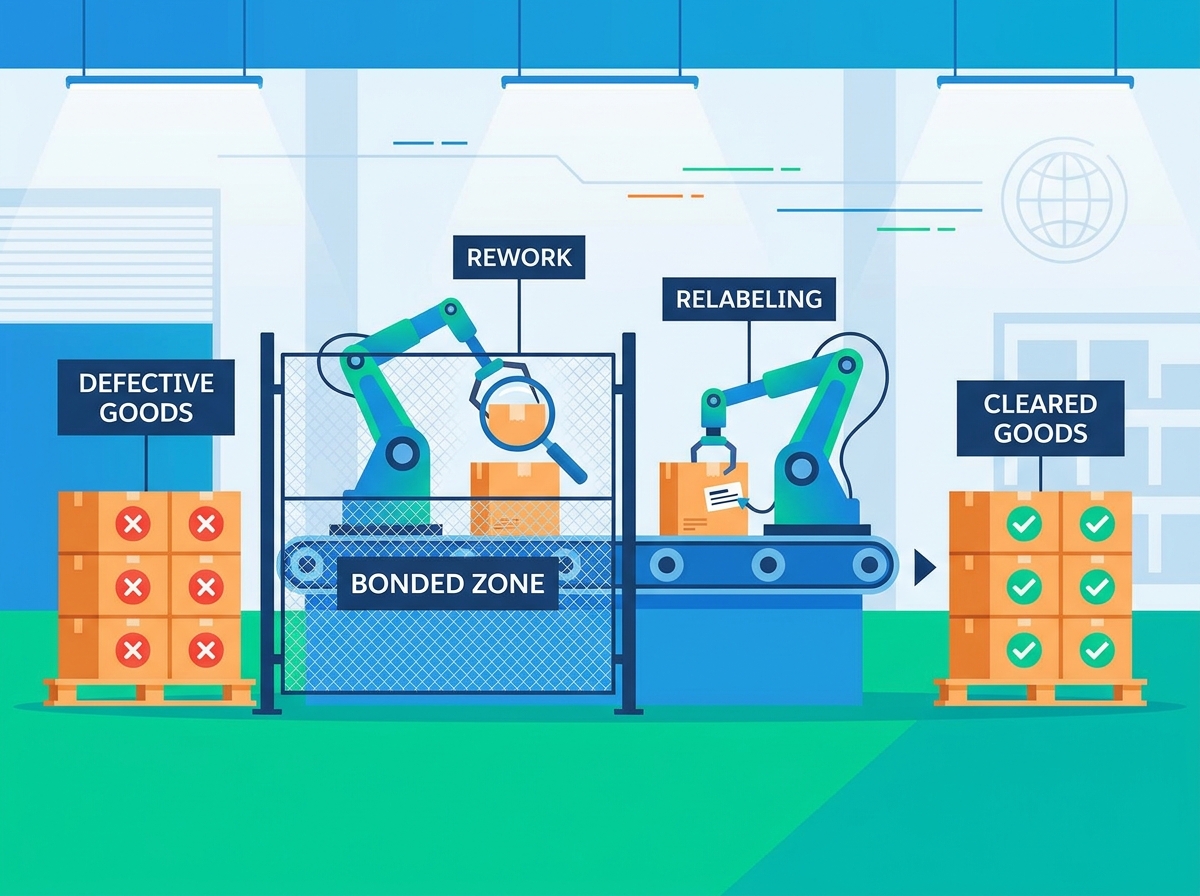
A bonded zone operates as a highly secure perimeter controlled by customs. Imported goods are retained here without the immediate payment of duties or taxes. Technically considered outside the domestic customs territory, this unique legal status provides operations directors with a critical buffer. It allows teams to manage inventory requiring physical modification before it legally enters the local market.
Within this controlled environment, rework refers to the physical correction of defective products. Imagine a shipment of 10,000 smartwatches arriving with outdated firmware or shifted internal components. Technicians can flash the new software or reassemble the units on-site. Conversely, relabeling involves updating external or internal packaging to meet stringent local compliance laws. Common tasks include applying local language translation stickers, correcting compliance marks, or swapping incorrect barcodes to ensure accurate retail scanning.
Why Packaging Defects Damage Brand Equity
Packaging serves as the crucial first touchpoint between a consumer and a brand. Minor defects like smeared ink, torn shrink wrap, or missing nutritional information severely erode consumer trust. In today's highly connected retail landscape, a single batch of poorly packaged goods easily triggers widespread customer complaints. Visible unboxing videos highlighting these flaws can devastate a product launch.
Beyond aesthetic concerns, incorrect labeling poses severe product liability threats. If a product lacks mandatory warning labels, the manufacturer faces immediate legal action and mandatory recalls. Intercepting these discrepancies within a customs-controlled warehouse protects the bottom line. It guarantees that only pristine, fully compliant products reach retail shelves. This defends the brand's premium positioning and ensures consumer safety.
The Strategic Role of Logistics Partners in Rework
Beyond Basic Storage: Value-Added Operations
Historically, third-party logistics providers were viewed merely as landlords offering empty floor space. Today's modern supply chain demands much more. Top-tier logistics partners now provide comprehensive warehousing and cargo handling services that act as a direct extension of the overseas manufacturing line. When a shipment arrives compromised, these value-added interventions become operational lifelines.
Rather than viewing a storage facility as a static holding pen, forward-thinking operations directors leverage it as a dynamic processing hub. Facilities equipped for these interventions supply dedicated labor, specialized tooling, and the necessary climate-controlled environments. This strategic pivot transforms a potential logistical disaster into a highly manageable, localized operational task.
Capabilities in Complex Repackaging
Executing high-volume cargo relabeling and repackaging requires highly specific operational infrastructure. It is rarely a matter of simple manual labor. Restoring a factory-fresh appearance to damaged outer cartons often necessitates industrial-grade heat sealers. Advanced facilities utilize automated conveyor systems capable of processing up to 5,000 units daily to maximize efficiency.
Common capabilities extend to kitting and assembly. Workers might insert missing promotional materials or localized instruction manuals into product boxes. Precision is paramount during compliance stickering. Technicians require alignment tools to ensure the permanent adhesion of regulatory labels. When dealing with hazardous materials, the stakes are even higher. Handling chemical leaks demands trained personnel equipped with advanced personal protective equipment operating strictly within spill-contained zones.
Core Comparison: Rework vs. Overseas Return
| Evaluation Metric | Bonded Zone Rework | International Return |
|---|---|---|
| Freight Costs | Minimal localized transport fees | Exorbitant two-way transoceanic shipping |
| Turnaround Time | 3 to 7 days typically | 45 to 90 days minimum |
| Customs Risk | Controlled environment, zero double-taxation | High risk of re-entry inspection failures |
| Carbon Footprint | Extremely low | Massive emissions from ocean freight |
Standard Operating Procedures for Quality Control
Receiving, Storage Location, and Identification
Strict inventory segregation forms the bedrock of any successful recovery operation. The moment defective goods enter the facility, workers must physically isolate them from compliant, ready-to-ship inventory. This segregation prevents the catastrophic error of accidentally dispatching faulty units to end consumers.
Best practices dictate integrating a robust Warehouse Management System with physical identification protocols. Defective pallets are immediately routed to a designated quarantine sector. Here, they are wrapped in highly visible warning tape and digitally locked within the system software. This dual-layer identification guarantees that warehouse pickers cannot access the units until the entire correction cycle is finalized and authorized by quality assurance personnel.
Execution and Quality Assurance Protocols
Facilities must adhere to a rigorous, step-by-step procedure to maintain absolute consistency. The process begins with an initial defect assessment. Quality engineers inspect a sample batch to pinpoint the root cause. They determine whether the issue stems from a systemic manufacturing flaw or isolated transit damage. Based on these findings, engineers draft a detailed instruction manual specifying the exact tools, repair steps, and safety protocols required.
Once the blueprint is established, trained staff execute the bonded zone quality inspection and rework along a dedicated assembly line. Technicians might use precision scales to verify the weight of newly kitted components. They also utilize diagnostic software to test repaired electronics. Following the physical modifications, an independent inspector reviews the batch. This final audit certifies that the goods now perfectly align with both original manufacturing specifications and local regulatory mandates.
Navigating Customs Clearance and Trade Compliance
Managing Clearances for Rejected Inventory
When domestic customs authorities reject a shipment due to missing compliance documents or labeling errors, standard procedures halt. Bringing those goods back into a controlled environment requires specialized customs clearance for returned goods. The logistics provider must file precise declarations proving the goods are re-entering the zone specifically for repair, rather than as a new commercial import.
This bureaucratic process involves submitting original export documentation, buyer rejection letters, and a comprehensive repair plan. After the corrections are executed, a secondary clearance process is initiated. The updated, fully compliant goods are presented to customs alongside a detailed audit log. The expertise of a licensed customs broker is indispensable here. They ensure correct tariff codes are applied and double-taxation is entirely avoided.
Strategies for Re-Exporting Repaired Goods
In certain scenarios, defective goods simply cannot be brought up to local compliance standards. Alternatively, the brand may decide to divert the repaired items to an entirely different international market. Under these circumstances, the goods must be re-exported.
Navigating re-export regulations permits businesses to ship the modified goods out of the facility to a foreign destination. This happens without ever paying the host country's domestic import duties. This specific strategy acts as a vital financial shield for global brands. It ensures capital is not squandered on tariffs for inventory that will never be consumed within that specific domestic territory.
Industry-Specific Rework Challenges and Compliance
Medical Devices and Pharmaceuticals
The healthcare sector faces the highest level of regulatory scrutiny during any physical intervention. Regulatory bodies maintain incredibly strict guidelines distinguishing between basic servicing and full remanufacturing. If a repair process alters a device's original performance specifications, it crosses into remanufacturing territory. This triggers the need for entirely new regulatory submissions.
Precision in pharmaceutical labeling is literally a matter of life and death. A misplaced decimal point on a dosage sticker or a swapped barcode on a drug delivery device can result in fatal patient outcomes and massive legal penalties. Consequently, facilities handling these sensitive products must operate within certified cleanroom environments utilizing multi-tiered verification protocols.
Food Safety and Allergen Control
Handling defective food and beverage shipments introduces severe biological and chemical risks. When packaging defects occur, such as compromised vacuum seals or misprinted expiration dates, the recovery process must prioritize consumer safety above all operational metrics.
Facilities managing food reprocessing must strictly adhere to Hazard Analysis and Critical Control Point frameworks. A primary challenge is preventing cross-contamination. If a batch of gluten-free snacks requires new outer cartons because an allergen warning was omitted, the repackaging must occur in a sanitized, strictly segregated zone. This prevents ambient dust from contaminating the product. Additionally, cold-chain items demand rapid processing within refrigerated sectors maintaining strict temperatures between 2 degrees Celsius and 8 degrees Celsius to prevent spoilage.
Hazardous Chemical Repackaging
Chemical interventions carry significant environmental and occupational safety risks. If a shipment of industrial solvents arrives with leaking intermediate bulk containers or non-compliant safety labels, standard warehouse environments are wholly inadequate.
Chemical recovery operations require specialized infrastructure. This includes advanced ventilation systems, integrated spill containment trenches, and sophisticated fire suppression technology. Workers must be heavily trained in hazardous material handling. Every newly applied label must accurately reflect the chemical composition and emergency response protocols dictated by the Globally Harmonized System. This ensures the materials are safe for final domestic transit.
Choosing the Right Partner for Supply Chain Recovery
Evaluating Key Operational Capabilities
Executing a successful recovery strategy relies entirely on the technical and regulatory capabilities of your logistics partner. Selecting a provider based solely on the lowest storage rate is a critical strategic error. Decision-makers must rigorously evaluate the provider's operational agility and regulatory expertise against concrete engineering standards.
First, verify their customs expertise. A top-tier provider employs in-house, licensed customs brokers who deeply understand the nuances of moving goods in and out of bonded status. Next, examine their industry-specific certifications, ensuring they hold necessary medical or hazardous material credentials tailored to your exact product line. Finally, assess their scalability. Product recalls happen without warning. Your partner must possess the labor depth and spatial flexibility to rapidly scale operations and process thousands of units under punishing deadlines.
The Necessity of Technological Visibility
In modern supply chain management, flawless physical execution must be paired with absolute digital transparency. Reliable partners utilize advanced, cloud-based Warehouse Management Systems offering real-time inventory visibility to their clients.
During a high-stakes recovery project, operations directors should never be left in the dark. Client portals must display exactly how many units are locked in quarantine, how many are actively undergoing repairs, and how many have been cleared for final shipping. This digital audit trail is a mandatory requirement for proving compliance to customs authorities during the final clearance phase.
Conclusion and Next Steps
Defective imports do not have to result in catastrophic financial losses or logistical nightmares. Strategically leveraging specialized duty-free facilities allows businesses to isolate compliance issues directly at the border. You entirely bypass the exorbitant costs and delays of international return shipping.
Efficiently executing physical corrections and label updates within a controlled environment allows brands to maintain strict regulatory compliance. It salvages valuable inventory and fiercely protects brand equity. Supply chain leaders should view these specialized operations as a core component of global trade resilience. If you are facing customs rejections or need immediate inventory correction, explore the professional solutions at JFSZ Logistics. Partnering with proven experts ensures your supply chain remains agile, compliant, and highly profitable, even when unexpected defects arise.
Frequently Asked Questions
Q1: What is the difference between standard storage and bonded zone operations?
Standard facilities store goods that have already cleared domestic customs and for which all applicable import duties have been paid. Bonded facilities store goods before they officially enter the local market. This critical legal distinction allows businesses to hold, inspect, and perform necessary physical corrections on inventory without paying premature tariffs. Import duties are only assessed when the fully compliant goods leave the controlled area and enter domestic commerce.
Q2: Can any product undergo modifications within these specialized zones?
While standard consumer goods like electronics, apparel, and homewares easily undergo basic modifications, highly regulated items require specialized handling. Products such as industrial chemicals, perishable foods, and medical devices dictate that the handling facility possesses strict industry certifications to legally and safely perform any physical or packaging alterations.
Q3: How does this strategy save money on defective imports?
If a shipment arrives at a destination port with incorrect compliance labels or minor manufacturing defects, customs authorities will reject it. Returning that entire container to the overseas manufacturer incurs massive international ocean or air freight costs, plus weeks of transit delays. Executing the required corrections in a local, duty-free warehouse eliminates these round-trip international freight costs and gets the compliant product to the retail market significantly faster.
Q4: Do I need a special broker to handle the legal entry of rejected goods?
Yes. Navigating the legal entry of returned or rejected goods requires highly specific customs declarations to avoid paying double duties or facing severe compliance penalties. It is strongly recommended to partner with a logistics provider featuring an integrated, licensed customs brokerage team. This ensures the physical manipulation of the goods aligns perfectly with the legal documentation filed with government authorities.
Q5: How is the quality of the modified goods guaranteed?
Top-tier logistics providers implement strict standard operating procedures governed by robust quality management systems like ISO 9001. This highly controlled process includes physically segregating defective goods into locked quarantine zones, strictly following manufacturer-provided repair guidelines, and conducting an independent, final quality audit before the goods are officially certified and released for domestic distribution.
Q6: How long does bonded zone rework typically take?
The timeline depends entirely on the complexity of the intervention and the volume of the shipment. Simple relabeling for a single container can be completed in 48 to 72 hours using automated systems. Complex electronic flashing or component replacement may take one to two weeks. A professional logistics partner will provide a precise time study during the initial defect assessment phase.
Q7: What documents are required for bonded zone relabeling?
To legally perform relabeling within a customs-controlled area, you typically need the original commercial invoice, the packing list, and the bill of lading. Additionally, you must provide a formal declaration outlining the exact nature of the non-compliance, a detailed scope of work for the proposed relabeling, and the new, compliant label artwork approved by the relevant local regulatory authority.
Related Blogs
-
 Door to door shipping from China simplifies international logistics. But how can you ensure smooth delivery from factory to destination? Choosing the right shipping method, preparing documents, and understanding customs responsibilities are essential. This guide explains each shipping step, compares sea, air, and express services, and clarifies DDP and DAP terms. Learn how to arrange reliable deliveries and avoid unexpected costs.
-
 When production stops, every delivery day matters. Delayed components can disrupt schedules and customer commitments. Air freight from China offers a practical solution for urgent commercial shipments. However, choosing the right service requires careful planning. This guide compares standard, priority, and express shipping. You will also learn about flight schedules, customs clearance, and cargo preparation.
-
 Air freight from China offers speed, but costs can vary significantly. Do you know what determines your final shipping bill? This guide explains air freight cost from China, including per-kilogram rates, chargeable weight, surcharges, and destination fees. Learn how to estimate costs and reduce shipping expenses.
