



Global digital retail is expanding at an unprecedented rate. This surge pushes merchants into a fierce race for faster delivery times. High tariffs, complex border regulations, and sluggish shipping routes consistently erode profit margins. Upfront duty payments drain working capital long before a single unit reaches the checkout cart.
Current industry analyses reveal a structural pivot in global supply chain architecture. Market intelligence indicates a massive migration toward tax-deferred staging zones, a trend accelerating as international trade policies grow increasingly volatile. Enterprise brands are actively dismantling fragile just-in-time inventory models. They are rebuilding around resilient, strategically placed buffer stocks. Storing high-value merchandise in customs-controlled zones has become the premier method to absorb market shocks. Retailers can now maintain robust inventory levels without paralyzing their cash flow.
In this comprehensive technical guide, we will unpack the exact mechanics of these specialized facilities. We will explore the tangible financial benefits, operational workflows, and strategic frameworks necessary to determine if your brand infrastructure requires a critical upgrade.
Key Takeaways
- Cash Flow Optimization: Bonded facilities allow e-commerce businesses to legally defer customs duties and taxes until the product is physically sold and shipped to the end consumer.
- Faster Fulfillment: Storing inventory adjacent to international buyer hubs drastically reduces cross-border transit times compared to direct-from-origin freight.
- Value-Added Services: Modern tax-deferred facilities offer comprehensive manipulation of goods. This ensures regional compliance and seamless last-mile delivery.
- Strategic Flexibility: Implementing a dual-warehouse strategy—combining standard local and bonded storage—is the new baseline for resilient supply chain architecture.
What is a Custom Bonded Warehouse in E-commerce?
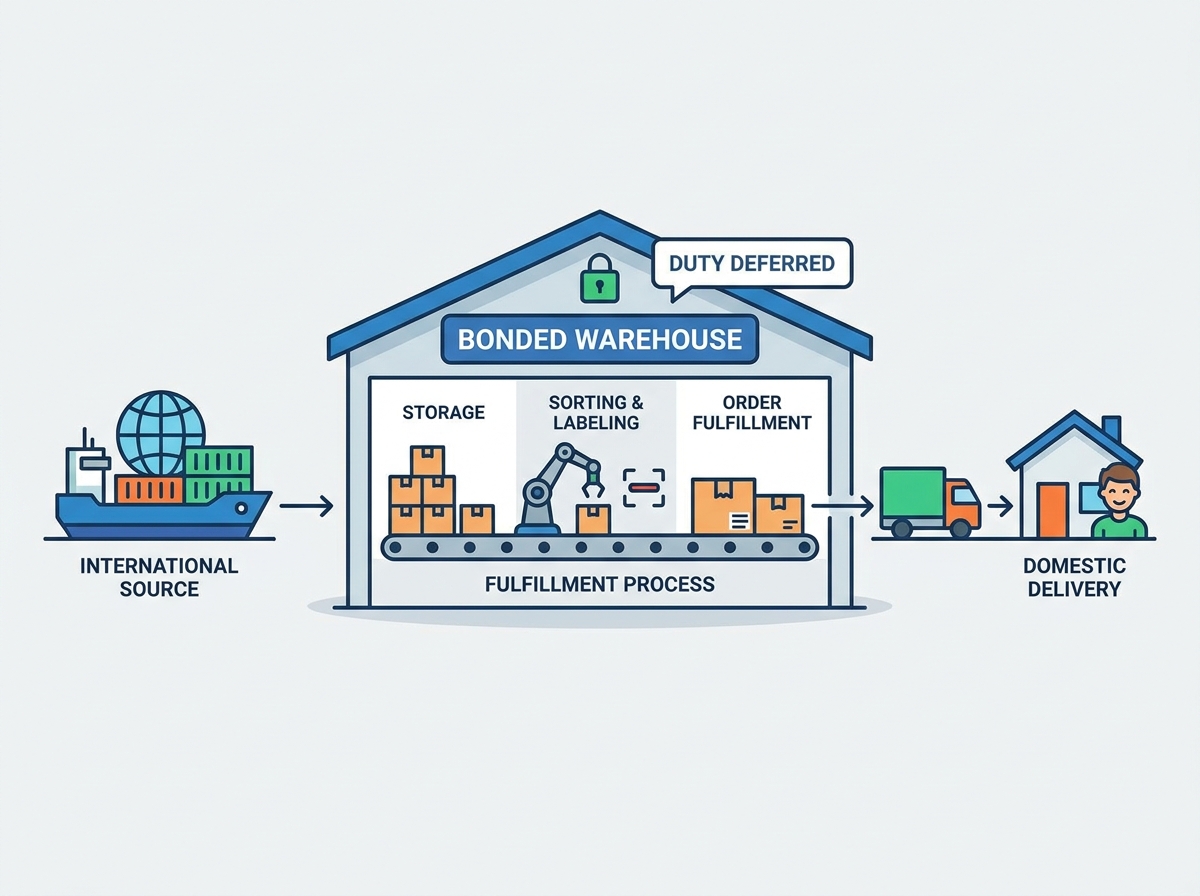
A customs bonded warehouse operates as a highly secure, government-regulated facility. Within these authorized perimeters, imported merchandise undergoes storage, manipulation, or specific manufacturing operations without triggering immediate tax liabilities. The fundamental engineering principle driving this system is duty deferral. The financial liability for taxes is only executed when the goods are officially withdrawn for domestic consumption.
In the context of modern digital retail, this traditional B2B logistics model has evolved into a high-speed engine. Instead of merely holding bulk raw materials on static pallets, modern bonded facilities act as dynamic staging grounds for B2C global inventory. E-commerce merchants can import massive quantities of stock into a target continent without tying up crucial operational capital in upfront tax payments.
Today, top-tier cross-border warehousing services integrate bonded storage seamlessly into their technology stacks. Through advanced Warehouse Management Systems, sellers gain real-time visibility into their deferred-tax inventory. This digital integration allows brands to manage stock levels, monitor customs compliance via automated API webhooks, and execute fulfillment orders with the exact same efficiency as domestic nodes.
How Bonded Warehousing Services Work for Cross-Border Fulfillment
Understanding the operational flow of these specialized facilities is crucial for evaluating their impact on your supply chain. The process transforms a notoriously complex regulatory environment into a streamlined fulfillment pipeline.
Receiving and Inbound Customs Clearance
The logistical journey begins when a shipping container arrives from an overseas manufacturer at the port of entry. Instead of clearing standard customs and forcing immediate duty payments, the goods are transported directly to the facility under a strict customs bond. This bond acts as a financial guarantee to the government that all eventual duties will be settled. Warehouse technicians then scan inbound barcodes, officially registering the SKUs into the bonded database. From a legal perspective, the inventory remains outside the consumer market.
Storage and Inventory Management
Once inside the secure zone, the goods are safely racked and tracked using sophisticated software platforms. These systems must maintain rigorous compliance with customs regulations. Leading facilities engineer their operations to achieve 99.9% inventory accuracy. The management software provides merchants with a centralized dashboard to monitor inventory levels, track product movement, and forecast demand. Because bonded storage generally permits long-term holding periods, brands can store buffer stock without worrying about arbitrary time constraints.
Value-Added Services
A critical advantage of modern facilities is the allowance for inventory manipulation prior to final market entry. Facilities offer specialized sorting and labeling for fulfillment, which is absolutely vital for merchants needing to adapt generic packaging to specific regional compliance laws. Goods can be unpacked from bulk pallets, kitted into subscription boxes, or prepped specifically for FBA requirements. This ensures that when an item finally leaves the loading dock, it is fully compliant and ready for immediate last-mile carrier injection.
Order Processing and Dispatch
The final operational step is triggered directly by the end consumer. When a shopper completes a checkout online, the system instantly alerts the warehouse floor. The specific item is picked, packed, and scanned out of the secure network. It is only at this exact micro-moment that customs duties are calculated and paid. For many B2C shipments, this process leverages specific low-value thresholds, potentially eliminating duties entirely for individual orders. The parcel then seamlessly enters the domestic carrier network for rapid drop-shipping delivery.
Major Benefits of Using Bonded Warehouses for E-commerce
For rapidly expanding brands, transitioning to customs-controlled storage is far more than a logistical pivot. It is a strategic financial upgrade. Evaluating the true business impact requires looking simultaneously at operational efficiency and capital preservation.
Improved Cash Flow via Duty Deferral
The most immediate and impactful benefit is the preservation of working capital. In standard importing, bringing ten thousand units of a high-value product into a country requires paying duties on all units upfront. Bonded storage eliminates this bottleneck. By paying taxes only on items that have already been purchased by a customer, brands can redirect massive amounts of capital toward performance marketing and funding new production runs.
Faster Shipping and Better Customer Experience
Modern consumers expect rapid delivery, demanding their packages within two to three days. Shipping direct-from-origin can take weeks and is highly prone to arbitrary customs delays at the border. Pre-positioning bulk stock in a tax-deferred facility near the end consumer reduces cross-border transit times to mere days. The buyer experiences domestic-like shipping speeds, which significantly improves brand trust and repeat purchase rates.
Simplified Returns Management
Reverse logistics is traditionally a massive profit-killer for international merchants. If a customer returns a product across borders, merchants often face complex re-importation paperwork or are forced to pay double duties. Conversely, bonded warehouses can receive international returns directly into their secure zones. Because the facility is technically outside the domestic customs territory, returned goods can be inspected, refurbished, and placed back into active inventory without incurring additional local import duties.
Avoidance of Unnecessary Duties on Unsold Goods
Market demand can be notoriously unpredictable. If a particular SKU fails to gain traction in a target market, standard warehousing leaves the merchant absorbing the sunk cost of the import duties already paid. In a bonded facility, unsold goods can be legally re-exported to a more profitable country, or destroyed under official customs supervision. The duties to the host country are completely avoided, effectively mitigating the financial risk of global expansion.
Streamlined Cross-Border Logistics
Managing multiple freight forwarders, independent customs brokers, and fragmented local nodes creates dangerous data silos. Utilizing a unified provider for cross-border e-commerce logistics simplifies the entire supply chain ecosystem. A single partner managing the inbound freight, bonded storage, real-time customs clearance, and final-mile dispatch ensures strict accountability and provides true end-to-end visibility.
Bonded vs. Standard Warehousing Services: Which Do You Need?
Selecting the right logistics infrastructure depends heavily on your specific product type, sales velocity, and corporate financial strategy. Neither option is universally superior. They serve distinctly different operational needs.
Standard Warehousing is engineered for domestic goods, or imported commodities where duties are exceptionally low or have already been settled at the port of entry. It requires lower regulatory compliance overhead and is straightforward for fast-moving consumer goods with highly predictable turnover.
Bonded Warehousing is essential for high-value imported goods, businesses experiencing cash-flow constraints, or enterprise brands utilizing a specific country as a central distribution hub for neighboring regions. It requires stringent customs compliance but offers unparalleled financial flexibility.
| System Feature | Standard Warehousing | Bonded Warehousing |
|---|---|---|
| Duty Payment Timing | Executed upfront upon entry into the country | Deferred until the item is sold and dispatched |
| Regulatory Compliance | Standard commercial requirements | Strict customs regulations and 24/7 security protocols |
| Storage Time Limits | Generally unlimited | Regulated by customs parameters |
| Re-exportation | Difficult to reclaim taxes if re-exported | Seamless re-export with zero duty liability |
| Optimal Use Case | Domestic goods, fast-moving low-duty imports | High-value imports, multi-country distribution hubs |
Advanced Supply Chain: The Dual Warehouse Strategy
As international trade becomes increasingly complex, relying on a single storage methodology exposes merchants to unnecessary financial risks. Industry leaders are rapidly adopting a more sophisticated approach known as the dual warehouse strategy. This method involves the synchronized use of both a standard local facility and a specialized customs-controlled facility to optimize inventory placement based on product velocity.
In this dynamic model, merchants allocate fast-moving, highly predictable SKUs to a standard domestic warehouse where duties have already been settled. These items are staged for immediate last-mile dispatch. Simultaneously, high-value, slow-moving, or newly introduced SKUs are routed to the secure bonded warehouse. By utilizing bonded inventory distribution services, merchants maintain a centralized master hub that feeds smaller local fulfillment nodes only when actual consumer demand dictates. This effectively defers tax liabilities until the exact moment of market entry.
Furthermore, this dual approach acts as a critical buffer against market volatility. If a specific country unexpectedly raises import duties on a particular commodity, inventory held in a bonded state remains untouched by the new local tariffs. If the new tax rates render the market unprofitable, the merchant retains the total flexibility to reroute the goods to a different country without ever paying the host nation’s increased duties.
Decision Framework: Should Your Brand Use a Bonded Warehouse?
Transitioning to a highly regulated infrastructure requires careful consideration of your business model and international expansion goals. Not every e-commerce operation requires this level of logistical complexity. To determine if your brand is ready to integrate these services, evaluate your operations against the following critical parameters.
Assess Your Product Margins and Tariffs
The most immediate indicator that your business could benefit from tax-deferred storage is the tariff classification of your goods. Analyze the specific Harmonized System codes for your products. Are your goods subject to high import duties or anti-dumping tariffs in your target market? Products like consumer electronics, luxury apparel, or specialized machinery carry heavy tax burdens. If paying these taxes at the port severely impacts your working capital, the duty deferral mechanism is highly advantageous.
Evaluate Your Order Volume and Global Reach
Market expansion inherently carries a degree of uncertainty. When launching your brand in a new geographic region, accurately forecasting order volume is a massive challenge. Committing bulk inventory to a standard domestic warehouse means you are fully liable for all associated import taxes. Bonded storage provides a low-risk environment for market testing. You can position a substantial amount of inventory close to the new target audience. If the market test fails, you simply re-export the inventory elsewhere, completely avoiding local duties.
Analyze Your Cash Flow Needs
Cash flow is the lifeblood of any scaling digital enterprise. Funds tied up in static inventory and premature tax payments are funds that cannot be allocated toward growth. Review your current cash conversion cycle. Does paying bulk import taxes restrict your operational budget? If your financial modeling indicates that deferring tax payments by 60 to 120 days would significantly improve your liquidity, shifting to a customs-controlled model is a financially sound strategic move.
What to Look for in a Cross-Border Logistics Partner
If your decision framework points toward adopting this advanced strategy, the next critical step is selecting the right fulfillment provider. Managing inventory under strict government control requires regulatory adherence, advanced technological infrastructure, and specialized operational capabilities.
First, demand robust tech integration. Operating within a customs-controlled environment requires absolute inventory accuracy. The logistics provider’s management software must track inventory at the granular SKU level in real-time. Furthermore, this system must integrate seamlessly via API with your existing Order Management Systems. Real-time data synchronization ensures that when an order is placed, the software accurately calculates the specific duty owed on that single transaction.
Second, evaluate their comprehensive fulfillment capabilities. Storing goods securely is only one component of the fulfillment equation. To maintain a competitive edge, your chosen partner must excel in multi-channel operations. Look for partners capable of handling both B2B bulk distribution and direct-to-consumer drop-shipping. Precision FBA prep capabilities and localized repackaging are essential to ensure that all outbound parcels meet the specific compliance standards of the destination country.
Finally, insist on a proven track record. General warehousing experience does not automatically translate to competence in international digital retail. It is imperative to select a partner with deep, verifiable expertise specifically in global e-commerce logistics, rather than just traditional pallet-in and pallet-out freight forwarding.
Conclusion
Navigating the complexities of global e-commerce requires highly intelligent and adaptable logistics. Bonded warehouses are no longer exclusive tools reserved for massive enterprise conglomerates. They are highly accessible, strategic levers for growing e-commerce sellers aiming to optimize cash flow and accelerate delivery speeds.
By leveraging tax-deferred storage, you can legally postpone duty payments, drastically reduce cross-border transit times, and test new international markets with minimal financial risk. Implementing a robust fulfillment strategy allows your brand to focus capital where it matters most—acquiring customers and building superior products.
To upgrade your fulfillment infrastructure, explore the comprehensive solutions at JFSZ Logistics. Whether you require robust B2B and B2C fulfillment, precision FBA prep, or seamless drop-shipping capabilities, selecting the right operational model is critical. Visit JFSZ Logistics to find the exact warehousing configuration that aligns with your brand's growth trajectory.
FAQ
How long can I keep my e-commerce inventory in a bonded warehouse?
The permissible storage duration for goods held in a customs-controlled facility varies significantly depending on the jurisdiction and local regulations of the host country. In the United States, merchandise can typically remain in a bonded facility for up to five years without incurring duty payments. In other regions, such as parts of the European Union or specific Asian logistics hubs, the standard duration may range from one to three years, often with options to apply for official extensions. For the vast majority of e-commerce businesses, these timeframes provide ample runway to ensure inventory turnover.
Are bonded warehousing services more expensive than standard providers?
Base storage rates in a customs-regulated facility often carry a slight premium compared to standard domestic warehouses. This price difference is directly attributed to the stringent physical security measures, continuous camera monitoring, and rigorous administrative reporting required by customs authorities. However, evaluating the cost on storage rates alone is misleading. The massive financial advantages gained through duty deferral, improved cash flow liquidity, and the complete avoidance of taxes on unsold or re-exported goods typically result in a net positive return on investment that far outweighs the marginal increase in monthly storage fees.
Can a bonded warehouse handle individual B2C e-commerce orders?
Yes, modern facilities are specifically engineered to accommodate high-volume, individual B2C e-commerce fulfillment. Unlike traditional B2B storage that only moves bulk pallets, specialized e-commerce hubs are equipped for granular pick-and-pack operations. They routinely perform complex kitting and localized repackaging to ensure each individual parcel is ready for the end consumer. When these individual orders are dispatched directly to consumers, they seamlessly enter domestic carrier networks for rapid last-mile delivery.
What happens if my goods fail to sell?
One of the primary advantages of utilizing this strategy is the total mitigation of dead stock liability. If inventory fails to sell in the target market, you are not trapped into paying the local import duties. Because the goods have never technically entered the domestic commerce zone, you have two highly cost-effective options. First, you can re-export the inventory to a different country where demand is higher, paying only the freight costs. Alternatively, if the goods are obsolete, you can have them officially destroyed under the direct supervision of customs authorities. In both scenarios, the local import duties are completely and legally avoided.
How do De Minimis thresholds interact with bonded fulfillment?
De Minimis rules dictate the value threshold below which imported goods are exempt from customs duties and taxes. When you fulfill individual B2C orders directly from a bonded warehouse to a consumer, each package is treated as a separate import at the moment it leaves the facility. If the retail value of that individual order falls below the destination country's De Minimis threshold, it clears customs entirely duty-free. This allows merchants to import bulk inventory without paying upfront taxes, and subsequently fulfill individual orders to customers without ever paying duties, legally maximizing profit margins.
Can my existing e-commerce platform integrate directly with a bonded facility?
Absolutely. Top-tier logistics providers engineer their Warehouse Management Systems with open API architectures designed specifically for e-commerce integration. Whether you operate on Shopify, Magento, Amazon, or a custom ERP, these systems establish a two-way data sync. When a customer places an order on your storefront, the data flows instantly to the bonded facility for pick-and-pack execution. Simultaneously, the system updates your available inventory levels and automatically generates the precise customs documentation required for that specific parcel's dispatch.
Related Blogs
-
 Door to door shipping from China simplifies international logistics. But how can you ensure smooth delivery from factory to destination? Choosing the right shipping method, preparing documents, and understanding customs responsibilities are essential. This guide explains each shipping step, compares sea, air, and express services, and clarifies DDP and DAP terms. Learn how to arrange reliable deliveries and avoid unexpected costs.
-
 When production stops, every delivery day matters. Delayed components can disrupt schedules and customer commitments. Air freight from China offers a practical solution for urgent commercial shipments. However, choosing the right service requires careful planning. This guide compares standard, priority, and express shipping. You will also learn about flight schedules, customs clearance, and cargo preparation.
-
 Air freight from China offers speed, but costs can vary significantly. Do you know what determines your final shipping bill? This guide explains air freight cost from China, including per-kilogram rates, chargeable weight, surcharges, and destination fees. Learn how to estimate costs and reduce shipping expenses.
