



Are you paying import taxes twice on your own products?
For global manufacturers, international product returns are a harsh reality of cross-border trade. Bleeding your profit margins just to repair your own goods is unacceptable. When exported goods break down, standard reverse logistics trigger a costly financial trap. You face heavy customs duties, domestic taxes, and severe administrative delays. Fortunately, a highly effective legal alternative exists. Utilizing designated special economic zones allows companies to repair and return goods without technically importing them into the domestic market. Navigating this lucrative operational loophole successfully requires specialized customs clearance services. This ensures strict regulatory compliance while keeping your supply chain moving efficiently.
Key Takeaways
- Zero Import Duties: Learn how bonded areas allow you to repair and return exported goods without paying standard import taxes.
- Streamlined Logistics: Discover how specialized maintenance services speed up turnaround times for your international clients.
- Regulatory Compliance: Understand the strict customs rules governing returned goods, including tariff classifications and documentation requirements.
- The Role of Experts: See why partnering with professional logistics providers is critical to avoiding fines, delays, and cargo seizure during the re-export process.
What is Bonded Area Maintenance for Returned Exports?
Managing international product returns presents a complex logistical hurdle for enterprise supply chains. Bringing a malfunctioning product back to the manufacturer typically triggers a standard import process. The manufacturer is then forced to pay import duties and taxes on goods they originally produced.
A Bonded Area provides a secure, government-supervised alternative. Within these designated borders, goods can be stored, inspected, or processed without facing standard domestic customs duties. Goods entering a bonded zone from overseas have not yet crossed the invisible border into domestic commerce.
Within this framework, bonded cargo maintenance services offer a specific legal pathway. This operational model allows businesses to bring previously exported goods back into a certified facility strictly for troubleshooting, testing, and repair. The goods remain under continuous customs supervision. Standard import taxes are entirely bypassed. Once repaired, the goods ship directly back to the international buyer.
The Financial Trap of Traditional International Product Returns
Failing to utilize a bonded environment exposes manufacturers to significant financial liabilities. The traditional reverse logistics model fundamentally misaligns with modern global trade speeds.
The Double-Duty Dilemma
Imagine an automotive parts manufacturer exporting specialized sensors. If a defect occurs and the European buyer ships them back via standard logistics, local customs treats the returning sensors as brand-new imports. The company pays tariffs, value-added taxes, and processing fees on their own manufactured goods. This double-duty dilemma completely erases the initial profit margin. Furthermore, if replacement parts must be imported to fix the machine, those parts face taxation as well.
The Nightmare of Standard Clearance Processes
Beyond direct financial costs, standard clearance is an administrative nightmare. Customs authorities demand extensive documentation. Discrepancies in serial numbers or degraded packaging lead to prolonged customs holds. Goods sit in port facilities for weeks. Your international buyer waits frustrated.
| Logistics Metric | Traditional Reverse Logistics | Bonded Area Maintenance |
|---|---|---|
| Import Duties & Taxes | Paid in full upon re-entry | 100% Exempt |
| Customs Clearance Speed | 7 to 14 days average hold | Under 24 hours via bonded transit |
| Component Taxation | Taxes applied to imported spare parts | Spare parts exempt if consumed in repair |
| Operational Risk | High risk of cargo seizure due to origin disputes | Low risk with proper WMS and serial tracking |
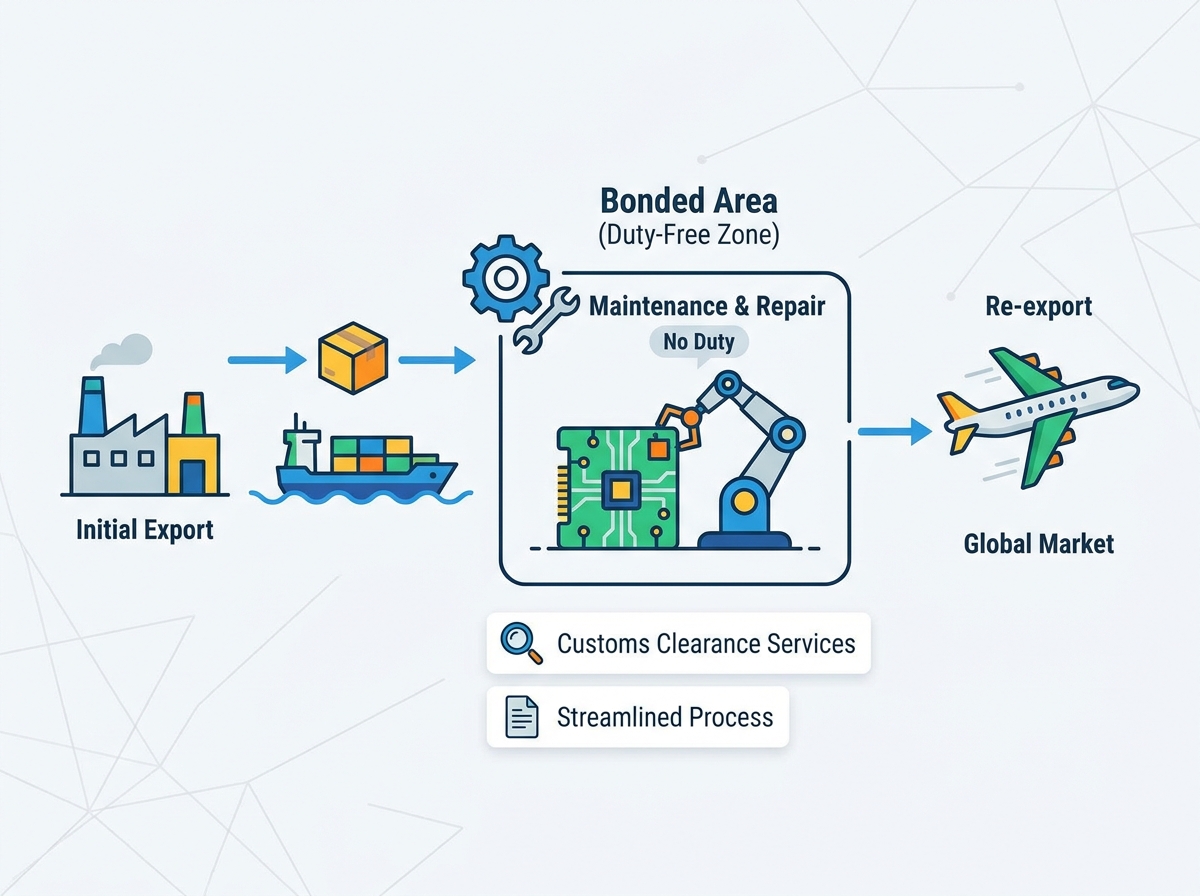
Key Benefits of Utilizing Bonded Facilities for Reverse Logistics
Transitioning reverse logistics into a bonded environment provides measurable advantages. Companies optimize financial performance and service delivery simultaneously.
Absolute Duty and Tax Exemption
The primary advantage is direct bottom-line protection. Returning goods are legally exempt from import duties and domestic taxes. Raw materials or specialized tools imported into the zone to facilitate the repair are also exempt. They must be consumed during the process or re-exported with the final product.
Faster Turnaround Times for Global Customers
Customer retention relies on rapid after-sales support. Bypassing standard domestic customs queues allows expedited transit directly from the port to the bonded facility. Technicians begin diagnostic work days earlier.
Value-Added Processing and Upgrades
Modern facilities offer more than a basic repair workbench. Through bonded zone circulation processing, companies perform comprehensive value-added services. Technicians replace defective printed circuit boards, flash new firmware, and recalibrate sensors. The customer receives a perfectly functioning, upgraded product.
How to Select the Right Bonded Repair Workflow and Parameters
Executing a duty-free repair requires precise coordination. The workflow must follow strict statutory guidelines. When selecting a logistics partner, specific operational parameters dictate success or failure.
Initial Assessment and Customs Declaration
The workflow begins before the defective goods leave the buyer's facility. The logistics provider files a specialized customs declaration. Categorizing the incoming shipment as returns for repair is critical. Accurate classification prevents the shipment from being flagged for standard taxation. For optimal efficiency, look for providers offering returned export goods customs clearance with electronic data interchange capabilities. This ensures declaration processing times remain under 24 hours.
Secure Transport and Warehouse Specifications
Cargo arriving at the port of entry must be transported by bonded carriers. The unbroken chain of custody is legally required. The receiving bonded warehouse should feature 24/7 CCTV customs monitoring, advanced Warehouse Management System inventory tracking, and specialized electrostatic discharge safe zones for electronic repairs.
The Maintenance and Repair Phase
Authorized technicians access the zone to perform necessary repairs. Strict inventory management is mandatory. Every replacement part imported must be tracked. Defective parts removed from the original machine must be accounted for and destroyed under customs supervision.
Final Clearance and Return Shipment
After testing and repackaging, the final hurdle is the returned goods repair and re-export clearance. The customs broker files outbound documentation proving the repaired item matches the originally received defective item. Verification often relies on matching serial numbers.
Crucial Customs Regulations and Industry Trends
Bonded area maintenance is heavily regulated. Customs authorities monitor these zones rigorously to prevent tax evasion.
Navigating Global Customs Codes
Compliance begins with proper tariff classification. Proper application requires empirical proof of origin, a detailed commercial invoice, and a formal repair contract.
The Repair versus Remanufacturing Rule
A critical compliance metric is the distinction between repairing and remanufacturing. Regulations allow troubleshooting, part replacement, and restoring a product to its original functional state. They strictly prohibit fundamentally altering the product into a new item with a different tariff classification. Violating this rule results in severe financial penalties.
Shifting Global Supply Chain Dynamics
Recent market shifts reveal a transformation in how multinational corporations handle reverse logistics. Driven by the surge in cross-border e-commerce and a global push toward circular economy practices, governments are streamlining bonded zone regulations. Data indicates a robust thirty percent year-over-year increase in manufacturers leveraging these special economic zones. Shifting repairs to bonded facilities transforms a massive cost center into a strategic advantage for sustainability.
Strict Time Limits for Re-Export
Goods cannot remain in a bonded facility indefinitely. Customs authorities impose strict statutory time limits. This ensures bonded zones are used for active processing rather than long-term storage. The time limit typically ranges from six months to one year.
Ideal Industries for Bonded Zone Repairs
The empirical return on investment is particularly high for specific sectors characterized by high-value products.
Electronics and Smart Devices
Consumer electronics and telecommunications hardware sectors are prime candidates. Devices like servers, routers, and complex printed circuit boards are high-value but lightweight. They frequently require firmware updates or microchip swapping. Performing these precise repairs in a bonded zone prevents the erosion of tight profit margins.
Heavy Machinery and Automotive Parts
Paying a second round of import duties would be financially devastating for industrial equipment manufacturers. A single industrial robotic arm can be valued in the hundreds of thousands of dollars. Bonded maintenance allows manufacturers to replace faulty hydraulics or control units without incurring catastrophic tax liabilities.
Cross-Border E-commerce
The explosion of cross-border e-commerce has led to a surge in international consumer returns. Managing high-volume returns efficiently is a logistical hurdle. Bonded zones allow retailers to consolidate defective returns, refurbish them, and route them to secondary international markets while maintaining a tax-neutral position.
Why Partnering with Expert Customs Clearance Services is Non-Negotiable
Understanding theoretical benefits is only the first step. Executing the process legally and efficiently is a complex operational challenge. Attempting to navigate this landscape without specialized expertise introduces severe compliance risks.
Avoiding Costly Compliance Penalties
Customs authorities monitor bonded zones with intense scrutiny. The foundational requirement is proving the goods entering the bonded area are the exact same goods previously exported. A single clerical error or a mismatch in serial numbers can trigger audits. Utilizing professional customs clearance services ensures every declaration is empirically accurate.
End-to-End Reverse Logistics Management
The most efficient supply chains rely on comprehensive providers. This includes coordinating initial international freight forwarding, managing secure transport, providing specialized warehouse space, and executing final re-export clearance. Fragmenting responsibilities across unaligned vendors increases documentation errors.
Custom Solutions for Your Supply Chain
Every product line has unique reverse logistics requirements. A professional customs broker will audit your export data and design a customized strategy. Aligning the regulatory framework with actual operational capabilities transforms a costly headache into a streamlined competitive advantage.
Conclusion
Using bonded areas for maintenance saves significant capital. It stops you from paying unfair import taxes twice on goods you originally manufactured. This process requires highly accurate paperwork and seamless logistics coordination. One mistake can cause severe delays or heavy financial fines. Always work with experienced professionals for this task. They keep your global return process legally compliant and exceptionally fast. If your enterprise is struggling with reverse logistics costs, explore customized bonded warehouse and customs clearance solutions. Visit https://www.jfszlogistics.com to consult with our logistics engineers and build a compliant, high-speed return supply chain today.
Frequently Asked Questions
Do I have to pay taxes on replacement parts shipped into the bonded area?
Generally, no. Under standard bonded warehouse regulations, replacement parts and components imported directly into the bonded zone specifically for the purpose of repairing the exported goods are also exempt from standard import duties. However, these parts must be strictly accounted for. They must either be integrated into the final product and re-exported, or any unused parts must remain in the bonded zone or be legally destroyed under customs supervision.
How long can my returned goods stay in the bonded zone for repair?
Statutory time limits vary significantly depending on the specific country's customs regulations and the type of bonded facility. Typically, the allowable timeframe ranges from six months to one year. If the repair process requires more time due to complex technical issues or parts shortages, authorized logistics providers can often file formal extension requests with customs authorities, provided there is a valid operational justification.
Can any logistics company handle returned export goods customs clearance?
No. Managing goods that have not officially cleared domestic customs requires specific government certifications. You must partner with a logistics provider that holds active bonded warehouse licenses, employs certified customs brokers, and operates approved bonded transport vehicles. Utilizing an uncertified provider for reverse logistics will result in standard import procedures, triggering immediate duty and tax liabilities.
What happens if the goods cannot be repaired?
If technicians determine that the returned goods are damaged beyond repair, they cannot simply be thrown away in standard domestic waste. Because the goods technically exist outside the domestic customs territory, they must be handled legally. The company has two options. You can formally import the broken goods to dispose of them domestically, paying applicable duties based on their depreciated value. Alternatively, you can execute a witnessed destruction of the goods within the bonded zone under the direct supervision of customs officials.
What is the difference between standard warehousing and bonded cargo maintenance services?
The fundamental difference lies in the legal status of the goods regarding customs clearance. Standard warehousing occurs after goods have officially entered a country and all applicable import duties and taxes have been paid. In contrast, bonded maintenance occurs in a highly secure, government-supervised zone before formal customs clearance takes place. This invisible border allows businesses to store, test, and repair goods without ever triggering the financial liabilities associated with domestic importation.
What documents are required to initiate a bonded area repair process?
Initiating this process requires a specific set of documents to prove the cargo's origin and intent. You will typically need the original export declaration, the commercial invoice from the initial sale, a formal repair contract or agreement with the overseas buyer, and a detailed packing list. Customs authorities rely on these documents to verify that the returning items match the original exports perfectly.
Can I upgrade my product's hardware during a bonded return?
Modifications are strictly regulated under the repair versus remanufacturing rule. You can replace defective components with updated versions to restore functionality. For instance, swapping a faulty internal component for a slightly upgraded model is generally acceptable. However, you cannot fundamentally alter the product's core function or change its tariff classification. Major hardware overhauls that create a completely new product are prohibited in a bonded repair context.
Related Blogs
-
 Door to door shipping from China simplifies international logistics. But how can you ensure smooth delivery from factory to destination? Choosing the right shipping method, preparing documents, and understanding customs responsibilities are essential. This guide explains each shipping step, compares sea, air, and express services, and clarifies DDP and DAP terms. Learn how to arrange reliable deliveries and avoid unexpected costs.
-
 When production stops, every delivery day matters. Delayed components can disrupt schedules and customer commitments. Air freight from China offers a practical solution for urgent commercial shipments. However, choosing the right service requires careful planning. This guide compares standard, priority, and express shipping. You will also learn about flight schedules, customs clearance, and cargo preparation.
-
 Air freight from China offers speed, but costs can vary significantly. Do you know what determines your final shipping bill? This guide explains air freight cost from China, including per-kilogram rates, chargeable weight, surcharges, and destination fees. Learn how to estimate costs and reduce shipping expenses.
