



Exported goods failing abroad create a costly nightmare for global manufacturers. An overseas client reports a critical malfunction or a dead-on-arrival unit. Bringing that defective cargo back home typically triggers a cascade of hefty import duties. Complex tax liabilities follow immediately. Returning items simply to fix a minor issue feels like being penalized twice for the same product. How do you break this cycle?
Bonded area maintenance solves this exact problem. Businesses can repair, test, and upgrade goods without suffering double taxation by utilizing specialized customs-supervised zones. We will demystify the entire lifecycle of tax-suspended repairs in this comprehensive guide. We will cover the mandatory paperwork, strict statutory timelines, and the operational nuances required to keep your supply chain moving seamlessly.
Key Takeaways
- Duty-Free Repairs: Bonded area maintenance allows businesses to repair or test goods without paying standard import duties or Value-Added Tax.
- Strict Timelines: Customs authorities enforce rigid deadlines, typically six months, for goods to enter, undergo maintenance, and exit the secure zone.
- Documentation is King: Regulatory success relies on precise paperwork. This includes formal repair contracts, detailed Bill of Materials, and accurate inventory ledgers.
- End-to-End Compliance: Partnering with professional customs brokers prevents costly administrative delays and potential cargo confiscation.
Global Industry Trends in Tax-Suspended Logistics
Looking at recent shifts in international trade, the demand for tax-suspended jurisdictions is surging. Industry analysts note a rapid growth in high-value exports. Products like electric vehicle components, solar inverters, and smart consumer electronics have fundamentally altered the aftermarket landscape. Global supply chains now face stringent environmental regulations. Manufacturers must repair rather than replace defective units to meet sustainability goals.
Governments worldwide are actively expanding bonded warehouse privileges to attract these high-tech repair operations. Supply chain managers now have unprecedented opportunities to leverage these zones for significant cost reductions. As front-line logistics engineers, we see companies shifting from reactive return policies to proactive bonded maintenance strategies every single day.
Understanding Bonded Zone Processing and Repair Logistics
A bonded maintenance area functions as a highly secure, customs-supervised geographical jurisdiction. Foreign goods can be brought into this specific facility for processing or repair without being legally imported into the host country domestic commerce. The goods remain in transit from a strict regulatory standpoint. They are effectively suspended in a tax-free bubble.
The primary business value lies in cash flow preservation. A company exports a product that subsequently requires a firmware upgrade. Bringing it back through standard import channels usually results in a massive financial burden. Bonded zones eliminate this liability entirely.
Successfully executing this strategy requires absolute mastery over bonded zone processing and repair logistics. This involves coordinating the physical movement of defective goods from the port of entry directly into the supervised facility. You must manage the inventory of spare parts meticulously. Furthermore, the physical space must comply with stringent security standards, such as around-the-clock surveillance and segregated storage areas.
The Step-by-Step Process for Bonded Warehouse Maintenance
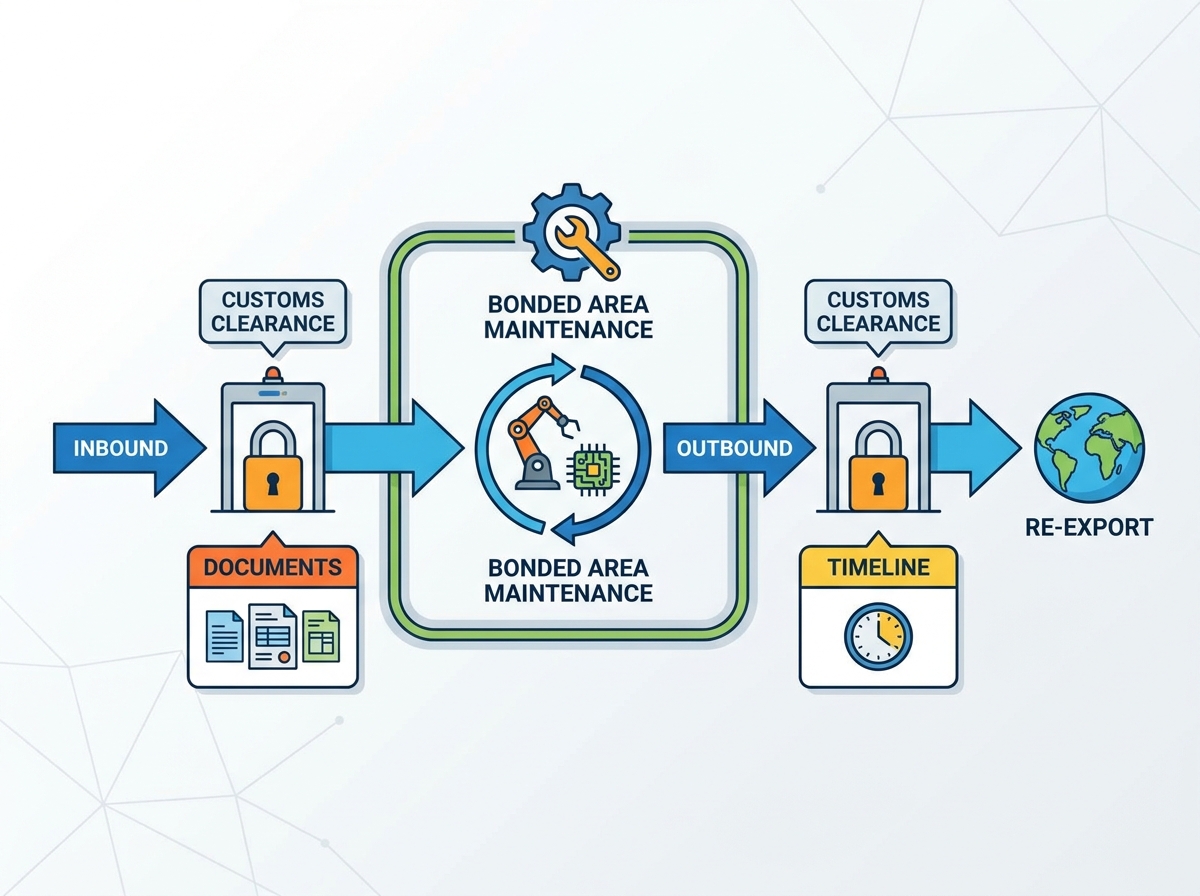
Executing a repair project within a tax-suspended facility requires strict adherence to a multi-phase operational framework. Customs authorities monitor each phase closely. They must guarantee that the goods are genuinely being repaired and not illicitly diverted into the local market.
Phase 1 Pre-Approval and Registration
The enterprise must apply to the local regulatory body to establish a specific repair ledger before any defective container arrives. This entails submitting the project scope and proving the origin of the goods. Customs evaluates whether the proposed repair fundamentally changes the nature of the product. Such modifications are generally prohibited under standard maintenance regulations.
Phase 2 Inbound Logistics
The defective goods are shipped back once the ledger is officially approved. They bypass standard import clearance bottlenecks upon arrival. Bonded trucks transport the sealed containers directly from the terminal into the approved facility.
Phase 3 The Repair Operation
This phase encompasses the actual bonded warehouse maintenance and cargo handling. Technicians operating in static-free environments swap out faulty motherboards and run rigorous diagnostic stress tests. Inventory segregation is the critical rule here. Defective parts, new spare components, and fully repaired units must be physically separated on the warehouse floor.
Phase 4 Outbound Logistics
The goods are repackaged after maintenance and quality assurance testing are complete. The inventory ledger is updated to reflect the exact consumption of spare parts. This initiates the final re-export phase back to the overseas client.
Navigating Export Returned Goods Customs Clearance
Goods are typically returned for several objective reasons. Warranty claims, critical manufacturing defects, or outright customer rejections are common triggers. The regulatory challenge remains identical regardless of the cause. Standard import procedures are designed for items entering the domestic market for consumption. Applying these standard procedures to returns creates a massive tax liability.
Businesses must utilize specific regulatory pathways to bypass this hurdle. Processing export returned goods customs clearance requires the importer of record to prove a crucial fact. They must demonstrate beyond a reasonable doubt that the returning items are the exact same units originally exported.
Actionable advice for navigating this includes strict serial number matching. The numbers on the returning defective units must perfectly match the documentation listed on the original packing lists. Providing clear photographic evidence of the defects helps verify that the return is legitimate. This proves the operation is not a scheme to avoid import quotas.
Essential Documents Required for Bonded Area Maintenance
The success of any bonded operation hinges entirely on documentation. Regulators operate on a document-first basis. The physical cargo will remain frozen at the dock if the paperwork is flawed.
Specific foundational documents are mandatory to secure the initial approval. The original export declaration proves that the goods were previously shipped out. The commercial invoice verifies their exact specifications. A formal repair contract must explicitly state the terms of the warranty.
Operational documentation ensures ongoing compliance once the cargo is safely inside the facility. The detailed Bill of Materials is the most scrutinized document. This record must list exactly which new spare parts will be consumed and which burnt-out components will be removed. Specialized Bonded Entry and Exit Declaration Forms are utilized to move the goods in and out of the zone.
| Compliance Metric | Standard Import Processing | Bonded Area Maintenance |
|---|---|---|
| Tax & Duty Status | Fully applicable upon entry | 100 percent suspended |
| Documentation Focus | Commercial value and tariffs | Bill of Materials and original export proof |
| Time Restrictions | Unlimited domestic circulation | Strict six-month processing window |
| Waste Management | Standard domestic disposal | Customs-supervised destruction or re-export |
Timelines and Deadlines for Bonded Repair Projects
Operating within a bonded zone is not an open-ended privilege. Authorities enforce rigid statutory time limits. These facilities must be used for active processing rather than tax-free storage.
The standard allowable time for a repair project is six months in most major global jurisdictions. This statutory clock is unforgiving. It begins ticking the exact moment the defective goods are officially registered entering the facility. The entire lifecycle must be completed within this window.
Supply chain disruptions can occasionally push a project past the standard timeframe. Businesses can apply for a formal extension when this occurs. This application must typically be submitted at least thirty days before the original deadline expires. Breaching these timelines transforms a tax-free operation into a severe financial liability. Authorities will unilaterally revoke the bonded status, triggering immediate demands for full back-taxes.
Re-Export Customs Procedures for Repaired Goods
The operational phase ends once physical maintenance is completed. Closing the loop correctly is just as critical as the initial inbound entry. The repaired goods cannot legally remain in the zone indefinitely.
The final step involves executing the re-export customs procedures for repaired goods. Officers verify that the outward-bound functional item corresponds directly to the defective item that originally entered. They will cross-reference the updated inventory ledger and the serial numbers on the outgoing pallets.
Managing the waste is a highly complex component. You cannot simply toss a cracked screen into a local dumpster. These defective parts still hold bonded status. Businesses generally have three legally compliant options. They can re-export the broken parts, hire a certified waste management company for supervised destruction, or formally import the scrap material based on its reduced residual value.
Selecting the Right Logistics Partner Based on Core Parameters
Navigating the labyrinth of bonded ledgers and statutory timelines is not a task for amateurs. Attempting to handle complex bonded logistics in-house is a high-risk endeavor. Minor clerical errors lead to massive delays.
How do you evaluate a professional customs broker? Front-line engineering teams look for specific operational parameters. You need a partner offering Authorized Economic Operator certification to guarantee priority processing. Look for facilities equipped with twenty-four-hour surveillance and dedicated electrostatic discharge safe zones. High-end providers integrate their Warehouse Management Systems directly with customs application programming interfaces. This ensures your Bill of Materials reconciliation takes seconds rather than days.
Digitalization and Compliance in Customs Bonded Warehouses
The era of managing cross-border repairs through physical paperwork is rapidly coming to an end. Authorities globally are transitioning to paperless single-window systems. Businesses must adopt digital-first compliance strategies to survive.
Efficient operations rely heavily on advanced warehouse software. The data is instantly transmitted to the ledger when a defective item is scanned into the facility. The digital Bill of Materials is updated in real-time as parts are swapped.
Record retention has become a cornerstone of long-term compliance. Regulators retain the legal right to conduct post-clearance audits long after the goods have left the country. Enterprises insulate themselves against audit risks by utilizing cloud-based records. This ensures every serial number and destruction certificate is instantly retrievable.
Conclusion
Bonded area maintenance is a highly effective mechanism to manage global returns. Manufacturers can protect their cash flow while delivering exceptional aftermarket support by keeping goods in a suspended regulatory state.
This privilege comes with stringent oversight. Success hinges on meticulous documentation and flawless execution of cargo handling. A single mismatched serial number can quickly erase any financial benefits.
Partnering with specialized clearance experts is a strategic necessity. If you are struggling with complex return logistics, it is time to upgrade your approach. Explore the comprehensive solutions at JFSZ Logistics to find the exact customs clearance and warehousing services that fit your supply chain needs. Let professional brokers handle the compliance so you can focus on engineering excellence.
Frequently Asked Questions
What is the main difference between standard import and bonded area maintenance?
Standard imports require paying duties and taxes immediately upon the cargo entry into the domestic market. Bonded maintenance allows goods to enter a specific regulated zone entirely tax-free, provided they are re-exported immediately after the repair is completed.
Can I repair any type of product in a bonded warehouse?
Most commercial goods and industrial machinery can be repaired within these zones. Hazardous materials or goods that undergo a fundamental change in nature generally do not qualify under standard maintenance rules.
What happens to the defective parts removed during the repair process?
Defective parts cannot be freely discarded in the host country domestic waste system. They must be re-exported with the repaired items, officially destroyed under strict customs supervision, or formally imported by paying the applicable taxes based on their current diminished scrap value.
Why do I need specialized services for export returned goods?
Processing returned goods requires definitive proof of the items original export status. A specialized broker ensures the exact matching of serial numbers and documents. This prevents your returned cargo from being erroneously taxed as brand-new domestic imports.
What are the penalties for exceeding the bonded maintenance time limit?
Failing to re-export goods within the standard six-month window triggers severe consequences. Customs authorities will revoke the tax-suspended status, forcing the goods into standard import classification. This results in immediate back-taxes, cumulative late fees, and potential cargo confiscation.
How do you handle warranty parts replacement in a customs-supervised zone?
Warranty replacements require strict inventory segregation. Technicians must log every new component pulled from the bonded spare parts inventory. The removed defective part must be cataloged in the digital Bill of Materials to ensure the final outbound shipment perfectly balances with the inbound ledger.
Related Blogs
-
 Door to door shipping from China simplifies international logistics. But how can you ensure smooth delivery from factory to destination? Choosing the right shipping method, preparing documents, and understanding customs responsibilities are essential. This guide explains each shipping step, compares sea, air, and express services, and clarifies DDP and DAP terms. Learn how to arrange reliable deliveries and avoid unexpected costs.
-
 When production stops, every delivery day matters. Delayed components can disrupt schedules and customer commitments. Air freight from China offers a practical solution for urgent commercial shipments. However, choosing the right service requires careful planning. This guide compares standard, priority, and express shipping. You will also learn about flight schedules, customs clearance, and cargo preparation.
-
 Air freight from China offers speed, but costs can vary significantly. Do you know what determines your final shipping bill? This guide explains air freight cost from China, including per-kilogram rates, chargeable weight, surcharges, and destination fees. Learn how to estimate costs and reduce shipping expenses.
