



Margin compression, geopolitical volatility, and fluctuating fuel costs are forcing logistics directors to rigorously defend their freight routing decisions. The current supply chain landscape leaves no room for complacency. Defaulting to legacy shipping modes causes severe financial bleed. Choosing air freight purely for speed ignores the massive impact on profit margins. Conversely, selecting ocean freight purely for its low baseline cost overlooks Total Landed Cost, inventory holding costs, heavy packaging requirements, and the severe risk of stockouts.
Supply chain leaders need a robust framework to evaluate cargo value, dimensional weight, lead time requirements, and ESG goals. Balancing these factors determines the optimal allocation between air freight and ocean shipping. This strategic alignment ensures products reach the market efficiently without eroding profitability. By shifting away from binary choices, organizations can build resilient, cost-effective routing models that adapt to real-world disruptions.
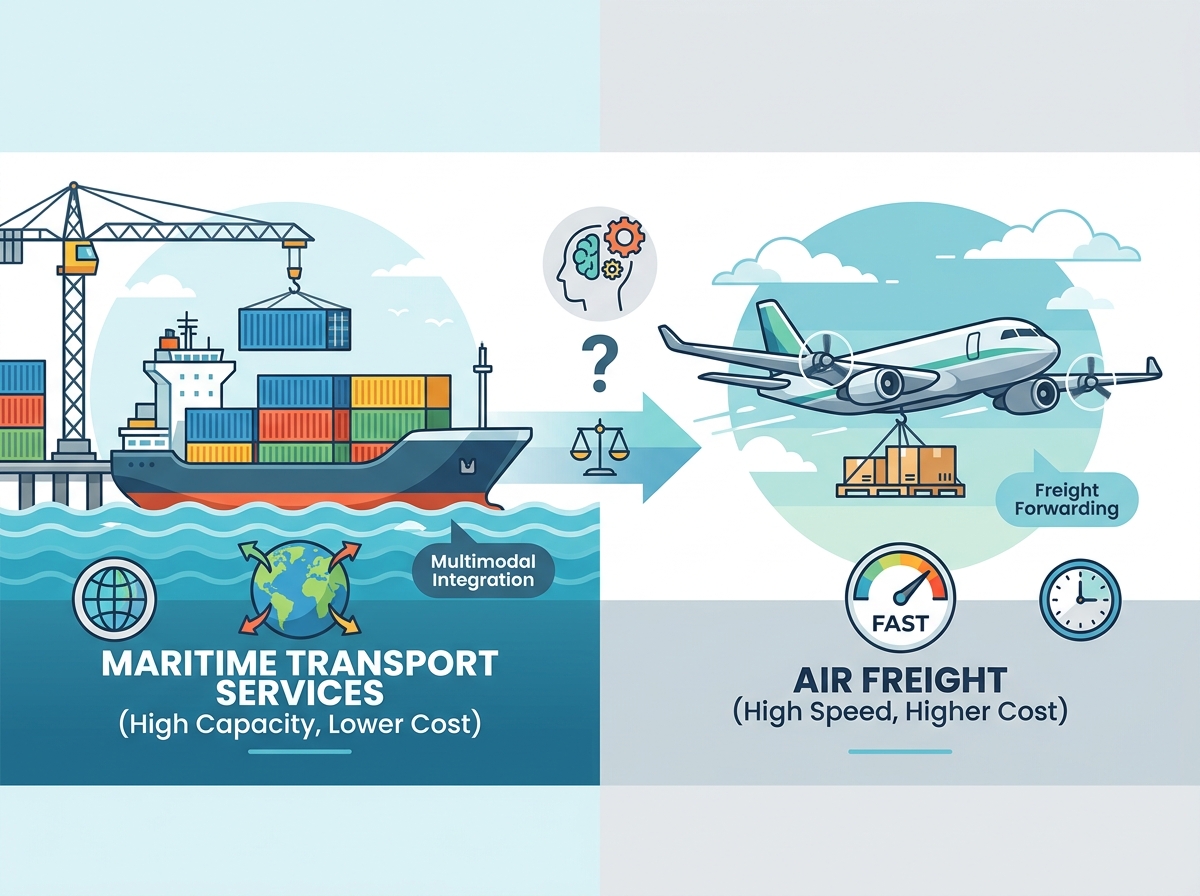
Cost vs. Volume Dynamics: Air freight pricing relies on chargeable weight (often resulting in 5x–20x higher costs for heavy goods), whereas maritime shipping leverages container volume (FCL/LCL), drastically reducing per-unit transport costs.
Inventory Capitalization: The extended transit times of ocean freight require higher safety stock levels; the cost of tied-up capital must be weighed against the freight savings.
Risk, Reliability, and Packaging: Air freight offers tighter delivery windows, lower handling risks, and reduced packaging costs, while maritime freight requires robust mitigation strategies for port congestion, moisture protection, and blank sailings.
Hybrid Agility: Integrating multimodal international transportation strategies and executing strategic modal shifts can bridge the gap, offering a middle ground for cost and speed.
Framing the Decision: Success Criteria for Freight Allocation
Defining Logistics Outcomes
Logistics leaders must balance competing metrics to achieve optimal supply chain performance. Service Level Agreement adherence remains a top priority. Late deliveries damage client relationships and trigger contractual penalties. Margin protection requires strict control over transportation spend, as freight costs directly impact the cost of goods sold. Cash flow heavily depends on inventory turnover rates. Goods sitting in transit tie up working capital that could be deployed elsewhere. Finally, carbon footprint reduction is no longer optional. Regulatory pressures and corporate sustainability mandates force companies to measure and minimize emissions across their entire distribution network.
The Product-to-Mode Matrix
Cargo characteristics dictate the baseline mode selection before market variables apply. High-tech components and high-value electronics often require air transport. Their high profit margins easily absorb premium freight rates, and rapid delivery minimizes obsolescence risks. Perishable goods demand strict cold-chain integrity and speed, making air travel mandatory. Conversely, low-margin, high-volume commodities fit perfectly into ocean containers. Heavy industrial parts, textiles, and raw materials rely on the massive capacity of ocean vessels to remain economically viable. Understanding this matrix prevents costly misallocations.
Cargo Profile | Primary Mode | Key Decision Driver | Exception Scenario |
|---|---|---|---|
High-Value / Low-Weight (e.g., Microchips) | Air Freight | Speed to market, low risk of obsolescence | High-volume stock replenishment |
Low-Value / High-Weight (e.g., Raw Steel) | Ocean Freight | Lowest possible per-unit transport cost | Emergency line-down situations |
Perishables (e.g., Fresh Seafood) | Air Freight | Strict temperature control and transit time | Frozen goods viable for reefer containers |
Oversized Industrial Machinery | Ocean Freight | Physical dimensional limits of aircraft | Disassembled components for urgent repair |
Shifting from Binary to Dynamic Routing
Relying on static annual contracts leaves supply chains vulnerable to market shocks. Modern logistics requires dynamic, data-driven modal shifts based on real-time disruptions and spot market rate fluctuations. When ocean ports face labor strikes or severe congestion, agile shippers divert critical SKUs to air freight to maintain inventory levels. Conversely, when air capacity tightens during peak consumer seasons, shifting non-urgent volume to ocean carriers protects margins. This fluid approach requires continuous monitoring of freight indices and close collaboration with carrier networks.
Air Freight: Strengths, Limitations, and Cost Realities
Speed and Supply Chain Velocity
Air freight delivers unmatched supply chain velocity, typically offering transit times of one to five days globally. This rapid movement directly supports just-in-time manufacturing models, where components arrive exactly when needed on the assembly line. A single delayed shipment in automotive or aerospace manufacturing can halt production, costing thousands of dollars per minute. Air transport mitigates this risk. Furthermore, commercial passenger airlines operate highly reliable daily schedules, providing consistent belly-cargo capacity that outpaces the frequency of ocean liner sailings.
The Economics of Chargeable Weight
Airlines do not simply charge by gross weight; they utilize a dimensional weight formula to account for the space a package occupies in the cargo hold. The industry standard divides the cubic volume of the shipment by a specific dimensional factor (often 6000 cubic centimeters per kilogram). Shippers pay whichever number is higher: the actual gross weight or the calculated dimensional weight. This metric creates a strict financial threshold. Shipping lightweight, bulky items via air quickly erodes product margins, making the mode financially unviable for mid-to-low-value goods.
Ideal Use Cases and Strategic Deployment
Certain scenarios make air freight mandatory regardless of the premium rates. Emergency logistics, such as delivering critical replacement parts for broken industrial machinery, rely entirely on air transport to minimize operational downtime. Pharmaceutical cold-chain distribution requires the strict temperature-controlled environments and rapid transit times that only active air cargo containers can provide. Additionally, initial product launches for consumer electronics heavily utilize air freight to flood global markets simultaneously, capturing market share before competitors can react.
Maritime Goods Transportation Services: Scalability and Margin Protection
Containerization, Volume Economics, and OOG Cargo
Ocean shipping dominates global trade through the sheer scale of containerization. Shippers choose between Full Container Load and Less than Container Load options based on their volume. FCL provides dedicated space, while LCL consolidates multiple shipments, allowing smaller volumes to benefit from ocean economies of scale. Utilizing maritime goods transportation services allows companies to absorb massive volume surges without proportional cost increases. Furthermore, ocean vessels possess the exclusive capability to handle Out-of-Gauge cargo. Oversized industrial equipment, wind turbine blades, and heavy machinery that exceed aircraft dimensional limits travel securely on flat racks or open-top containers.
Transit Times and Inventory Holding Costs
The primary trade-off for ocean freight's low cost is extended transit time, typically ranging from 20 to 45 days depending on the routing. This duration creates a "floating warehouse" effect. Companies must finance the inventory while it sits on the water, tying up working capital. Logistics planners must calculate the cost of this tied-up capital and increase warehouse safety stock to prevent stockouts during the long transit window. Accurate demand forecasting becomes essential to balance the freight savings against the increased inventory holding costs.
ESG Compliance and Carbon Footprint
Environmental sustainability heavily influences modern routing decisions. Ocean vessels produce significantly fewer greenhouse gas emissions per ton-mile compared to cargo aircraft. As corporations face stricter regulations regarding Scope 3 emissions, shifting volume to the water becomes a primary reduction strategy. Leveraging Maritime Transport Services aligns directly with corporate sustainability targets, allowing companies to maintain global distribution networks while actively managing their environmental impact.
Head-to-Head Evaluation Dimensions
Total Landed Cost Analysis
Comparing base freight rates provides an incomplete financial picture. A true Total Landed Cost analysis uncovers hidden fees across both modes. Ocean freight invoices include Bunker Adjustment Factors, Terminal Handling Charges, chassis split fees, and peak season surcharges. Air freight carries its own fuel and security surcharges. Packaging creates a massive cost gap. Air freight utilizes lightweight, double-walled corrugated boxes to minimize chargeable weight. Ocean cargo requires heavy, expensive ISPM-15 certified wood crating, extensive dunnage, and desiccants to protect against moisture, salt, and rough handling during the voyage.
Cargo Security and Risk Management
Risk profiles differ drastically between the sky and the sea. Air freight generally involves less physical handling, tighter airport security protocols, and shorter transit windows, resulting in lower damage and pilferage rates. Consequently, insurance premiums for air cargo remain relatively low. Maritime freight faces severe environmental and operational risks. Container rain caused by temperature fluctuations can ruin unprotected goods. Rough seas induce parametric rolling, occasionally resulting in containers lost overboard. Piracy in high-risk transit corridors further complicates the security landscape, driving up the cost of comprehensive marine insurance.
Customs, Compliance, and Documentation
Documentation rigor and customs clearance speeds vary by mode. Air Waybills serve as a contract of carriage and a receipt of goods, allowing for rapid processing upon arrival. Airport customs facilities prioritize speed, clearing shipments in hours. Ocean Bills of Lading act as a title to the goods, requiring strict handling and transfer procedures. Ocean clearance involves complex manifest filings, port authority coordination, and potential container examinations, often taking several days. Delays in ocean documentation directly result in costly port demurrage and detention fees.
Bridging the Gap: Multimodal International Transportation
Sea-Air Routing Strategies
When pure air freight destroys margins and pure ocean freight misses delivery deadlines, hybrid routing provides the solution. The sea-air model combines the strengths of both modes. A common route involves shipping goods via ocean from Asian manufacturing hubs to a transit point like Dubai or Colombo. Upon arrival, ground teams transfer the cargo to an airport for the final leg into Europe or North America. Implementing Multimodal International Transportation cuts transit times in half compared to pure ocean routing while significantly reducing costs compared to direct air freight.
Leveraging Freight Forwarding Services for Agility
Executing complex multimodal strategies requires specialized expertise and global infrastructure. Shippers rely on external partners to act as the control tower for their supply chain. Engaging Freight Forwarding Services provides access to predictive analytics and dynamic routing capabilities. These partners monitor port congestion, capacity crunches, and sudden shifts in spot rates. If a primary ocean port experiences a labor strike, the forwarder intercepts the cargo mid-transit, rerouting it to an alternative port or shifting it to an air charter to ensure continuous supply.
Implementation Risks and Mitigation Strategies
Maritime Risks: Port Congestion and Blank Sailings
Ocean shipping operations face constant disruption. Carriers frequently execute blank sailings, canceling scheduled voyages to manage capacity and prop up rates. This leaves cargo stranded at the origin port. Severe port congestion and labor strikes further delay vessel berthing and container unloading. To mitigate these risks, shippers must diversify their ports of entry rather than relying on a single gateway. Utilizing Non-Vessel Operating Common Carriers provides flexible routing options across multiple steamship lines, while strategic buffer stock planning absorbs the shock of unexpected transit delays.
Air Risks: Capacity Crunches and Volatile Surcharges
Air cargo capacity remains highly sensitive to external shocks. Reductions in commercial passenger flights immediately remove massive amounts of belly-cargo space from the market. Geopolitical airspace restrictions force freighters to fly longer, less efficient routes, driving up fuel surcharges and reducing overall payload capacity. During peak fourth-quarter shipping seasons, spot market rates skyrocket. Shippers mitigate these risks by securing Block Space Agreements with carriers, guaranteeing capacity at fixed rates, and diversifying their carrier networks to avoid over-reliance on a single airline.
Conclusion
Neither shipping mode holds universal superiority. Optimal supply chain design requires a segmented, analytical approach based on SKU-level profitability, physical dimensions, and delivery urgency. High-margin, time-sensitive goods belong in the air. High-volume, predictable demand, and oversized cargo belong on the water. Multimodal strategies serve the middle ground.
Conduct a historical freight spend audit to identify SKUs that consistently erode margins due to expedited shipping.
Calculate true inventory holding costs to determine the financial impact of extending transit times via ocean freight.
Engage with enterprise-grade freight forwarding partners to model alternative routing scenarios and secure multimodal capacity.
Redesign export packaging specifications to ensure cargo remains protected during ocean transit without adding unnecessary dimensional weight for air legs.
FAQ
Q: What is the average cost difference between air freight and maritime shipping?
A: Air freight typically costs 5 to 20 times more than maritime shipping. The exact multiplier depends heavily on the cargo's dimensional weight, current spot market rates, and the specific trade lanes being utilized. Heavy, bulky items incur the highest penalties in the air.
Q: How do I calculate the break-even point between air and ocean freight?
A: You must compare the premium cost of air freight against the combined costs of ocean transport. This includes the base ocean rate, heavy export packaging, increased warehousing needs, the cost of capital tied up in floating inventory, and the financial risk of potential lost sales from stockouts.
Q: Are maritime transport services reliable enough for Just-In-Time (JIT) manufacturing?
A: Yes, while transit times are significantly longer, highly predictable maritime schedules can support JIT operations. Success requires integrating accurate, long-term demand forecasting with strategic buffer stocks positioned near the manufacturing facility to absorb any minor port delays.
Q: What is multimodal international transportation?
A: It is the use of two or more modes of transport under a single contract to move goods from origin to destination. This approach optimizes the balance of speed and cost, with sea-air routing being the most common example to bypass congested trade lanes.
Q: How can freight forwarding services reduce my overall shipping costs?
A: Forwarders consolidate Less than Container Load shipments to maximize space utilization. They leverage their aggregate volume to negotiate better carrier contracts and dynamically execute modal shifts mid-transit to avoid costly delays, port storage fees, and peak season surcharges.
Q: Which shipping method has a lower environmental impact?
A: Ocean freight produces significantly fewer greenhouse gas emissions per ton-mile compared to air freight. Shifting cargo from air to ocean is a critical strategy for companies looking to meet strict ESG goals and reduce their Scope 3 supply chain emissions.
Related Blogs
-
 Door to door shipping from China simplifies international logistics. But how can you ensure smooth delivery from factory to destination? Choosing the right shipping method, preparing documents, and understanding customs responsibilities are essential. This guide explains each shipping step, compares sea, air, and express services, and clarifies DDP and DAP terms. Learn how to arrange reliable deliveries and avoid unexpected costs.
-
 When production stops, every delivery day matters. Delayed components can disrupt schedules and customer commitments. Air freight from China offers a practical solution for urgent commercial shipments. However, choosing the right service requires careful planning. This guide compares standard, priority, and express shipping. You will also learn about flight schedules, customs clearance, and cargo preparation.
-
 Air freight from China offers speed, but costs can vary significantly. Do you know what determines your final shipping bill? This guide explains air freight cost from China, including per-kilogram rates, chargeable weight, surcharges, and destination fees. Learn how to estimate costs and reduce shipping expenses.
