



Are high upfront customs duties crushing your cash flow? Managing import capital during supply chain delays is incredibly stressful. Imagine unloading twenty containers of seasonal apparel at the port. You immediately face a massive tax bill before a single item is sold or distributed. For many global businesses, this scenario is a harsh daily reality.
Bonded zones offer a secure financial safety net. By leveraging these specialized facilities, companies can legally suspend their tax burdens. This strategic move transforms static inventory from a financial liability into a highly flexible asset.
In this comprehensive guide, you will learn how strategic warehousing options streamline imports. We will detail the operational mechanics of bonded facilities, compare them to alternative frameworks, and demonstrate how to select the right partner for your global supply chain.
Key Takeaways
- Duty Deferral: Bonded zones allow importers to legally delay paying taxes and customs duties until goods officially enter the local consumer market. This drastically improves working capital.
- Strategic Flexibility: Imported goods can be stored, sorted, manipulated, or re-exported to third-party countries without ever facing local customs duties from the host country.
- Framework Differences: While various trade zones offer significant tax benefits, they differ structurally in manufacturing allowances, storage time limits, and baseline compliance regulations.
- End-to-End Solutions: Top-tier logistics providers combine bonded storage with seamless cross-border delivery networks to optimize the entire fulfillment process.
What Are Bonded Warehousing Services and How Do They Work?
To make informed supply chain decisions, it is critical to understand the precise operational and legal framework of a bonded facility. In international trade, a bonded warehouse is not merely a storage building. It is a highly regulated and secure zone that operates under the direct supervision of national customs authorities.
The Definition of a Customs Bonded Warehouse
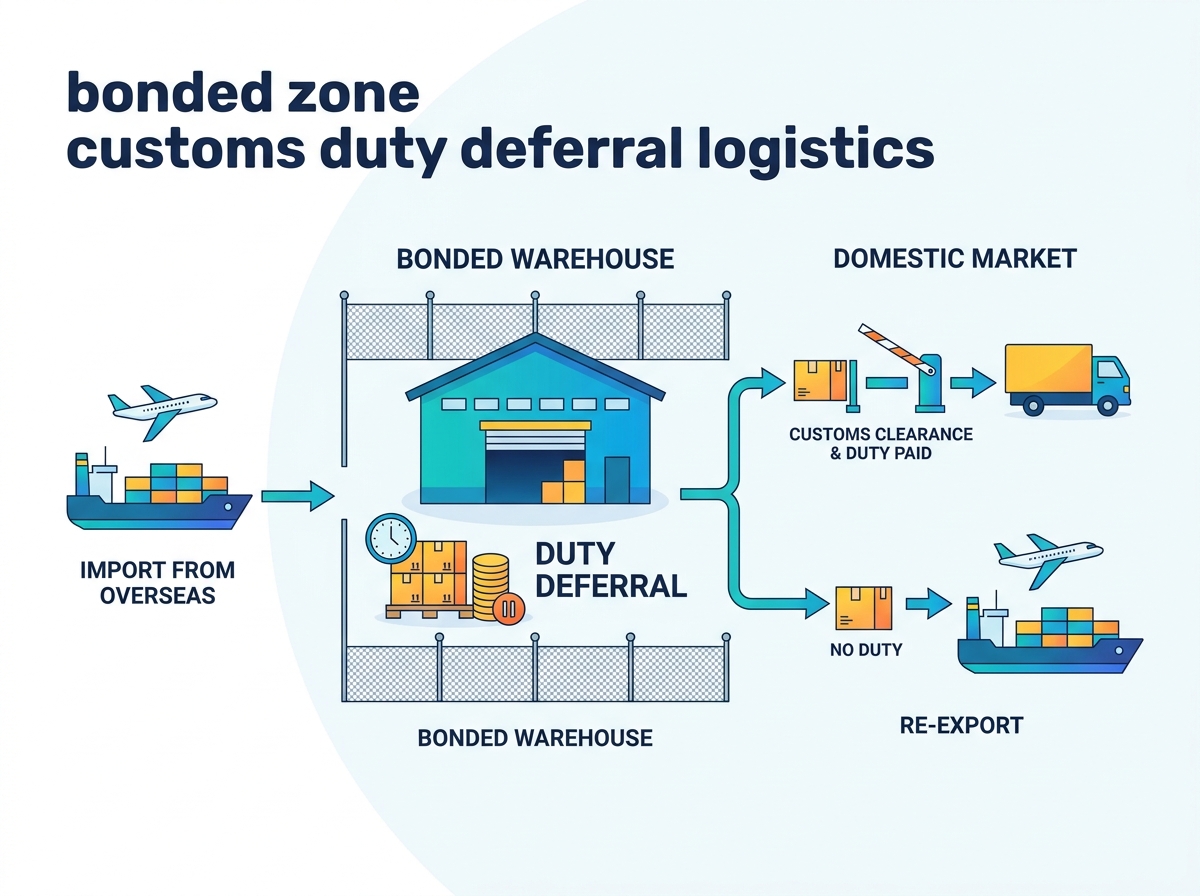
From an engineering and logistics standpoint, a customs bonded warehouse is a secured facility where imported dutiable merchandise can be stored or undergo specific light operations without the immediate payment of customs duties. Upon the entry of goods into the warehouse, the proprietor and the importer incur a joint liability under a customs bond. This bond serves as a strict financial guarantee to the government. It ensures that all applicable duties and taxes will eventually be paid when the goods are withdrawn for local consumption.
In practice, if the goods are exported directly from the warehouse to another country, the duty liability is entirely canceled. This mechanism effectively suspends the tax burden during the storage period. Consequently, it gives importers unparalleled financial breathing room.
Who Actually Needs Bonded Warehousing Services?
While standard storage suffices for domestic goods, bonded facilities are strategically necessary for specific business models. The ideal candidates for these services typically fall into distinct categories.
- Global E-commerce Sellers: These businesses store bulk inventory near target markets. Goods are cleared and duties are paid only as individual consumer orders are fulfilled. This prevents bulk upfront taxation.
- High-Value Goods Traders: Importers of electronics, luxury fashion, or automotive parts use bonded zones to defer massive tax liabilities. Capital remains fluid until the final sale is confirmed.
- Seasonal Inventory Managers: Retailers importing winter apparel or holiday goods months in advance can store inventory in a bonded zone. They pay duties only when the peak season begins and goods are dispatched to retail stores.
- Transshipment Distributors: Multinational businesses use a central hub to consolidate goods before distributing them to multiple different countries. They avoid paying double duties by utilizing duty-free re-export rules.
The Financial Edge and Industry Trends in Duty Deferral
The primary driver for adopting a bonded strategy is financial optimization. By integrating bonded zone customs duty deferral logistics into a broader supply chain, companies can fundamentally alter their cash conversion cycles.
Industry Shifts Toward Strategic Buffering
Recent global trade data highlights a distinct shift in how global importers manage their liabilities. With fluctuating tariffs, shifting trade policies, and unpredictable shipping lanes, importers are pivoting away from strict just-in-time models. Instead, mid-to-large-scale enterprises are utilizing bonded zones as strategic buffers. This approach mitigates the risk of sudden duty hikes and provides a safe harbor during geopolitical disruptions. Businesses integrating bonded frameworks report maintaining significantly more liquid capital during economic downturns compared to competitors relying on standard clearance models.
Maximizing Cash Flow Through Duty Deferral
In standard import models, a company must pay all applicable tariffs, Value-Added Tax, and processing fees at the port of entry before the cargo can be released. Duty deferral entirely shifts this financial burden. By moving goods directly from the port to a bonded facility, the importer retains that capital. This preserved liquidity can be reinvested into core business operations, such as funding marketing campaigns or expanding product lines. The duties are only paid incrementally as goods are withdrawn for domestic distribution. This perfectly aligns tax liabilities with actual revenue generation.
Safe Harbor for Restricted or Quota Goods
International trade is heavily regulated by quotas, anti-dumping laws, and strict licensing requirements. If an importer brings in goods subject to an absolute quota that has already filled for the year, standard customs procedures would require the goods to be destroyed or immediately exported. A bonded warehouse provides a critical safe harbor. Importers can legally store the merchandise in the bonded zone until the next quota period opens. Similarly, if goods require pending approvals from health or safety agencies, they can wait in the facility without incurring compliance penalties or expensive port demurrage charges.
The Big Comparison: Customs Bonded vs Free Trade Zones vs Standard Warehousing
Importers frequently confuse bonded warehouses with Free Trade Zones or assume standard warehousing is sufficient. Selecting the correct facility type requires a clear understanding of the regulatory boundaries and operational allowances of each.
| Feature | Customs Bonded Warehouse | Free Trade Zone | Standard Warehousing |
|---|---|---|---|
| Duty Payment | Deferred until local withdrawal | Deferred or eliminated upon export | Paid upfront at the port |
| Storage Time Limits | Strictly regulated up to 5 years | Generally unlimited | Unlimited depending on contract |
| Permitted Activities | Light manipulation, sorting, kitting | Heavy manufacturing and assembly | Any standard storage activity |
| Customs Supervision | High strict inventory tracking | Moderate periodic reporting | None post clearance |
Standard warehousing involves no customs supervision. Consequently, for imported goods to enter a standard warehouse, they must be fully cleared through customs at the port of entry. All duties and tariffs must be paid in full beforehand. For fast-moving consumer goods with immediate turnover, standard warehousing is often sufficient. However, for slow-moving inventory or high-tariff items, standard warehousing forces an unnecessary and premature financial burden on the importer.
Navigating Compliance and Documentation
For many importers, the regulatory environment surrounding international trade is a significant source of operational friction. However, understanding the compliance framework is essential. Regulatory oversight ensures that while importers benefit from deferred taxes, government agencies maintain strict visibility over the movement of goods.
Step-by-Step Customs Entry Process
The journey of goods into a bonded facility follows a highly regulated and sequential pathway. When a shipment arrives, it is not immediately cleared for domestic consumption. First, an initial bonded entry is filed upon port arrival. This alerts authorities that the goods will bypass immediate local commerce.
Next, the cargo undergoes bonded transit. It must be moved from the port of discharge to the warehouse using a bonded carrier. This carrier operates under a specific financial surety that guarantees safe transfer. Once the cargo reaches the facility, the receiving process involves meticulous inspection. Warehouse staff meticulously scan each item into a Warehouse Management System. If a single carton is missing, the discrepancy triggers an immediate compliance alert. Finally, the goods leave the warehouse through authorized pathways. These include withdrawal for local consumption, duty-free re-exportation, or destruction under customs supervision.
Accurate documentation is the absolute cornerstone of bonded logistics. A single clerical error can result in delayed cargo release or substantial financial penalties. Because the regulatory environment is unforgiving, successful enterprises rely on professional partners to manage these complex customs procedures for bonded cargo. Critical paperwork typically includes the Commercial Invoice, the Bill of Lading, and specific entry forms mandated by local authorities.
Location Strategy and Transit Hubs
In global supply chain management, geographic positioning is just as critical as regulatory compliance. Selecting the right location for a bonded facility can drastically reduce transit times and lower freight costs. For companies sourcing heavily from Asia, strategic regional hubs provide a distinct competitive advantage.
The Ultimate Transit Hub Advantage
Certain regions operate under unique administrative frameworks that make them highly efficient logistics nodes. As a designated free port, the entirety of Hong Kong operates with virtually zero import tariffs and no sales tax on the vast majority of commercial goods. Its proximity to the manufacturing powerhouses of mainland China allows importers to consolidate goods from multiple factories quickly. Instead of shipping fragmented less-than-container-load shipments directly to destination countries, businesses can funnel their production into Hong Kong bonded transit warehousing entirely free of complex tax obligations.
The rise of direct-to-consumer retail has fundamentally shifted how importers utilize these zones. Consider a brand manufacturing consumer electronics in Shenzhen. Instead of exporting bulk containers to a high-tax warehouse in the United States, the brand moves its finished goods across the border into a transit facility. When a customer places an order online, the individual item is picked, packed, and injected directly into the international parcel network via air freight. Because the goods are shipped individually, they often fall under the low-value threshold of the destination country. This legally bypasses destination customs duties and drastically reduces overhead.
Beyond Storage: Active Fulfillment Integration
The traditional view of a bonded warehouse as a static storage unit is outdated. Today’s high-performing supply chains require dynamic facilities that act as active fulfillment centers. The integration of duty deferral with advanced order fulfillment capabilities allows importers to streamline operations significantly.
Value-Added Services Inside the Zone
While heavy manufacturing is generally prohibited, customs authorities typically permit a range of light manipulation or value-added services. These activities are crucial for preparing goods for final sale without triggering duty payments. Authorized activities often include kitting, repacking goods to meet local market retail standards, applying compliance labels, and conducting quality control inspections. If a batch of goods is found to be defective during quality control, it can be destroyed under customs supervision or re-exported to the manufacturer. This saves the importer from paying duties on unsellable inventory.
The most effective logistics strategies eliminate handoffs between disparate service providers. When an importer utilizes integrated warehouse storage and cross-border delivery services, the transition from bonded storage to last-mile delivery becomes seamless. In a unified model, the logistics provider's system is directly connected to the importer's e-commerce platform. As soon as an order drops, warehouse staff pick the item from bonded inventory. The in-house customs brokerage team simultaneously files the necessary withdrawal entries. This micro-level duty management prevents importers from paying bulk duties on slow-moving stock.
How to Choose the Right Provider: A Technical Selection Guide
Entrusting inventory and tax liability to a third party requires rigorous vendor vetting. Not all logistics providers possess the infrastructure or the legal authority to operate bonded facilities effectively. A failure on their part can result in severe supply chain disruptions, revoked import privileges, and heavy fines. When auditing potential partners, decision-makers should evaluate specific technical benchmarks.
- In-House Customs Brokerage Integration: Separating warehousing from customs clearance creates communication silos. Look for providers that offer integrated brokerage ensuring customs clearance within 24 to 48 hours. This ensures immediate filing of bonded entries synchronously with physical cargo movements.
- Advanced API-Driven WMS Technology: Customs authorities require precise unit-level tracking of bonded goods. A robust Warehouse Management System must offer real-time API integration with your enterprise resource planning software and generate automated compliance reports.
- Multi-Modal Freight Network: A provider that only handles storage leaves you responsible for drayage and international freight. End-to-end providers seamlessly connect ocean freight, air transport, and bonded storage. This drastically reduces margin stacking and transit delays.
- Security Certifications: High-value bonded goods require 24/7 surveillance. Look for providers that carry recognized supply chain security certifications. These certifications often grant expedited clearance times and reduce random customs inspections.
FAQ: Quick Answers for Importers
What is the difference between a public and private bonded warehouse?
A public bonded warehouse is operated by an independent third-party logistics provider and is available for use by multiple different importing companies. A private bonded warehouse belongs to a specific enterprise and is used exclusively for storing that company's own imported merchandise. Public facilities are generally preferred by mid-sized businesses to avoid the high overhead and strict compliance costs associated with managing a private facility.
Can I store restricted or hazardous materials in a bonded facility?
Yes, but it requires highly specialized facilities. Not all bonded warehouses are legally authorized or physically equipped to handle hazardous materials, chemicals, or temperature-sensitive goods. You must verify that the logistics provider holds the specific environmental and safety permits required by local authorities to store those particular classifications of goods.
How long can I keep my goods in a bonded warehouse?
Storage limits depend entirely on the jurisdiction. In the United States, goods can typically remain in a customs bonded warehouse for up to five years from the date of importation. In other regions, the limit may be shorter, such as one to three years. Extensions are sometimes granted under specific circumstances, but strict inventory rotation is always advised.
Do I have to pay duties if my goods are destroyed in a bonded warehouse?
Generally, no. If imported goods are damaged, spoiled, or deemed commercially unviable while stored in a bonded facility, the importer can request to have them destroyed. As long as this destruction occurs strictly under official customs supervision and is properly documented, the associated duties and taxes are entirely waived.
Can I manufacture goods inside a bonded warehouse?
In most standard customs bonded warehouses, manufacturing is strictly prohibited. Importers are only permitted to perform light manipulation. This includes activities like sorting, cleaning, repacking, testing, and kitting. If your operations require heavy assembly, processing, or transforming raw materials into finished goods, you will need to utilize a designated Free Trade Zone.
Does my company need its own customs bond to use these warehousing services?
Not necessarily. While large-scale importers often maintain their own continuous customs bonds, many businesses successfully operate under the umbrella of a licensed third-party logistics provider’s bond. Leveraging a logistics partner's existing bond infrastructure can save your company significant administrative hassle, underwriting costs, and compliance liabilities.
Conclusion
Bonded zones are powerful financial tools for modern importers. They protect your cash flow, provide strategic flexibility for re-exports, and optimize global supply chains. Stop tying up your vital working capital in upfront customs duties and unpredictable port fees.
By partnering with a logistics provider that offers expert warehousing, in-house customs clearance, and cross-border freight forwarding solutions, you can streamline your import process. Ensure absolute compliance from origin to destination. Evaluate your current fulfillment strategy today and explore tailored, high-performance solutions with JFSZ Logistics to elevate your global supply chain.
Related Blogs
-
 Door to door shipping from China simplifies international logistics. But how can you ensure smooth delivery from factory to destination? Choosing the right shipping method, preparing documents, and understanding customs responsibilities are essential. This guide explains each shipping step, compares sea, air, and express services, and clarifies DDP and DAP terms. Learn how to arrange reliable deliveries and avoid unexpected costs.
-
 When production stops, every delivery day matters. Delayed components can disrupt schedules and customer commitments. Air freight from China offers a practical solution for urgent commercial shipments. However, choosing the right service requires careful planning. This guide compares standard, priority, and express shipping. You will also learn about flight schedules, customs clearance, and cargo preparation.
-
 Air freight from China offers speed, but costs can vary significantly. Do you know what determines your final shipping bill? This guide explains air freight cost from China, including per-kilogram rates, chargeable weight, surcharges, and destination fees. Learn how to estimate costs and reduce shipping expenses.
